-
-
cover
-
schema


Inspiration
Medical training excels at clinical science but often lacks a safe, repeatable way to practice the art of communication. We were inspired by the need to create a "flight simulator" for doctors, allowing them to hone their soft skills - empathy, active listening, and breaking bad news - in a controlled environment without real-world consequences, ultimately improving patient outcomes and trust.
What it does
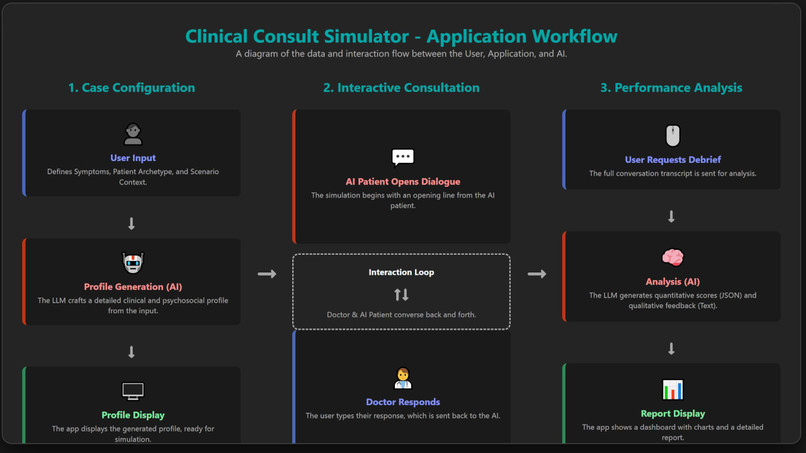
Clinical Consult Simulator is an AI-powered training platform where medical professionals engage in realistic dialogues with AI-driven patients. Users define a clinical scenario by setting key symptoms and a patient archetype (e.g., "anxious," "stoic"). The AI then generates a detailed patient profile and role-plays through the consultation. Upon completion, the user receives an instant, detailed performance debrief, including quantitative scores on communication skills and clinical strategy, plus qualitative feedback on strengths and areas for improvement.
How we built it
The application is a self-contained single-page application built with vanilla JavaScript, HTML, and CSS for maximum portability and performance. Its core intelligence is powered by Large Language Models (LLMs) via APIs (Google Gemini for analysis and dialogue). We used sophisticated prompt engineering to guide the AI's behavior for three key tasks: patient profile generation, in-dialogue patient responses, and post-consultation performance analysis. The browser's native Web Speech API (SpeechSynthesis) is integrated to provide voice to the characters, creating a more immersive experience.
Challenges we ran into
Our biggest challenge was prompt engineering. Crafting prompts that could consistently coax a structured JSON object for the dashboard and a high-quality narrative report from the LLM required extensive iteration. Another challenge was ensuring the voice selection logic was robust, as different browsers expose the SpeechSynthesis API differently; we had to create a reliable system to assign distinct, appropriate voices for the demo roles. Finally, we refined the user experience to make a feature-rich tool feel intuitive, leading to the creation of the fully interactive guided tour.
Accomplishments that we're proud of
We are most proud of creating a complete, closed-loop learning system: practice, get analyzed, and improve. The dual-mode debriefing feature - which combines objective, graphical metrics with actionable, written advice - is a key accomplishment. We are also proud of the fully interactive guided tour, which seamlessly onboards new users by activating UI elements as it explains them, making a complex tool immediately accessible. Finally, preserving the demo case as a ready-to-use template after the tour provides a perfect starting point for the user's first training session.
What we learned
This project taught us the immense power of structured AI prompting to turn a general-purpose LLM into a specialized expert tool for education. We learned that the quality of the AI's output is directly proportional to the clarity and detail of our instructions. We also learned that in a training application, the user experience is paramount; the debriefing visuals and guided tour are just as important as the underlying AI logic for creating an effective learning environment.
What's next for Clinical Consult Simulator
Our roadmap is focused on enhancing realism and long-term learning. The next major step is to implement voice input (speech-to-text) to allow the user to speak their responses as the doctor. We will also activate the import/export case functionality to allow users to save and share their custom scenarios. Further down the line, we plan to expand the library of scenario presets with more complex ethical dilemmas and introduce a user dashboard to track performance metrics and improvement over time.


Log in or sign up for Devpost to join the conversation.