-
-
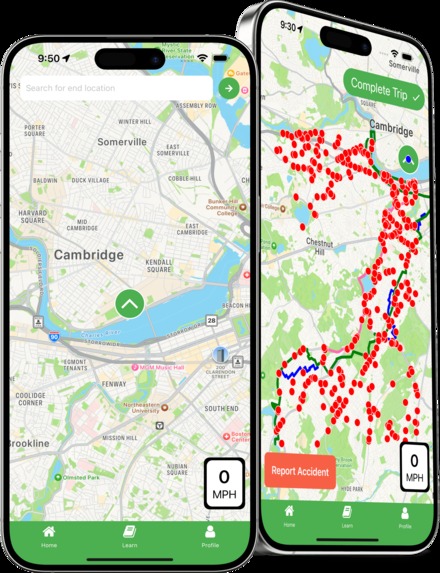
DriveWise! Drive smarter with real-time updates and a comprehensive accident map
-
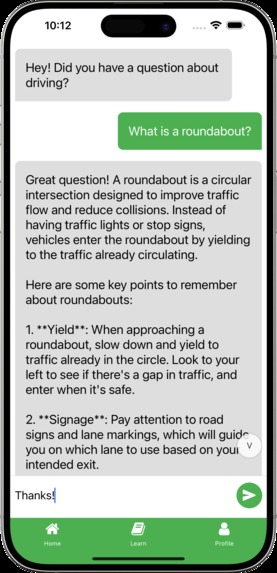
Learn with our fine-tuned LLM that uses RAG on driver manuals to answer all the driving queries you have
-
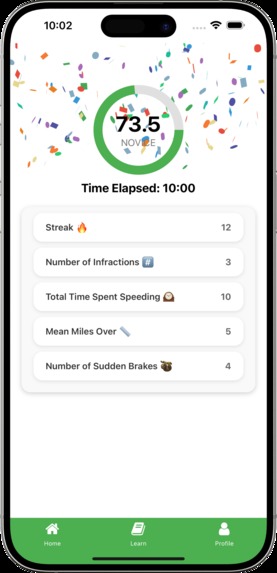
Track your driving progress and celebrate milestones with DriveWise—where every trip brings you closer to becoming a road-savvy driver!


DriveWise: Building a Safer Future in Route Planning
Motor vehicle crashes are the leading cause of death among teens, with over a third of teen fatalities resulting from traffic accidents. This represents one of the most pressing public safety issues today. While many route-planning algorithms exist, most prioritize speed over safety, often neglecting the inherent risks associated with certain routes. We set out to create a route-planning app that leverages past accident data to help users navigate safer routes.
Inspiration
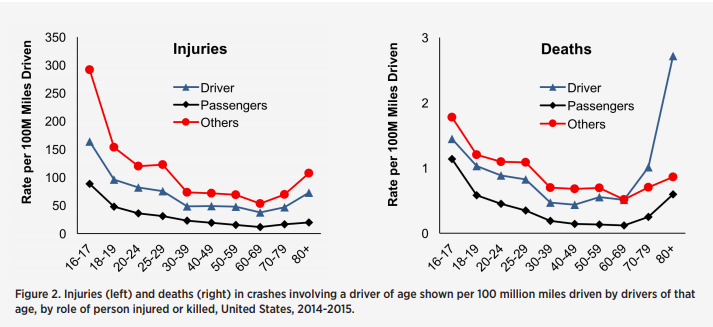
The inexperience of young drivers contributes to the sharp rise in accidents and deaths as can be seen in the figure below.
This issue is further intensified by challenging driving conditions, road hazards, and the lack of real-time risk assessment tools. With limited access to information about accident-prone areas and little experience on the road, new drivers often unknowingly enter high-risk zones—something traditional route planners like Waze or Google Maps fail to address. However, new drivers are often willing to sacrifice speed for safer, less-traveled routes. Addressing this gap requires providing insights that promote safer driving choices.
What It Does
We developed DriveWise, a route-planning app that empowers users to make informed decisions about the safest routes. The app analyzes 22 years of historical accident data and utilizes a modified A* heuristic for personalized planning. Based on this data, it suggests alternative routes that are statistically safer, tailoring recommendations to the driver’s skill level. By factoring in variables such as driver skill, accident density, and turn complexity, we aim to create a comprehensive tool that prioritizes road safety above all else.
How It Works
Our route-planning algorithm is novel in its incorporation of historical accident data directly into the routing process. Traditional algorithms like those used by Google Maps or Waze prioritize the shortest or fastest routes, often overlooking safety considerations. DriveWise integrates safety metrics into the edge weights of the routing graph, allowing the A* algorithm to favor routes with lower accident risk.
Key components of our algorithm include:
Accident Density Mapping: We map over 3.1 million historical accident data points to the road network using spatial queries. Each road segment is assigned an accident count based on nearby accidents.
Turn Penalties: Sharp turns are more challenging for new drivers and have been shown to contribute to unsafe routes. We calculate turn angles between road segments and apply penalties for turns exceeding a certain threshold.
Skillfulness Metric: We introduce a driver skill level parameter that adjusts the influence of accident risk and turn penalties on route selection. New drivers are guided through safer, simpler routes, while experienced drivers receive more direct paths.
Risk-Aware Heuristic: Unlike traditional A* implementations that use distance-based heuristics, we modify the heuristic to account for accident density, further steering the route away from high-risk areas.
By integrating these elements, DriveWise offers personalized route recommendations that adapt as the driver's skill level increases, ultimately aiming to reduce the likelihood of accidents for new drivers.
Accomplishments We're Proud Of
We are proud of developing an algorithm that not only works effectively but also has the potential to make a real difference in road safety. Creating a route-planning tool that factors in historical accident data is, to our knowledge, a novel approach in this domain. We successfully combined complex data analysis with an intuitive user interface, resulting in an app that is both powerful and user-friendly.
We are also kinda proud about our website. Learn more about us at idontwannadie.lol
Challenges We Faced
This was one of our first hackathons, and we faced several challenges. Having never deployed anything before, we spent a significant amount of time learning, debugging, and fixing deployment issues. Designing the algorithm to analyze accident patterns while keeping the route planning relatively simple added considerable complexity. We had to balance predictive analytics with real-world usability, ensuring that the app remained intuitive while delivering sophisticated results.
Another challenge was creating a user interface that encourages engagement without overwhelming the driver. We wanted users to trust the app’s recommendations without feeling burdened by excessive information. Striking the right balance between simplicity and effectiveness through gamified metrics proved to be an elegant solution.
What We Learned
We learned a great deal about integrating large datasets into real-time applications, the complexities of route optimization algorithms, and the importance of user-centric design. Working with the OpenStreetMap and OSMnx libraries required a deep dive into geospatial analysis, which was both challenging and rewarding. We also discovered the joys and pains of deploying an application, from server configurations to domain name setups.
Future Plans
In the future, we see the potential for DriveWise to go beyond individual drivers and benefit broader communities. Urban planners, law enforcement agencies, and policymakers could use aggregated data to identify high-risk areas and make informed decisions about where to invest in road safety improvements. By expanding our dataset and refining our algorithms, we aim to make DriveWise functional in more regions and for a wider audience.
Links
- Paper: Mathematical Background
- GitHub: DriveWise Repository
- Website: idontwannadie.lol
- Video Demo: DriveWise Demo
Built With
- cerebras
- chroma
- google-maps
- mapquest
- node.js
- openai
- openstreetmap
- pinecone
- python
- react-native
- tune.ai


Log in or sign up for Devpost to join the conversation.