-
-
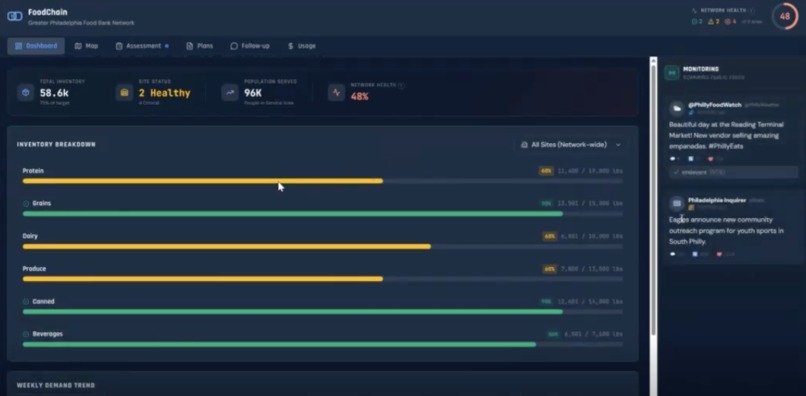
Dashboard

FoodChain
Inspiration
We've both volunteered at food banks, and the problem was familiar. 47.9 million Americans are food insecure. The largest SNAP cuts in history just eliminated the equivalent of 6-9 billion meals a year, more than Feeding America's entire annual output. Food banks find out about crises when the line gets longer. We built FoodChain because the warning signs are always there before it's too late, and this tool is the fastest way to act on them, bringing meals to those who need them.
What it does
FoodChain monitors public signals (news, social media, community alerts) for food security threats, and when it detects one, automatically launches a full AI pipeline: extract crisis parameters, compute supply-demand gaps across every site in the network, search for emergency food sources in parallel, and generate three optimized response plans — fastest delivery, lowest cost, and best nutritional coverage — each with real procurement costs, distance-based delivery estimates, and inter-site transfer recommendations. It treats the network as a network: if one site has surplus protein while another is short, it suggests a transfer instead of a new order. One click, real database, real AI calls, actionable order sheets out the other end, eight cents in total AI compute tracked per-agent through Lava.
How we built it
Next.js/TypeScript frontend with Mapbox GL JS for network visualization, Supabase PostgreSQL for all data (sites, inventory, suppliers, demand history). Hex notebooks for embedded analytical dashboards and a custom Threads agent for natural-language database querying. FastAPI backend with a LangGraph multi-agent pipeline routing all LLM calls through Lava (used for unified SDK, four different model types, embedded analytical dashboards), streaming events via SSE. Gap analysis and optimization are deliberately pure Python.
Challenges we ran into
Our first optimizer produced three identical plans because it sorted sources differently but used them all. We had to rethink strategies as filters (fastest excludes anything over 2 days) instead of as just sorts.
Accomplishments that we're proud of
The pipeline is real. Any crisis description produces a valid response with auditable numbers (you can look at every AI call in the website, and see the data-analysis through Hex). Inter-site transfers are something no existing food bank tool suggests, and we handle them natively. And a complete crisis analysis costs cents, which means a director can tell their board exactly what proactive planning costs.
What we learned
The charitable food system runs on spreadsheets, phone calls, and exhausted people. The USDA stopped collecting food insecurity data this year. AI's highest leverage here isn't replacing judgment, it's compressing the time between signal and action from days to minutes.
What's next for FoodChain
Real food bank partnerships starting with Philabundance and their 350 partner agencies, live data integration with news and economic indicator feeds, and scaling to Feeding America's full network. Hunger in America is not a supply problem; it's a coordination problem. What's missing is the connective intelligence to match supply to need when it matters most.
Built With
- anthropic-claude-api
- fastapi
- framer-motion
- haversine
- hex
- langgraph
- lava
- mapbox-gl-js
- next.js
- oracle
- postgresql
- python
- recharts
- server-sent-events
- supabase
- tailwind-css
- typescript


Log in or sign up for Devpost to join the conversation.