-
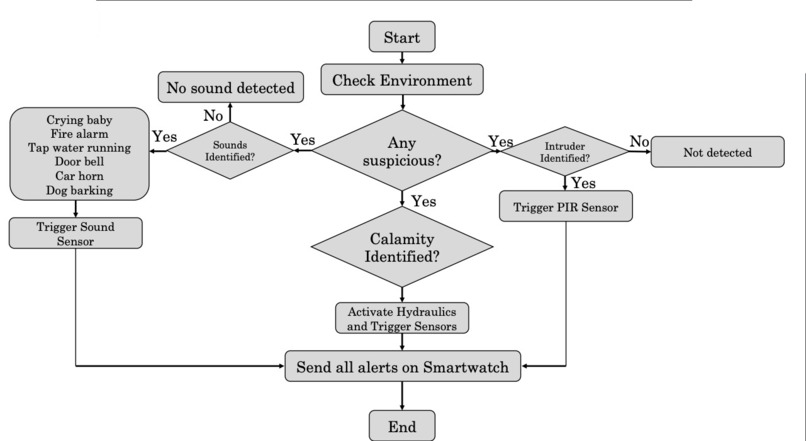
Prototype flow diagram

🌍 Generative Domotics: A New Era of Intelligent Infrastructure
🚀 Inspiration Behind the Project
The idea of Generative Domotics was inspired by observing a simple question:
Why are our homes still reactive when they can become intelligent and proactive?
While researching smart systems, I realized that most traditional smart homes only respond to manual commands — turning lights on/off, adjusting temperature, or sending alerts. They lacked context awareness, predictive intelligence, and autonomous decision-making.
Inspired by advancements in Internet of Things and Generative AI, I envisioned a home that could:
- Detect disasters before damage escalates
- Understand human emotions (e.g., baby crying)
- Protect itself from fire or intrusion
- Optimize energy autonomously
- Act without waiting for human input
This vision became Generative Domotics — a self-adjusting, self-protecting, and self-sustaining infrastructure model.
🧠 What I Learned
This project became a deep interdisciplinary journey. I learned:
1️⃣ AI Model Development
- Training CNN models for sound classification
- Using YOLO for real-time intrusion detection
- Understanding spectrogram-based acoustic learning
For example, audio classification relied on transforming raw sound signals into spectrogram features:
[ S(f, t) = |\text{STFT}(x(t))|^2 ]
where:
- ( x(t) ) = time-domain signal
- STFT = Short-Time Fourier Transform
- ( S(f,t) ) = frequency-time representation
2️⃣ Sensor Fusion & Event Prioritization
A key innovation was combining multiple sensors into a unified decision model:
[ E(t) = \sum_{i=1}^{n} w_i S_i(t) ]
Where:
- ( S_i(t) ) = sensor output
- ( w_i ) = priority weight
- ( E(t) ) = fused event score
This helped prioritize emergencies like fire over routine motion detection.
3️⃣ Edge + Cloud Architecture
I explored hybrid deployment using:
- Raspberry Pi (edge computing)
- Docker containers
- Cloud database integration
- Real-time alert pipelines to smartwatch/mobile
This improved:
- Latency reduction
- Offline capability
- Deployment flexibility
🛠 How I Built the Project
The system was developed in structured phases:
🔹 Phase 1: Requirement Definition
Identified key hazards:
- Fire
- Intrusion
- Baby distress
- Earthquake
- Flood
🔹 Phase 2: Sensor Integration
Integrated:
- Sound sensors
- Smoke detectors
- PIR motion sensors
- Seismic sensors
- Water-level sensors
🔹 Phase 3: AI Model Training
- Audio classification using CNN
- Intrusion detection using YOLO
- Model optimization for edge devices
🔹 Phase 4: Event-Driven Algorithm (GEN-SAFE-ALERT)
Core Logic:
Initialize sensors
Loop forever:
  Collect sensor data
  Classify events
  Prioritize emergencies
  Trigger response systems
  Send alerts to smartwatch/mobile
🔹 Phase 5: Smart Response Mechanisms
Unlike traditional systems that only notify, this system acts:
- 🚁 Fire detection → Deploy fire-response drone
- 👶 Baby crying → Adjust lighting + notify parents
- 🚪 Intrusion → Activate deterrents
- 🌊 Flood → Shut valves + send alerts
- 🌎 Earthquake → Stabilization trigger
⚡ Challenges I Faced
🔸 1. Sound Misclassification
Background noise sometimes confused the CNN model. Solution:
- Expanded dataset
- Used data augmentation
- Improved feature extraction
🔸 2. Real-Time Processing on Edge
Edge devices have limited memory and compute power. Solution:
- Model pruning
- Quantization
- Lightweight YOLO variants
🔸 3. Sensor Synchronization
Different sensors operate at different sampling rates. Solution:
- Timestamp normalization
- Event buffering system
🔸 4. False Positives in Intrusion Detection
Animals triggered alerts. Solution:
- Added object classification layer
- Used threshold confidence scoring
🌱 Impact & Vision
Generative Domotics moves infrastructure from:
Reactive → Intelligent → Autonomous → Generative
It creates a home that:
- Learns
- Predicts
- Acts
- Sustains itself
The long-term vision includes:
- Smart city integration
- Disaster-resilient communities
- Carbon-neutral homes
- AI-driven public infrastructure
🎯 Final Reflection
This project taught me that infrastructure is no longer about concrete and steel — it is about data, intelligence, and adaptive systems.
Generative Domotics is not just a smart home model. It is a blueprint for self-evolving infrastructure of the future.


Log in or sign up for Devpost to join the conversation.