-
-
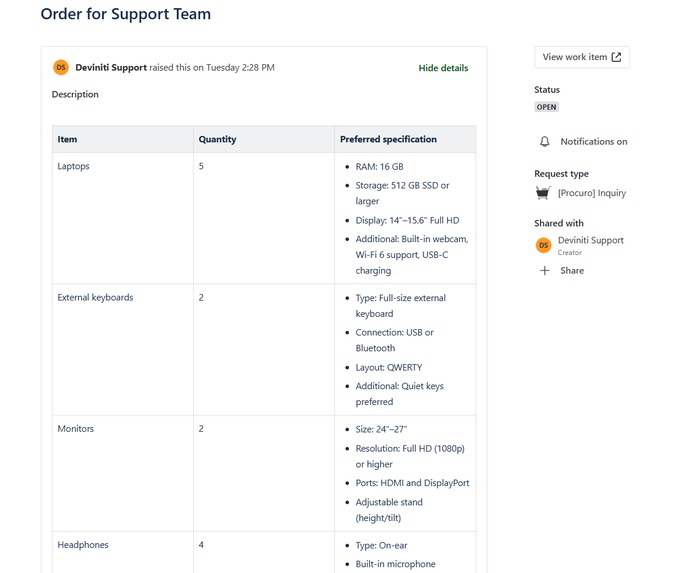
Raise a request
-
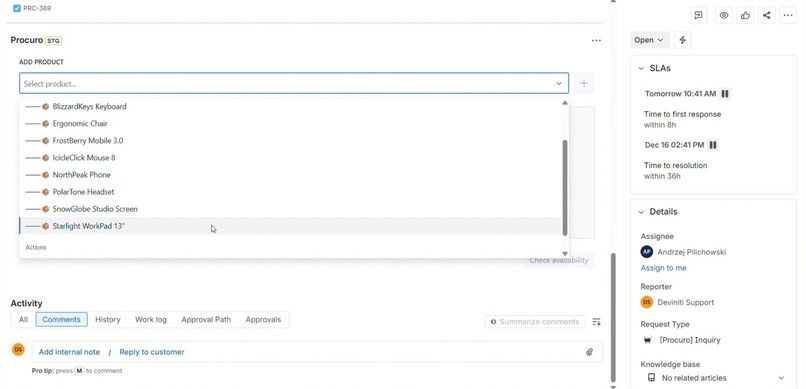
Add what is needed
-
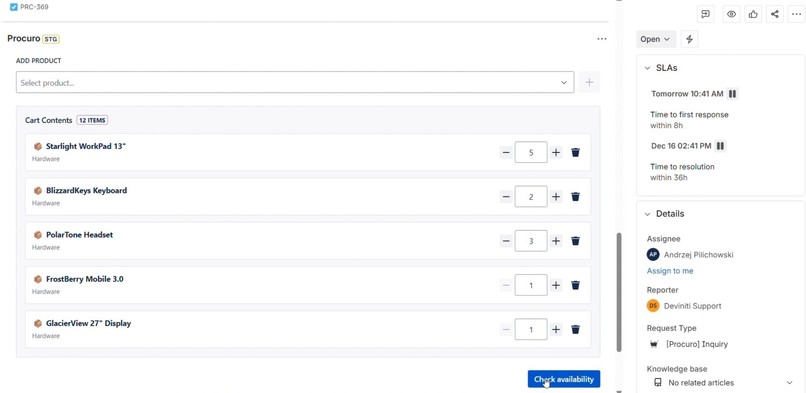
Check avaiability
-
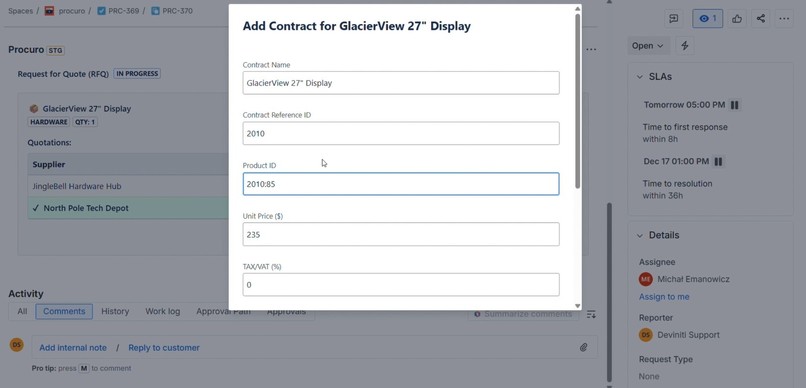
Add a contract for missing products
-
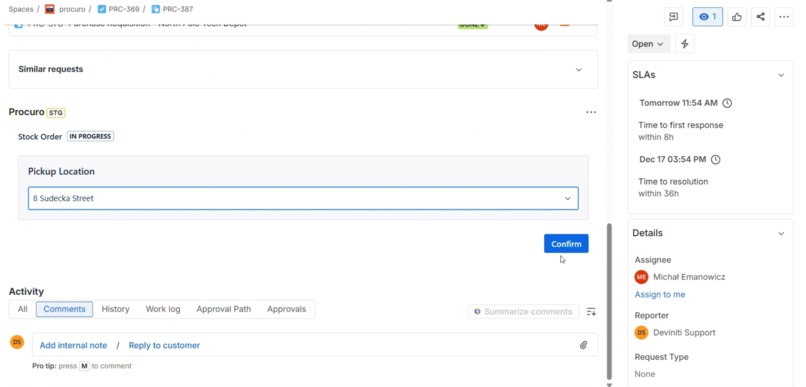
Stock order
-
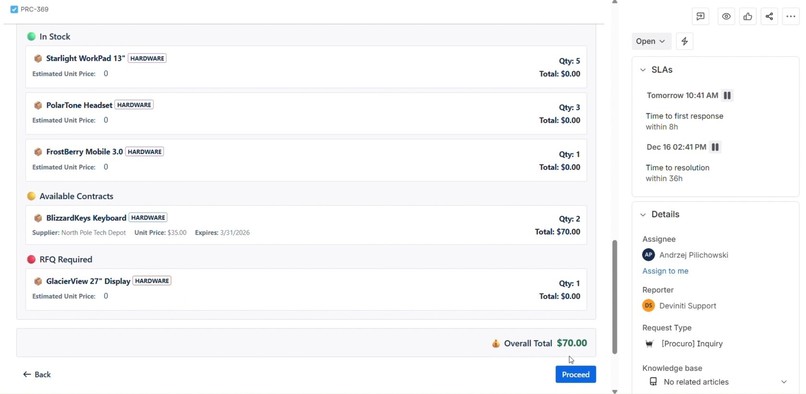
See the order summary centralized under the base request


Inspiration
Our inspiration came from three main observations.
First, our clients increasingly expect end-to-end solutions where we stay close to their processes and reduce the burden on their internal teams. They are looking for partners who operate not only as technical specialists, but as true solution experts.
Second, we see a clear shift in Atlassian’s strategy toward becoming more customer-centric. The platform increasingly focuses on delivering complete solutions and understanding real customer problems rather than providing isolated tools. This aligned perfectly with our approach, so we built an offering grounded in our Atlassian expertise and real procurement needs.
Third, several of our clients already use Atlassian to support procurement implementations. This revealed inefficiencies and gaps in collaboration that are not addressed by standard IT-focused use cases. Procurement emerged as a unique, underexplored area within the Atlassian ecosystem and a clear opportunity for innovation.
What it does
Our product directly addresses the core pain points procurement teams face today. Many teams still rely on emails, PDFs, spreadsheets, and disconnected tools to manage PRs and RFQs. This leads to siloed communication, scattered knowledge, long processing times, and high operational costs caused by manual work.
These inefficiencies also introduce real business risk: selecting the wrong supplier, making pricing errors, delaying orders, losing critical knowledge when individuals leave, or relying on information stored only in people’s inboxes rather than shared systems.
Our solution replaces these fragmented workflows with a unified procurement process built on Atlassian. It streamlines request intake, automates repetitive tasks, and improves visibility for all participants—from the requester, through procurement, to logistics and warehouse teams.
The solution supports both P2P (Procure-to-Pay) and S2P (Source-to-Pay) flows, covering the full lifecycle from supplier sourcing and evaluation through ordering and fulfilment. By leveraging Atlassian as a strong foundation, we add procurement-specific logic, automation, and structure -resulting in faster processing, improved compliance, and full transparency across the organisation.
How we built it
Leveraging Jira Assets as the foundation, the core innovation of Procuro lies in how we use Jira Service Management Assets as the entire data layer. Instead of building yet another external database, we recognised that many organisations already manage vendors, catalogs, and related data inside Atlassian.
Procuro extends this model by treating procurement entities as structured Assets:
- Products & Catalogs: Each product is an Asset with specifications, categories, and pricing.
- Supplier Database: Vendors, contacts, payment terms, and performance data are stored as Assets.
- Contract Repository: Active contracts, pricing agreements, and terms are linked directly to suppliers and products.
- Address Book: Delivery locations and billing addresses are managed as structured Asset objects.
This approach eliminates data duplication and turns the existing CMDB into the brain of the procurement system.
To make this data usable, we built intelligent search and filtering capabilities using custom JQL extensions and Jira entity property indexing. This allows teams to query procurement data with simple, natural conditions (for example, finding all orders waiting for delivery) and build dashboards, reports, and automation without learning a new system.
Built entirely on the Atlassian Forge platform and using Atlaskit components, Procuro feels like a native Jira experience - secure, scalable, and consistent with the tools teams already use every day.
Challenges we ran into
One of our biggest technical challenges was generating professional, business-grade PDF documents such as Purchase Orders, Purchase Requisitions, and RFQs within Atlassian’s Forge ecosystem.
We were committed to a fully cloud-native approach: no external servers, no third-party infrastructure, and all data remaining inside Atlassian for security and compliance reasons. Procurement teams require legally compliant, well-formatted documents with customizable branding, dynamic product tables, and calculated totals.
We solved this by building a fully template-based PDF generation system that operates entirely within Forge’s constraints using pure JavaScript libraries. Organisations can define their own branded templates, which are then processed at runtime inside Atlassian’s infrastructure—without external services or system-level tools.
Accomplishments that we're proud of
We’re especially proud of the depth of customer understanding behind this solution. By investing heavily in discovery and mapping cause-and-effect relationships between pain points and business outcomes, we were able to focus on problems that truly matter. Early feedback has been consistently positive, confirming that our approach resonates with procurement teams and reflects real-world needs.
What we learned
We learned two important lessons: the critical value of strong domain expertise, and the importance of maintaining a close, iterative relationship with customers where feedback directly shapes the product.
What's next for Procurement Solution
We are designing a new, procurement-focused UI tailored for business users who do not work with Jira on a daily basis, making the solution approachable without sacrificing Atlassian-native power.
We also plan to invest in AI capabilities to improve key procurement metrics—especially around RFQs, such as supplier comparison, decision support, and accelerating sourcing processes—delivering a more intelligent and data-driven procurement experience.
Built With
- assets-api
- forge
- issue-properties
- jira-api


Log in or sign up for Devpost to join the conversation.