-
-
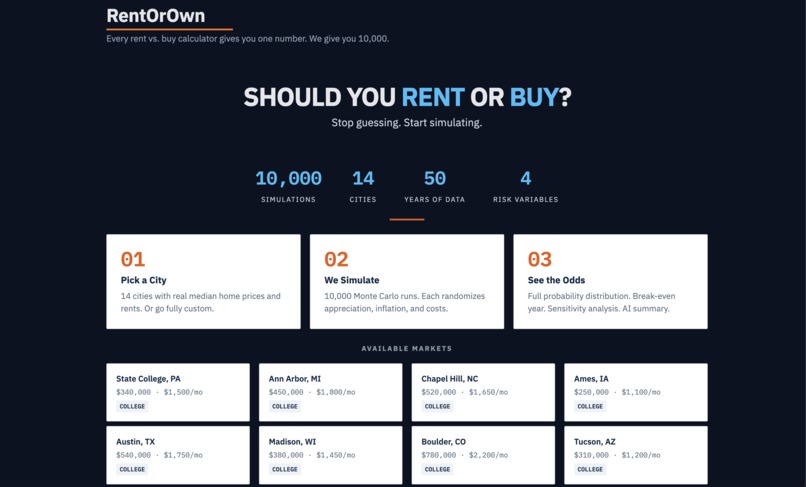
Market grid showing U.S. cities categorized by type, displaying key baseline data including median home prices and monthly rent.
-
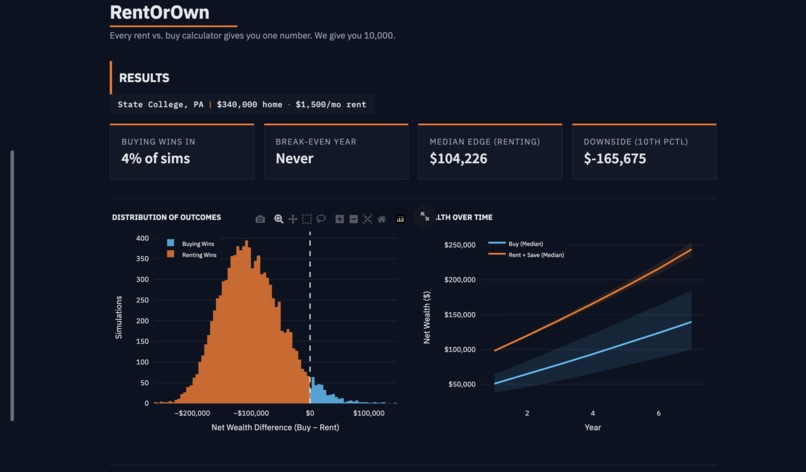
10-year Monte Carlo simulation results showing a 29.8% win rate for buying vs renting, with percentile-based wealth trajectory charts.
-
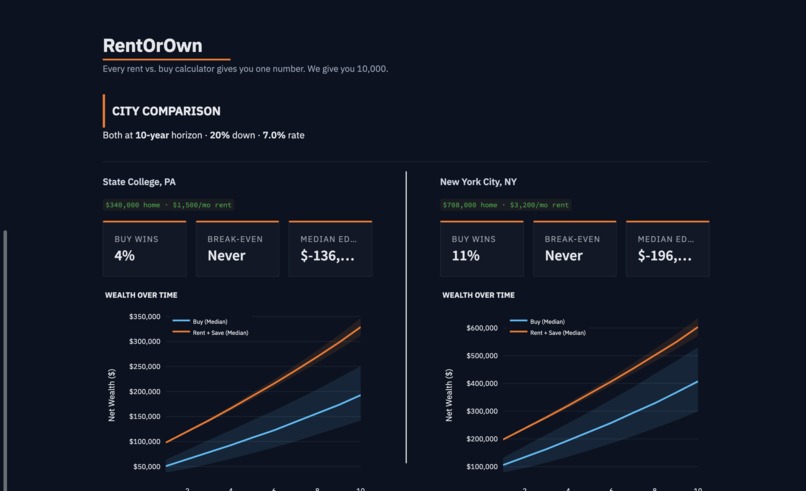
Simulated market insights and a sensitivity analysis calculating correlation coefficients for economic factors like stock returns.


Inspiration
Seeing the chaotic housing market around State College made us realize how hard it is to make smart, long-term real estate decisions. Standard online calculators are too rigid and rely on static averages. We wanted to apply data science techniques alongside AI tools to build something better: a tool that actually models the inherent financial uncertainty of renting versus buying.
What it does
RentOrOwn runs thousands of Monte Carlo simulations to project wealth over your chosen timeline and shows the probability and dollar edge of buying versus renting a property. It also shows how sensitive your outcomes are to drivers like stock returns, rent inflation, and maintenance costs, and includes an AI assistant to answer natural-language questions about your personalized results.
How we built it
We built the core simulation engine using pure Python and NumPy for high-performance statistical modeling. The frontend is a dark-mode Streamlit dashboard that relies on Plotly for interactive trajectory charts. In order to make raw data understandable to the user, we integrated the Gemini API to act as a conversational financial guide that analyzes the personalized live simulation outputs in plain English.
Challenges we ran into
Finding reliable, long-term historical data to feed our models was incredibly tedious. We had to stitch together S&P 500 returns, rent inflation (via the FRED API), and home appreciation from multiple different sources just to get a baseline. Once we had the data, accurately accounting for financial uncertainty was a massive hurdle. Building a Monte Carlo engine that realistically models future market volatility required constant tweaking of our statistical distributions and variance logic.
Accomplishments that we're proud of
We are really proud of how we transformed dense statistical forecasting into an accessible, intuitive experience. By using high-level computational science (Monte Carlo simulations, correlation coefficients) with a conversational AI interface, we made a complex financial analysis tool that anyone can understand and learn from.
What we learned
We leveled up our skills in NumPy array manipulation and Streamlit UI design. More importantly, we learned how to effectively architect a system where deterministic mathematical models and generative AI work together seamlessly, allowing the LLM to synthesize massive arrays of quantitative data into qualitative advice.
What's next for RentOrOwn
We want to move beyond our current dataset by integrating live API feeds (like FRED and local MLS data) for real-time market accuracy. We also plan to expand our market grid to cover every major U.S. zip code and add user authentication so people can save their custom scenarios and track their financial outlook over time.


Log in or sign up for Devpost to join the conversation.