


Inspiration
Over the last year, we've undergone changes in our support team, prompting a thorough review of our internal processes. Most significantly, with a new team in place, we needed to re-establish daily communication to ensure we maintain a strong grip on our customers' overall sentiment.
As a service manager, I found myself in discussions with the team about whether we should prioritize issues based on subjective analysis of customer mood. This led to the question: could we create a solution that would help us standardize the criteria for identifying customer emotions and sentiments?
Until a little over a month ago, this was just a new development idea, when Codegeist was launched, and since it was AI-based, we decided it was the perfect time to try to answer that question.
What it does
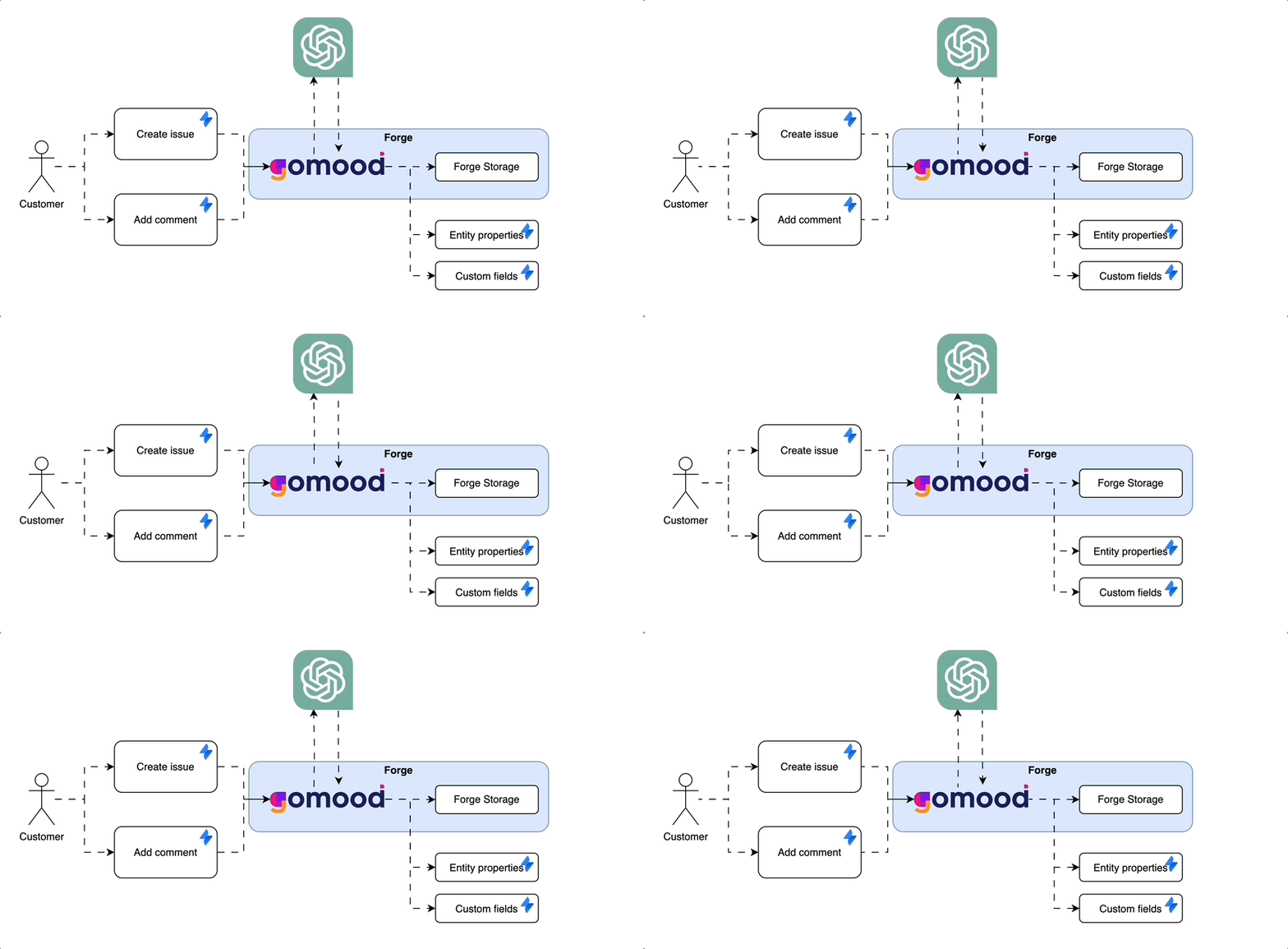
Once Gomood is installed and every time one of your customers (reporters or request participants) creates an issue or add comments to it, Gomood will analyze that text and classify it to automatically categorize incoming support issues in sentiments and emotions.
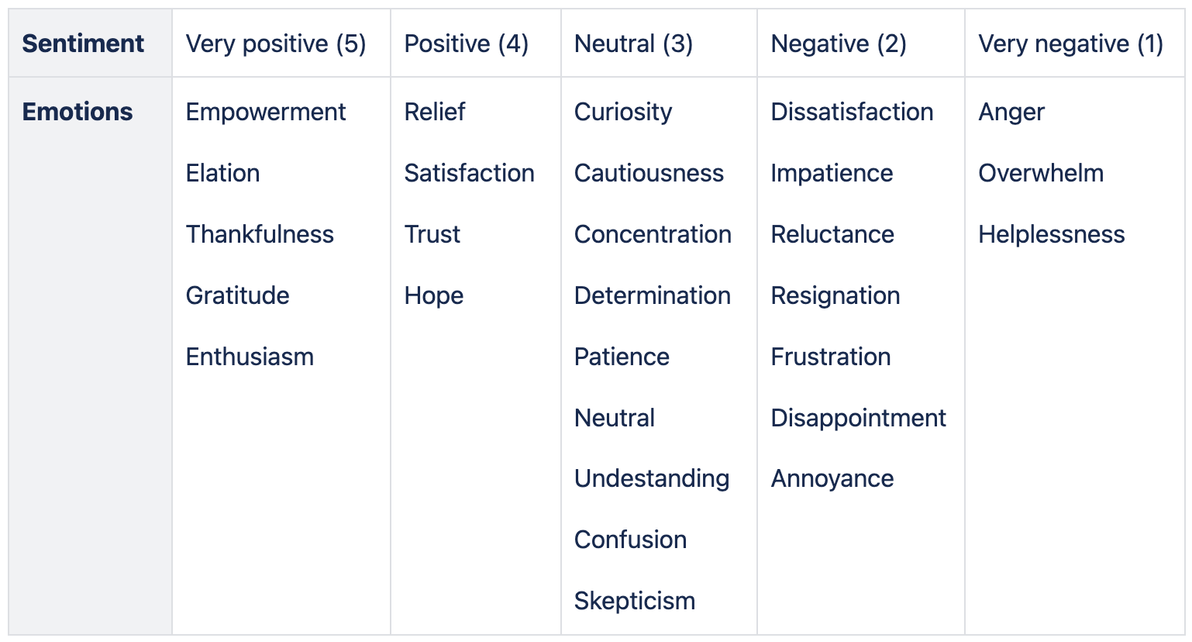
We are going to do the next classification:
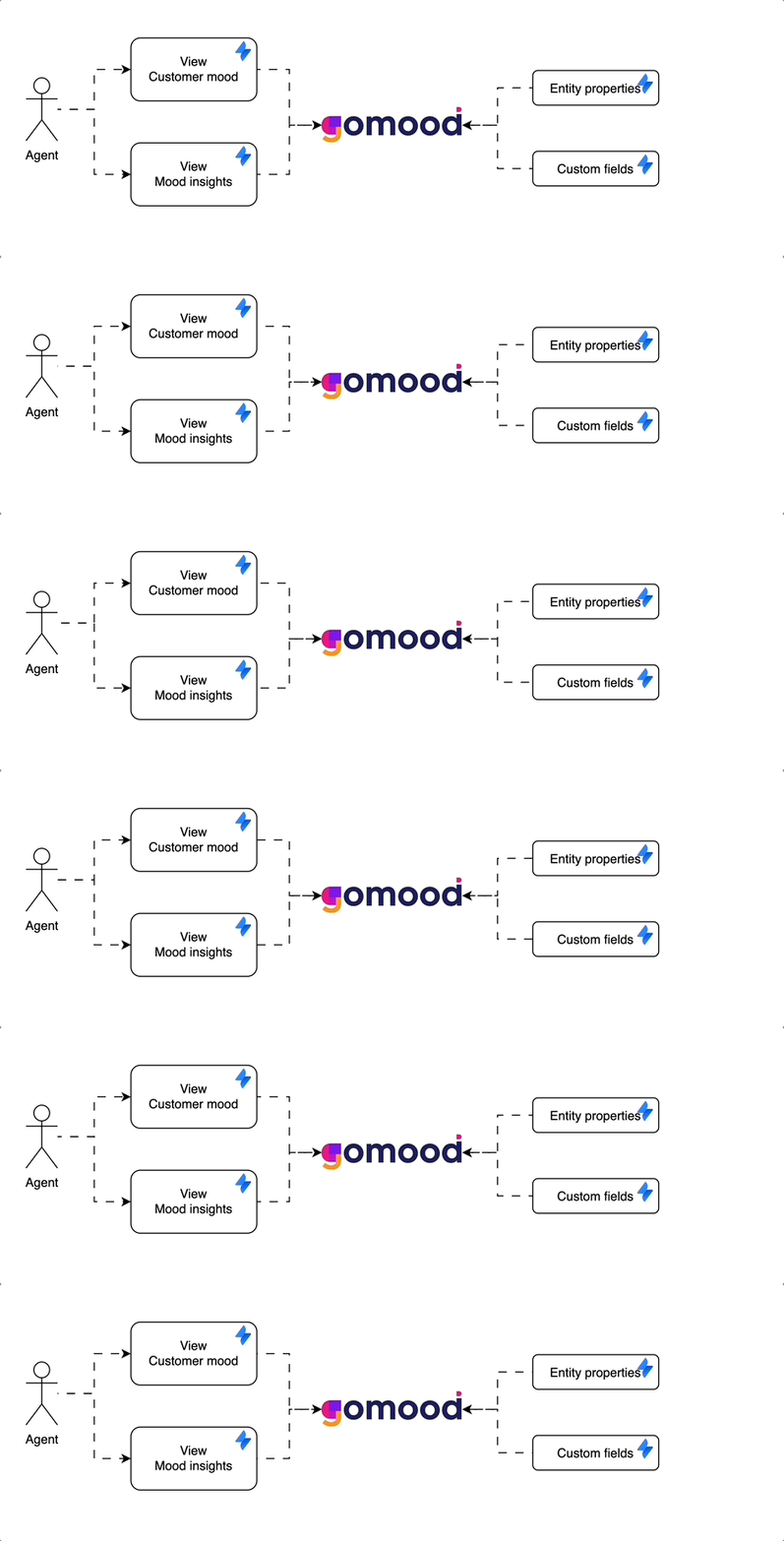
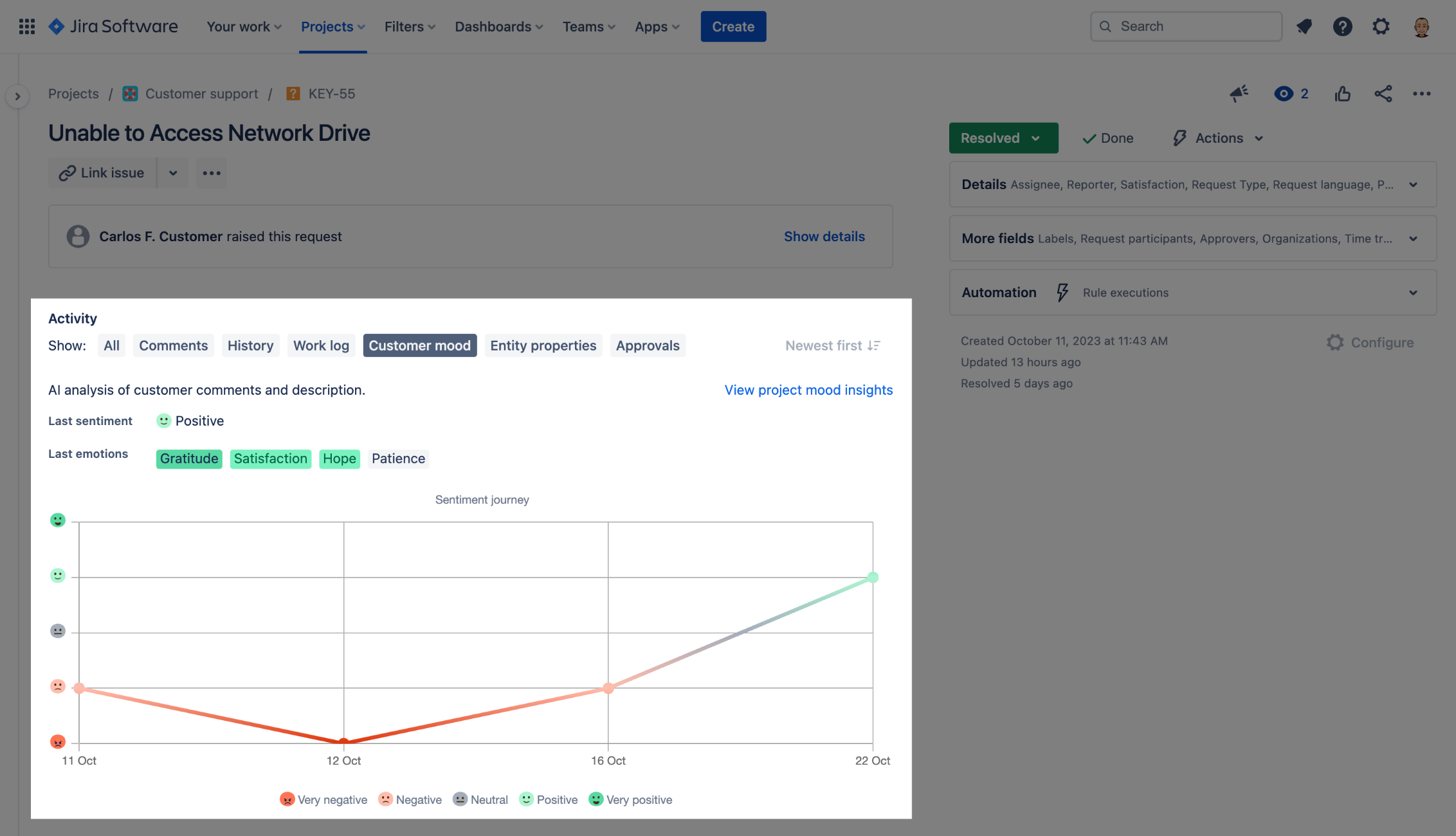
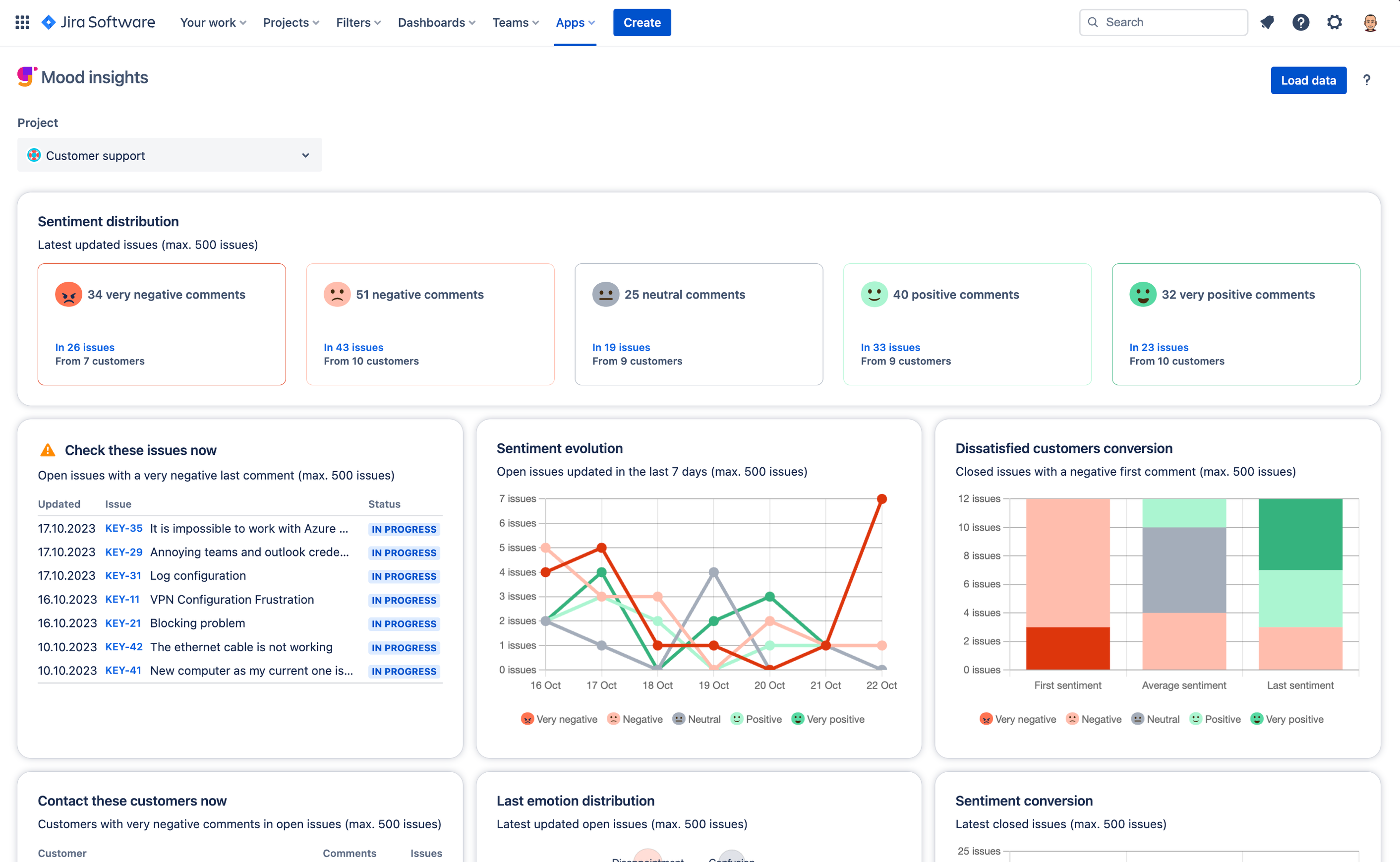
Once Gomood start storing data, everytime an Agents go to the Customer mood tab in the issue view or go to the Mood Inisghts (in the Apps menu) they can view the sentiments and emotions data and reports.
This is how you will see customer sentiment on every issue:
And this is how you will see the Jira Service Management project reports. (Please, check the video or the documentation where we explain each report)
Bonus: Gomood able you to review mood data in the issue and project insights, but it also stores mood data in custom fields. Those custom fields are automatically created when you install Gomood in your Jira instance. You can configure them as any other custom field you may have, please check the documentation to know more.
How we built it
Discovery
We have used Jira Product discovery and RICE framework to select the idea to present in Codegeist. Taking into account that we want to present an app with potential to succeed in the Atlassian Marketplace.
Development
After having a first design, we had several meetings to take some decisions. Gomood use the AI to extract sentiment & emotions from a text, but this is not the main goal of the app which is provide our users reports and insights they can review to take their own decisions to improve their services.
Gomood is Forge native, it is developed using the Forge framework. Now we have some experience using it, but is always challenging working with its limitations.
For the frontend, we have chosen Custom UI for its Flexibility. UI kit is great but it is not flexible enough and we will test UI Kit 2 in further developments.
Gomood data is stored in the Forge platform. We are only reaching the AI outside the platform: for us is key that our customers data is safe.
Environment
We are participating in the Multi-user ownership EAP that ables us the possibility to grant permission to different teammates to a particular Forge app.
This is crucial to manage environments: every one of us that was working with the code can deploy it in our personal development environments. Having the ability of creating custom development environments unlocks our development process for Forge apps and some of us can start working together.
Agile mindset
Our goal was to create one dashboard with seven reports and the issue customer mood view, but all of this perhaps was too much. We build the app in a incremental mode:
- Version 1: Issue view
- Version 2: 3 reports
- Version 3: 4 reports more (7 in total)
When we started the development we decided to present at least the Version 1, but finally we have been able to present the Version 3. During this time, we were collecting feedback, we made some changes to the app to make Gomood even better.
Challenges we ran into
Work with AI
The first time you do something it may be a challenge for you, and this is our very first app that uses AI. Now it so common to hear everywhere there are AI powered products, but it is a completely new world you have to know before using it.
If you want to extract all the potential of a new technology, it is not only about knowing it is there and how to interact with it but how to use it deeply. So, knowing things about risks, internal designs, examples…is always valuable because it will make you have better interactions with it.
Optimize AI cost
Generative AIs have a high computing cost and for that you have to pay for it. We really want to give the best solutions to our customers, this is not something optional, and it have been a challenge to define some features here.
For example, we want our users can see the app value at a glance when they install one of our apps. So for that we include and option to analyze issue data from the selected project in order to have useful reports the very first time you are working with Gomood. Analyzing data can be so costy (imagine a project with thousands of issues you have to analyze) so, instead of discarding that feature, we have put some limitations there.
Performance
Performance is not an option. Every customer expect the best of our apps, so we have to develop them with an eye on that.
With Gomood we are providing insights at two entity levels in Jira: issues and projects.
At issue level we are getting sentiments and emotions for each customer comment. The AI has it own times and we have to be as quick as possible in the other parts of the process.
At project level, it was more challenging. We need to show a lot of issue data to give powerful insights to our customers. Gomood can be so useful because of that, you can review how your entire service projects are performing looking at the customer mood. So for that, we have used custom fields, entity properties and Forge storage to optimize times as much as possible.
Working together in Forge
As mentioned before, the Multi-user ownership EAP is key for us. It has unblocked the possibility to work together in a Forge app. This is the very first time that not a single person has been working at a time in a Forge app.
Having the possibility to have your custom environments is great not to have collisions by using the same development environment. Now you can create your own ones. And this has also improved our development process: Now every branch may be tested in a different environment before sending it to staging/production.
Accomplishments that we're proud of
Forge native
We are aligned with Atlassian and so for that we are creating all of our new apps using the Forge platform. They are Forge native and this is great because you can be focused on the development but, in the other hand, there are some limitations you may face. Deal with them and being able to build the best valuable solution to your customers is always something you can be proud of.
Working with AI in a responsible way
This year’s Codegeist is focused on apps that use AI in any manner. But, for use is really important the path, not only the goal: is not only about using AI but how we do it. Not sharing customer data is crucial for us, we are not exposing their critical data outside Jira.
Solution-vision product
Atlassian is transitioning from individual products to comprehensive solutions, with a particular focus on IT Service Management (ITSM). Identifying gaps in the ITSM landscape and proactively addressing them has been a key priority for us.
What we learned
Refine the prompts you are giving to the AI
When you contact a generative AI, you need to tell it what to do and how to do it. This is known as the context and you have to give it to the AI in every single communication. OpenAI, which is the company of the AI we are using, is charging you for the entire prompt, including the context.
So, the context should be precise to get the best result from the AI but at the same time it must be concise not to be charged a lot for the context you are giving to the AI.
Trust AI generated data
We are using AI to process text and summarize them. But the main goal of Gomood is not to provide you this information but to give you some tools to improve your services.
As we want to give our customers the most reliable tools for that, we are taking care about the data summarization the AI is giving us. If it is not matching on what we are expecting, we are not giving our customers this not reliable outcome.
Value proposition
Utilizing state-of-the-art technologies and user-friendly experiences, our aim is to provide a solution that enables companies to personalize customer service based on their mood.
By applying consistent analysis criteria to all data, we enhance accuracy, maintain objectivity, and extract more valuable insights. Companies can now proactively address issues without waiting for NPS metrics.
Acting promptly, we enhance customer engagement, foster stronger relationships, and create a more supportive environment for our teams.
With Gomood, we optimize efficiency, reducing wait times for critical customers and decreasing customer churn rates. Ultimately, we elevate both the voice of the customer and the voice of the employee.
Key benefits
Improved Voice of the customer: continuos improvement of the relation with every customer, specially reacting when the customer mood is critical.
Improve Voice of the employee: The higher the customer satisfaction, the more pleasant and pleasant the day-to-day life of the support teams will be. In addition, a better detection of critical customers will imply a better selection of the person who attends to them.
Consistent analysis criteria for customer comments: being objective and faster than any human.
Enhanced customer mood control: with Gomood, teams can proactively monitor and control what is happing with every customer in real time. This allows for timely corrective actions and ensures better service to them.
Data-driven decision making: providing real-time mood data and actionable insights, Gomood helps offer the best customer service and make informed decisions.
Team transparency: Gomood promotes transparency bottom up of the real situation with customers. This encourages decision making at the top level in a fast and agile manner, without the need for intermediaries.
What's next for Gomood
- Settings by reports.
- Analyze agent comments -- Insights to help on the Voice of the employee -- Emotions by agent -- Sentiment journey of agents or by agent
- A chart for the sentiment journey for several project issues
- Suggest and assignee with a customer, based on its matching. An angry customer with an assertive agent.
Built With
- customui
- forge
- javascript
- openai
- react




Log in or sign up for Devpost to join the conversation.