-
-
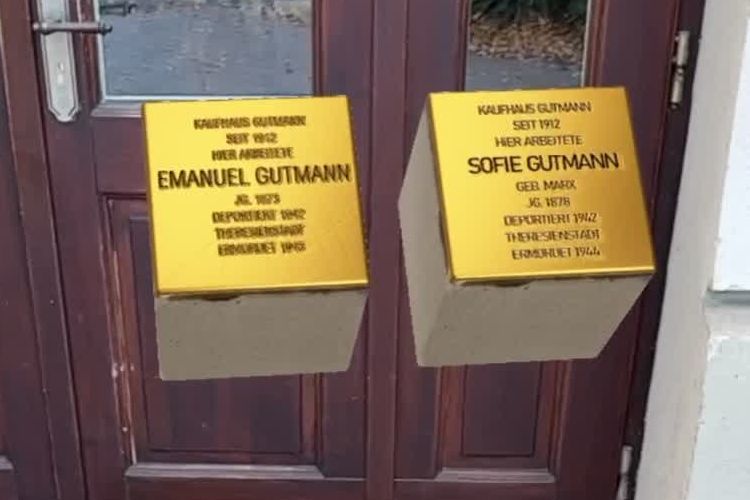
Two virtual Stolpersteine commemorating Emanuel and Sofie Gutmann
-
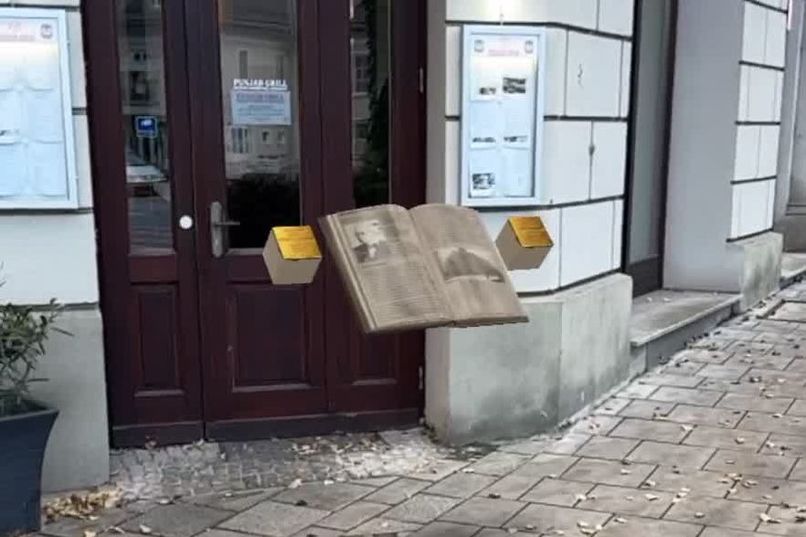
The virtual memorial book to read the stories of the Gutmann family


Inspiration
For 20 years, artist Gunter Demnig has been commemorating the victims of National Socialism by placing brass plaques on the pavement in front of their last chosen address.
Several local sub-projects and initiatives are now collecting additional information, stories and photos about these victims who once lived among us.
There are now STOLPERSTEINE in at least 1200 places in Germany and more than 20 other European countries.
This makes AR with geospatial data an ideal medium to connect the Stolpersteine with the stories of the past. stolpARsteine tries to tell us these stories and shows us the places as they could be if history had taken a different path.
What it does
stolpARsteine tells the story of Emanuel and Sofie Gutmann, who owned and operated a department store in Munich at 205 Lindwurmstrasse. They lost the store during the Aryanization period and the business was taken over by Albert Helfferich. The app brings back the bright advertising of the GUTMANNs and shows how the place looked like 90 years ago.
Emanuel and Sofie were murdered in the Theresienstadt concentration camp in 1943 and 1944. You can commemorate them by placing one or more pebbles on their memorial stone, as is the Jewish custom.
You can also learn about the STOLPERSTEINE project initiated by Gunter Demnig. Additional links will give you information about the Aryanization of other famous department stores and other Jewish families in Munich.
How I built it
The entire AR application was created using Adobe Aero. The models were created and edited in Blender and the PBR textures were done with Krita.
I didn't follow the advice from the Aero tutorials to do a proof of concept with simple models first, but I'll do that next time ;) Somehow the idea with the pebbles and the memorial stone came to me quite late. It would be better to have a storybook before you start modeling, but brainstorming with yourself is hard and the best ideas came at the end. However, I missed team members for the creative and editorial part.
Challenges I ran into
I decided to join Google's Immersive Geospatial Challenge quite late and couldn't find any team members. I started working on it on November 16th anyway. Watching the tutorial videos for Adobe Aero convinced me that it could be done in 5 days. It was a lot of work anyway :) So I signed up for the Aero pre-beta and started working on the models.
The first little challenge was that Aero doesn't support bump maps, so I had to bake a normal map in Blender for the brass plaques. But the biggest effort was to get the page flip animation right. My first approach was to use blend shapes, which are not supported, so I had to redo the animation using a skeleton. In the end, the page flip took me two full days.
There is also no support for grabbing an object and placing it somewhere. So I had to do a workaround using the Follow Action with the camera as the target. Another option would be to use predefined animations for the stones, but that would be less interactive and I ran out of time.
Thanks to Janet Fang, I finally got my pre-beta for Aero on Friday evening, but I didn't discover it until Sunday afternoon. So I had a little more than a day to test the geospatial API with Aero. I wasn't sure if the tracking was accurate enough - but it was, phew!
Accomplishments that I am proud of
Well, I am proud to say that I managed to do it in 5 days all by myself, and I was even able to record the video with the last rays of the sun on Monday.
Finally, this is my first AR application - tadaaaa!
What I've learned
- I used Adobe Aero for the first time and now I am an expert :D
- I learned how to create a rig to do a skeletal animation for the page flip and I now understand how weight painting works in Blender.
- I learned how to create PBR textures (ambient, bump, normal and roughness) for the brass plaques and how to bake a normal map from a bump map. ## What's next for stolpARsteine Of course there are many more STOLPERSTEINE in Europe, but I think it would be a great achievement to create an AR experience for most of the stones in Munich. There are some stones where we only have the name of the victim, but not the biography. So it doesn't make sense to create a full AR experience for all of them.
Technically, I have to optimize the models for download size and performance and do some testing on different mobile phone models.
Coincidentally, there is a meeting of the Munich STOLPERSTEIN community tomorrow evening and I would like to present my project there. I am looking forward to the feedback of the community.
References
- Emanuel Gutmann - Memorial Book of the City of Munich: Elisabeth Rosa M. Noske, edited by C. Fritsche https://gedenkbuch.muenchen.de/index.php?id=gedenkbuch_link&gid=1728
- Sofie Gutmann - Memorial Book of the City of Munich: Elisabeth Rosa M. Noske, edited by C. Fritsche https://gedenkbuch.muenchen.de/index.php?id=gedenkbuch_link&gid=1729
- Familie Gutmann – DMAO Denk Mal Am Ort München https://youtu.be/wHRh6K1Wk7Q
- Familie Gutmann – Denk Mal Am Ort München https://www.denkmalamort.de/deutsch/m%C3%BCnchener-geschichten/
- Guided tour through former Jewish department stores in Munich - Denk Mal Am Ort (tour guide Heidi Rehn) https://fb.watch/oondtH_p4c/
- "Stolpersteine für Sofie und Emanuel Gutmann“ – Abendzeitung (text), Hartmut Heller (photo) https://www.abendzeitung-muenchen.de/muenchen/stadtviertel/stolpersteine-fuer-sofie-und-emanuel-gutmann-art-503760
- Stolpersteine – Gunter Demnig https://www.stolpersteine.eu/en/home
- Translation to English by DeepL - https://www.deepl.com/translator
- 3D book model by Joy - https://sketchfab.com/lloydrostek
Built With
- aero
- blender
- krita


Log in or sign up for Devpost to join the conversation.