My Summer 2015 Internship Experience
at Computational Intelligence Research Laboratory (CIR Lab),
Biomedical Engineering Center, Faculty of Engineering,
Chiang Mai University, CHIANG MAI, THAILAND
Author: Thanatcha Khunkhet (Kwan)
How did I find this opportunity, and why did I choose to do internship here?

I googled ‘Bioinformatics Chiang Mai Thailand’ and biomed.eng.cmu.ac.th which is this place’s site came up. So, I emailed administrative staffs that seemed kind introducing myself and my past coursework related to bioinformatics as well as saying that I had an interest to do internship at the center if possible. Then, about two months later I got a replied from Assoc.Prof.Nipon Theera-Umpon, the Director of Biomedical Engineering Center, that it was possible to come to the lab and do internship during summer2015. Hooray! I accepted this opportunity because I had to come back home in Chiang Mai to take care of my grandmother and visit my mother and finding any internship in Chiang Mai would be the only choice I could make. Although CMU is 50 minutes far from my house, it is manageable. Also, I like the green environment of Chiang Mai University. I came in to talk with the administrative staff (P’Ann –Auntika Udomsom ) immediately when I arrived Chiang Mai after my Sophomore year in US had ended. That day was the last day of lab tour for new graduate students so I joined the group and thus got to visit laboratory that provides CNC and 3D-printer services in Faculty of Engineering and another laboratory at Associated Medical Sciences department. Furthermore, I got to meet another BME graduate students both who work in CIR lab and those that does not. The tour served as an introduction to BME international graduate study program so English was used as the main language for communication in the tour. So I asked question as normal but it seemed like my English accent somehow impressed all other graduate students in the program. They told me later when we had break that they thought I was born in US when they heard me talked. In addition, I was able to discuss with researchers and graduate students regards to biochemistry and genetic engineering techniques (Zinc Finger Nuclease ZFN, protein model analysis, etc). Thank to my biochemistry workshop (BIO 250H) I took last semester.
What did I think I would get to do?
I thought I would get to assist any researcher in the laboratory to accomplish any small project either in web or dry lab. Vague and seems pointless ? Yes. I admit that really had no idea what I would get to do. However, on the other side, I think that it was good that I did not expect much so that get me stay open to learn new things regardless to what the opportunity is as long as in is in scope of the mission of this laboratory and Biomedical Engineering Center as well.
What do I do here?
Second day — meeting with Assoc.Prof.Nipon Theera-Umpon (or Dr.Nipon in my writing here).
I met Dr.Nipon on the second day and we talked about what researchers and graduates students here do, what is the difference between Thai and American biomedical engineering curriculums, and where we were compared to international level. Then, we went on discuss about my interest, experience, and what I could potentially do while doing internship here at Computational Intelligence Research Laboratory (CIR lab) which Dr.Nipon is taking care/in charge of. He gave me a topic to work on which is predict survival rate of cancer patient using any machine learning technique. Cool? Yes, but honestly I really had no idea where to start. He gave me a little guideline about some models I may interested to look at and whom I should talk to. Thank to him for the flexibility he gave. This way, I can learn to push myself and explore a lot of things. Then, he asked P’Lek, Kittichai Wantanajittikul, researcher in the CIR lab to be my mentor whom I could ask for advice if I have any question.
The Third Day and After
Let’s begin with my description about how the lab look like. I have learned from P’Lek on the first day that biomedical engineering laboratories may be categorized into two big different groups which are ‘’dry” and “wet” lab. Wet lab is the lab that works with chemical or biological part/life and dry lab works with computer to run experiment. Walking into CIR lab here, you will see a number of desks with a computer on and a graduate students or research assistant behind the the desk (depends on if they came in to lab to work or not because some of them have to teach classes or work in other laboratory too). So where would you see me? At the very end of this lab where there is a white long table with a couple chairs which I guess originally serve as a meeting/hanging out table. Here I sit back to back to P’Lek’s desk so I can ask him anytime (note again that P’Lek is my mentor). And it’s just Me (head to think and fingers to type) and my Macbook pro 13-inches screen with internet connected from the lab’s wifi. I started tackle down the given study topic by reading Machine Learning for Medical Diagnosis.pdf . By doing this, I got exposed to many terms related to Machine Learning and Cancer Diagnostic which intrigued me to learn more about them. Therefore, I began to study in Coursera: Standford Machine Learning by Andrew Ng. Here is a list of course’s content: http://www.holehouse.org/mlclass/. The course covers from introduction to Machine Learning (ML) to its application (e.g. photo OCR, email spam classification etc). The introduction contents includes examples of ML problems and its categories (i.e. regression vs logistic regression (classification), supervised (labeled) vs unsupervised (unlabeled)). Coursera is a great tool for learning because it doesn’t only offer a lecture video but also quizzes and programming assignments with evaluation system within itself. This way the learners can actually really learn by doing, that is making some mistake and learn from it. The course teaches ML techniques that are regression, logistic regression, neural network, support vector machine (SVM), clustering, dimensionality reduction with principle component analysis (PCA). In addition, it also teaches overview of how to apply machine learning to a real world problems as well as offers some sample problems for us to work on so we can get a hand on it and get some ideas of ML application. Review summary of linear algebra are also included in the course. So, I could understand mathematic concepts behind each technique/algorithm even though I had not taken Linear Algebra before. Programming language used in this class is Octave which is similar to MatLab but free, and even though I had never programmed in MatLab, it isn’t take much effort for me to pick this the Octave language up at all (My most comfortable programming language is Java).
Find Cancer Datasets
So I completed the Machine Learning course, but then what? I had to find a cancer dataset to work on. The problem is not that the dataset is rare, but it is the fact that it is available a lot out there and I had to pick one to start with. Thus comes the problem of how to choose the dataset. One dataset source that many scientific papers I read had mentioned is UCI Machine Leaning Dataset. So I chose it as a good place to start looking at. The data I began to ‘play’ with was Breast Cancer Wisconsin (Original) Data Set from that source (UCI). I learned to understand the format and general idea of the dataset then use library function to read it to code/algorithm and process it. I tried read the dowloaded dataset with python’s pandas, regular load in Octave, and R. Also, I ran into a software name Weka which is quite often seen in ML research papers and journals.
Plot and Graphics … and scikit-learn
After had figured out how to read the data file, to me visualize data seemed to be the most obvious step to do next. I plotted the dataset in R and explored matplotlib package libraries in python. I found scikit-learn for machine learning in python so I explored several plot examples and plotted scatter plot of my dataset. Thanks to Sebastian Raschka blog which teaches these. My dataset have more than three attributes so I tried to find python library that contains PCA function to reduce number of features to three so I could plot them in 3D plot. By doing this, I got to explore some often-used functions in ML library – numpy, pandas, and matplotlib. Also, I have learned to use ipython notebook to keep my works. Ipython notebook is great because I can keep markdown, python code, and run result (including inline graph), all in the same page; then share to others as well.
Math
Many linear algebra topics are mentioned in Coursera Machine Learning. Although I understood those topics presented, I wanted to see more what linear algebra is actually really about and more of its application problems. At my school, Linear algebra and Differential Equation is offered as MTH 165 course which I was going to take in this coming fall, so I thought that it would be helpful to learn it so I could be ahead of the game for that course and that could help me ease my overall works for this coming semester which I had registered for 5 math and computer science courses, 2 audit, and 1 half-lab. I have learned about matrix and its basic operations in high-school so I jumped on studying this MTH165 materials by doing webwork for that course (I used guest-login to access the problems). Then, when I ran into the problem that I didn’t know how to do, I googled that topics and learned (some good education sources I used often were Paul’s Online Math Notes and Khan Academy). Eventually, I completed 12 assignments in that webworks within 8 days. Whoa, that’s something I accomplished this summer.
Other Programming Languages
After completed math course, I got into an idea that it would be nice to explore and practice many programming languages. But what languages I should learn? I knew Java and a little bit of C, but I had heard that Python, R, and Perl are used by many bioinformaticians and data scientists.
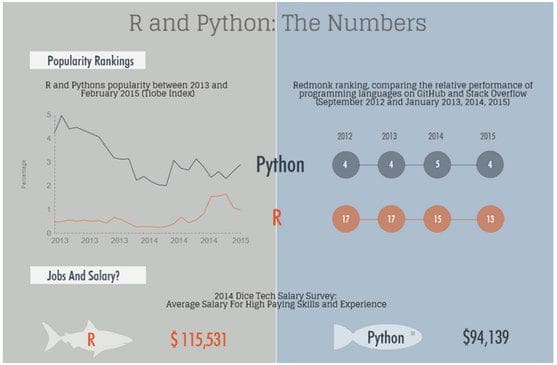
Python seemed to be more interesting to me than R at that point so I started learning python from CodeAcademy. It’s interactive programming so students can learn by programming small tasks and an assignment that summarize all the functions learned in each topic. Visit https://www.codecademy.com for more idea of how it works. As explained in the figure above, R is another language that seemed to be pretty popular among statisticians (and whoever works with data/data analysis). I explored it by completing R swirl module in R studio, and I could see how it is popular due to wide varieties of libraries offered among R users. However, I didn’t stick with it much, and got back to work with python more.
Other Research Topic Discussion
I told Dr.Nipon that I’m interested in computational structural biology so he introduced me to P’Kik whose thesis title is Development if Selective Criteria for 3-D Poses of DARPin and CD4 Complex by ZDOCK Molecular Docking Histogram Analysis. She told me her about her thesis including the motivation behind the topic. Her work interested me and I would love to get some experience on this kind of work more if any chance is offered.
Git/GitHub
Being in Computer Science community, it is impossible to have never heard of friends saying how useful Git/GitHub is in working on a project. I learned once in Unix Seminar but didn’t get to use it so didn’t get the hang of it. However, after having been writing quite amount of codes this summer, I thought that it would be a good idea to keep tracking of my work with Git and GitHub and upload to GitHub server so employers can see my work in the future as well. So, I learned to use git from youtube video. Here are some commands that I regularly use and still use almost everyday – git add [file or folder], git commit -m “[commit message]”, git log —oneline, git status, git push origin master (push to remote[origin] from branch[master]).
Check out my summer works on my practice repository on GitHub: https://github.com/tkhunkhe/practice.git
Unix
I have got into using terminal which is a Unix-like environment in my mac since I attended Unix seminar from Computer Interest Floor(CIF) in Spring 2015 and Unix sessions held by Joe Anderson, Senior Information Analyst in Biology Department at University of Rochester. Command in terminal is cool, automate in it as well. I regularly use basic commands (pwd, ls, ls -l, mkdir, mv, cp, ssh, scp, chmod, echo, >, >>, man ) but hopefully will get to use more of other cool commands and get the hang of it in the future (I learned ask and xargs but forget it).
Web Development and Blogging
Towards the end of my internship, I wanted to report my internship in a blog so anyone can access. I thought that it would be helpful to learn some web programming skills so I went to CodeAcademy again and completed jQuery and Javascript and Web Programming with HTML and CSS courses. Then, I started to play around with WordPress in oder to create my blog.
English Assistant
So far, it probably seems to you that I focus only on improving my skill and some of you may question that what I actually get to do with the lab. Here besides getting connected to graduate students and research assistants in the lab and learn what do they do in their theses and researches, I helped them with English (despite the fact that my English writing skill is at an primary school student).That was I answered their questions, made suggestion based on what I know (plus google of course), fix some grammar and awkward sentences, and translated their Thai words to English. What do I get by doing this, besides making friends? Regarding to Biomedical Engineering research, I learned about terms and scientific steps in some researches in detail thus widen my knowledge. Regarding to graduate study, I learned what are the steps in doing a thesis and what are some obstructions/difficulties. For example, in some researches the obtaining data is the most difficult step, while in some other researches, the . In fact, writing the paper also seems to be such a burden especially for those students in international program in which the papers have to be written in English. Also, the thesis format can be annoying in editing paper step as well; especially the time gets closed to the deadline. Regarding to English in scientific writing, I learned that active voice is actually recommended. This fact surprised me at first because it is the opposite for the chemistry lab reports I have done in the past. In addition, helping them increases my confidence in writing English more thus reduces my hate towards writing too.
Organized
I’m a type of person that saves almost every piece of my work (and other things as well actually) because I think that it may be useful in the future. However, as many of you may experience, most of the things we saved do not get touched for years; some even have been forgotten. One reason that they do not get used because they are not organized and not easy-to-reach. So I organized my digital data (eliminate some, design an organizing system, label) as well as learn to utilize more-than-one free cloud storage services.
What I’ve observed ..
Research opportunities in Thailand
: There are opportunities. Quite a number of researchers here are skilled, and well-known in international level. Technologies that are behind and Politics (and mostly funding) seem to hinder us from reaching the same level as American and European (this is my opinion).
Career in Research
: Although title researchers may not get a lot of credit from the society compared to physicians, this career gives the person quite amount of freedom. Freedom in thought and opinion as well as in having your normal work schedule (not like physicians that must be able to get called anytime). In academia, you pretty much have your life to spend although the payment may not start very high. In fact, there are many opportunities for one to make money while being in this field such as being a tutor etc.
International Study Program in Thailand
: English is used as the main language in several academic programs now in Thailand. Although not fluent, we are making some progress and I can see that we will exist and take more role in this globalization world in the future soon.
Culture and Characteristics of the laboratory
– Work hard, Play hard.
: The lab atmosphere for a new intern like me may be intimidating at first. Everyone has their own working space (behind a laptop or computer). Normally, the lab is very quiet which I think make sense for focus and productivity (especially, for this time of the year that theses/journals are due for many people). However, when it’s a time for break (one person moves to get some water, coffee, instant noodles, or snacks), some others will immediately come to join and the conversation will then begin. Many members share other interests besides academic researches too. It’s fun to join the conversation which makes the internship experience much better. In addition, sometimes, lab members go out for lunch or dinner together and in that they talk about all the fun and interesting things as well as intellectual stuff. I had a chance to join their dinner once, and it was really fun. They all are funny and I laughed so hard.
– Closed Facebook group for lab members
: FB group is a great way to keep old and present lab members connected to each other. I have found that it is a really great way for a new member or intern like me to get to make friend with other. Without this window, I wouldn’t be able make friend with almost all other lab members because the nature of this lab is not so open (sorry introvert’s problem). That is everyone works behind one own laptop/PC. However, I try to smile and say hi whenever I can. Update news, questions, shared useful information, are posted here.
‘Hot’ scope of research topics here (I think) = image processing, fuzzy c-mean algorithm
( see list of research topics here http://biomed.eng.cmu.ac.th/?researchlist.php&type=5 )
Frequently-mentioned Terms
Dataset, normalize (normalize data), reduce
KNN (=k-nearest-neighbor), SVM (support vector machine), Neural (=neural network), fuzzy (fuzzy C-mean algorithm; I still don’t really get how it works though),
ground-truth, experts, error, accuracy,
k-fold cross-validate
image, ..
Side-note observation, this lab do not implement virtualization.
Extra notes about how I work

Free Tools I use
With the fact that I have to design my own work and study (imagine a freelance), I’ve managed to learn to utilize productivity tools. Here are the tools I use:
– Google Calendar : planner
– Evernote : great for keeping note
– Limitless : chrome productivity extension, great for keep track of your web usage
– Evernote Web Clip and Pocket: keep bookmarks
– Right Task : Chrome Extension, put tasks check-list to the right of Gmail page, very nice
– Google Docs : Collaboration tool, create and share file, stored in google drive thus can access from anywhere
Note that there are some other tools that I tried but didn’t stick with it. [ok I may write about them sometimes later]. In addition, there are some tools I have installed but haven’t yet get to explore what it’s got to offer one is 1-click-timer which works under the idea of using timer to boost productivity. There is several more other tools actually but I just don’t want to think of it right now.
Am I stayed motivated to accomplish my task 100% entire day every day through out three months of internship?
No, of course not. But here is how I take a break. I explored new productivity tools, read some society-related article, write a blog, and organize my digital data. At least, it is productive on the other sides.. right?
Summary
How does this intern experience change my view?
– Writing in English is actually not that hard.
– Keep track of your work and show it.
One sentence for what I have learned
Machine Learning is cool and has a wide rage of applications.
Another sentence for what next
Man, I want to write an app utilize wearable device’s sensors.
How do I think this internship experience will benefit me?
– This experience has given me a chance to start gathering up my profile/works in Bioinformatics so increase chance for getting internship in US next summer and even some jobs.
– increases my confidence in writing a little bit so that will help me in upper-level writing courses and projects etc.
– exposed me to graduate study program and academic research so I have some idea of how it is like
– form connections to Thai researchers and research laboratory
– gave me some idea of what data mining is about so MAY ease my Data Mining, and Computation Intro to Stat courses this coming Fall 2015.
– good start to be a little more organized
Special Thanks
Although I didn’t create anything “cool” while I am here, I have learned so much; and being in the CIR lab is definitely counted for it. Here I would love to give a special thank to everyone who is a part of my journey in Biomedical Engineering (BME) and Computation. Thank you to Assoc.Prof.Nipon Theera-Umpon (Aj.Tor) who gave me this opportunity to do an internship in this laboratory. Without him, I would not get to see what BME academia world looks like. Thank you to P’Lek, my mentor, who introduced me to the lab and answered all my questions. Thank you to P’Kik who came in to tell me about her research no matter how busy she was. Thank you to P’Au that is always being friendly to me. I feel warmth every time I get to talk to her. Thank you to P’Anne that introduced and connected me to all other people here. Thank you to P’Nok and P’Phop that always come in the lab early so I can get into the lab as early as I want. Thank you for being my packed-lunch-to-work team too, so I don’t feel odd/awkward in not going out for lunch. Thank you to P’Nu and P’Ton that talk to me and discuss with me about English, Biosensors topics, theses, and researches. Thank you to P’Ko for being a researcher role model, for being helpful and friendly (although I didn’t get to talk to him much). Thank you to P’Mai, P’Nui, and P’Jaew for the fun talk. Thank you to all other lab members that contributed to my precious experience here in Computational Intelligence Research Laboratory, Biomedical Engineering Centers, Faculty of Engineering, Chiang Mai University, CHIANG MAI, THAILAND.
Excuse me, that I don’t know everyone’s full name. I hope you all don’t mind. Thank you. I wish you all the best of luck and hope to see you again. 😀
N’Kwan.
I’m open and looking forward to any comment and suggestion. So please feel free to leave your question/comment(s) below this page.
PS: The prefix P’ in Thai serves as a pronoun suggesting that the referred subject is older than an author (me). For example, ‘P’Ann’ is used to call Ann who is older than me. The use of this prefix shows respect to the older from the younger. In contrast, N’ is as a prefix to call a younger person.
Life is short. “Do the best you can, and don’t take life too serious.” – Will Rogers
 kwan_khunkhet

Awesome report N’Kwan. You’ve had an interesting internship this summer. Without question this has broadened your interest in this field, and you have learned much more about it. For you this would be an exciting field of work as a career. Best of luck to you as you continue your studies.
LikeLike
Thank you John 🙂
LikeLike