
Requestly
Requestly is a lightweight, git-native API client that enables effortless testing and collaboration without requiring a login.
Visit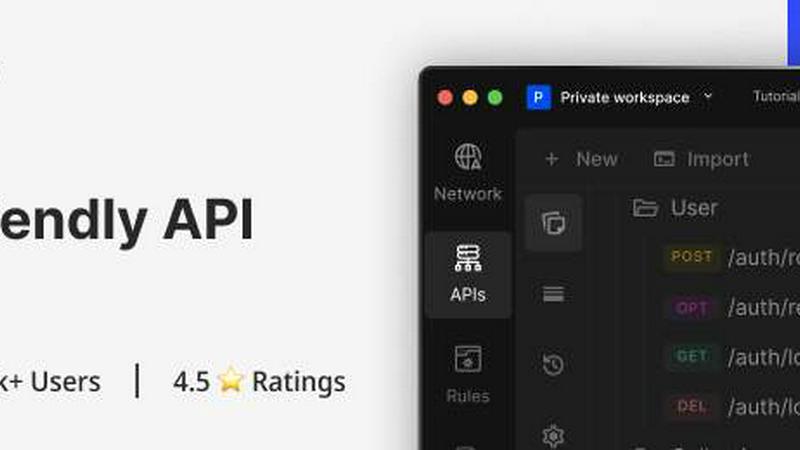
About Requestly
Requestly is a modern, lightweight API client engineered for development teams that demand control, efficiency, and security in their API workflows. As a local-first, Git-native platform, it provides a powerful alternative to traditional, cloud-dependent tools like Postman. Its core value proposition lies in its commitment to developer sovereignty: all data, including API collections, environments, and scripts, is stored directly on the user's machine as files, eliminating reliance on vendor cloud storage and ensuring data privacy. This architecture enables seamless integration with version control systems like Git, allowing teams to manage, diff, and collaborate on API collections as code—a paradigm shift for modern DevOps practices. Trusted by over 300,000 developers from leading companies such as Microsoft, Amazon, and Google, Requestly supports both REST and GraphQL APIs with advanced features like schema introspection, pre/post-request scripting, and environment variables. With no mandatory login required to start, it reduces friction and accelerates onboarding, making it an indispensable tool for individual developers and enterprises alike who prioritize a streamlined, secure, and collaborative API development lifecycle.
Features of Requestly
Git-Native Collections
Requestly fundamentally rethinks API collection management by storing collections as local files (e.g., in JSON or YAML format). This Git-native approach allows developers to version control their API specifications alongside their application code, enabling precise tracking of changes, seamless branching, and familiar collaboration workflows through pull requests and code reviews. This feature directly addresses the challenges of synchronizing API definitions across teams and environments, providing a single source of truth that is both human-readable and machine-processable.
Local-First & Login-Free Operation
Operating on a local-first principle, Requestly ensures all sensitive API data, request history, and environment variables remain securely on your device. This architecture enhances security and performance, as operations do not depend on a cloud service. Coupled with a no-compulsory-login model, developers can download the client and begin testing APIs immediately without creating an account, significantly reducing setup time and eliminating concerns about vendor data lock-in or privacy breaches.
AI-Enhanced API Development
Requestly integrates artificial intelligence directly into its core workflow to streamline API interaction. The AI assists in generating complex requests, writing test assertions, and debugging responses by analyzing patterns and suggesting corrections. This capability reduces manual effort, helps identify issues faster, and lowers the barrier to creating robust API tests, making the development and debugging process more efficient and intelligent.
Comprehensive REST & GraphQL Support
The platform offers full-featured clients for both REST and GraphQL APIs. For REST, it provides a familiar interface with parameter management and authorization helpers. For GraphQL, it includes advanced capabilities like schema introspection, which automatically fetches and understands the GraphQL schema to provide intelligent auto-completion, query validation, and documentation lookup, dramatically improving the developer experience when working with complex GraphQL endpoints.
Use Cases of Requestly
API Development and Testing in CI/CD Pipelines
Development teams can integrate Requestly's Git-native collections directly into their Continuous Integration and Delivery (CI/CD) pipelines. By treating API collections as code, teams can automatically run API test suites as part of their build process. This ensures that any changes to the API or the application are validated against a contract, catching breaking changes early and promoting a more reliable and automated deployment workflow, as advocated in modern DevOps practices.
Secure and Compliant Enterprise API Workflows
Enterprises operating in regulated industries require tools that adhere to strict security standards. Requestly's local-first data storage, SOC-II compliance, Single Sign-On (SSO) integration, and role-based access control (RBAC) make it suitable for secure enterprise environments. Teams can collaborate on internal and third-party APIs without exposing sensitive data to external cloud servers, maintaining compliance with internal data governance policies.
Team Collaboration on API Specifications
Requestly facilitates effective collaboration through shared local workspaces and its free team collaboration features. Frontend, backend, and QA engineers can work within a unified workspace, sharing collections, environment variables, and scripts. By syncing these workspaces via Git, team members can stay aligned on the latest API contracts, reducing miscommunication and accelerating parallel development efforts across different service boundaries.
Migrating from Legacy API Clients
Teams looking to move away from bloated, cloud-centric API clients like Postman can use Requestly's one-click import functionality. This allows for a seamless migration of existing collections, environments, and pre-request scripts. Developers can quickly transition to a faster, more controllable environment without losing historical work, immediately benefiting from the local-first and Git-integrated workflow.
Frequently Asked Questions
How does Requestly ensure the security of my API data?
Requestly employs a local-first architecture, meaning your API collections, environment variables, request histories, and secrets are stored exclusively on your local machine, not on Requestly's servers. For enterprise teams, it adds layers of security including SOC-II compliance, data encryption for data in transit and at rest, and detailed audit logs. This approach minimizes the attack surface and gives you full control over your sensitive data.
Can I collaborate with my team using Requestly?
Yes, Requestly offers robust collaboration features even on its free tier. Teams can use shared local workspaces and leverage the Git-native nature of collections to collaborate. By storing collection files in a shared Git repository, team members can clone, make changes, and submit pull requests. The platform also provides role-based access control (RBAC) within shared workspaces to manage permissions for admins, editors, and viewers.
Does Requestly support mocking API responses?
Yes, Requestly includes a mock server feature. This allows developers to simulate API endpoints before the backend implementation is complete. You can define expected request and response structures, enabling frontend and mobile teams to develop and test their integrations independently and in parallel with backend development, streamlining the overall development process.
Is Requestly completely free to use?
Requestly offers a powerful free version that includes core features like the local-first API client, Git integration, REST/GraphQL support, environment variables, and free team collaboration with shared workspaces. This makes it viable for individual developers and small teams. The platform also provides enterprise plans with advanced security, compliance, and support features for larger organizations, as indicated by its use in Fortune 500 companies.
Similar to Requestly

ProcessSpy is an advanced, native macOS process monitor offering real-time analytics, JavaScript filtering, and detailed system insights for power.

Claw Messenger provides your AI agent with its own iMessage number for instant, seamless communication from any platform without a Mac.

Datamata Studios provides developers with free utilities and real-time skill trend data to inform their coding and career decisions.

OpenMark AI benchmarks over 100 LLMs on your specific tasks, delivering rapid insights into cost, speed, quality, and stability without setup.

OGImagen is an AI-powered tool that instantly generates and delivers optimized Open Graph images with ready-to-use meta tags for all major social.

qtrl.ai empowers QA teams to scale testing with AI agents while maintaining full control and governance throughout.

Blueberry is a unified Mac app that streamlines web app development by integrating editing, terminal, and browsing.

