
The working of a servlet is based on a well-defined lifecycle managed by the servlet container. It handles how a servlet is loaded, initialized, processes client requests, and is finally destroyed. Understanding this flow is essential for building efficient and scalable web applications.
- Uses multithreading to handle multiple client requests efficiently.
- Platform-independent and runs on any Java-supported server.
- Reused across multiple requests, improving performance and scalability.
Servlet LifeCycle
These lifecycle methods (init(), service(), destroy()) form the basic structure of a servlet.
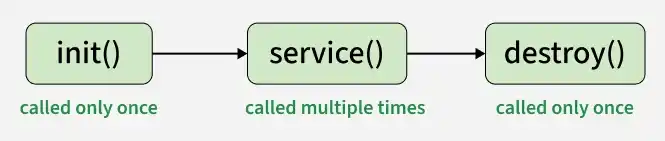
Flow of Execution
The following steps describe how a task is scheduled and executed using ScheduledExecutorService.
Step 1: Loading and Instantiation
- The container loads the servlet class.
- Creates an object using the no-argument constructor.
Step 2: Initialization – init() Method
- Called only once after servlet creation.
- Receives
ServletConfigobject - Used for one-time setup tasks
Syntax:
public void init(ServletConfig config) throws ServletException
Step 3: Request Processing – service() Method
- Called for every client request
- Container creates a new thread for each request
- Calls service(request, response)
- Internally delegates to: doGet() -> for GET requests and doPost() ->for POST requests.
Step 4: Destruction – destroy() Method
- Called once when servlet is removed from memory
- Releasing resources (e.g., closing database connections or connection pools)
- Notifying external systems that the servlet is no longer active
Syntax:
public void destroy()
public dass SkeletonServet extends HttpServlet
{
    public void init()
    {
        // Initialization code goes here
    }
    publicvoid service()
    {
        // Meaningful work happens here
    }
    public void destroy()
    {
        // Free resources here
    }
}
Explanation:This servlet class defines the lifecycle methods where init() initializes resources, service() handles client requests, and destroy() releases resources when the servlet is removed.
