
Linear Regression is a fundamental supervised learning algorithm used to model the relationship between a dependent variable and one or more independent variables. It predicts continuous values by fitting a straight line that best represents the data.
- It assumes that there is a linear relationship between the input and output
- Uses a best‑fit line to make predictions
- Commonly used in forecasting, trend analysis, and predictive modelling
For example we want to predict a student's exam score based on how many hours they studied. We observe that as students study more hours, their scores go up. In the example of predicting exam scores based on hours studied. Here
- Independent variable (input): Hours studied because it's the factor we control or observe.
- Dependent variable (output): Exam score because it depends on how many hours were studied.
We use the independent variable to predict the dependent variable.
Best Fit Line in Linear Regression
In linear regression, the best-fit line is the straight line that most accurately represents the relationship between the independent variable (input) and the dependent variable (output). It is the line that minimizes the difference between the actual data points and the predicted values from the model.
1. Goal of the Best-Fit Line
The goal of linear regression is to find a straight line that minimizes the error (the difference) between the observed data points and the predicted values. This line helps us predict the dependent variable for new, unseen data.
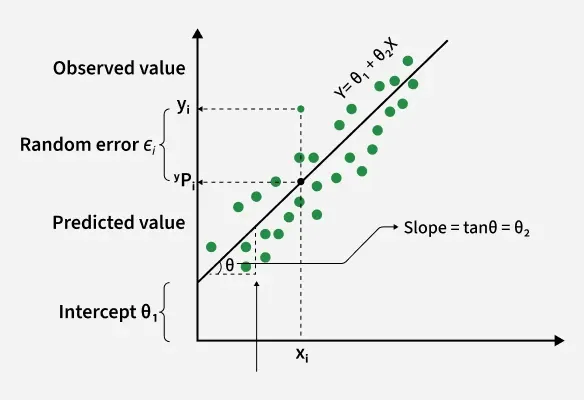
Here Y is called a dependent or target variable and X is called an independent variable also known as the predictor of Y.
\theta_1 represents the intercept, which is the value of Y when X = 0\theta_2 represents the slope, which shows how much Y changes for a unit change in X
There are many types of functions or modules that can be used for regression. A linear function is the simplest type of function. Here, X may be a single feature or multiple features representing the problem.
2. Equation of the Best-Fit Line
For simple linear regression (with one independent variable), the best-fit line is represented by the equation
y = mx + b
Where:
- y is the predicted value (dependent variable)
- x is the input (independent variable)
- m is the slope of the line (how much y changes when x changes)
- b is the intercept (the value of y when x = 0)
The best-fit line will be the one that optimizes the values of m (slope) and b (intercept) so that the predicted y values are as close as possible to the actual data points.
3. Minimizing the Error: The Least Squares Method
To find the best-fit line, we use a method called Least Squares. The idea behind this method is to minimize the sum of squared differences between the actual values (data points) and the predicted values from the line. These differences are called residuals.
The formula for residuals is:
Residual =
yᵢ - ŷᵢ
Where:
yᵢ is the actual observed valueŷᵢ is the predicted value from the line for thatxᵢ
The least squares method minimizes the sum of the squared residuals:
Σ(yᵢ - ŷᵢ)²
This method ensures that the line best represents the data where the sum of the squared differences between the predicted values and actual values is as small as possible.
4. Interpretation of the Best-Fit Line
- Slope (m): The slope of the best-fit line indicates how much the dependent variable (y) changes with each unit change in the independent variable (x). For example if the slope is 5, it means that for every 1-unit increase in x, the value of y increases by 5 units.
- Intercept (b): The intercept represents the predicted value of y when x = 0. It’s the point where the line crosses the y-axis.
In linear regression some hypothesis are made to ensure reliability of the model's results.
Limitations:
- Assumes Linearity: The method assumes the relationship between the variables is linear. If the relationship is non-linear, linear regression might not work well.
- Sensitivity to Outliers: Outliers can significantly affect the slope and intercept, skewing the best-fit line.
Hypothesis function in Linear Regression
In linear regression, the hypothesis function is the equation used to make predictions about the dependent variable based on the independent variables. It represents the relationship between the input features and the target output.
For a simple case with one independent variable, the hypothesis function is:
h(x) = β₀ + β₁x
Where:
h(x) or( ŷ) is the predicted value of the dependent variable (y).x is the independent variable.β₀ is the intercept, representing the value of y when x is 0.β₁ is the slope, indicating how much y changes for each unit change in x.
For multiple linear regression (with more than one independent variable), the hypothesis function expands to:
h(x₁, x₂, ..., xₖ) = β₀ + β₁x₁ + β₂x₂ + ... + βₖxₖ
Where:
x₁, x₂, ..., xₖ are the independent variables.β₀ is the intercept.β₁, β₂, ..., βₖ are the coefficients, representing the influence of each respective independent variable on the predicted output.
Assumptions of the Linear Regression
1. Linearity: The relationship between inputs (X) and the output (Y) is a straight line.
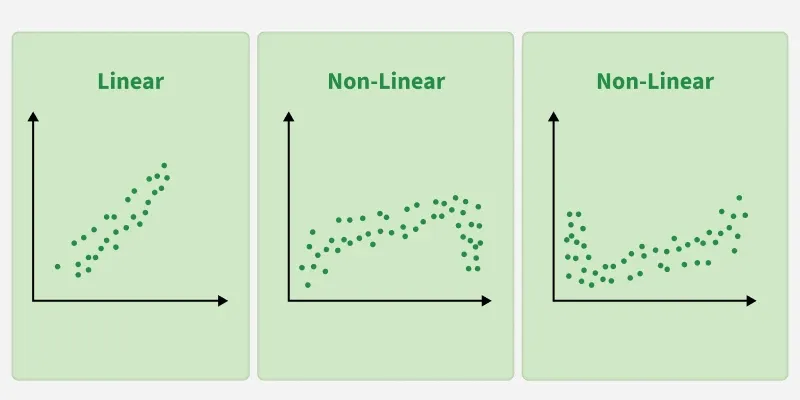
2. Independence of Errors: The errors in predictions should not affect each other.
3. Constant Variance (Homoscedasticity): The errors should have equal spread across all values of the input. If the spread changes (like fans out or shrinks), it's called heteroscedasticity and it's a problem for the model.
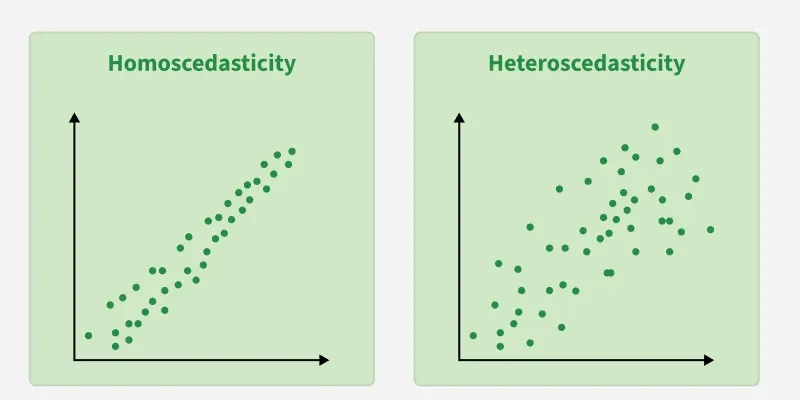
4. Normality of Errors: The errors should follow a normal (bell-shaped) distribution.
5. No Multicollinearity (for multiple regression): Input variables shouldn’t be too closely related to each other.
6. No Autocorrelation: Errors shouldn't show repeating patterns, especially in time-based data.
7. Additivity: The total effect on Y is just the sum of effects from each X, no mixing or interaction between them.'
To understand Multicollinearity detail refer to article: Multicollinearity.
Types of Linear Regression
When there is only one independent feature it is known as Simple Linear Regression or Univariate Linear Regression and when there are more than one feature it is known as Multiple Linear Regression or Multivariate Regression.
1. Simple Linear Regression
Simple linear regression is used when we want to predict a target value (dependent variable) using only one input feature (independent variable). It assumes a straight-line relationship between the two.
Formula
\hat{y} = \theta_0 + \theta_1 x
Where:
\hat{y} is the predicted valuex is the input (independent variable)\theta_0 is the intercept (value of\hat{y} when x=0)\theta_1 is the slope or coefficient (how much\hat{y} changes with one unit of x)
Example:
Predicting a person’s salary (y) based on their years of experience (x).
2. Multiple Linear Regression
Multiple linear regression involves more than one independent variable and one dependent variable. The equation for multiple linear regression is:
\hat{y} = \theta_0 + \theta_1 x_1 + \theta_2 x_2 + \cdots + \theta_n x_n
where:
\hat{y} is the predicted valuex_1, x_2, \dots, x_n \quad are the independent variables\theta_1, \theta_2, \dots, \theta_n \quad are the coefficients (weights) corresponding to each predictor.\theta_0 \quad is the intercept.
The goal is to find the best-fit line that predicts Y accurately for given inputs X.
Use Cases
- Real Estate: Predict property prices using location, size and other factors.
- Finance: Forecast stock prices using interest rates and inflation data.
- Agriculture: Estimate crop yield from rainfall, temperature and soil quality.
- E-commerce: Analyze how price, promotions and seasons affect sales.
Once you understand linear regression and its types, the next step is building the model in practice.
Cost function for Linear Regression
In Linear Regression, the cost function measures how far the predicted values (
\text{Cost function}(J) = \frac{1}{n}\sum_{n}^{i}(\hat{y_i}-y_i)^2
Here:
\hat{y_i} = \theta_1 + \theta_2x_i
To minimize this cost, we use Gradient Descent, which iteratively updates θ1 and θ2 until the MSE reaches its lowest value. This ensures the line fits the data as accurately as possible.
Gradient Descent for Linear Regression
Gradient descent is an optimization technique used to train a linear regression model by minimizing the prediction error. It works by starting with random model parameters and repeatedly adjusting them to reduce the difference between predicted and actual values.
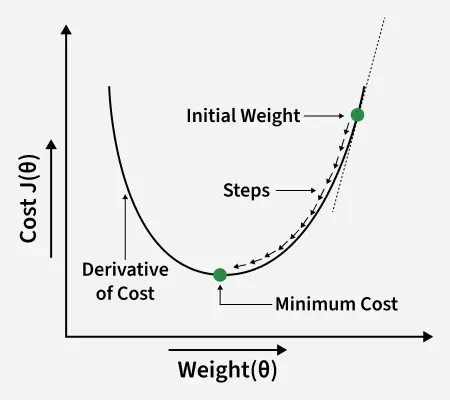
How it works:
- Start with random values for slope and intercept.
- Calculate the error between predicted and actual values.
- Find how much each parameter contributes to the error (gradient).
- Update the parameters in the direction that reduces the error.
- Repeat until the error is as small as possible.
This helps the model find the best-fit line for the data.
For more details you can refer to: Gradient Descent in Linear Regression
Evaluation Metrics for Linear Regression
A variety of evaluation measures can be used to determine the strength of any linear regression model. These assessment metrics often give an indication of how well the model is producing the observed outputs.
- Mean Squared Error (MSE): Measures the average squared difference between actual and predicted values to avoid cancellation of errors.
- Mean Absolute Error (MAE): Calculate the accuracy of a regression model. MAE measures the average absolute difference between the predicted values and actual values.
- Root Mean Squared Error (RMSE): Square root of the residuals variance is RMSE. It describes how well the observed data points match the expected values or the model's absolute fit to the data.
- R-Squared: Indicates how much variation the developed model can explain or capture. It is always in the range of 0 to 1. In general, the better the model matches the data, the greater the R-squared number.
- Adjusted R-square: Measures the proportion of variance explained by the model while adjusting for the number of predictors and penalizing irrelevant features.
Regularization Techniques for Linear Models
- Lasso Regression: Regularizes a linear regression model, it adds a penalty term to the linear regression objective function to prevent overfitting.
- Ridge regression: Adds a regularization term to the standard linear objective to prevent overfitting by penalizing large coefficient in linear regression equation. It useful when the dataset has multicollinearity where predictor variables are highly correlated.
- Elastic Net Regression: Hybrid regularization technique that combines the power of both L1 and L2 regularization in linear regression objective.
Python Implementation of Linear Regression
1. Import the necessary libraries
import numpy as np
import matplotlib.pyplot as plt
from sklearn.linear_model import LinearRegression
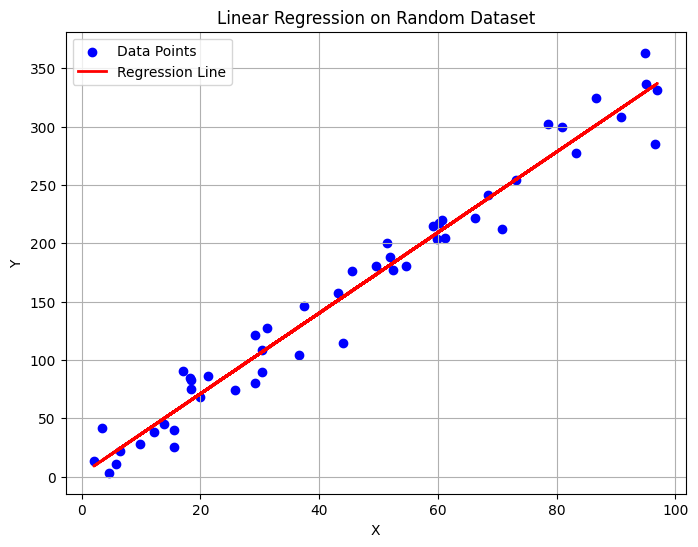
2. Generating Random Dataset
np.random.seed(42)

X = np.random.rand(50, 1) * 100

Y = 3.5 * X + np.random.randn(50, 1) * 20
3. Creating and Training Linear Regression Model
model = LinearRegression()
model.fit(X, Y)
4. Predicting Y Values
Y_pred = model.predict(X)
5. Visualizing the Regression Line
plt.figure(figsize=(8,6))
plt.scatter(X, Y, color='blue', label='Data Points')
plt.plot(X, Y_pred, color='red', linewidth=2, label='Regression Line')
plt.title('Linear Regression on Random Dataset')
plt.xlabel('X')
plt.ylabel('Y')
plt.legend()
plt.grid(True)
plt.show()
Output:
6. Slope and Intercept
print("Slope (Coefficient):", model.coef_[0][0])
print("Intercept:", model.intercept_[0])
Output:
Slope (Coefficient): 3.4553132007706204
Intercept: 1.9337854893777546
Why Linear Regression is Important
Here’s why linear regression is important:
- It’s easy to understand and interpret, making it a starting point for learning about machine learning.
- Helps predict future outcomes based on past data, making it useful in various fields like finance, healthcare and marketing.
- Many advanced algorithms, like logistic regression or neural networks, build on the concepts of linear regression.
- It’s computationally efficient and works well for problems with a linear relationship.
- It’s one of the most widely used techniques in both statistics and machine learning for regression tasks.
- It provides insights into relationships between variables (e.g., how much one variable influences another).
Advantages
- Simple and easy to implement with interpretable coefficients.
- Computationally efficient, suitable for large datasets and real-time applications.
- Relatively robust to outliers.
- Serves as a good baseline model.
- Widely available in ML libraries and software.
Limitations
- Assumes a linear relationship between variables.
- Sensitive to multicollinearity among features.
- Requires proper feature engineering.
- Can overfit or underfit depending on data.
- Limited for modeling complex relationships.
