
Spring is one of the most popular frameworks for building enterprise applications, but traditional Spring projects require heavy XML configuration, making them complex for beginners. Spring Boot solves this problem by providing a ready-to-use, production-grade framework on top of Spring, eliminating boilerplate configuration and enabling rapid development.
- Reduces development time by simplifying project setup
- Provides opinionated defaults for faster decision-making
- Makes it easier to build and deploy standalone applications
Features:
Spring Boot provides all the features of Spring while being significantly easier to use. Here are its key features:
- Auto-Configuration: Spring Boot automatically configures the application based on the dependencies present in the project
- Embedded Server: Spring Boot includes embedded servers like Tomcat, Jetty, or Undertow, allowing applications to run without external server installation.
- Easy Deployment: Spring Boot applications can be packaged as JAR or WAR files and deployed directly to servers or cloud environments. By 2025, it offers seamless integration with Docker and Kubernetes for easier cloud-native deployment and scaling.
- Standalone Application: Applications can run as executable JAR files using a simple main() method.
- Microservice-Based Architecture: Spring Boot supports building independent, modular services instead of a monolithic application, improving scalability, maintainability, and deployment flexibility.
Evolution of Spring Boot
Spring Boot was introduced in 2013 following a JIRA request by Mike Youngstrom to simplify Spring bootstrapping.
Major Spring Boot Versions:
- Spring Boot 1.0 (April 2014)
- Spring Boot 2.0 (March 2018)
- Spring Boot 3.0 (November 2022) (Introduced Jakarta EE 9+, GraalVM support)
- Latest Version (2025): Spring Boot 3.x (Enhancements in observability, native images and containerization)
Spring Boot Architecture
To understand the architecture of Spring Boot, let’s examine its different layers and components.
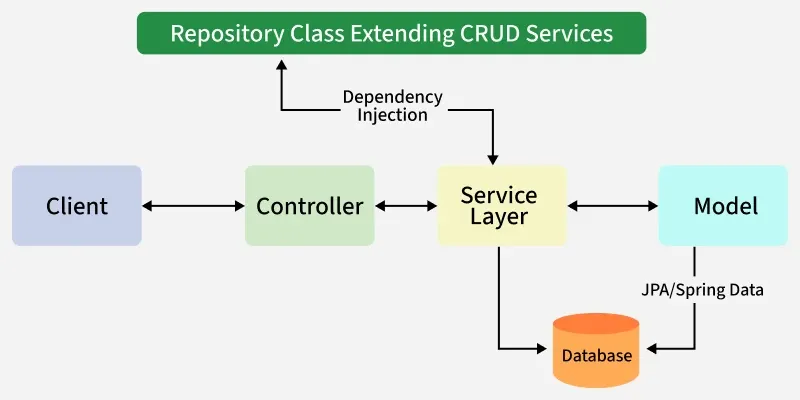
Let’s understand the layered architecture in application development, which helps organize code by separating responsibilities into different layers, improving maintainability and scalability.
- Client Layer: The external user or system that sends HTTP/HTTPS requests to interact with the application.
- Controller Layer (Presentation Layer): Handles client requests, processes them, and forwards them to the service layer while returning responses.
- Service Layer (Business Logic Layer): Contains the business logic and coordinates operations between the controller and repository layers.
- Repository Layer (Data Access Layer): Manages database operations such as create, read, update, and delete (CRUD).
- Model Layer (Entity Layer): Represents the application's data structure and maps Java objects to database tables.
- Database Layer: The storage system where application data is permanently stored and retrieved.
Request Flow in Spring Boot
Client ->Controller ->Service ->Repository ->Database ->Response
- A Client makes an HTTPS request (GET/POST/PUT/DELETE).
- The request is handled by the Controller, which is mapped to the corresponding route.
- If business logic is required, the Controller calls the Service Layer.
- The Service Layer processes the logic and interacts with the Repository Layer to retrieve or modify data in the Database.
- The data is mapped using JPA with the corresponding Model/Entity class.
- The response is sent back to the client. If using Spring MVC with JSP, a JSP page may be returned as the response if no errors occur.
Applications of Spring Boot
Spring Boot is widely used in modern software development because of its simplicity, scalability and production-ready features. Here are some of its major applications:
- Enterprise Applications: Build complex applications such as Hospital Management Systems, Banking Systems or ERP solutions with minimal configuration.
- Cloud-Native Applications: Seamless integration with Docker, Kubernetes and cloud platforms (AWS, Azure, GCP) for deployment and scaling.
- Real-Time Applications: Supports Reactive Programming for chat applications, streaming platforms, IoT systems and event-driven systems.
- Batch Processing Applications: With Spring Batch, Spring Boot is used for ETL (Extract, Transform, Load), report generation and large data processing.
