
SQL (Structured Query Language) allows users to store, retrieve, update and delete data efficiently. SQL is widely used across industries because it provides a robust, reliable and scalable way to handle large volumes of structured data.
- SQL is used to manage relational databases effectively.
- It allows users to store, retrieve, update and delete data.
- SQL provides a robust and reliable method for handling large datasets.
- It is scalable and widely adopted across industries.
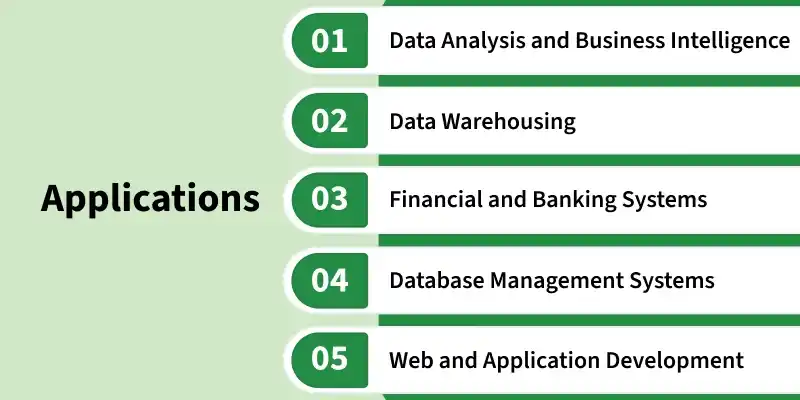
Now, we are exploring the applications of SQL and how it is used across various industries to manage and analyse data efficiently.
1. Database Management Systems (DBMS)
SQL is primarily used to create, modify and manage databases in a structured manner.
- Creates tables, schemas and indexes to organize data
- Alters database structures to meet evolving requirements
- Deletes or archives data while maintaining database integrity
- Ensures proper data storage and organization
2. Data Analysis and Business Intelligence (BI)
SQL enables efficient data querying for reporting and decision-making.
- Uses
SELECTqueries to fetch specific information - Supports aggregation functions like
SUM,AVG,COUNTfor analysis - Enables filtering and sorting using
WHERE,ORDER BYandGROUP BY - Helps generate business intelligence reports
3. Web and Application Development
SQL supports transactions to maintain data accuracy and consistency.
- Ensures ACID properties (Atomicity, Consistency, Isolation, Durability)
- Uses
COMMITto save successful operations - Uses
ROLLBACKto undo incomplete or failed operations - Essential in banking, e-commerce and financial systems
4. Data Warehousing
SQL is used to combine and manage data from multiple sources for analytics.
- Performs ETL (Extract, Transform, Load) processes
- Integrates data from different databases and platforms
- Ensures data consistency and compatibility
- Supports large-scale enterprise data management
5. Financial and Banking Systems
SQL ensures reliability and precision in financial operations.
- Tracks account transactions, balances and loans
- Maintains audit trails and ensures regulatory compliance
- Processes large volumes of financial data securely
- Example: Banks use SQL to manage ATM transactions, online banking and credit card processing
6. Healthcare Systems
Healthcare applications leverage SQL for patient management and medical records.
- Stores patient data, medical history, prescriptions and appointments
- Facilitates secure access for doctors and staff
- Supports data analytics for medical research and reporting
- Example: Hospital management systems track patient treatments and lab results efficiently
7. Education and E-Learning Platforms
SQL is widely applied in educational institutions and online learning platforms.
- Manages student records, courses and faculty information
- Tracks performance, attendance and assessments
- Supports online registrations and content delivery
- Example: Platforms like Moodle and Coursera manage thousands of users and courses
8. Inventory and Supply Chain Management
SQL helps businesses optimize inventory and logistics operations.
- Tracks products, suppliers and stock levels in real-time
- Automates ordering and replenishment processes
- Analyzes supply chain performance for efficiency improvements
- Example: Retail companies like Amazon use SQL to manage millions of products and warehouse operations worldwide.
9. Government and Public Sector Applications
Government organizations use SQL to manage citizen data and administrative processes.
- Maintains records for taxation, voter registration and public services
- Generates reports for policy-making and resource allocation
- Ensures secure storage of sensitive information
- Example: Public health departments use SQL to track vaccination records or disease outbreaks.
10. Research and Scientific Applications
SQL databases support scientific research and data-intensive projects.
- Stores experimental data and research results systematically
- Performs complex queries for data analysis
- Facilitates collaboration through shared databases
- Example: Astronomy or genomics projects use SQL to manage massive datasets from experiments or observations.
