// AGENTIC RUNTIME

Fast & Efficient Agents that Scale

Every LLM call starts from zero. Harper fills the gap: full context assembled in milliseconds, up to 85% fewer LLM calls. Simple to deploy. Designed to replicate globally.
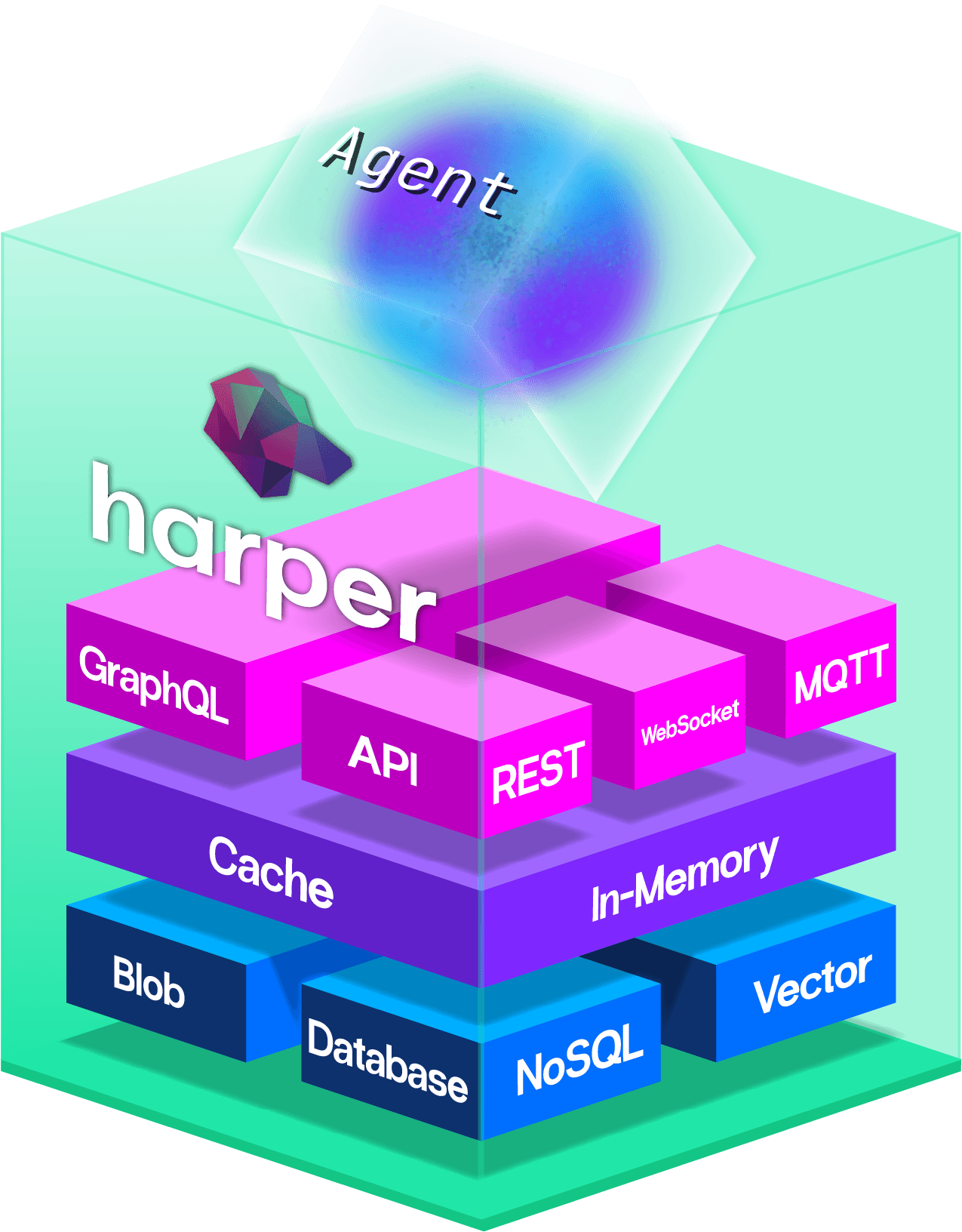
Illustration of an agent running directly in Harper, positioned above unified APIs (GraphQL, REST, WebSocket, MQTT). The agent operates within Harper’s fused stack, accessing cache and in-memory layers in-process for low-latency performance, alongside integrated data services including blob storage, database, NoSQL, and vector capabilities.
// TWO CHOICES

If cost and performance matter, there's only one path.

The teams winning in production aren't iterating on LLM-first architectures. They're building context-first from day one — faster for users, cheaper to operate, and better responses.
PROTOTYPE

LLM-First

Each tool call is a new trip through the LLM.
Customer chat LLM Order history Shopify API LLM Past emails Helpdesk API LLM Similar requests Vector search LLM Business rules Config / wiki LLM Response

Good For Demos

Fast to build with tool-calling frameworks. Works for simple, low-stakes queries. Breaks under complexity, cost, and latency pressure at scale.
5
LLM CALLS
4
TOOL ROUND TRIPS
10-20s
LATENCY
HIGH
TOKEN SPEND
PRODUCTION

Context-First on Harper

Deterministic context assembly before the first call.
Customer chat Unified Runtime All data co-located, in-process Semantic cache Resolved interactions Customer Profile + offers Active orders Status + proofs Business rules Turnaround, pricing Order history Previous transactions Assembled context payload Cache hit No LLM call. Return proven answer. New request LLM Single call, full context Response

Built For Production

Requires more structure upfront. Dramatically faster and cheaper at scale. Handles edge cases predictably. The model reasons over complete information, not fragments.
0-1
LLM CALLS
0
TOOL ROUND TRIPS
<50ms
ASSEMBLY
MINIMAL
TOKEN SPEND
// HANDS-ON HELP

Building on context-first? Get a dedicated Harper engineer.

A 45-minute session with a Harper engineer. Bring your current stack and workload. Leave with a reference architecture, a cost model, and a deployment plan.
// Used by teams at Red Hat · Ralph Lauren · Ubisoft · Verizon · Ford · Western Union · Stub Hub

Get on the Calendar

// REQUEST RECEIVED

We'll reach out.

We couldn't submit your request.
Please try again.
// BY THE NUMBERS

Measure context assembly in milliseconds, not seconds.

1-10ms
VECTOR LOOKUPS
<50ms
FULL CONTEXT ASSEMBLY
65-85%
LLM CALL REDUCTION
1
PROCESS

See Semantic Caching Cut Costs in Real Time

A conversational agent with vector memory, semantic caching, and local embeddings running entirely on Harper. Ask the same question twice. Watch the LLM call disappear.
LIVE DEMO
> What's the tallest building in the world?
LATENCY 5.2s · COST $0.0098 · WEB 1 search
> Which building is the tallest globally?
LATENCY 0.03s · CACHE HIT · $0.00 · saved $0.0098
// WHAT CHANGES AT SCALE

Outcomes that compound when agents hit production.

Harper does not make models smarter. It collapses the stack around them so the inputs get better and the operations get simpler at the same time.
FEWER TOKENS

Cut LLM spend by up to 85%

Every resolved interaction is vectorized and stored. When a similar request comes in, the runtime returns a proven answer without touching the LLM. For the rest, deterministic routing and rich context mean fewer calls and shorter loops.
SPEED

Sub-50ms context assembly

No network hops between services. No serialization overhead. Customer records, order history, vector search, and business rules queried in parallel, in the same memory space.
SECURITY

Smaller attack surface

One process, one runtime. No API keys scattered across services. No orchestration layer bridging disconnected systems. Data stays co-located, not spread across the network.
LLM FREEDOM

Don't lock into one LLM

When agents are managed separately from the LLM, the model becomes a commodity. Switch providers. Negotiate pricing. Use different models for different tasks.
EDGE-READY

Replicate everywhere

A self-contained runtime is designed for replication. Run your agent with its full data context in 2, 10, or 20 locations. Global speed, local intelligence.
SIMPLICITY

Dev to prod, same surface

What you build locally is what you deploy. One self-contained runtime. No infrastructure to wire together between prototype and production.

// ARCHITECTURE

Everything your agent needs in one process.

In most stacks, these components live in separate services. Here, they run in the same process. Structured data, vector embeddings, caching, real-time pub/sub, REST API, and your application logic in a single Node.js runtime.
Data sources
Webhooks
CRM
ERP
Commerce
Email
Harper Runtime multi-threaded process
Agent
Agent loop
Workflow
Memory
Model client
Guards
In-process platform
Database
Vector + embed
Semantic cache
Real-time ingest
Scheduling
MCP client + server
REST · WS · SSE
Outbound (HTTP, Slack)
LLM (any)
Claude
GPT
Gemini
Open source
// GO DEEPER

The architecture and the math.

Two deep dives that break down why production systems are converging on this pattern, and what it means for your LLM bill.

Start building your agent in minutes.

Build a production-ready system without stitching together five services.
npm create harper@latest CLICK TO COPY