QVAC SDK 0.22 is out, and it adds Laya, a model that makes decisions instead of writing text.
We added:
- Laya support: answers the questions you define, each with a probability
- CUDA support: for LLM, embedding and VLA models.
- MiniMax-H3 image to video: start a clip from your own picture
- MOSS-SoundEffect v2: create sound effects on device
- Model fit checks: broader model coverage, improved estimates for model combinations, and opt-in load refusal before model loading begins
- Parallel tool calls: agents run several tools in one turn
Learn more in the thread below.
Complete release doc here:
Star ⭐️ for updates.
Local vs cloud at Tetris.
• Jev (cloud): 316ms per decision, buried alive, game over
• Laya (local, open-weights): 43ms per decision, running clean on a 16GB MacBook Air
11x faster and it didn't even need the cloud to get there.
Laya can help protect your website from agentic attack jailbreaking. Imagine a swarm of agents attacking your website, and in under 33 ms, it all gets blocked. Also, before the agent is allowed to call a tool (send email, query a database, execute code, etc.), Laya can answer: “Is this action consistent with the original user request and safe under the current policy?” Low confidence or a clear “no” triggers a human review or hard block. All on your browser with the 421 M model on edge!!!
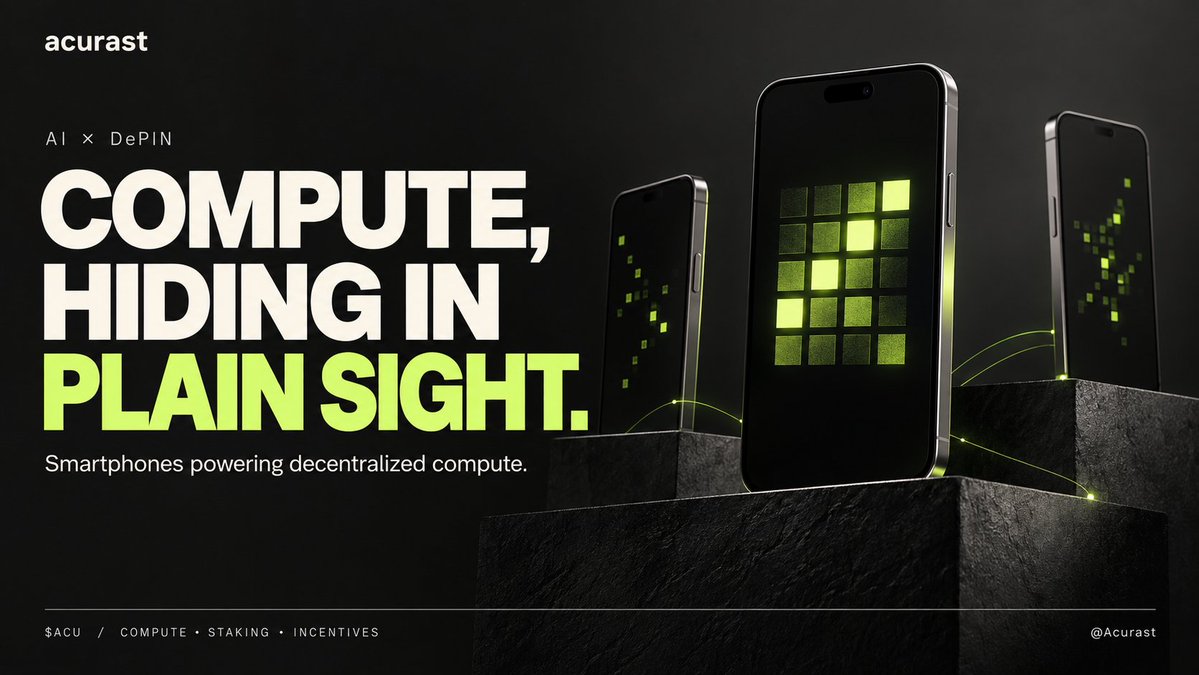
The most interesting thing about @Acurast is where it looks for compute: the phone sitting unused in your drawer.
Much of the AI infrastructure conversation revolves around building bigger data centers. Acurast is exploring how much useful work we can get from hardware people already own.
I think that deserves attention, with one distinction: different AI tasks need different hardware.
Training a frontier model is a very different job from classifying an email, filtering a message, or running a small decision model. Smartphones have limits. But there is a market for smaller, repeated tasks that don’t need an entire GPU cluster.
That’s where the AI × DePIN thesis becomes interesting to me.
Acurast lets developers deploy workloads to a distributed network of smartphone Processors. It adds another source of compute capacity, with a lower barrier to contributing hardware. Whether that capacity is useful depends on the workload, uptime, latency, and cost of getting a correct result.
There’s already something concrete to try.
Acurast’s Laya demos run a decision model on an Android phone’s CPU. The examples include email sorting, chat moderation, and screening prompts for injection attempts. Acurast reports roughly 0.2–1 second per decision in those demos.
You can try them at and inspect the device serving the request. The team also acknowledges the limitations: classifications can be wrong, and queues grow when requests exceed a phone’s capacity.
That gives developers a useful starting point: test a task, measure the response, and decide whether the hardware fits.
The harder question is trust. If someone else owns the phone, how do you verify the device running your workload?
Acurast uses hardware-backed attestation through Google Key Attestation and Apple App Attest. It also checks for revoked attestations and removes affected devices from receiving deployments and rewards.
That’s an important detail. Verification has to continue after a phone joins the network. It also means the security model retains dependencies on those hardware and platform providers.
Where does $ACU fit?
ACU has defined roles in network fees, compute provisioning incentives, staking, and governance. The documentation describes deployment compute costs as gas fees; developers also have a USDC access route.
The mechanism I find most relevant is Staked Compute.
Providers lock tokens against a compute commitment. ACU holders without hardware can delegate to providers. Benchmarks and heartbeats track capacity and availability, while rewards account for committed compute, stake, and time parameters.
This gives providers an economic reason to maintain the capacity they promise. Developers need machines that stay available, not just devices that once registered.
There’s an important distinction when assessing those rewards: Acurast’s tokenomics specifies 5% annual inflation, with 70% allocated to the Staked Compute Pool. Staking rewards therefore shouldn’t be confused with revenue from paying compute customers.
My view is that incentives can help establish supply. Repeat customers will tell us how valuable that supply actually is.
The numbers I’d watch:
• Paid workloads and returning developers.
• Cost per successfully completed task.
• Reliability under sustained load.
• How usage grows relative to token-funded incentives.
Those measures would tell me more than an onboarded-phone count alone.
Acurast’s opportunity is to make distributed smartphone compute useful enough that developers choose it for specific jobs. If it can do that consistently, the connection between network activity and ACU’s utility becomes much more tangible.
For anyone curious, Cloud Rebellion offers a way to explore the ecosystem through quests, app deployments, and onboarding a supported phone. You earn MIST points through the program; MIST and ACU are different things.
I’d start with a demo and a spare device before committing more resources.
If you want to join, here’s my referral link:
Referral code: emk6ts
Finding a spare phone is easy; finding a reliable source of computing power is far more difficult.
This is the aspect of @Acurast that I find most compelling.
Connecting smartphones into a network creates a supply of computing resources. However, for developers to entrust this network with real-world workloads, several additional requirements must be met: suitable hardware, verifiable execution, consistent availability, and a compelling incentive for device owners to remain part of the network.
The intersection of AI and DePIN (Decentralized Physical Infrastructure Networks) must address all of these challenges.
AI workloads are highly diverse. Training large-scale models requires different resources compared to tasks like classifying messages, running a small inference model, or handling the backend for AI agents. In my view, the computing power derived from smartphones is best suited for tasks that align with their specific hardware characteristics—tasks frequent enough to generate genuine, sustained demand.
Acurast aggregates resources from smartphones into a decentralized computing network. Developers deploy workloads, which are then executed by the participating devices. This offers an alternative approach to accessing computing resources, distinct from traditional, centralized infrastructure.
The real question is: will a developer continue to use this network after their initial experiment?
I would start with a specific, narrow use case—measuring response times, error rates, and the cost per successful outcome. From there, gradually increase the workload. An initial implementation might appear inexpensive, but it can quickly become costly if the application is forced to repeatedly re-execute tasks due to errors.
Acurast’s "Laya" demos serve as a solid starting point: a decision-making model running on a mobile device, handling tasks such as email classification or chat content moderation. The published examples are transparent about their shortcomings and processing limitations, which helps users better understand the appropriate use cases for this approach.
The $ACU token is integrated into the operational framework through network fees, staking mechanisms, governance, and incentives for those providing computational power.
Under the "Staked Compute" model, providers lock up tokens as a commitment to supply computing capacity. Token holders can delegate their stake without needing to operate hardware themselves. Benchmarks and "heartbeat" signals are used to monitor the capacity and availability underlying these commitments.
To me, the crucial element lies in the value provided by such a commitment: developers need the assurance that resources will remain available to them tomorrow.
Furthermore, it is important to make a clear economic distinction: staking rewards are derived from the protocol’s inflationary mechanism and are not inherently equivalent to revenue generated from customers. A sustainable computing marketplace requires both users willing to pay for services and participants willing to supply the necessary resources. That is how I gauge Acurast’s progress: the return of developers, the presence of meaningful workloads, reliable execution, and competitive costs.
The potential is immense if off-the-shelf hardware can consistently meet these demands. Every successfully completed task serves as proof of this.
If you’d like to explore it yourself, you can join the "Cloud Rebellion"—a program featuring tasks and opportunities to connect compatible devices to the network. Participants are rewarded with MIST points (distinct from ACU tokens).
Try the demo to get a clear sense of how the network actually operates.