Welcome, Class of 2030 and All New Students!
August 21, 2026

(New Students Display Trinity Medals After Convocation)
Welcome, Class of 2030 and All New Trinity Students!
Remarks by President Patricia McGuire ’74
at the New Student Convocation
August 21, 2026
Good morning! I am so pleased to welcome you — the Class of 2030 and new students in other classes — to the New Student Convocation for the College of Arts & Sciences, a ceremony marking the end of your orientation period and your official welcome into the Trinity community. During this ceremony, you will sign the Honor Pledge and receive your Trinity medals, special symbols of your new lives as Trinity Women. Congratulations!
We start with the invocation by Dr. Jeannine Marino, Assistant Professor of Religious Studies, who will also bless your Trinity Medals:
Gracious God,
We thank you for gathering us here today as we begin a new academic year. We give thanks for the life of each new student and for their loved ones, who have encouraged and journeyed with them along the way. We also give thanks for all the faculty and staff at Trinity, who will guide, encourage, and walk alongside our students throughout their journey here.
Dear God, may your wisdom guide us as we learn from one another, building relationships in which both students and educators are enriched and transformed.
May the knowledge and experiences we gain at Trinity help us discover the deeper purpose of our lives and our careers, always in service to others, especially those most in need.
May your hope fill us with courage, so that we never give up, even when the journey is difficult.
May your love open our hearts to discover the richness and beauty of the diversity among us, helping us to find lifelong friends and a community where we truly belong.
May your joy be with us throughout this journey.
And may all that we learn, all that we become, and all that we do at Trinity contribute to a more just, peaceful, and loving world.
Amen.
…….
And we ask You, O God, to bless these Trinity Medals, symbols of the new students’ entrance into the Trinity community and their commitment to its values.
Amen.
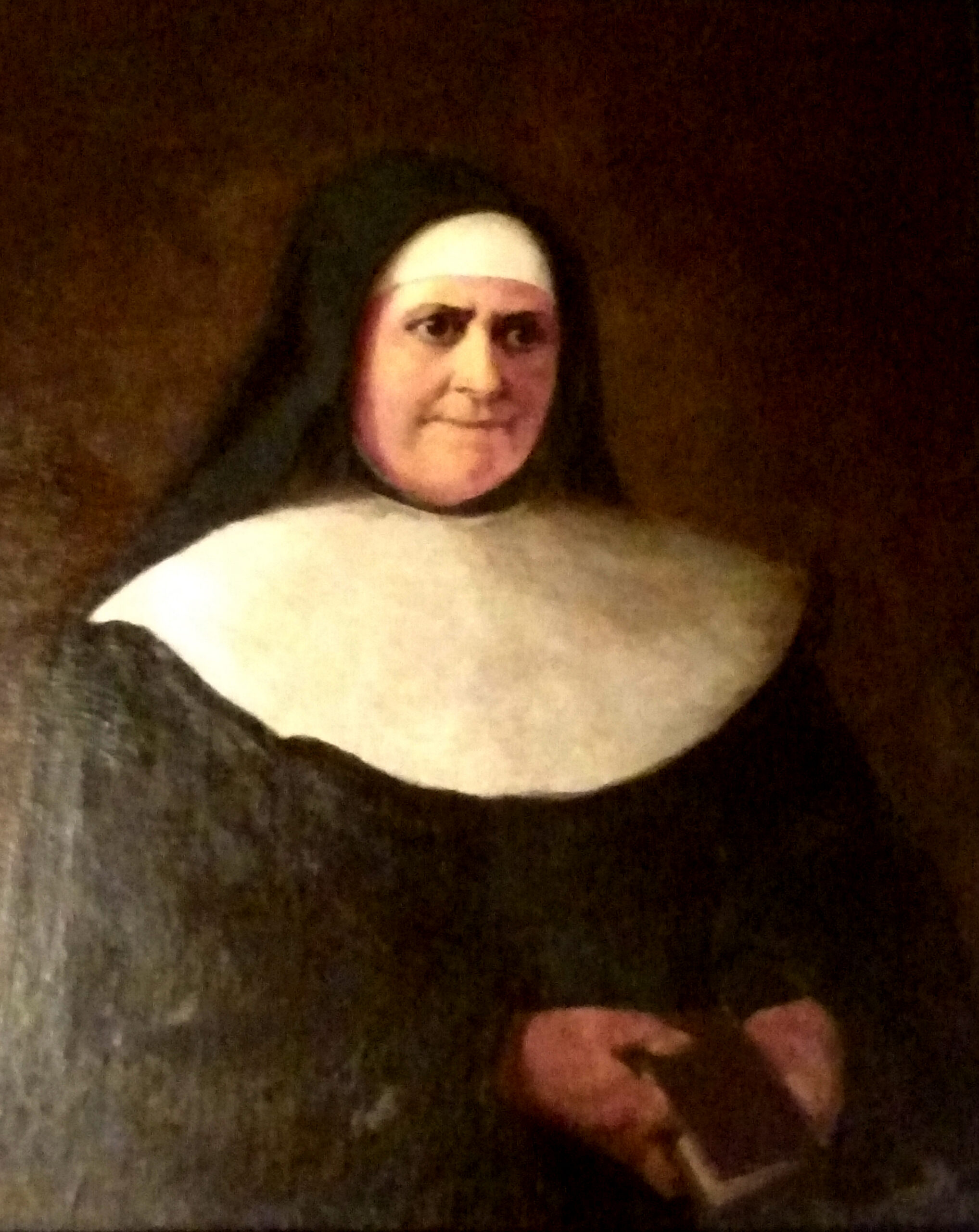 Yesterday, August 20, was the 129th birthday of Trinity, established with articles of incorporation dated August 20, 1897. Intrepid, courageous women — the Sisters of Notre Dame de Namur — founded this great college because they believed that women deserved a higher education equal to that of men back in that day. (Trinity Founder Sister Julia McGroarty pictured on the left.) Women were barred from admission to then-new Catholic University. Not everyone was happy about the idea of women going to college back then — some conservative priests at Catholic University wrote to the Pope complaining that the Sisters of Notre Dame who were trying to start Trinity were engaging in heresy — a heresy called “Americanism” because the idea of women’s education was considered very liberal.
The sisters persisted, the students came, and history began to roll forward.
It took three years for Trinity to go from articles of incorporation to actual buildings, faculty and classes. 126 years ago, on a cold, rainy November morning, in the Year 1900, 19 intrepid young women first set foot on Trinity’s campus in what was then considered the “countryside” of the nation’s capital. Michigan Avenue was a dirt road (below), and the college they came to inhabit had one building — or, should I say, a single wing of one building under construction, the south wing of Main Hall (below).


A century and a quarter later, we may look back at the quaint tale of those women (above, Class of 1904) and marvel at their fortitude and determination to make a go of it in a place that must have seemed very strange and foreboding to them. They were pioneers, women destined to change the course of history for the generations who followed them here.
Today, you are the women of destiny, you are the new generation of pioneer women poised to make history yet again.
 Who are you? We know some things about you from your class data profile:
- 34% aspire to be nurses; others plan to study Business, Criminal Justice, Biology, Psychology, Early Childhood Education and other subjects;
- 83% are U.S. citizen or permanent residents.
- You were born in 24 different countries including, in addition to the United States: El Salvador, Guatemala, Honduras, Mexico, Cameroon, Ethiopia, Afghanistan, Germany, Jamaica, South Africa, Dominican Republic, Haiti, Venezuela, and many others.
- The majority of you are from the District of Columbia and Maryland, with 17 states represented in this class including, among others, Virginia, Georgia, South Carolina, California, Alabama, Florida, Maine, New York, New Jersey and others.
- You are racially and ethnically diverse, including 46% who identify as Black or African American while 47% identify as Hispanic or Latina.
- You are Baptist and Muslim, Buddhist and Catholic, and many other faiths.
- You are graduates of Coolidge, Columbia Heights/Bell, Cardozo, Roosevelt, Jackson Reed, Don Bosco, Banneker, Eastern and many other high schools.
You are coming to Trinity because you have big dream for yourselves and your families — you know that a great education will make all the difference in helping you to realize your full potential throughout your lives.
Today we welcome you into this grand community and tradition of women scholars arrayed in a long line back to those first 19 students in 1900. They started traditions that continue to this day — traditions like the class colors (The Class of 2030 is a Green Class! So am I!!) and, most important, the Honor System This morning you will take the Honor Pledge and sign the Honor Roll, and then you will receive your Trinity medals.
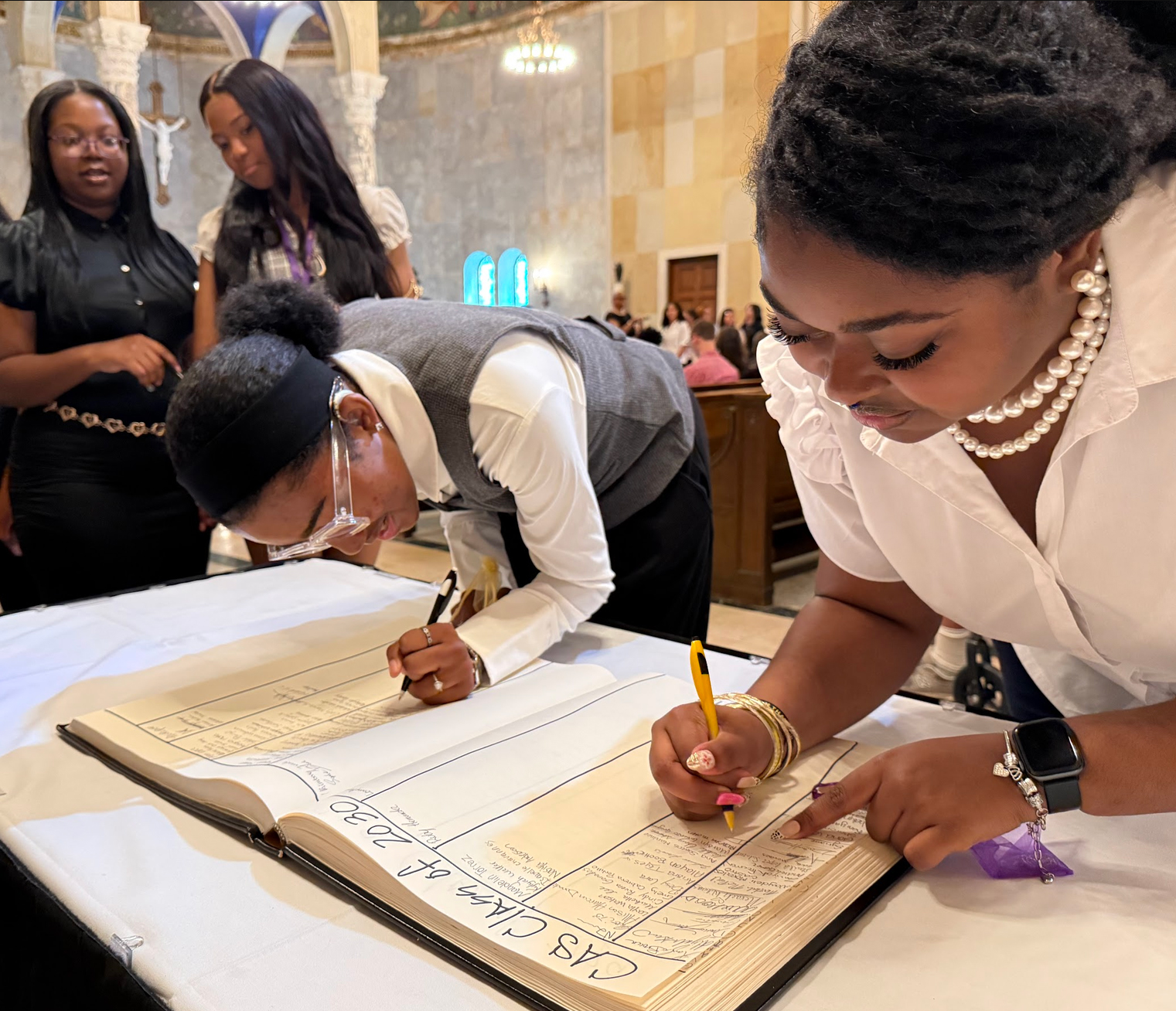
The Honor Agreement and Medal Ceremony
The Honor Agreement has been our tradition since the founding of Trinity. We expect you to live lives of honor and integrity, and to help each other to do so. This sets Trinity apart from many other schools and many places of business today.
The mission and values of Trinity, as embodied in our Honor System, reject any and all acts and words of hatred against other individuals; we welcome, honor and respect everyone here at Trinity and we expect you to treat every other person you encounter here with the respect and dignity they deserve.
This is the essence of the Honor Code, along with, of course, a deep commitment to being truthful in everything.
As part of this ceremony you will also receive the Trinity Medal, a symbol of your entrance into the Trinity community and commitment to the values of the Honor System.
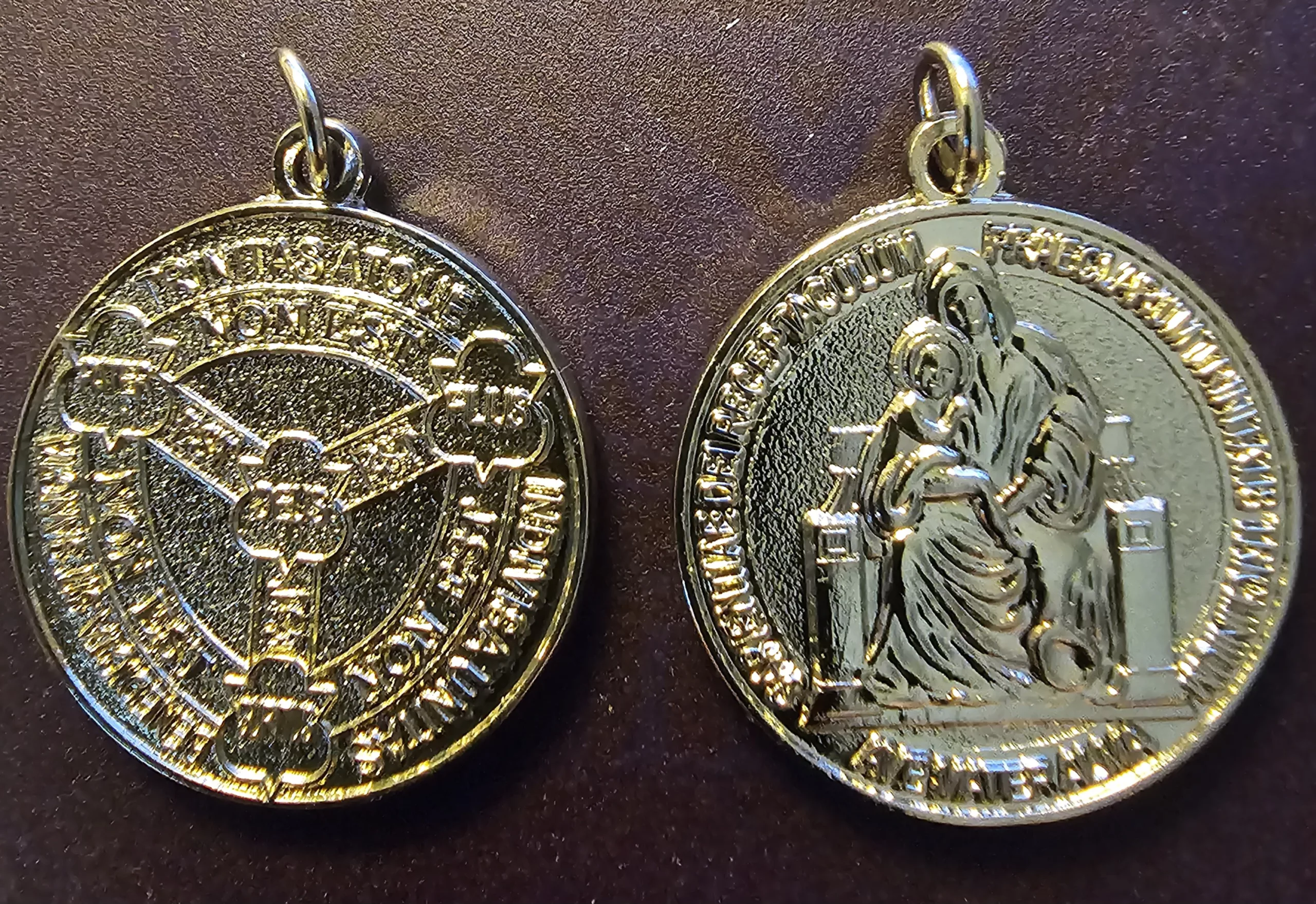
The Trinity Medal has, on its front, the image of Our Lady – Notre Dame – the patron of the Sisters of Notre Dame who founded Trinity in 1897. On the back is the Celtic triangle symbolizing the Trinity. Your Trinity Medals are symbols — symbols of the power of women to change the world. Wear them well, wear them with pride, never do anything to disgrace them!
To conduct this part of the program, I am pleased to recognize Dean of Students Meechie Bowie will lead you in the Honor Pledge. After you recite the Honor Pledge, Dean Meechie will call you forward to receive your medals and sign the Honor Roll.
“I realize the responsibility involved in membership in the Trinity College community. I agree to abide by the rules and regulations of this community. I also affirm my intention to live according to the standards of honor, to which lying, stealing, and cheating are opposed. I will help others to maintain this responsibility in all matters essential to the common good of the community.”
[The students then came forward one-by-one. Each announced her name with the guidance of Dean Bowie. Next, Provost Carlota Ocampo and Dean Sita Ramamurti handed each student her medal. Then the students signed the Honor Book. Photos below capture the phases of this beautiful traditional ceremony.]


CLOSING REMARKS
As you came forward for this ceremony, I was so impressed by the way each one of you stepped up to the microphone and proudly declared your name. Yes! You are here because you are strong, proud women with big dreams, and you should always be ready to say your name, loud and strong! Congratulations!
As I watched you walk in procession for this ceremony, I also imagined you on the day that you will walk up this aisle in your caps and gowns. What a day that will be! Always remember: graduation is the goal!!
You have received your Trinity medals and signed the Honor Book signifying your commitment to continue in that long line of women reaching back to the start of the last century. Across the last 126 years, thousands of Trinity Women have sat in your places, studied in our classrooms and library, conducted research in our labs and played on our fields and courts. They have formed lasting friendships and cultivated a great love for learning throughout their lives.
You may have heard of some of the famous women who once were Trinity first year students just like you — women like Speaker Emerita Nancy Pelosi ‘62, or former Chief of Staff to the First Lady Maggie Williams ‘77, or former Kansas Governor and HHS Secretary Kathleen Sebelius ‘70.
You will hear about and even get to know some of our more recent women of achievement — women like Beatrice Peterson ‘12 who was just named as the Journalist of the Year by the National Association of Black Journalists; or women like Tekedra Mawakana ’93 who is the CEO of Waymo, Google’s self-driving car service; or women like Sydney Cross ’10 whose career in foreign service has taken her from the State Department to the US Transportation Command and soon to the Middle East; or Ewa Obutuse ’20 whose advocacy for Dreamers led to a new Maryland law paving the way for undocumented persons to work in licensed professions.
These are just a handful of the thousands of accomplished women who, like you today, once sat in this chapel on their very first week as Trinity Women, wondering what the future might hold.
 Who among you will be cited in the future as exemplars for new generations? Never forget this opportunity and obligation: from your first day at Trinity, you are writing your history for the future to see your example, for other women to take inspiration and determination from what you have been able to do.
You are joining the Trinity community in an historic year, the 250th year of the great American experiment in Democracy. We know that our nation is stressed right now — politically, economically, socially, spiritually. You will be the citizen leaders for your communities, our city and nation well into the latter half of the 21st Century. What will you contribute to the protection of civil rights, the achievement of justice, the relief of poverty, education of children, improvement in healthcare, establishment of peace at home and abroad? Those may seem like lofty, ephemeral goals — but they are goals that we all must work to achieve every single day.

You are joining this academic community on the cusp of an entirely new technological revolution, a brave new world shaped by Artificial Intelligence. We know little about AI except that it has been created and controlled by a few very powerful men — mostly men — and that there are some very good uses for AI, but many pernicious and even evil applications. Whether you choose to work in healthcare or education or business or politics or government, you will have to learn about and develop a healthy philosophy toward the application and management of AI across almost all facets of our lives.
Many of you will be pursuing careers as nurses and healthcare professionals. We need you! Your ability to care for your patients will lean on the very best of your Trinity education. And you will be on the front lines of some of the most contentious issues of our society — the controversy over vaccines, the issue of gender affirming treatments, ongoing questions about reproductive rights, and access to good healthcare for all people regardless of their ability to pay.
The scientists among you will engage the important issues of environmental health and climate change, regardless of what politicians say, the problems are real; the journalists in this class will find yourselves at the center of an increasingly worrisome conflict between wealthy corporate owners of media and the public’s right to know the news unfiltered by political diktats; those who will be teachers face the essential imperative to improve literacy and the ability of students to recognize the difference between real facts and fake news.
 In all of this, you will be using the best of your Trinity education to investigate the facts, to engage critical and moral reasoning to solve problems, to write and speak clearly and persuasively, and to exert leadership for progress, for good change, for justice and peace in all of the communities you inhabit. In doing this, you will emulate the Trinity Women who came before you, and blaze trails for those who will follow you. You will prove the wisdom of our founders, the great Sisters of Notre Dame de Namur, who never met you but who would be so proud of you today.
May the power, wisdom, love and light of the Trinity go with you all through your college days! Congratulations, Class of 2030!
(Below: the images on the Trinity Medal include the Celtic symbol for the Trinity, and on the front, the image of Madonna and Child, taken from the pediment over Notre Dame Chapel, see bottom photo.)

Choosing Public Service
August 11, 2026
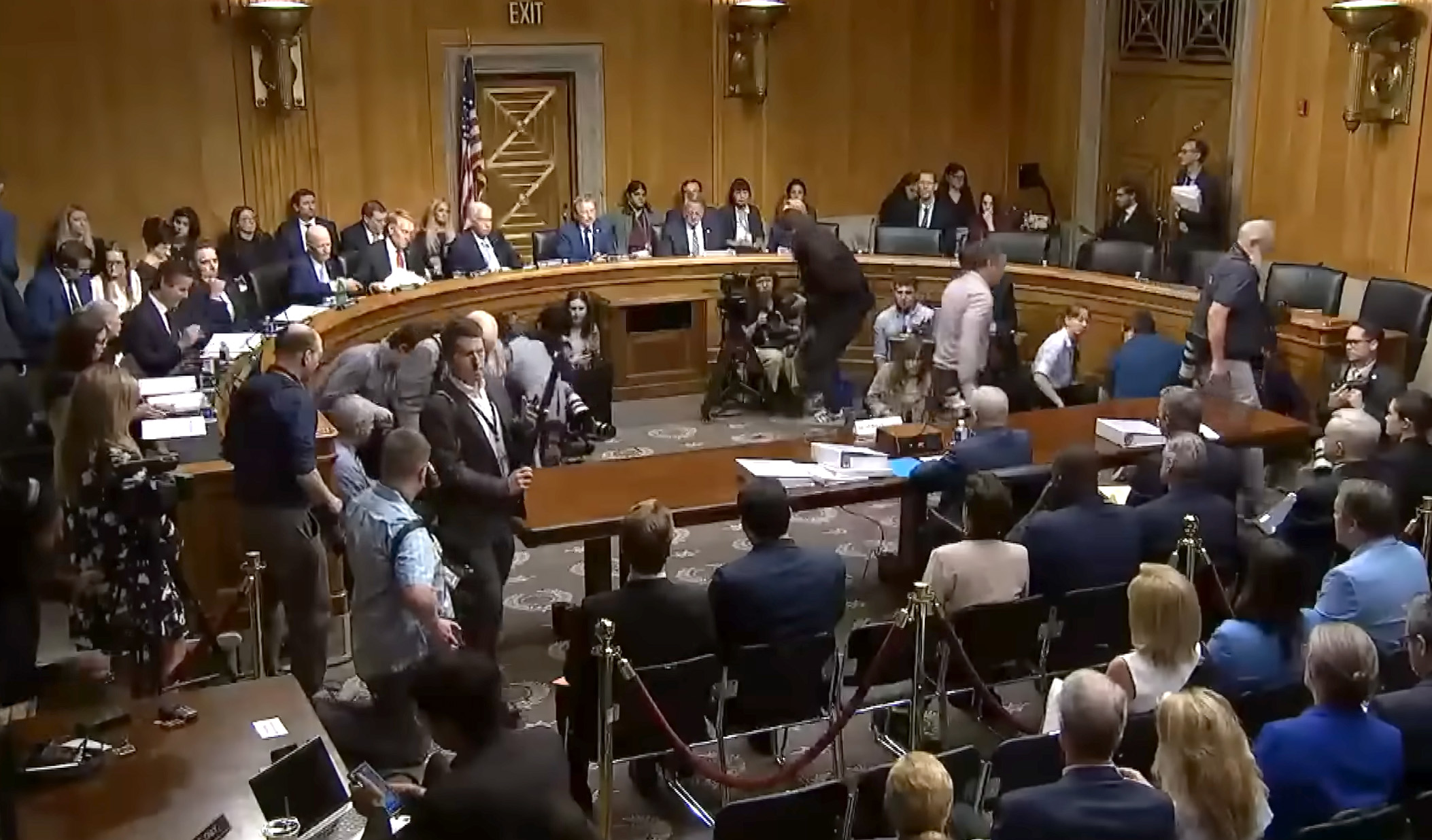
(Video screenshot of Dr. Fauci appearing before the Senate Homeland Security Committee)
In my senior year at Trinity, in Spring 1974, I attended a gathering of students, scholars and public officials organized by a group known as the Center for the Study of the Presidency. The American presidency was in grave distress at that time due to the Watergate investigation into possible obstruction of justice by President Richard Nixon over the “third rate burglary” of the Democratic National Committee headquarters at the Watergate office building. Nixon was on the verge of impeachment, and numerous officials in his administration were under investigation or about to be indicted for their roles in the Watergate cover-up; some went to jail as a result. The guest speaker at the CSP event was Vice President Gerald Ford, someone who became the second highest public official in the country because his predecessor, Spiro Agnew, had to step down due to a corruption scandal.
Vice President Ford gave a perfectly benign speech about how great the government was and how much the Nixon administration did for our country, and how all of us college students should consider careers in government. He said nothing about the scandals. So, with the brashness of a 21-year-old Trinity senior, when the time came for questions, I raised my hand and he called on me! I stood up and asked the vice president of the United States: with all the scandals in the Nixon administration and the trauma so many members of his administration caused for everyday citizens, how could Mr. Ford encourage any college students to consider pursuing careers in government?
I could hear people gasp, but after looking hard at me for a minute, the vice president replied that it was exactly that kind of boldness that our country needed at that point in time, and he hoped I would take up the challenge. I sat down feeling a bit patronized but glad his answer was friendly. Afterward, the CSP president R. Gordon Hoxie scolded me for my impertinent question — leading me to think I had done the right thing since the question was legitimate and Vice President Ford surely could have given a more satisfying answer.
President Nixon resigned that summer, on August 9, 1974, avoiding an impeachment trial. At that time, many of us college students thought that Nixon and his cronies were the absolute worst examples of corrupt public officials, and many of us wanted nothing to do with service in such a scandal-plagued government.
I thought of that moment last week as I watched the very hostile, disgraceful grilling that Dr. Anthony Fauci received at the hands of Senator Rand Paul and the Senate Homeland Security and Government Affairs Committee. Dr. Fauci had a long and very distinguished career as the head of the National Institute of Allergies and Infectious Diseases, and he was the chief medical advisor to both Presidents Trump and Biden during the Covid-19 pandemic. I’m not going to rehash all of the issues with Covid-19, including the vast reservoir of conspiracy theories that continues to fuel right-wing political retribution in some quarters. Suffice to say that, all these years after Covid-19, Senator Paul and others continue to promote the conspiracies and go out of their way to scapegoat former public officials like Dr. Fauci.
At the hearing, Dr. Fauci refused to answer questions, pleading his 5th Amendment rights. He did so in the belief that the questions were hostile efforts to get him to say something that could be used against him. Subsequent to the hearing, Senator Paul and the Republicans on the committee took the unusual step of voting to hold Dr. Fauci in contempt of Congress. The result of this effort to shame and malign Dr. Fauci remains unknown at this writing, likely to be tied-up in legal challenges for months to come.
As I watched Senator Paul pursue his malignant crusade against Dr. Fauci, I could feel that 21-year-old college senior rising in me again, wanting to leap up and shout out: “How can you expect anyone to want to go into public service when you treat them so shamefully?” Being older, perhaps wiser, and not having an audience to goad me into shouting a rash question — alone in my office watching the hearing clips on YouTube — I was able to ponder the scene more rationally, and to think past my anger to the real answer.
In fact, as Vice President Ford tried to persuade me so long ago, and as I know for sure today, the miserable examples we see of public corruption and the abuse of power to enact political revenge should light fires in the rising generations to engage, not retreat, from the idea and necessity of public service. Indeed, the future of our American democracy and system of government depends on the ability of a new generation of leaders to step up to the challenge, to be willing to take the risk of public criticism in order to achieve necessary and durable change in our government.
The current moment demands a renewal of the idea of public service for the common good — a replenishment of the once-noble idea of the “habits of the heart” whether in government service or non-profit work or volunteer positions. We are in a moment of true ethical and moral crisis as a nation, but the moment is also an opportunity to pursue real change —- but to enact the change we must achieve, we need new leadership, new ideas, fresh energy and commitment to ideals that have never gone out of fashion, like the ideal of servant leadership, working to help others, living with a daily commitment to honor, integrity and achieving justice for all.
In this year of the America250 observance, we educators have a special responsibility to focus even more acutely on our responsibility to prepare the rising generations for leadership and service across the next 50-75 years of American life. In higher education, we need to stop moping in the corners over the ways in which the current government has been so awful to us — it has been, deal with it — and instead we need to refocus our energy on what we do best, teaching our students how to be change agents for good, advocates and activists for solutions that can make all lives better in this country.
God bless Dr. Fauci. Let his courage and professionalism be a model for the rising servant leaders of the future.
Continue reading →Read comments (0) Add CommentThe Cromwell Lesson
August 2, 2026

(Holbein portrait of Thomas Cromwell)
In the end, all those years of loyalty to the mad king’s demands for unquestioned subservience and bloody retribution against his perceived enemies did not matter for Thomas Cromwell. Cromwell lost his head anyway when Henry VIII grew tired of his long-time minister whose advice he no longer trusted. The beheading of Cromwell should be a cautionary tale for anyone who thinks that serving a despotic personality loyally is protection against the rages and rash orders. Read Hilary Mantel’s marvelous Wolf Hall trilogy if you are unfamiliar with the reference. (Yes, there is an excellent video version, too, but gosh darn it, if you want to save your head, READ!)
Jeanine Pirro, the U.S. Attorney for D.C., is no Thomas Cromwell, to be sure, and as of this writing she still has her head, and even her job. I do wonder why she did not quit her job immediately upon admitting that (a) her office bungled the prosecution of an innocent man for allegedly vandalizing the Lincoln Memorial reflecting pool, and (b) her boss, the current president, immediately took to social media to blast her, writing, “I 100% disagree with Jeanine Pirro” in the matter of the Department of Justice dropping the vandalism charges against David Hearn. The current administration always seems to be breaking with traditional ways of communicating, and so it is stunning, but not surprising, for the boss to criticize his subordinate so publicly and vehemently.
From the start, the case was an over-reach, a prosecution that appeared to be an effort to salve the president’s ire over the fact that his much-ballyhooed renovation of the reflecting pool was a bust. Rather than admitting that the renovation was botched, he needed scapegoats, and Judge Jeanine (her identity when she was a television personality) trumped-up the bogus charges while serving up the head of David Hearn, a famous Olympic kayaker who happened to be passing by the reflecting pool one day in full bicycle regalia and he stopped to inspect the pool whose liner was already detached and floating around. Such a juicy arrest and prosecution, a genuine Olympic hero committing vandalism! But…. not. As the Department of Justice motion withdrawing the indictment states, the damage to the reflecting pool was not a result of vandalism, but, instead, “…a rushed and flawed installation process, with repeated failures of the lining during the installation process, and extensive peeling of the lining throughout the Reflecting Pool…”
Many pundits are salivating over the political implications of this case, and legal mavens are examining the entrails of yet one more indictment gone wrong under the dubious leadership of Ms. Pirro. It’s clear this is yet one more case in a long line of cases over the last two years that should never have landed in court. Vindictive prosecutions have no place in the American system of justice.
But the real lesson we students of law, leadership and public service —- and especially all cabinet members and aides to the current regime — need to take from this tawdry episode (among many) is the Cromwell Lesson: if you abandon your moral judgment and, instead, devote your career to taking actions to feed the demands of a boss who seems to have no moral compass, at some point the lies and deception and concessions and sheer vituperative behavior will catch up with you, and, like Cromwell, you will find yourself standing at the gallows wondering how it all went so wrong. Better to quit the first time the boss tells you to do something that is clearly against all reason, all facts and moral reasoning; leave with at least your soul intact, and, one hopes, your body as well. You can always get another job; your head, along with your reputation, is hard to replace.
Continue reading →Read comments (0) Add CommentAdirondack Chronicles 2026: A Walk in the Woods
July 22, 2026

A few glorious weeks in the Adirondacks have reminded me once more of the essential work of the wilderness in sustaining life and health for our planet. The white pines towering above this landscape can be, in some places, older than the republic itself by a hundred years or more. The great trees of the northern forest provide cover and nourishment for all of the living things below, the smallest salamanders and chipmunks, the fertile deer and their fawns, the bears that roam through the mountains and forests, the large communities of birds of all species that call the trees home. And, oh yes, the trees nurture and nourish the physical and emotional lives of the humans who come to live among them — most for just a few weeks, some for all of their lives.

I was admiring the lush quiet beauty of the Adirondack forest preserve when I heard the news that the president of the United States, who has a tendency to say some weirdly dumb (with a “b”) things, accused Canada of failing to maintain its forests correctly because there has been a plague of wildfires this year in the northern boreal forest that stretches across the top of North America. The boreal forest is even denser than the Adirondack forest preserve, even older and even more remote. Indigenous people live in communities there, but most of the northern forest is inaccessible.
As I read about the president’s criticism of Canada for “letting” the wildfires happen (they were caused by lightening strikes in those deep forests, and such wildfires also burn in many places around the globe including in the United States), I could not help but contemplate the utter intellectual and emotional impoverishment of a person who seems to know so little about the natural world.
Has this man ever taken a walk in the woods?
Has he ever spent even just an hour of solitude in a forest, inhaling the aroma of balsam, walking softly across the duff underfoot, listening for the clatter of blue jays or rat-a-tat of woodpeckers or screeches of hawks high in the trees?
 Has this man ever sat by the streams running down the forested slopes, the melt after the heavy winter snows?
Has he ever heard the haunting call of a loon at dusk, or watched a merganser lead her long train of young ones across a lake rimmed by the great tall evergreens of the north?

 Has he ever watched a cedar waxwing greedily gobbling the serviceberries that keep the birds well fed into winter?

Does he know that the terrible destructive force of the wildfires is also life-giving for the forest, that after the burn new trees will grow again, and the forest will thrive once more?
Of course we know that his comments about the wildfires in Canada have nothing to do with the reality of the fires and forests. Political points are a short-term human game, devoid of care or respect for the long generational time horizons of the natural world.
But, still. Perhaps someone who apparently knows so little about his own forests here in the United States should refrain from criticizing another country’s forests. Perhaps he should take a walk in the woods and allow himself to discover the peace, joy and humility of understanding that we are all part of an ecosystem that sustains the life of the earth, including human life. Perhaps if he learned a bit about the wonders of the forest, he would also learn a bit about respecting human life in all of its amazing God-given diversity and beauty.

I’d be happy to take him for a walk along a forest road in the Adirondacks!
Continue reading →Read comments (0) Add CommentReflecting on America at 250
July 3, 2026
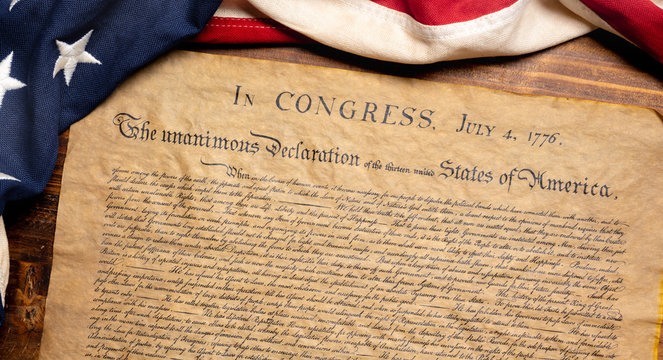
America has always been a fractious place. The United States was born out of a revolution sparked by cross-Atlantic tensions and conflict between the British rulers (King George III) and mostly wealthy colonial landowners (Washington, Jefferson, Madison, Monroe, et al.) who had grown increasingly resentful of monarchial rule, particularly when the monarch imposed taxation without representation. July 4, 1776 was not the end of the fight, but rather, the rocket blast proclaiming independence that fueled the American Revolution and the creation of the United States of America.
But having triumphed over their English brothers and cousins, the newly empowered Americans also fought bitterly with each other, and the long-festering disputes over slavery and states’ rights erupted into a horrific Civil War that nearly extinguished the American experiment in the 1860’s. That immensely costly war ended slavery and set the young nation on a path to power, but the divisive forces simmered across the next century, erupting into violence at different intervals, and laying the foundation for our contemporary political and social ruptures.
As America observes the 250th anniversary of the signing of the Declaration of Independence, we are rightfully proud of our nation’s triumphs, contributions to advanced civilization, and long role as a leader of the free world and model for the ideal democracy — to a point. It does not diminish our rightful pride in America’s achievements to express, as well, profound concern about the future of this democracy as we examine the worrisome signs and symbols of decay of our ideals and betrayal of our founding values at this moment in our history.
The Founders of this nation had long and intense debates about the power of the executive versus the legislature and courts. While some clearly favored a more monarchial structure, the “no kings!” contingent prevailed and the Constitution enacted in 1789 clearly called for a balance of powers among the executive, legislative and judicial branches. The executive was never supposed to be an all-powerful ruler, but rather, a servant to the needs of governance with powers tempered by the actions of Congress and courts.
250 years after the signing of the Declaration of Independence, the greatest danger to the future of democracy in the United States of America is the rise of a clearly authoritarian leader, someone who proudly proclaimed that he would be a “dictator on Day One” of his second term, and he is working hard and fast to fulfill that promise. The current president is asserting an unprecedented level of power with few guardrails — Congress is inert, the Supreme Court has conceded much of what he has asked for (with a few notable exceptions, see tariffs and birthright citizenship), and other courts are struggling to keep up with the tsunami of lawsuits his actions have prompted. From the War on Iran, to unleashing ICE agents and National Guard troops to cities across this nation, to squeezing huge concessions from universities and law firms and media companies, to engaging in outrageous acts of retaliation against his political opponents, to making a mess of the White House and other national monuments (see: reflecting pool) with his own decorations and weird notions of reconstruction, the current president has unleashed a frenzy of destructive actions that seek to force nations, institutions and people to bow to his will and whims. The consequences will shape this nation, for better or worse, for generations.
On this Independence Day, as we celebrate all that America has meant for the last 250 years, Americans should be mindful of our responsibility to ensure a vibrant future for this nation. America will not long survive if we continue to concede power to an authoritarian president whose goal is to bend everyone to his singular will. We must reassert the idea of “We, the People” as the true governors of our nation. We can start by reading and reflecting on what our founding document — the Declaration of Independence — calls us to do at this moment in our history.
In celebration of America’s 250th birthday, I present for your serious reading and reflection the text of the Declaration of Independence:
In Congress, July 4, 1776
The unanimous Declaration of the thirteen united States of America, When in the Course of human events, it becomes necessary for one people to dissolve the political bands which have connected them with another, and to assume among the powers of the earth, the separate and equal station to which the Laws of Nature and of Nature’s God entitle them, a decent respect to the opinions of mankind requires that they should declare the causes which impel them to the separation.
We hold these truths to be self-evident, that all men are created equal, that they are endowed by their Creator with certain unalienable Rights, that among these are Life, Liberty and the pursuit of Happiness.–That to secure these rights, Governments are instituted among Men, deriving their just powers from the consent of the governed, –That whenever any Form of Government becomes destructive of these ends, it is the Right of the People to alter or to abolish it, and to institute new Government, laying its foundation on such principles and organizing its powers in such form, as to them shall seem most likely to effect their Safety and Happiness. Prudence, indeed, will dictate that Governments long established should not be changed for light and transient causes; and accordingly all experience hath shewn, that mankind are more disposed to suffer, while evils are sufferable, than to right themselves by abolishing the forms to which they are accustomed. But when a long train of abuses and usurpations, pursuing invariably the same Object evinces a design to reduce them under absolute Despotism, it is their right, it is their duty, to throw off such Government, and to provide new Guards for their future security.–Such has been the patient sufferance of these Colonies; and such is now the necessity which constrains them to alter their former Systems of Government. The history of the present King of Great Britain is a history of repeated injuries and usurpations, all having in direct object the establishment of an absolute Tyranny over these States. To prove this, let Facts be submitted to a candid world.
He has refused his Assent to Laws, the most wholesome and necessary for the public good.
He has forbidden his Governors to pass Laws of immediate and pressing importance, unless suspended in their operation till his Assent should be obtained; and when so suspended, he has utterly neglected to attend to them.
He has refused to pass other Laws for the accommodation of large districts of people, unless those people would relinquish the right of Representation in the Legislature, a right inestimable to them and formidable to tyrants only.
He has called together legislative bodies at places unusual, uncomfortable, and distant from the depository of their public Records, for the sole purpose of fatiguing them into compliance with his measures.
He has dissolved Representative Houses repeatedly, for opposing with manly firmness his invasions on the rights of the people.
He has refused for a long time, after such dissolutions, to cause others to be elected; whereby the Legislative powers, incapable of Annihilation, have returned to the People at large for their exercise; the State remaining in the mean time exposed to all the dangers of invasion from without, and convulsions within.
He has endeavoured to prevent the population of these States; for that purpose obstructing the Laws for Naturalization of Foreigners; refusing to pass others to encourage their migrations hither, and raising the conditions of new Appropriations of Lands.
He has obstructed the Administration of Justice, by refusing his Assent to Laws for establishing Judiciary powers.
He has made Judges dependent on his Will alone, for the tenure of their offices, and the amount and payment of their salaries.
He has erected a multitude of New Offices, and sent hither swarms of Officers to harrass our people, and eat out their substance.
He has kept among us, in times of peace, Standing Armies without the Consent of our legislatures.
He has affected to render the Military independent of and superior to the Civil power.
He has combined with others to subject us to a jurisdiction foreign to our constitution, and unacknowledged by our laws; giving his Assent to their Acts of pretended Legislation:
For Quartering large bodies of armed troops among us:
For protecting them, by a mock Trial, from punishment for any Murders which they should commit on the Inhabitants of these States:
For cutting off our Trade with all parts of the world:
For imposing Taxes on us without our Consent:
For depriving us in many cases, of the benefits of Trial by Jury:
For transporting us beyond Seas to be tried for pretended offences:
For abolishing the free System of English Laws in a neighbouring Province, establishing therein an Arbitrary government, and enlarging its Boundaries so as to render it at once an example and fit instrument for introducing the same absolute rule into these Colonies:
For taking away our Charters, abolishing our most valuable Laws, and altering fundamentally the Forms of our Governments:
For suspending our own Legislatures, and declaring themselves invested with power to legislate for us in all cases whatsoever.
He has abdicated Government here, by declaring us out of his Protection and waging War against us.
He has plundered our seas, ravaged our Coasts, burnt our towns, and destroyed the lives of our people.
He is at this time transporting large Armies of foreign Mercenaries to compleat the works of death, desolation and tyranny, already begun with circumstances of Cruelty & perfidy scarcely paralleled in the most barbarous ages, and totally unworthy the Head of a civilized nation.
He has constrained our fellow Citizens taken Captive on the high Seas to bear Arms against their Country, to become the executioners of their friends and Brethren, or to fall themselves by their Hands.
He has excited domestic insurrections amongst us, and has endeavoured to bring on the inhabitants of our frontiers, the merciless Indian Savages, whose known rule of warfare, is an undistinguished destruction of all ages, sexes and conditions.
In every stage of these Oppressions We have Petitioned for Redress in the most humble terms: Our repeated Petitions have been answered only by repeated injury. A Prince, whose character is thus marked by every act which may define a Tyrant, is unfit to be the ruler of a free people.
Nor have We been wanting in attentions to our Brittish brethren. We have warned them from time to time of attempts by their legislature to extend an unwarrantable jurisdiction over us. We have reminded them of the circumstances of our emigration and settlement here. We have appealed to their native justice and magnanimity, and we have conjured them by the ties of our common kindred to disavow these usurpations, which, would inevitably interrupt our connections and correspondence. They too have been deaf to the voice of justice and of consanguinity. We must, therefore, acquiesce in the necessity, which denounces our Separation, and hold them, as we hold the rest of mankind, Enemies in War, in Peace Friends.
We, therefore, the Representatives of the united States of America, in General Congress, Assembled, appealing to the Supreme Judge of the world for the rectitude of our intentions, do, in the Name, and by Authority of the good People of these Colonies, solemnly publish and declare, That these United Colonies are, and of Right ought to be Free and Independent States; that they are Absolved from all Allegiance to the British Crown, and that all political connection between them and the State of Great Britain, is and ought to be totally dissolved; and that as Free and Independent States, they have full Power to levy War, conclude Peace, contract Alliances, establish Commerce, and to do all other Acts and Things which Independent States may of right do. And for the support of this Declaration, with a firm reliance on the protection of divine Providence, we mutually pledge to each other our Lives, our Fortunes and our sacred Honor.
Continue reading →Read comments (0) Add Comment
