
Featured Post
USDT Freeze Explained: How Tether Blocks Any Address (2026)
As of 2026-07-26, Tether has blacklisted 9,597 USDT addresses and frozen $5.69 billion via the USDT smart contract's freeze mechanic. This 2026 pillar guide covers how freezes work on-chain, why Tether freezes addresses (with 2026 case data from the $344M April Iran seizure to the $131M July Operation Economic Fury freeze, and roughly $1B cumulative Iran-linked seizures since the campaign began), how the multisig-delay window opens a documented escape channel (BlockSec's analysis of 8,310 executed freeze proposals recorded $215.5M moved out during the delay), what 'destroyed' USDT really means for victims (burn-and-reissue mechanism), whether frozen addresses can be unfrozen (3.6% do get removed), and how to build compliance around freeze risk.


~$1.6M Lost: Moke Token, LpdFi Exploits | BlockSec Weekly
During the week of August 3-9, 2026, 2 notable security incidents on BNB Chain resulted in approximately $1.6M in total losses, both from price manipulation. The highlighted LpdFi incident (~$697K) reused the same manipulable PancakeSwap pair reserves for both order valuation and interest redemption, letting the attacker inflate a position's principal and reshape the pool to redeem an oversized interest claim. Moke Token (~$906K) combined a manipulable spot price with duplicated LP dividend accounting to claim inflated MOKE and collect the resulting BNB dividends multiple times.
COLDCARD Incident: When a Wallet's "Random" Seed Wasn't Random
A silent build-and-integration bug in COLDCARD firmware routed Bitcoin seed generation onto a software RNG fallback, whose weak randomness left wallet seeds recoverable offline. Because the weakness is in the seed itself, a firmware update cannot undo it; verified sweeps reached 1,405 BTC (~$91M) by 7 August 2026, with private-channel estimates as high as 2,055 BTC.
What Are Stablecoin Payments? A Complete Guide for Businesses
Stablecoins settled close to $1.8T in some months, but real payments are a much smaller slice. What the numbers say, why collapsing transfer and settlement into one step matters, and where the limits are.
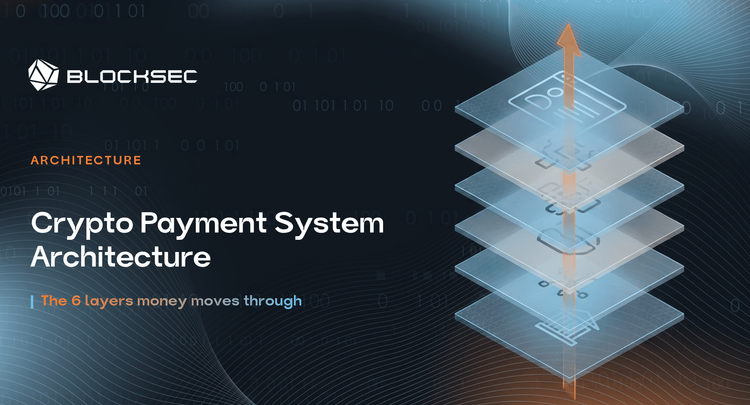
Crypto Payment System Architecture: The 6 Layers and How Money Moves Through Them
Six layers, from the blockchain up to your app, plus a nine-step pay-in flow and a riskier pay-out path that can't be undone. Including one misconception worth clearing up: MPC alone doesn't make a wallet self-custodied.
Global Crypto Payment License Map: MSB, MiCA, MPI
Most crypto payment firms don't need an issuance license — they need a payment license, and it differs by market: Circle alone holds MTLs in 46 US states. What each jurisdiction requires, plus 8 universal obligations.
On-Chain Compliance for Crypto Payments: AML/CFT, Freeze Risk & a 7-Point Checklist
The Travel Rule assumes both sides are licensed VASPs; when a transfer ends at a non-custodial wallet, there's no identity to exchange. What fills that gap, why stablecoin freezes are by design, and a 7-point self-check.
Key Management & Operational Security for Crypto Payments
Multisig, MPC, hot/cold, HSM — not one list of options but three separate dimensions: who signs, where the key lives, how exposed it is. Plus a hybrid split by fund temperature, and why blind signing helped cause Bybit.
Biggest Crypto Payment Hacks & the Attack Surface Beneath Them
Bybit needed several defenses to fail together. MoonPay needed one email. Three 2025 attacks traced to their entry points, and why the contract layer beneath — where USDC and USDT differ — is now your attack surface.
~$88M Lost: COLDCARD & LULA Exploits | BlockSec Weekly
During the week of July 27 to August 2, 2026, two notable security incidents caused roughly $88M in losses across Bitcoin and BNB Chain. The highlighted COLDCARD incident was a hardware-wallet firmware entropy failure: a build guard that checked whether an RNG configuration macro existed rather than whether it was enabled routed seed generation to a deterministic software fallback, enabling an attacker to recover affected seeds and sweep at least 1,370 BTC (~$88M) across a series of on-chain waves. The LULA token on BNB Chain lost ~$578K to a business-logic flaw where an attacker-reachable path could trigger its privileged `recycle()` function, pulling LULA out of a PancakeSwap V2 pair, resyncing its reserves to the manipulated balance, and draining its liquidity.
Why Is My USDT Frozen? 4 Reasons + What to Do (2026)
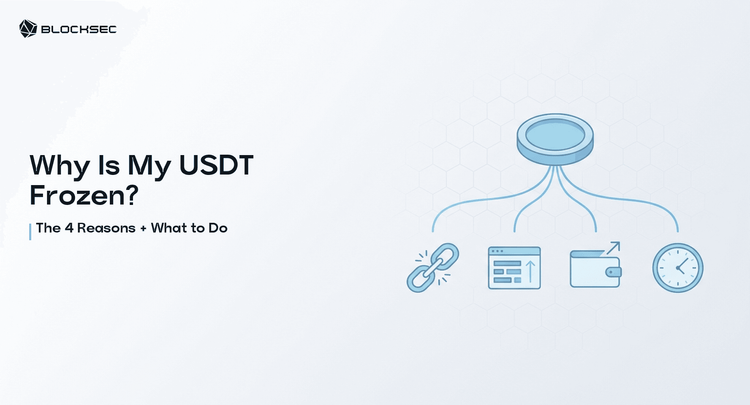
If your USDT is frozen, one of four things happened: Tether blacklisted your address on-chain, your exchange froze your balance for compliance review, the wallet you sent to is blacklisted, or a compliance hold has paused a specific transaction. This 2026 direct-answer primer walks through each branch with a fast self-classification path (the free 30-second address check) and the concrete next action for each reason.
How to Unfreeze USDT on Binance: 5-Step Playbook
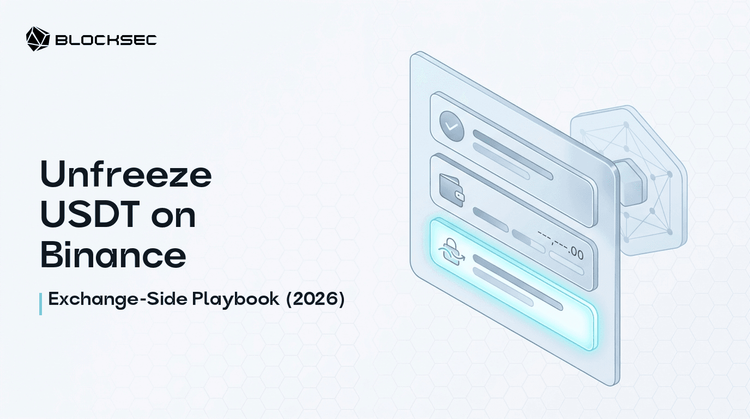
A Binance USDT freeze is a Binance-side compliance action (KYC/AML/jurisdiction/suspicious-activity/law-enforcement), where the balance is visible in the Binance account but locked from withdrawal or trading. This is structurally distinct from a Tether-side on-chain blacklist that hits a self-custody address. This guide covers the five publicly documented freeze categories, the 5-step official appeal playbook, category-specific timelines (48h for KYC vs. weeks for AML), a 60-second Binance-vs-Tether disambiguation check, and the edge case where a Tether-blacklisted incoming deposit triggers a Binance-side hold.
Stablecoins That Cannot Be Frozen: 2026 Map
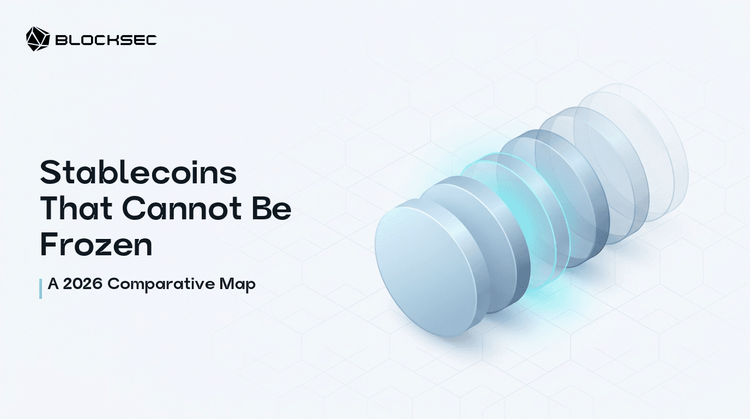
A 2026 comparative map of seven stablecoins (USDT, USDC, DAI, LUSD, Frax, RAI, Ethena USDe) across three freeze-capability axes: issuer freeze, contract-level admin, and peg mechanism. Written in a compliance-authority voice, the guide walks the honest trade-offs on each end of the spectrum, from fully-freezable, fully-liquid fiat-backed tokens to truly-unfreezable but thin-liquidity immutable-contract designs (LUSD, RAI), and shows why circulating supply and freeze capability track each other so closely.

