-
-
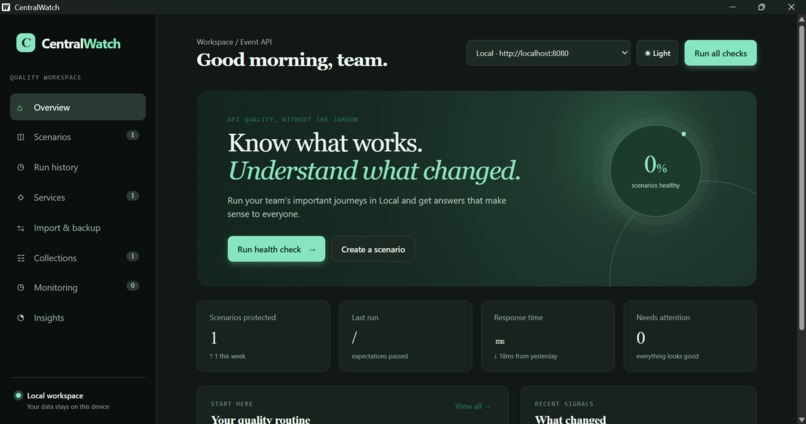
Test API's in an easy manner
-
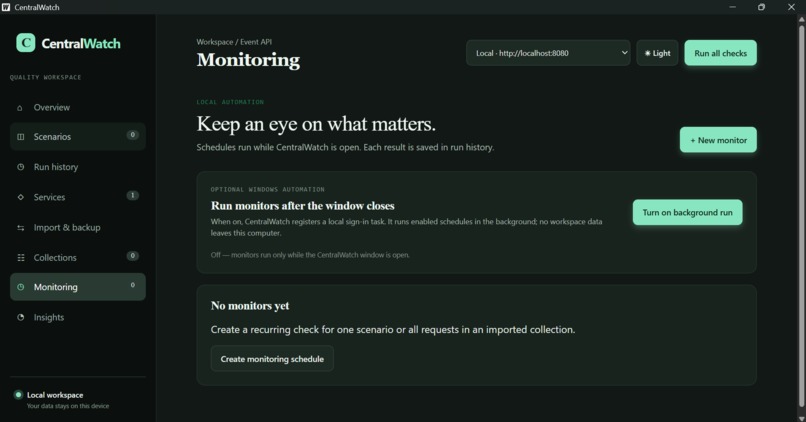
Always on monitoring
-
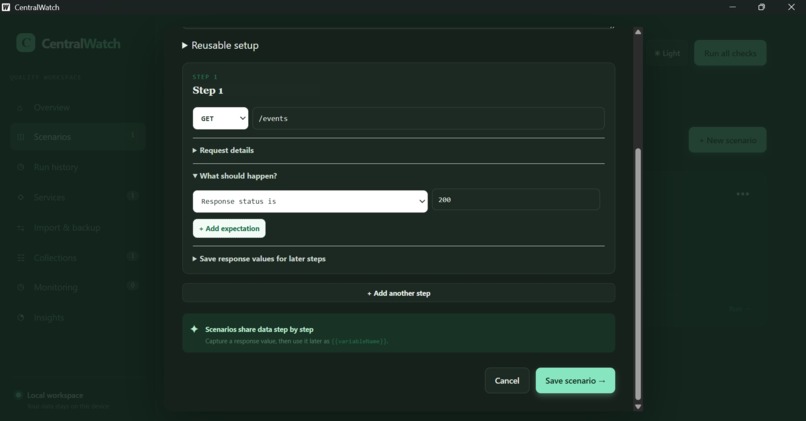
Create scenarios to test with ease


Inspiration
API testing is often powerful but intimidating. We wanted to make reliable API quality checks accessible to product, QA, support, and engineering teams—not only specialists who are comfortable writing raw requests and scripts.
What it does
CentralWatch is a local-first desktop API-testing workspace. Users create readable, multi-step scenarios, run them against named environments, and receive clear pass/fail results with request, response, and expectation details.
It supports REST and GraphQL, authentication, variables and captures, Postman and OpenAPI imports, response baselines, reports, scheduled monitoring, Teams alerts, and CI-ready JSON/JUnit output.
How we built it
CentralWatch uses Vue 3, TypeScript, and Vite for the desktop interface; Go for the application logic and HTTP/GraphQL runner; Wails for the desktop shell; and SQLite for local workspace and run-history storage. Credentials are kept in the operating-system keychain.
Codex with GPT-5.6 helped inspect and refine the codebase, clarify product behavior across the UI and backend, and create a reproducible judge workflow and project documentation.
Challenges we ran into
The hardest part was balancing flexibility with simplicity. API tools need to handle different request types, authentication methods, assertions, imports, and environments, while still being understandable to someone who is not an API-testing expert.
We also had to make safety a first-class concern: protecting secrets, keeping workspaces local, redacting sensitive values, and preventing accidental write operations against production APIs.
Accomplishments that we're proud of
We created a scenario-first workflow that turns technical API checks into readable business outcomes. We are especially proud of the local-first design, secure secret handling, production safeguards, response baselines, import support, monitoring, and the ability to take the same saved checks into CI.
What we learned
We learned that developer tools become more useful when they explain outcomes instead of only exposing technical details. Clear language, safe defaults, and guided workflows can make API quality work more approachable without removing the capabilities technical users need.
We also learned that local-first architecture requires deliberate trade-offs around storage, portability, credentials, and background monitoring.
What's next for CentralWatch
Next, we want to add team synchronization, shared workspaces, centralized monitoring results, richer OAuth flows, broader OpenAPI and Postman compatibility, test-data templates, and more collaboration features. The goal is to keep CentralWatch simple for everyday users while making it increasingly capable for teams that depend on APIs.
Built With
- codex
- go
- graphql
- inno-setup
- json
- junit
- microsoft-teams-webhooks
- modernc.org/sqlite
- openapi
- os-keychain
- postman-collection-v2.1
- rest-apis
- sqlite
- typescript
- vite
- vue-3
- wails-v2


Log in or sign up for Devpost to join the conversation.