LTX Models Overview
Multimodal video generation model
A production-grade foundation model deployable via API, on-prem, or open weights.
Licensing
LTX-2.5 is fully open source, free for companies under $10M in revenue. For teams building at scale, we offer a commercial license tailored to your product, infrastructure, and support needs.

API
Production-ready infrastructure for teams shipping AI into real products, with predictable performance, clear pricing, and zero guesswork.

LTX-2.5
Native multi-shot scenes. Real footage, editable. Cinema-grade EXR. A base built to be fine-tuned. The foundation, stronger.







.svg)







Our Vision
We believe creative systems should be reliable enough for real production, flexible enough to adapt to different workflows, and open enough to improve through use. This is why we’re building an open, production-grade system for cinematic, synchronized audio–video creation.
Innovation
Research
Research
LTX-2.5 is built on a 22B-parameter asymmetric dual-stream diffusion transformer. The weights and code are publicly available.
Asymmetric dual-stream DiT architecture. Joint audio-video generation with bidirectional cross-attention and modality-aware classifier-free guidance. Open weights and code.
LTX-2.5 is built on a 22B-parameter asymmetric dual-stream diffusion transformer. The weights and code are publicly available.
For academic teams pushing the boundaries of video generation, world simulation, and multimodal AI. Grants, model access, and research partnerships with the LTX team.
WHAT'S NEW
Meet LTX-2.5, an open world model.
LTX-2.5 renders cinema-grade detail, holds character and continuity across connected shots, and reconstructs sharper faces and legible text. It ships with a pretrained checkpoint for deep fine-tuning. Built for creative production, real-time experience, and physical AI.
Open Source
Open source, by design
An open source video generation model built to evolve in the real world. Excellence doesn’t happen in isolation. It emerges through real use, iteration, and collaboration. Open source is how we raise the bar — together.

Model weights, code, and core tooling are openly available for inception, extension, and reuse.
Improvement driven through real-world usage, iterative experimentation, and community driven collaboration.
Built on LTX
LTX Desktop.
Running on your machine.
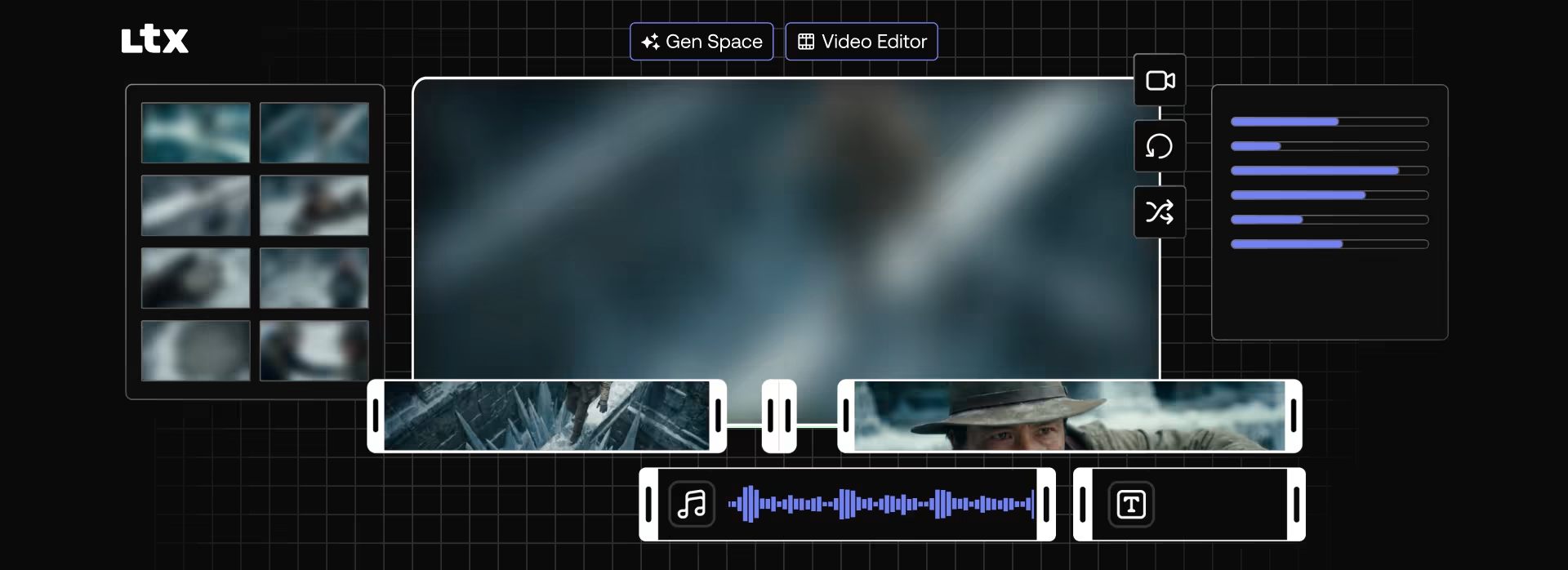
A full video editor built on the LTX-2.5 engine, running locally on your hardware. Open weights, no cloud dependency, released as open software. Run it locally or integrate the engine via API
LTX-2.5 Model
LTX-2.5 is here. Sharper, faster, yours to build on.
A stronger foundation for the worlds already being built on LTX. Native multishot, precise editing, and 4K HDR output, built to hold up from first draft to final render. Learn More →
Multishot
Generate connected scenes, not single clips. Hold character, environment, lighting, and voice consistent across wide, medium, and close-up shots in one generation.

Auto Duration
Let the model set the pace. Clip length is predicted from the described action, so scenes land at the right duration without manual tuning.

Native HDR
Generate high-resolution HDR footage built for professional finishing. Output drops straight into your grading and color pipeline, ready for the big screen.

Diffusion Fidelity Rendering
Generate every scene from a grid of high-fidelity keyframes that focus detail where it matters most. Get industry-leading pixel quality that holds up frame by frame, even on a cinema screen.

Customer Voices

"LTX is a driving force in AI video, so when the opportunity came up to work together, it felt like a no-brainer. Audio driving video, where sound becomes the control layer is the first of its kind in AI video generation. So when we launched LTX's model within ElevenCreative and saw such a notable volume in video generations, it wasn't a surprise. Creators were ready, they just needed the tools to catch up."

”AI laddered up to [the creative idea] perfectly, and the client was stoked that we were doing this partnership. We could create marketing materials for them that did not harm or put the animals under any stress at all. We weren’t filming the animals, we weren’t going there with lights and crew and putting the animals under stress.”

"At the very end, the creative changed and evolved and improved a lot with the tools that we had for creating new scenes, and created different angles, even with the prompts, we were getting different scenes, different sequences that we were able to adjust the creative and actually improve ideas."

“LTX's HDR IC-LoRA gives our compositors and colorists the latitude to truly blend these elements rather than just stack them. We're applying it across our generative animation and augmented crowds, and the line between what's generated and what's traditionally rendered disappears.”

"When editing AI-generated shots, the final edit always looks off, different contrast, values, color balance from shot to shot. We try to unify it in post, but 8-bit SDR leaves almost no latitude for color correction."

"The industry has long needed a bridge between generative AI and professional finishing standards. By moving past 8-bit SDR, we’ve eliminated the technical gap that kept AI assets from being used on high-fidelity displays and within complex spatial experiences. We’re no longer compromising on bit depth; we’re finally getting the dynamic range required for cinematic immersion in XR and virtual production. In the past, AI-generated content was a black box; you couldn't relight it or grade it without the image falling apart. Now, these assets behave like the real world, carrying the dynamic range needed to sit alongside traditionally captured elements. This gives our teams a professional-grade toolkit to integrate generative AI into their creative process."
FAQs
What are LTX Models?
LTX Models are multimodal video generation models designed for developers and product teams. They combine text, image, and video inputs to generate, animate, and edit video through a scalable API, enabling workflows like text-to-video, image-to-video, and selective video editing.
What can I build with LTX Models?
LTX Models can be used to build production-grade video systems, not just demos.
Common use cases include:
- Text-to-video and image-to-video generation
- Automated video editing, retakes, and refinement
- Creative tools and content platforms
- Internal production pipelines for studios, brands, and agencies
- AI-powered video features embedded inside larger products
LTX is designed to integrate directly into existing workflows — via API, open weights, or custom deployments.
Who are LTX Models built for?
LTX Models are built for teams that need reliable, scalable video generation, including:
- Developers and startups building AI-powered video products
- Creative platforms and AI hubs aggregating multiple models
- Studios, agencies, and in-house production teams
- Enterprises integrating video generation into real production systems
- Academic and research groups working with open, inspectable models
If you need predictability, control, and the ability to ship — LTX is designed for you.
Can I integrate LTX Model into my own product or platform?
Yes.
Many teams use LTX Model as a core capability inside their own products — either as a primary feature or as an embedded service.
You can integrate LTX Model via:
- The LTX API (managed, usage-based)
- Open model weights (self-hosted or customized)
This makes LTX Model suitable for both startups and large platforms that need flexibility around deployment, pricing, and control.
Is LTX Model suitable for real production use?
LTX Model is designed for production workloads, with a focus on:
- Stable, predictable outputs
- Long-form video generation
- Consistent quality across runs
- Performance that scales from small teams to large deployments
This is not a research demo or experimental-only release.
How does open source fit into LTX Models?
LTX is open by design.
Model weights, core code, and tooling are available for inspection, extension, and reuse.
Teams can:
- Run LTX locally or on their own infrastructure
- Fine-tune and customize models for specific domains
- Integrate deeply without vendor lock-in
For many organizations, this openness is critical for trust, experimentation, and long-term ownership.
Can LTX Model be deployed on-prem or in isolated environments?
Yes.
LTX Model supports self-hosted and isolated deployments for organizations with strict requirements around:
- Data privacy
- Security
- Regulatory compliance
- IP protection
This makes it suitable for enterprise, financial, governmental, and other sensitive environments.
Is LTX Model only for video generation?
Video is the core focus today, but LTX Model is built as a multimodal system.
It supports workflows that combine text, images, audio, and video, and is designed to expand as multimodal capabilities evolve.
Why is LTX Model is the best video model?
LTX Model is built around three principles:
- Production readiness — designed to work reliably, not just impress
- Openness and control — inspectable, modifiable, and deployable
- Integration-first design — meant to live inside real products and workflows
For many teams, this combination is what makes LTX Model viable beyond experimentation.
Where should I start?
- If you want a managed experience: start with the LTX API
- If you want full control: explore the open model weights
- If you’re evaluating for production: review the documentation and examples
Is the LTX Model free to try?
Yes. You can try LTX for free using the LTX Playground, where you can explore the models, generate videos, and experiment with different inputs before integrating the API into your product.
What is the latest LTX model?
LTX-2.5 is our latest model — delivering higher fidelity output, native multi-shot scenes, editing of real footage, and a pretrained base teams can adapt to their own domain. Learn more about LTX-2.5

