
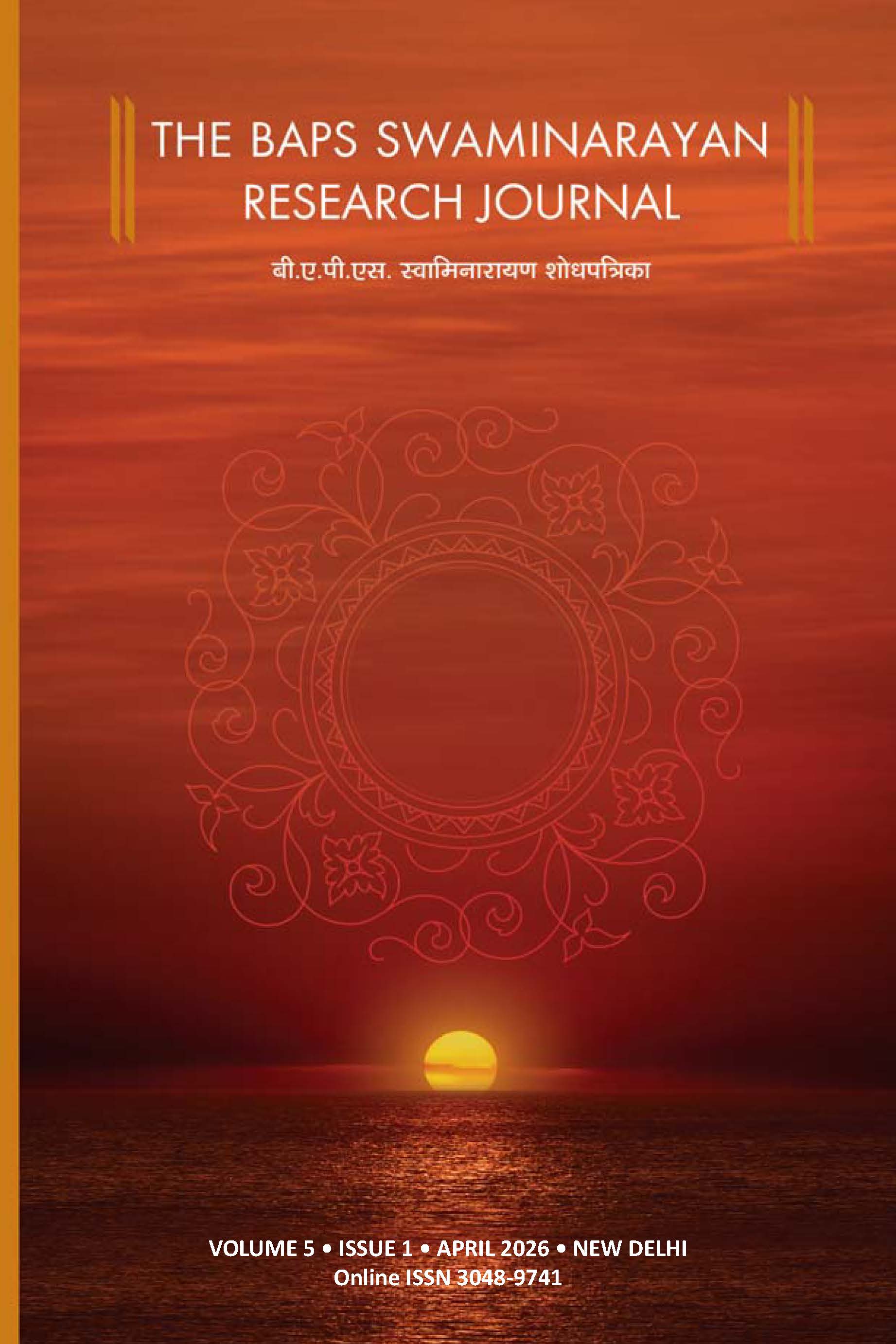
The BAPS Swaminarayan Research Journal

We are pleased to present Volume 5, Issue 1 of The BAPS Swaminarayan Research Journal. This issue explores how the ordinary materials of human life, including wealth and its stewardship, memory, sacred space, and poetry, become occasions for spiritual life within Indian thought. The articles in issue reconstitute financial conduct as a field of devotion and liberation, examine the cognitive and social effects of the collective memorization of the Satsaṅgadīkṣā, trace the revival of temple architecture in the twenty-first century, and inquire into the purpose of poetry and its soteriological function. Each study attends to a traditional form: scriptural, architectural, and poetic, to reveal tradition as a living and generative source that remains vital in the twenty-first century. This issue concludes with a review of the Svāminārāyaṇasiddhāntasudhā, the winner of the prestigious “Saraswati Samman” award bestowed in 2024.

Published 1 April 2026
Vol. 5 No. 1 (2026)

Announcements

8 October 2023

Call for Submissions

The BAPS Swaminarayan Research Journal seeks original research articles, review papers, and book reviews for its upcoming issues. We welcome contributions that further knowledge and understanding of Indian philosophy, history, theology, culture, and related fields. Our Journal publishes high-quality, peer-reviewed research that contributes to academic scholarship and promotes intellectual discourse.


More…

Current Issue

Published 1 April 2026
The BAPS Swaminarayan Research Journal

We are pleased to present Volume 5, Issue 1 of The BAPS Swaminarayan Research Journal. This issue explores how the ordinary materials of human life, including wealth and its stewardship, memory, sacred space, and poetry, become occasions for spiritual life within Indian thought. The articles in issue reconstitute financial conduct as a field of devotion and liberation, examine the cognitive and social effects of the collective memorization of the Satsaṅgadīkṣā, trace the revival of temple architecture in the twenty-first century, and inquire into the purpose of poetry and its soteriological function. Each study attends to a traditional form: scriptural, architectural, and poetic, to reveal tradition as a living and generative source that remains vital in the twenty-first century. This issue concludes with a review of the Svāminārāyaṇasiddhāntasudhā, the winner of the prestigious “Saraswati Samman” award bestowed in 2024.

Vol. 5 No. 1 (2026)

Publisher Information

Published by:
Dr. Jyotindra Dave on behalf of the BAPS Swaminarayan Research Institute, a unit of the Akshardham center for Applied Research in Social Harmony - AARSH.
Publishing Body:
The BAPS Swaminarayan Research Institute (a unit of the Akshardham center for Applied Research in Social Harmony - AARSH)
Address:
BAPS Swaminarayan Sanstha, Swaminarayan Akshardham, AARSH Building, 1st Floor, Pramukh Swami Maharaj Marg, NH 24, New Delhi 110092.
Editor-in-Chief:
Mahāmahopādhyāya Dr. Swami Bhadreshdas.
Aims and Scope:
The journal intends to publish the most insightful, profound, practical, and ground-breaking scholarship concerning a wide variety of discipline-specific learning. In addition to scholarship on the tradition’s own teachings, texts, and history, the journal’s focus of investigation will include everything from music to poetry, creative writing, visual arts, architecture, agriculture, performing arts, philosophy, Sanskrit, Indian vernacular languages, sacred texts, philology, linguistics, Indian darśanas, management, history (including Indian, art, and cultural history), medicine, computer technology, print and electronic publishing, foreign languages, cinematography, and even culinary studies as they pertain to the Svāminārāyaṇa tradition and Indian thought.
Email:
Frequency of Publication:
Semi-annual
Language:
English, Sanskrit, Hindi
Starting Year:
2022
Format:
Both Print and Online
Print ISSN:
2583-4029
Online ISSN:
3048-9741

© Akshardham Center for Applied Research in Social Harmony (AARSH) | Terms of Use | Privacy Policy