1. X
  2. GlobalCastMD
Log inSign up
GlobalCastMD
3,711 posts
GlobalCastMD profile banner
user avatar

GlobalCastMD

@GlobalCastMD
At GlobalCastMD, we have a mission to change the paradigm of medical education through innovation and creativity
Cleveland, Ohio
globalcastmd.com
Joined December 2011
1,920
Following
1,073
Followers
RepliesRepliesMediaMedia

Log in or sign up for X

See what’s happening and join the conversation

Continue with phone
or
Log in with username or email
Terms·Privacy·Cookies·Accessibility·Ads Info·© 2026 X Corp.
  • user avatar
    GlobalCastMD
    @GlobalCastMD
    Aug 21
    More information:cincinnatichildrens.org/service/c/cran…
    user avatar
    StayCurrentMD
    @StayCurrentMD
    Aug 21
    Craniosynostosis: refer before 3 months and a suturectomy + helmet may suffice. Wait, and it's open vault remodeling or distraction. Timing is the intervention. — Dr. Scott Rapp, CCHMC More information:cincinnatichildrens.org/service/c/cran… #PedSurg #MedEd Made possible by @CincyChildrens
    An infographic on a blue-gradient background with a light blue tag in the top left corner that reads "Craniofacial." In the top right corner is a white logo block reading "Made possible by Cincinnati Children's, changing the outcome together." 

Centered white text reads: "DID YOU KNOW" separated by a light blue line from "Two babies, both with craniosynostosis." 

Below, a bright blue rounded button contains the white text: "WHY MIGHT THEY GET DIFFERENT OPERATIONS?" 

At the bottom left, it reads "1/5," and a white arrow points to the right in the bottom right corner.
    An educational graphic on a blue background, labeled "Craniofacial" and "Made possible by Cincinnati Children's." 

The main text reads:
"THE ANSWER: THEIR AGE. THE YOUNGER THE BABY, THE SIMPLER THE OPERATION."

Below this, a large quote in white text reads: 
"Zero to three months: a suturectomy with cranial orthosis afterwards."

At the bottom left, a square portrait shows Scott Rapp, MD, FACS, a smiling man with short brown hair wearing a dark suit and white shirt. Beside his photo, his title is listed as: "Scott Rapp, MD, FACS, Associate Professor, UC Department of Surgery, Cincinnati Children's."
    An informational graphic with a blue and purple gradient background about craniofacial treatments based on age. 

At the top left, a light blue tag reads "Craniofacial." At the top right, a white box says "Made possible by Cincinnati Children’s." 

The main text reads:
"AGE DRIVES IT
UNDER 3 MONTHS
The small fix: a minimal suturectomy plus a molding helmet.

3 TO 6 MONTHS
A bigger operation: distraction or open vault remodeling."

At the bottom left, the page number reads "3/4" next to a white arrow pointing to the right at the bottom right corner.
    An informational graphic with a blue and purple gradient background. 

At the top left, a light blue pill-shaped badge reads "Craniofacial." In the top right, a white box says "Made possible by" above the Cincinnati Children's logo. 

The main text of the graphic, in white, reads:
"THE TAKEAWAY
SO REFER EARLY
The younger the baby, the smaller the operation.
Catch craniosynostosis early and the gentlest options stay open."

At the bottom left, it reads "4/4" in white. Large, faint purple-blue background graphics spell out "Craniofacial" at the top and "GO" at the bottom.
  • user avatar
    GlobalCastMD
    @GlobalCastMD
    Aug 21
    Full text: pubmed.ncbi.nlm.nih.gov/41995823/?utm_…
    user avatar
    StayCurrentMD
    @StayCurrentMD
    Aug 21
    New infographic by @lizzyPAC8 “Surgical and Catheter-Based Intervention in Pediatric Pulmonary Vein Stenosis" Takajo D et al. Full text: pubmed.ncbi.nlm.nih.gov/41995823/?utm_… #SoMe4PedSurg #PedSurg Made possible by @CincyChildrens
    An infographic titled "Surgical and Catheter-Based Intervention in Pediatric Pulmonary Vein Stenosis." 

The graphic summarizes a retrospective, single-center study from 2015–2023 of 56 patients with biventricular pulmonary vein stenosis, comparing catheter-based intervention versus surgical pulmonary vein repair. 

Key findings include:
* Catheter-based treatment became the preferred initial approach over time.
* Surgery was reserved for the most complex patients: multiple severely narrowed pulmonary veins, bilateral disease, and associated congenital heart defects.
* 92% of surgical patients needed another procedure, with most repeat procedures occurring within the 1st year.
* There was no significant difference in mortality between the surgical and catheter-based groups.

Conclusion: Consider catheter-based intervention first when anatomy allows. Reserve surgical repair for complex or extensive disease. Repeat procedures are common in both strategies.
  • user avatar
    GlobalCastMD
    @GlobalCastMD
    Aug 21
    Register: globalcastmd.com/wp-admin/admin…
    user avatar
    StayCurrentMD
    @StayCurrentMD
    Aug 20
    Kids with severe obesity develop T2 diabetes & metabolic syndrome in mid-childhood — not adulthood. Earlier referral changes outcomes. Elissa Williams, Lurie Children's, at #SCOPeS. Virtual Encore Sept 2, 9am CST. Register: globalcastmd.com/wp-admin/admin… #PedSurg @LurieChildrens
    Image
    00:00
  • user avatar
    GlobalCastMD
    @GlobalCastMD
    Aug 21
    Full EP: library.globalcastmd.com/podcast/5240?u…
    user avatar
    StayCurrentMD
    @StayCurrentMD
    Aug 20
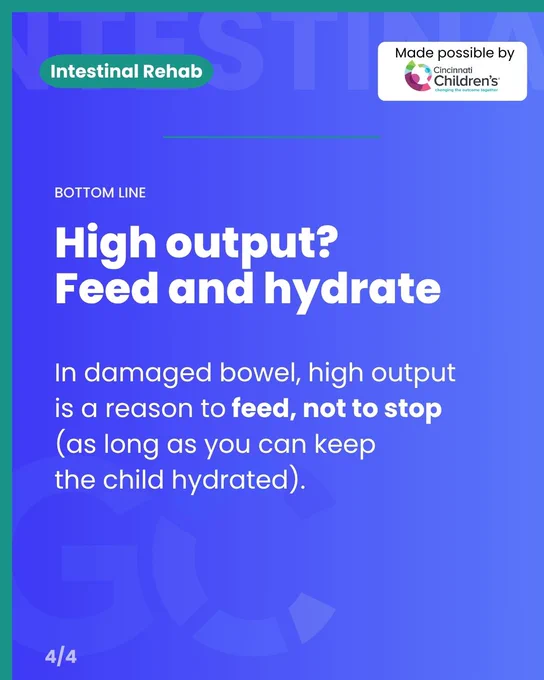
    Short bowel syndrome, high ostomy output: feed, don't hold. Dr. Helmrath (Cincinnati Children's) — high output without feeds is a reason to feed, not stop. Full EP: library.globalcastmd.com/podcast/5240?u… #SoMe4PedSurg #PedSurg Made possible by @CincyChildrens
    An informational graphic with a blue background and green accents.

In the top left, a green pill-shaped badge says "Intestinal Rehab" in white. In the top right, a white box says "Made possible by Cincinnati Children’s."

The main text, centered, asks: "WHAT WOULD YOU DO. A baby with short bowel syndrome with high ostomy output... DO YOU HOLD FEEDS OR KEEP FEEDING?" The last line of text is housed inside a green button.

At the bottom left, it says "1/5," and at the bottom right, a white arrow points to the right.
    A blue-themed graphic with a quote on intestinal rehab. 

At the top left, a green pill-shaped label reads "Intestinal Rehab" against a faint background text of "INTESTINAL". At the top right is a white box that says, "Made possible by Cincinnati Children’s."

In the center is a large quote in white text: "High outputs without feeding are [actually] an indication to feed, as long as a child can be hydrated." 

Below the quote on the left is a portrait of Dr. Michael Helmrath, a smiling man with brown hair, blue eyes, wearing a suit jacket and white collared shirt. To the right of his portrait, white text reads: "Michael Helmrath, MD, Director, Center for Stem Cell & Organoid Medicine (CuSTOM), Director, Surgical Research, Cincinnati Children’s."

At the bottom left, it reads "2/5" and at the bottom right is a white double-headed arrow pointing right.
    An informational graphic with a blue-to-purple gradient background. 

At the top left, a green pill-shaped badge reads "Intestinal Rehab." To the right is a logo for Cincinnati Children's, captioned "Made possible by."

The main text on the graphic reads:
"WHY & HOW 
Feeding to drive adaptation
Luminal nutrition teaches damaged bowel to adapt.
Early high output?
Blunt it with acid blockade or a prokinetic — and keep feeding and hydrating."

In the bottom left corner, it reads "3/4" and in the bottom right corner, a white arrow points to the right.
    An informational graphic with a blue-to-purple gradient background. 

In the top left, a green pill-shaped badge reads "Intestinal Rehab" in white text, set against a faint, large background word "INTESTINAL". In the top right, a white box reads "Made possible by Cincinnati Children's changing the outcome together" alongside their multi-colored logo.

The main text of the graphic reads:
"BOTTOM LINE
High output? Feed and hydrate
In damaged bowel, high output is a reason to feed, not to stop (as long as you can keep the child hydrated)."

In the bottom-left corner, "4/4" is written in white.
  • user avatar
    GlobalCastMD
    @GlobalCastMD
    Aug 21
    Register for the 17th Annual Southwest Trauma & Acute Care Symposium (STACS): cognitoforms.com/ArizonaTraumaA…
    user avatar
    StayCurrentMD
    @StayCurrentMD
    Aug 19
    Time to hemorrhage control isn't equal for all trauma patients. Dr. Jon Perlstein on disparities for injured older adults. STACS 2026, Nov 19-20, Phoenix. Register for the 17th Annual Southwest Trauma & Acute Care Symposium (STACS): cognitoforms.com/ArizonaTraumaA… #TraumaSurgery #MedEd
    An event flyer for STACS 2026, the 17th Annual Southwest Trauma & Acute Care Symposium, organized by the Arizona Trauma Association. 

The event is scheduled for November 19–20, 2026, at the Phoenix Convention Center in Phoenix, Arizona.

At the center is a headshot of speaker Jon Perlstein, MD, FACS, from Sutter Roseville Medical Center. He is a light-skinned, bald man with brown eyes, smiling and wearing a dark suit jacket, a light blue shirt, and a patterned blue tie.

Dr. Perlstein is presenting: "Disparity in Time to Hemorrhage Control Surgery for Injured Older Adults," examining disparities in surgery times and strategies for equitable, timely, and effective trauma care.

The background shows a scenic Phoenix landscape at sunset, featuring saguaro cacti, the city skyline, and mountains. 

An informational section titled "Why Attend STACS 2026?" lists key benefits: Learn, Connect, Improve, Collaborate, and Make an Impact. A bottom banner links to arizonatrauma.org/symposium.
Advertisement
Advertisement