Highlights
Image

Sign Up for CAISA's Newsletter

Receive updates on research, events, etc. regarding AI in society.

x
Events
Image
Read more
Research
Ethical Tensions in the Use of Artificial Intelligence in Elder Care

This brief is currently only available in Danish.

Summary (Translated)

Both expectations of and the use of artificial intelligence (AI) technologies are growing in Danish elder care. Many municipalities are already testing AI-based solutions in the hope of addressing the demographic challenges facing the welfare state, particularly workforce shortages and the increasing demand for care in an aging population. At the same time, the adoption of AI raises important questions about what constitutes high-quality elder care and how to ensure dignified and meaningful care for older citizens in an increasingly digitalized welfare system. These developments call for ethical reflection and dialogue among leaders, policymakers, care professionals, older adults, and their families. This brief contributes research-based perspectives to these discussions by identifying six key ethical tensions associated with the use of artificial intelligence in elder care.

Image
Read more
Events
Image
Read more
News
Digital Sovereignty Must Be Put into Practice

CAISA Chief Scientist contributes to debate at an event by the Confederation of Danish Industry.

How do organizations work with digital sovereignty in concrete terms? This was a central question at the DI Digital-event by the Confederation of Danish Industry on April 23rd, 2026, where the topic was on the agenda among companies, decision-makers, and experts.

CAISA Chief Scientist Roman Jurowetzki participated in the discussions and contributed with perspectives on how work on digital sovereignty is increasingly moving from strategic ambitions to operational choices in practice.

From Strategy to Practice

A key message from the event is that digital sovereignty cannot be reduced to a single overarching strategy. Instead, it concerns ongoing and concrete prioritizations within organizations, for example regarding the choice of technologies, partners, regulatory approaches, and the ability to adapt or replace systems.

Roman Jurowetzki emphasizes that organizations’ work with AI and digital solutions is itself a critical component of building digital sovereignty. Experience from implementation and operations creates the necessary capacity to navigate a complex technological and geopolitical landscape.

At the same time, the discussion highlighted that digital sovereignty largely concerns organizational capacity: The ability to understand one’s own systems, assess their performance, and make informed decisions on that basis. This requires, among other things, insight into digital infrastructures, competencies in AI and data, and systematic learning through practice.

A Core Research Area at CAISA

Digital sovereignty is a core research area at CAISA. The center focuses on analyzing how the concept is translated into practice in a Danish and European context, including how organizations balance innovation and control, and how political ambitions are transformed into concrete decisions.

Roman Jurowetzki’s participation in the DI Digital event is an example of how CAISA’s research is brought into play in ongoing discussions on digital development and governance.

Image
Read more
Research
Image
Read more
Events
Image
Read more
Research
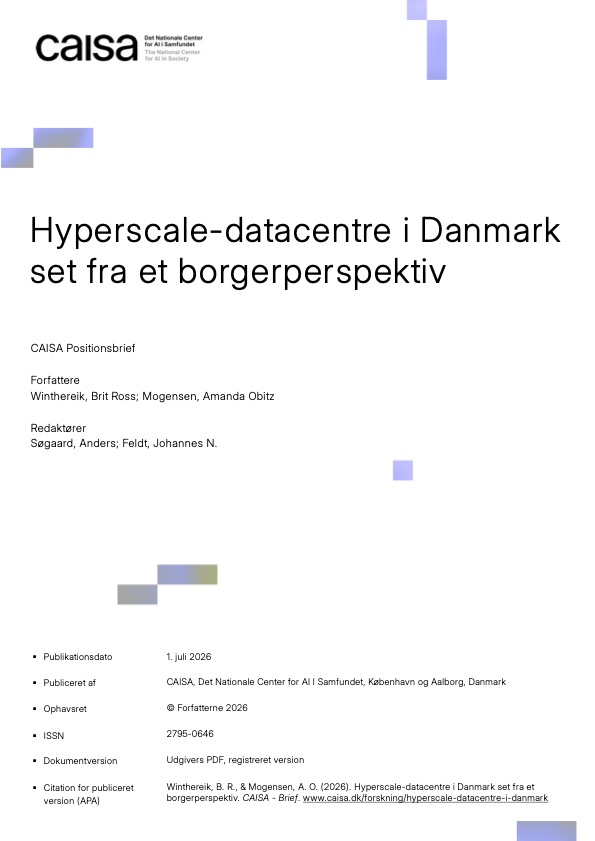
Hyperscale Data Centers in Denmark from a Citizen Perspective

This brief is currently only available in Danish.

Summary (Translated)

This brief presents social science research on data centers with a focus on citizens and local communities. The brief introduces a number of areas that are of critical importance for the locally anchored and democratically accountable siting of hyperscale data centers, including in particular pressure on the power grid, limited knowledge about the significance of data centers for drinking water resources and nature, and the risk of political polarization. Overall, it points to the necessity of a holistic perspective focused on the interplay between these very different areas. The main point of the brief is that knowledge about the negative impacts associated with the establishment of data centers should be included in the decision-making basis in step with the rapid increase in the number of hyperscale data centers. This may contribute to a better balance between the benefits and burdens that follow from the siting of hyperscale data centers in Denmark.

‍

Image
Read more
Image

The National
Center for AI
in Society

CAISA is a national consortium that brings together researchers from the University of Copenhagen, Aalborg University, Aarhus University, IT University of Copenhagen, and Technical University of Denmark in close collaboration with the Pioneer Centre for AI.
Read more about what we do