<?xml version="1.0" encoding="utf-8"?><feed xmlns="http://www.w3.org/2005/Atom" ><generator uri="https://jekyllrb.com/" version="3.10.0">Jekyll</generator><link href="https://climateainordics.com/feed.xml" rel="self" type="application/atom+xml" /><link href="https://climateainordics.com/" rel="alternate" type="text/html" /><updated>2026-11-03T18:22:52+00:00</updated><id>https://climateainordics.com/feed.xml</id><title type="html">Climate AI Nordics</title><subtitle>personal description</subtitle><author><name>Climate AI Nordics</name><email>contact@climateainordics.com</email></author><entry><title type="html">Learning when and where to adapt: Reinforcement learning for climate-resilient urban transport</title><link href="https://climateainordics.com/events/2026-11-02-2026-12-03-reinforcement-learning-for-climate-resilient-urban-transport" rel="alternate" type="text/html" title="Learning when and where to adapt: Reinforcement learning for climate-resilient urban transport" /><published>2026-11-02T00:00:00+00:00</published><updated>2026-11-02T00:00:00+00:00</updated><id>https://climateainordics.com/events/2026-12-03-reinforcement-learning-for-climate-resilient-urban-transport</id><content type="html" xml:base="https://climateainordics.com/events/2026-11-02-2026-12-03-reinforcement-learning-for-climate-resilient-urban-transport"><![CDATA[<p>Welcome to this week’s Learning Machines seminar.</p>

<p>This seminar is a collaboration between RISE and Climate AI Nordics – <a href="https://climateainordics.com/">climateainordics.com</a>.</p>

<p><strong>Title:</strong> Learning when and where to adapt: Reinforcement learning for climate-resilient urban transport</p>

<p><strong>Speaker:</strong> Miguel Costa, Technical University of Denmark</p>

<p><strong>Abstract:</strong> Cities need to decide now which climate adaptation measures to build, where to put them, and when, while facing deep uncertainty about how the climate will change over the coming decades. Each investment will last for a few decades and will be costly. Their impacts and benefits can also play out through coupled systems, such as, rainfall drives flooding, flooding disrupts how people move around the city, creating economic and wellbeing impacts. Classical optimisation methods struggle at the city-scale over a planning horizon of 75 years or more.
In this talk, I will present a decision-support framework which can address this problem by embedding an integrated assessment model inside a reinforcement learning (RL) loop. The model chains climate projections, a flood model, a transport simulation and an assessment of direct and indirect impacts. A graph neural network policy learns adaptation pathways from this model: it decides per zone and per year which nature-based and grey measures to deploy, balancing investment and maintenance costs against avoided damage, travel delays and cancelled trips.
On a full-city case study of pluvial flooding in Copenhagen (278 zones, 2025–2100, 42 scenarios from EURO-CORDEX), RL cuts total costs by about 25% compared with doing nothing and outperforms competing alternatives across two case studies (Bayesian optimisation, CMA-ES, trigger rules, Copenhagen’s own Cloudburst Plan design standard, and Direct Policy Search). Results hold across scenarios, including on held-out climate trajectories. I will then discuss how such a framework can support policymakers in making informed decisions and ongoing extensions of this work and opportunities for broader application, including optimization for non-economic impacts (e.g., quality of life, wellbeing), other case studies, and climate impacts.</p>

<p><strong>About the speaker:</strong> Miguel Costa is a postdoctoral researcher at the Technical University of Denmark (DTU), where he develops AI-driven decision-support tools for climate adaptation policymaking. His research sits at the intersection of transportation science, machine learning, and climate resilience, with a particular focus on bridging objective measurements and subjective human experiences in urban mobility contexts. He completed his PhD (summa cum laude) at Instituto Superior Técnico, University of Lisbon. There, he developed geospatial machine learning methods for mapping both objective and subjective cycling safety, bridging the gap between data-driven objective safety assessment and human experiences and perceptions.</p>

<p><strong>Location:</strong> Lindholmsallén 10, Gothenburg, or online using Zoom.</p>

<p><strong>Date:</strong> 2026-12-03 15:00</p>

<p>This seminar will have an in-person presence at RISE office in Gothenburg located at <a href="https://maps.app.goo.gl/wt4QAqnbSHF8i7Fu5">Lindholmsallén 10</a>, third floor. Make sure that you arrive in good time and ring the bell at the door.</p>

<p><strong>Upcoming seminars:</strong></p>

<ul>
  <li>2026-12-17: Lester Jame Miranda, University of Cambridge</li>
  <li>2027-01-14: Maria Perez Ortiz, University College London</li>
  <li>2027-01-28: Nicola Messina, ISTI-CNR</li>
  <li>2027-03-18: Hao Wei, Technical University of Munich (TUM)</li>
  <li>All seminars are 15:00 CET.</li>
</ul>

<p>More information and coming seminars: <a href="https://learningmachines.se">https://learningmachines.se</a></p>

<p>– The Learning Machines Team</p>]]></content><author><name>Climate AI Nordics</name><email>contact@climateainordics.com</email></author><category term="events" /><summary type="html"><![CDATA[Welcome to this week’s Learning Machines seminar.]]></summary><media:thumbnail xmlns:media="http://search.yahoo.com/mrss/" url="https://climateainordics.com/images/posts/2026-11-02-2026-12-03-reinforcement-learning-for-climate-resilient-urban-transport.jpg" /><media:content medium="image" url="https://climateainordics.com/images/posts/2026-11-02-2026-12-03-reinforcement-learning-for-climate-resilient-urban-transport.jpg" xmlns:media="http://search.yahoo.com/mrss/" /></entry><entry><title type="html">Doctoral Researcher (PhD Student), 3 positions, Development of Data Science and AI for Spatial Data</title><link href="https://climateainordics.com/job-openings/2026-10-28-doctoral-researcher-phd-student-3-positions-development-of-data-science-and-ai-for-spatial-data-finland/" rel="alternate" type="text/html" title="Doctoral Researcher (PhD Student), 3 positions, Development of Data Science and AI for Spatial Data" /><published>2026-10-28T00:00:00+00:00</published><updated>2026-10-28T00:00:00+00:00</updated><id>https://climateainordics.com/job-openings/doctoral-researcher-phd-student-3-positions-development-of-data-science-and-ai-for-spatial-data-finland</id><content type="html" xml:base="https://climateainordics.com/job-openings/2026-10-28-doctoral-researcher-phd-student-3-positions-development-of-data-science-and-ai-for-spatial-data-finland/"><![CDATA[<!-- CAIN relevance: 95/100; ai_ml 35/35; climate_environment 30/35; nordic 20/20; research 10/10. Editorial triage score, not a verified qualification. -->
<p>The positions are part of the MINE-THE-GAP project, funded by the European Research Council (ERC), which combines satellite imagery, mining data reports, and AI to map mining activities and their impacts worldwide. The selected candidates will lead their own thesis on mapping different aspects of mining, such as mining land use, mining waste, and minerals and commodities. They will develop scalable deep learning and computer vision models using large Earth observation datasets and contribute to open science.</p>

<p>The positions are based on the Kuopio campus of the University of Eastern Finland. The role offers opportunities for international collaboration and research visits abroad through an extensive network of partner institutions.</p>

<p>Key qualifications:</p>
<ul>
  <li>Eligibility for postgraduate studies, i.e., a Master’s degree in a quantitative field (e.g., Data Science, Computer Science, Engineering, Geoinformatics, Statistics, or a related field).</li>
  <li>Good command of written and spoken English.</li>
  <li>Good programming skills (e.g., Python/R).</li>
  <li>Interest in machine learning and spatial data.</li>
  <li>Experience with machine learning or deep learning (e.g., PyTorch, TensorFlow, scikit-learn) or strong motivation to learn these skills.</li>
  <li>Experience with Earth observation or geospatial data, desirable but not required.</li>
  <li>Experience with cloud computing or collaborative software development (e.g., GitHub) is also welcome.</li>
</ul>

<p><strong>Deadline:</strong> November 17th, 2026</p>

<p><a href="https://uef.varbi.com/en/what:job/jobID:978704/type:job/where:51/apply:1">Apply through the official recruitment system</a></p>]]></content><author><name>Climate AI Nordics</name><email>contact@climateainordics.com</email></author><category term="job-openings" /><summary type="html"><![CDATA[The positions are part of the MINE-THE-GAP project, funded by the European Research Council (ERC), which combines satellite imagery, mining data reports, and AI to map mining activities and their impacts worldwide. The selected candidates will lead their own thesis on mapping different aspects of mining, such as mining land use, mining waste, and minerals and commodities. They will develop scalable deep learning and computer vision models using large Earth observation datasets and contribute to open science.]]></summary></entry><entry><title type="html">Master’s thesis: Robust and uncertainty-aware urban land-cover mapping at property scale</title><link href="https://climateainordics.com/job-openings/2026-10-28-masters-thesis-robust-and-uncertainty-aware-urban-land-cover-mapping-at-property-scale-sweden/" rel="alternate" type="text/html" title="Master’s thesis: Robust and uncertainty-aware urban land-cover mapping at property scale" /><published>2026-10-28T00:00:00+00:00</published><updated>2026-10-28T00:00:00+00:00</updated><id>https://climateainordics.com/job-openings/masters-thesis-robust-and-uncertainty-aware-urban-land-cover-mapping-at-property-scale-sweden</id><content type="html" xml:base="https://climateainordics.com/job-openings/2026-10-28-masters-thesis-robust-and-uncertainty-aware-urban-land-cover-mapping-at-property-scale-sweden/"><![CDATA[<!-- CAIN relevance: 88/100; ai_ml 30/35; climate_environment 30/35; nordic 20/20; research 8/10. Editorial triage score, not a verified qualification. -->
<p>This thesis project involves using AI and remote sensing data to improve the accuracy and robustness of urban land-cover mapping at property scale. The work will explore methods to enhance segmentation under challenging conditions and develop detailed classifications of hard surfaces for environmental applications. The project is part of the Krontech initiative, which aims to create a practical tool for property-level land-cover analysis.</p>

<p>The thesis can be carried out in Stockholm, Gothenburg, or Malmö, Sweden. It is a hybrid position, allowing for a combination of on-site and remote work.</p>

<p>Key qualifications:</p>
<ul>
  <li>Experience in programming in Python.</li>
  <li>Experience in training and using neural networks.</li>
  <li>Experience with computer vision, semantic segmentation, GIS, remote sensing, PyTorch, QGIS, GeoPandas, GDAL, or rasterio is beneficial.</li>
</ul>

<p><strong>Deadline:</strong> November 30th, 2026</p>

<p><a href="https://career.ivl.se/en-GB/jobs/8512589-master-s-thesis-robust-and-uncertainty-aware-urban-land-cover-mapping-at-property-scale?utm_source=LinkedIn">Apply through the official recruitment system</a></p>]]></content><author><name>Climate AI Nordics</name><email>contact@climateainordics.com</email></author><category term="job-openings" /><summary type="html"><![CDATA[This thesis project involves using AI and remote sensing data to improve the accuracy and robustness of urban land-cover mapping at property scale. The work will explore methods to enhance segmentation under challenging conditions and develop detailed classifications of hard surfaces for environmental applications. The project is part of the Krontech initiative, which aims to create a practical tool for property-level land-cover analysis.]]></summary></entry><entry><title type="html">Postdoc in AI and digital modelling of electric power systems</title><link href="https://climateainordics.com/job-openings/2026-10-28-postdoc-in-ai-and-digital-modelling-of-electric-power-systems-sweden/" rel="alternate" type="text/html" title="Postdoc in AI and digital modelling of electric power systems" /><published>2026-10-28T00:00:00+00:00</published><updated>2026-10-28T00:00:00+00:00</updated><id>https://climateainordics.com/job-openings/postdoc-in-ai-and-digital-modelling-of-electric-power-systems-sweden</id><content type="html" xml:base="https://climateainordics.com/job-openings/2026-10-28-postdoc-in-ai-and-digital-modelling-of-electric-power-systems-sweden/"><![CDATA[<!-- CAIN relevance: 95/100; ai_ml 35/35; climate_environment 30/35; nordic 20/20; research 10/10. Editorial triage score, not a verified qualification. -->
<p>The postdoc will work on developing methods and supporting software for analysis, modelling, optimisation and control of electric power systems from a system perspective. The project involves building a national digital twin of the Swedish power system with open datasets and demonstrators for data exchange between grid companies and flexible customers.</p>

<p>The position is based in Stockholm, Sweden. The work is carried out in close collaboration with industry and grid operators.</p>

<p>Key qualifications:</p>
<ul>
  <li>A doctoral degree or an equivalent foreign degree in electric power engineering or a closely related field, with a focus on modelling, machine learning or optimisation at the power system level.</li>
  <li>Documented experience of software development for the analysis of large datasets, for example in Python or Julia.</li>
  <li>Good command of Swedish and English, spoken and written.</li>
  <li>Preferred qualifications include a doctoral degree obtained within the last three years prior to the application deadline, documented research expertise in the field, evidenced by publications, and good knowledge of open source solutions in the field.</li>
</ul>

<p><strong>Deadline:</strong> October 31st, 2026</p>

<p><a href="https://kth.varbi.com/en/what:job/jobID:967857/type:job/where:51/apply:1">Apply through the official recruitment system</a></p>]]></content><author><name>Climate AI Nordics</name><email>contact@climateainordics.com</email></author><category term="job-openings" /><summary type="html"><![CDATA[The postdoc will work on developing methods and supporting software for analysis, modelling, optimisation and control of electric power systems from a system perspective. The project involves building a national digital twin of the Swedish power system with open datasets and demonstrators for data exchange between grid companies and flexible customers.]]></summary><media:thumbnail xmlns:media="http://search.yahoo.com/mrss/" url="https://climateainordics.com/images/external-organizations-logos/kth.png" /><media:content medium="image" url="https://climateainordics.com/images/external-organizations-logos/kth.png" xmlns:media="http://search.yahoo.com/mrss/" /></entry><entry><title type="html">Postdoctoral Researcher, Machine Learning &amp;amp; Cheminformatics</title><link href="https://climateainordics.com/job-openings/2026-10-28-postdoctoral-researcher-machine-learning-cheminformatics-finland/" rel="alternate" type="text/html" title="Postdoctoral Researcher, Machine Learning &amp;amp; Cheminformatics" /><published>2026-10-28T00:00:00+00:00</published><updated>2026-10-28T00:00:00+00:00</updated><id>https://climateainordics.com/job-openings/postdoctoral-researcher-machine-learning-cheminformatics-finland</id><content type="html" xml:base="https://climateainordics.com/job-openings/2026-10-28-postdoctoral-researcher-machine-learning-cheminformatics-finland/"><![CDATA[<!-- CAIN relevance: 95/100; ai_ml 35/35; climate_environment 30/35; nordic 20/20; research 10/10. Editorial triage score, not a verified qualification. -->
<p>The postdoctoral researcher will develop a data-driven screening workflow for biomaterial design, combining molecular representations, machine learning, physics-based simulations, and experimental data. The role involves working with an interdisciplinary team to predict how chemical modifications influence the properties of wood-based biopolymers and establishing classical baselines for quantum computing comparisons.</p>

<p>The position is based in Espoo, Finland, and involves collaboration with an interdisciplinary team of experts from chemistry, mathematics, and physics, as well as a dedicated group of quantum physicists.</p>

<p>Key qualifications:</p>
<ul>
  <li>A doctoral degree in a relevant field such as computer science, data science, machine learning, chemical or material informatics, or a closely related discipline, completed no more than five years ago.</li>
  <li>Strong practical experience in data-driven modelling and at least one of the following: molecular representations, quantitative structure-activity relationships, or chemical or material informatics.</li>
  <li>Ability to work with molecular representations and connect molecular structure to measured or simulated material properties.</li>
  <li>Strong programming skills in Python or a comparable scientific programming language, with experience in developing documented and reproducible computational workflows.</li>
  <li>A strong scientific track record relevant to the position and the ability to produce high-quality scientific outputs.</li>
  <li>Fluency in English and the ability to work in an international, multidisciplinary research environment.</li>
</ul>

<p><strong>Deadline:</strong> November 8th, 2026</p>

<p><a href="https://ats.talentadore.com/apply/postdoctoral-researcher-machine-learning-cheminformatics/8R2Lj3">Apply through the official recruitment system</a></p>]]></content><author><name>Climate AI Nordics</name><email>contact@climateainordics.com</email></author><category term="job-openings" /><summary type="html"><![CDATA[The postdoctoral researcher will develop a data-driven screening workflow for biomaterial design, combining molecular representations, machine learning, physics-based simulations, and experimental data. The role involves working with an interdisciplinary team to predict how chemical modifications influence the properties of wood-based biopolymers and establishing classical baselines for quantum computing comparisons.]]></summary></entry><entry><title type="html">Climate AI Nordics Newsletter, October 2026</title><link href="https://climateainordics.com/newsletter/2026-10-28-october/" rel="alternate" type="text/html" title="Climate AI Nordics Newsletter, October 2026" /><published>2026-10-28T00:00:00+00:00</published><updated>2026-10-28T00:00:00+00:00</updated><id>https://climateainordics.com/newsletter/october</id><content type="html" xml:base="https://climateainordics.com/newsletter/2026-10-28-october/"><![CDATA[<style> body{font-family: arial, sans-serif;} img{ float: right; width: 8em; margin: 0.4em;} p{margin: .6em 0.2em .6em 0.2em;} h1{margin: .6em 0.2em .6em 0.2em;} h2{margin: .6em 0.2em .6em 0.2em;} h3{margin: .6em 0.2em .6em 0.2em;} h4{margin: .6em 0.2em .6em 0.2em;}</style>
<p>Welcome to the October edition of the Climate AI Nordics Newsletter!</p>
<p>Enjoy our community highlights, updates from our partners, events, and new job opportunities!</p>
<p>We connect the Nordic region’s researchers and practitioners at the intersection of AI and climate action. Whether your focus is on emission mitigation, ecosystem resilience, or biodiversity, this community is built to help your work thrive.</p>
<p>If you know colleagues in academia, public agencies, or industry who share these interests, invite them to join us at 
<a href="https://climateainordics.com/join">climateainordics.com/join</a>.</p>
<h1 id="community-spotlight">Community spotlight</h1>
<p>
<br clear="all" /></p>
<h2 id="featured-paper-topoflow-topography-aware-pollutant-flow-learning-for-high-resolution-air-quality-prediction">Featured paper: TopoFlow: topography-aware pollutant Flow learning for high-resolution air quality prediction</h2>
<p>
<img src="https://climateainordics.com/images/posts/topoflow-figure.png" alt="" /></p>
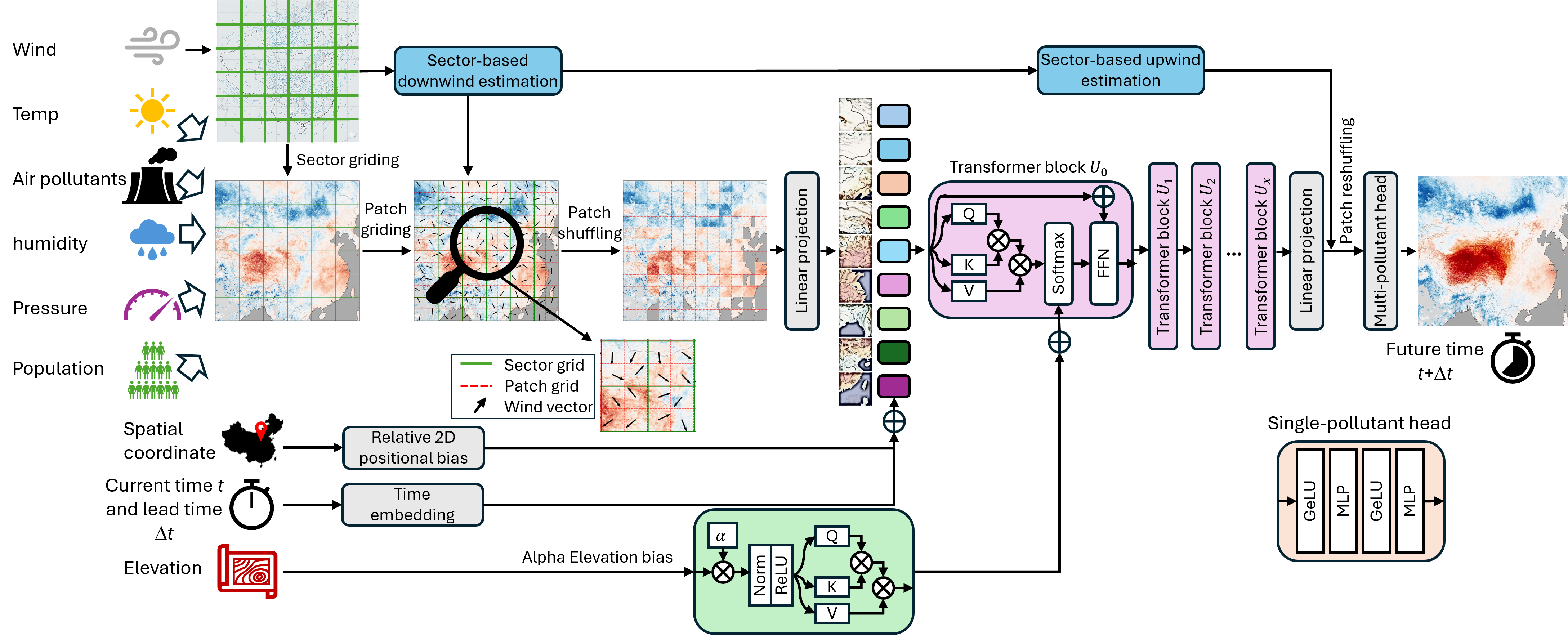
<p>This month’s Climate AI Nordics featured paper is “TopoFlow: topography-aware pollutant Flow learning for high-resolution air quality prediction”. This work introduces a physics-guided transformer that incorporates wind and topography directly into the model to improve air quality forecasting.
<br /> 
<strong>
<a href="https://climateainordics.com/featured-works/2026-10-23-featured-paper-topoflow/">Read more!</a></strong></p>
<p>
<br clear="all" /></p>
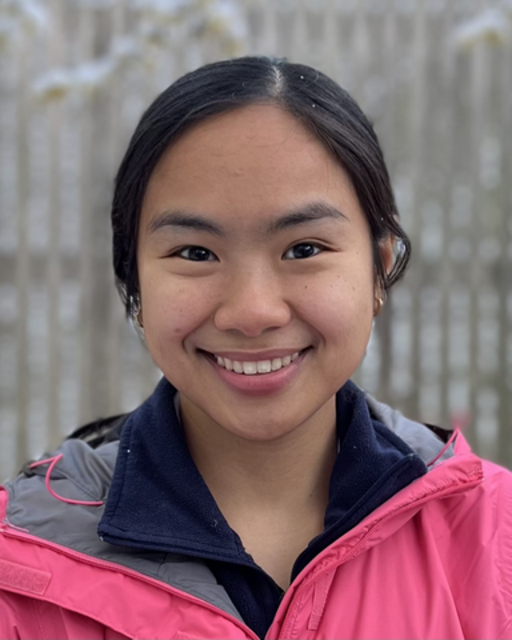
<h2 id="featured-member-october-2026-mélisande-teng">Featured member, October 2026: Mélisande Teng</h2>
<p>
<img src="https://climateainordics.com/images/people/featured/MelisandeTeng.jpg" alt="" /></p>
<p>Mélisande Teng is a postdoctoral researcher at the University of Copenhagen and the Pioneer Centre for AI. She develops machine learning methods for biodiversity monitoring, in particular species distribution modeling, forest monitoring with remote sensing and bioacoustics.
<br /> 
<strong>
<a href="https://climateainordics.com/featured-member/2026-10-21-melisande-teng/">Read more!</a></strong></p>
<h1 id="news">News</h1>
<p>
<br clear="all" /></p>
<h2 id="3rd-nordic-workshop-on-ai-for-climate-meet-our-first-two-invited-speakers">3rd Nordic Workshop on AI for Climate: meet our first two invited speakers</h2>
<p>
<img src="https://climateainordics.com/images/posts/2026-10-26-oslo-speakers/oslo-speakers_small.jpg" alt="" /></p>
<p>
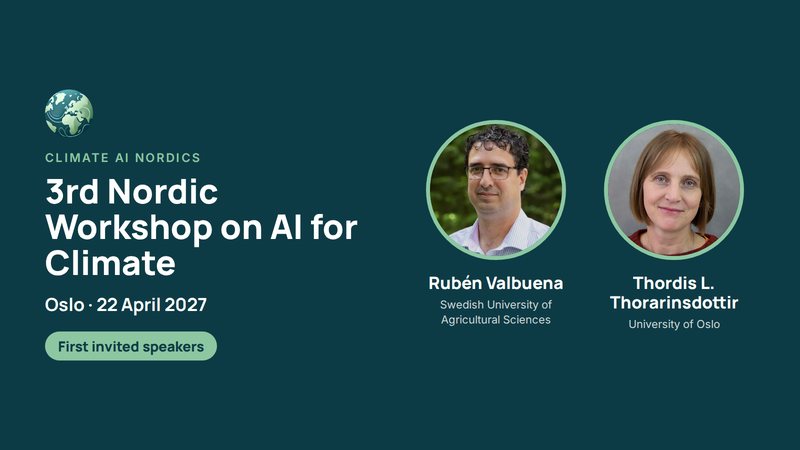
<em>2026-10-26</em> We are happy to announce the first two invited speakers at the 3rd Nordic Workshop on AI for Climate in Oslo on 22 April 2027: Rubén Valbuena (Swedish University of Agricultural Sciences) and Thordis L. Thorarinsdottir (University of Oslo).
<br /> 
<strong>
<a href="https://climateainordics.com/news/2026-10-26-oslo-workshop-first-speakers/">Read more!</a></strong></p>
<p>
<br clear="all" /></p>
<h2 id="two-years-of-climate-ai-nordics--celebrating-with-an-improved-website">Two years of Climate AI Nordics – celebrating with an improved website</h2>
<p>
<img src="https://climateainordics.com/images/posts/2026-10-26-two-years/two-years_small.jpg" alt="" /></p>
<p>
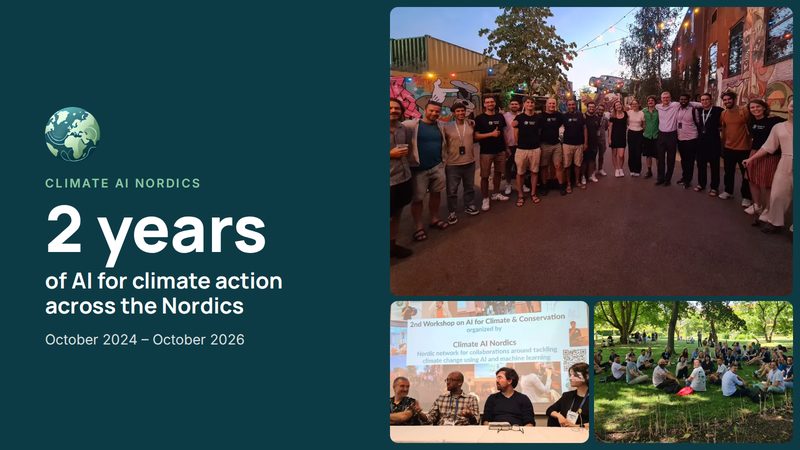
<em>2026-10-26</em> Climate AI Nordics turns two! We look back at a year of workshops, partnerships and community growth – and celebrate with a redesigned website that makes it easier to find news, events and people in the network.
<br /> 
<strong>
<a href="https://climateainordics.com/news/2026-10-26-two-years-new-website/">Read more!</a></strong></p>
<p>
<br clear="all" /></p>
<h1 id="coming-events">Coming events</h1>
<p>
<br clear="all" /></p>
<h2 id="atmostem-from-high-resolution-emission-mapping-to-environmental-intelligence">AtmoSTEM: From high-resolution emission mapping to environmental intelligence</h2>
<p>
<img src="https://climateainordics.com/images/posts/2026-10-07-2026-11-05-atmostem-from-high-resolution-emission-mapping-to.png" alt="" /></p>
<p>
<em>Event date: 2026-11-05.</em></p>
<p>Webinar with Anastasia Kakouri, University of Aegean. The spatial and temporal representation of anthropogenic emissions is essential for atmospheric modelling, yet its influence on the predictive performance of data-driven air quality models remains insufficiently assessed. This study introduces AtmoSTEM, a modular European framework integrating high-resolution emission modelling with machine learning-based concentration prediction. AtmoSTEM combines CAMS-REG emission inventories, sector-specific geospatial proxies, and CAMS-TEMPO profiles to generate spatially and temporally resolved anthropogenic emissions. The initial application covers daily PM2.5 and PM10 emissions at 1 km spatial resolution across Europe for 2015–2024. The resulting emissions are integrated with meteorological, satellite-derived, atmospheric composition, and geospatial information to support machine learning-based predictions of ground-level pollutant concentrations. An Extreme Gradient Boosting (XGBoost) approach is employed to investigate the relationships between anthropogenic emissions, environmental conditions, and observed air pollution levels, with particular emphasis on the contribution of high-resolution emission information to predictive performance. Model predictions are evaluated against independent ground-based observations from air quality monitoring stations across Europe. The study aims to assess the potential of integrating high-resolution spatiotemporal emissions with machine learning for air quality prediction, providing a basis for more spatially detailed population exposure assessments and epidemiological research.
<br /> 
<strong>
<a href="https://climateainordics.com/events/2026-10-07-2026-11-05-atmostem-from-high-resolution-emission-mapping-to">Read more!</a></strong></p>
<p>
<br clear="all" /></p>
<h2 id="3rd-nordic-workshop-on-ai-for-climate-2027">3rd Nordic Workshop on AI for Climate (2027)</h2>
<p>
<img src="https://climateainordics.com/events/2027-nordic-workshop/nordic-workshop-2027.png" alt="" /></p>
<p>
<em>Event date: 2027-04-22.</em></p>
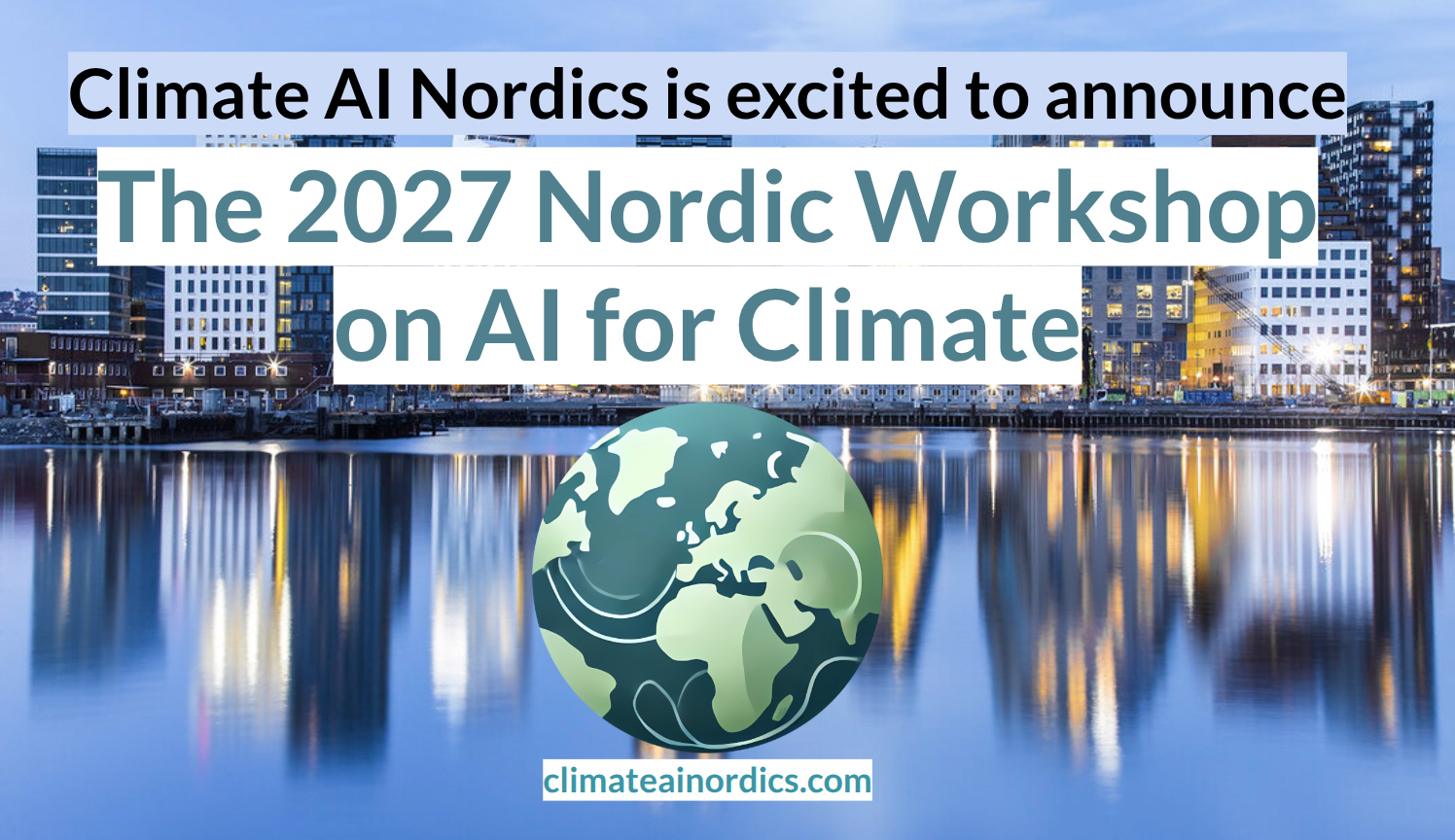
<p>The 2027 Nordic Workshop on AI for Climate will gather researchers from the Nordics. This one-day, in-person workshop will take place in Oslo, April 22nd 2027. The workshop will feature a mix of keynotes, oral presentations, and posters around the topics of AI for tackling climate change, including AI for biodiversity and the green transition. The workshop will be a meeting point for a wide range of researchers from (primarily) around the Nordic countries.
<br /> 
<strong>
<a href="https://climateainordics.com/events/2027-nordic-workshop">Read more!</a></strong></p>
<p>
<br clear="all" /></p>
<h1 id="recent-events">Recent events</h1>
<p>
<br clear="all" /></p>
<h2 id="machine-perception-for-scientific-measurement-from-satellite-imagery">Machine perception for scientific measurement from satellite imagery</h2>
<p>
<img src="https://climateainordics.com/images/posts/2026-09-15-2026-10-08-machine-perception-for-scientific-measurement-from.png" alt="" /></p>
<p>
<em>This event took place 2026-10-08.</em> Webinar with Rangel Daroya, University of Massachusetts Amherst. In many scientific domains, the goal is not simply to classify an image or produce a visually plausible segmentation, but to estimate quantities that scientists and decision-makers can use: river width, water extent, sediment concentration, habitat change, or other physical variables. These tasks require models that are robust to distribution shift, efficient under limited supervision, and reliable enough to support downstream measurement. In this talk, I will discuss machine learning and computer vision methods for this setting, with a focus on geospatial imagery and hydrology. Scientific domains such as remote sensing expose several fundamental limitations of current vision systems. Models must operate across sensors, geographic regions, seasons, and acquisition conditions, often with limited labeled data and multispectral inputs that differ from standard natural image benchmarks. They must also detect small or thin structures, handle temporal variation, and avoid errors that may appear minor under conventional vision metrics but lead to substantial errors in scientific measurements. I will discuss three aspects that try to solve these problems: learning transferable representations that can adapt across tasks and datasets, developing data-efficient perception methods for multispectral and geospatial imagery, and translating model predictions into reliable physical measurements. I will highlight work on task transfer, satellite representation learning, river segmentation, and downstream estimation of river width and other hydrological variables. More broadly, this work aims to develop robust, transferable, and data-efficient machine perception systems that can turn large-scale satellite and scientific imagery into reliable measurements of the physical world.
<br /></p>
<p>
<strong>
<a href="https://climateainordics.com/events/2026-09-15-2026-10-08-machine-perception-for-scientific-measurement-from">Read more!</a></strong></p>
<p>
<br clear="all" /></p>
<h1 id="job-openings">Job openings</h1>
<p>
<br clear="all" /></p>
<h2 id="postdoctoral-researcher-machine-learning--cheminformatics">Postdoctoral Researcher, Machine Learning &amp; Cheminformatics</h2>
<p>VTT is seeking a Postdoctoral Researcher to develop data-driven screening workflows for biomaterial design using machine learning, physics-based simulations, and experimental data.
<br /></p>
<p>Deadline: November 8th, 2026
<br /></p>
<p>
<strong>
<a href="https://climateainordics.com/job-openings/2026-10-28-postdoctoral-researcher-machine-learning-cheminformatics-finland/">Read more!</a></strong></p>
<p>
<br clear="all" /></p>
<h2 id="postdoc-in-ai-and-digital-modelling-of-electric-power-systems">Postdoc in AI and digital modelling of electric power systems</h2>
<p>
<img src="https://climateainordics.com/images/external-organizations-logos/kth.png" alt="" /></p>
<p>KTH Royal Institute of Technology seeks a postdoc to develop AI and digital modelling methods for electric power systems, contributing to the creation of a national digital twin of the Swedish power system.
<br /></p>
<p>
<strong>
<a href="https://climateainordics.com/job-openings/2026-10-28-postdoc-in-ai-and-digital-modelling-of-electric-power-systems-sweden/">Read more!</a></strong></p>
<p>
<br clear="all" /></p>
<h2 id="masters-thesis-robust-and-uncertainty-aware-urban-land-cover-mapping-at-property-scale">Master’s Thesis: Robust and Uncertainty-Aware Urban Land-Cover Mapping at Property Scale</h2>
<p>IVL Swedish Environmental Research Institute seeks a master’s student to work on a thesis project focused on improving urban land-cover mapping using AI, aerial imagery, and GIS data.
<br /></p>
<p>Deadline: November 30th, 2026
<br /></p>
<p>
<strong>
<a href="https://climateainordics.com/job-openings/2026-10-28-masters-thesis-robust-and-uncertainty-aware-urban-land-cover-mapping-at-property-scale-sweden/">Read more!</a></strong></p>
<p>
<br clear="all" /></p>
<h2 id="doctoral-researcher-phd-student-3-positions-development-of-data-science-and-ai-for-spatial-data">Doctoral Researcher (PhD Student), 3 positions, Development of Data Science and AI for Spatial Data</h2>
<p>The University of Eastern Finland invites applications for three Doctoral Researcher (PhD Student) positions focused on the development of data science and AI for spatial data at the School of Computing on the Kuopio campus.
<br /></p>
<p>
<strong>
<a href="https://climateainordics.com/job-openings/2026-10-28-doctoral-researcher-phd-student-3-positions-development-of-data-science-and-ai-for-spatial-data/">Read more!</a></strong></p>
<p>
<br clear="all" /></p>
<h2 id="machine-learning-engineer-for-computer-vision-and-controlled-pesticide-use">Machine learning engineer for computer vision and controlled pesticide-use.</h2>
<p>
<img src="https://climateainordics.com/images/external-organizations-logos/dat_small.png" alt="" /></p>
<p>Dimensions Agri Technologies (DAT) are recruiting a machine learning engineer. The selected candidate will help reduce and optimize the use of pesticides by developing targeted schemes through machine learning model assisted computer vision.
<br /></p>
<p>Deadline: Rolling
<br /></p>
<p>
<strong>
<a href="https://climateainordics.com/job-openings/2026-01-19-ml-engineer-dat/">Read more!</a></strong></p>
<p>
<br clear="all" /></p>
<h2 id="join-the-climate-change-ai-core-team">Join the Climate Change AI Core Team!</h2>
<p>
<img src="https://climateainordics.com/images/external-organizations-logos/ccai_small.png" alt="" /></p>
<p>Climate Change AI is looking for new core team members to play leading roles in the organization’s ongoing activities. (Note that this is for the world-spanning organization Climate Change AI. Currently, Climate AI Nordics is not looking for Core team members.)
<br /></p>
<p>Deadline: Rolling
<br /></p>
<p>
<strong>
<a href="https://climateainordics.com/job-openings/2025-11-26-core-team-members-ccai/">Read more!</a></strong></p>
<p>
<br clear="all" /></p>
<h2 id="aiui-full-stack-engineer">AI/UI full stack engineer</h2>
<p>
<img src="https://climateainordics.com/images/external-organizations-logos/unibloom.png" alt="" /></p>
<p>Unibloom is looking for an AI-native developer to help transform procurement collaboration for sustainability goals.
<br /></p>
<p>Deadline: Rolling
<br /></p>
<p>
<strong>
<a href="https://climateainordics.com/job-openings/2025-11-07-full-stack-developer-unibloom/">Read more!</a></strong></p>
<p>
<br clear="all" /></p>
<h2 id="internship-opportunity-at-rise-lund-ecological-annotation-of-drone-imagery">Internship Opportunity at RISE Lund: Ecological Annotation of Drone Imagery</h2>
<p>
<img src="https://climateainordics.com/images/external-organizations-logos/rise-margins_small.png" alt="" /></p>
<p>RISE Research Institutes of Sweden is looking for 1–2 motivated interns in Fall 2025 to annotate drone imagery for biodiversity AI research, supporting a collaborative project with Arla. Part-time (50%), based in Lund, and perfect for students in ecology, biology, or environmental science.
<br /></p>
<p>Deadline: Rolling
<br /></p>
<p>
<strong>
<a href="https://climateainordics.com/job-openings/2025-06-05-intern-rise/">Read more!</a></strong></p>
<h1 id="your-news-in-the-newsletter">Your news in the newsletter!</h1>
<p>
<strong>Make sure to share your work with us, by sending us an email (
<a href="mailto:contact@climateainordics.com">contact@climateainordics.com</a>), posting in our Slack or some other channel, and we’ll add it to the news feed! Take the chance of showcasing your work or your events to the community!</strong></p>
<p>Also be sure to follow us on 
<a href="https://www.linkedin.com/company/climate-ai-nordics/">LinkedIn</a> and 
<a href="https://bsky.app/profile/climateainordics.com">BlueSky</a>. Climate AI Nordics will have the most impact if you repost and like our stories!</p>
<p>
<strong>
<a href="https://climateainordics.com/">Climate AI Nordics</a></strong> is a network of 
<a href="https://climateainordics.com//people/">researchers</a> working to harness AI in tackling the climate crisis through both mitigation and adaptation.</p>
<p>We promote the development of AI-based tools and optimization methods that support sustainable decision-making—helping reduce emissions, restore ecosystems, and build climate resilience.</p>]]></content><author><name>Climate AI Nordics</name><email>contact@climateainordics.com</email></author><category term="newsletter" /><summary type="html"><![CDATA[Welcome to the October edition of the Climate AI Nordics Newsletter! Enjoy our community highlights, updates from our partners, events, and new job opportunities! We connect the Nordic region’s researchers and practitioners at the intersection of AI and climate action. Whether your focus is on emission mitigation, ecosystem resilience, or biodiversity, this community is built to help your work thrive. If you know colleagues in academia, public agencies, or industry who share these interests, invite them to join us at climateainordics.com/join. Community spotlight Featured paper: TopoFlow: topography-aware pollutant Flow learning for high-resolution air quality prediction This month’s Climate AI Nordics featured paper is “TopoFlow: topography-aware pollutant Flow learning for high-resolution air quality prediction”. This work introduces a physics-guided transformer that incorporates wind and topography directly into the model to improve air quality forecasting. Read more! Featured member, October 2026: Mélisande Teng Mélisande Teng is a postdoctoral researcher at the University of Copenhagen and the Pioneer Centre for AI. She develops machine learning methods for biodiversity monitoring, in particular species distribution modeling, forest monitoring with remote sensing and bioacoustics. Read more! News 3rd Nordic Workshop on AI for Climate: meet our first two invited speakers 2026-10-26 We are happy to announce the first two invited speakers at the 3rd Nordic Workshop on AI for Climate in Oslo on 22 April 2027: Rubén Valbuena (Swedish University of Agricultural Sciences) and Thordis L. Thorarinsdottir (University of Oslo). Read more! Two years of Climate AI Nordics – celebrating with an improved website 2026-10-26 Climate AI Nordics turns two! We look back at a year of workshops, partnerships and community growth – and celebrate with a redesigned website that makes it easier to find news, events and people in the network. Read more! Coming events AtmoSTEM: From high-resolution emission mapping to environmental intelligence Event date: 2026-11-05. Webinar with Anastasia Kakouri, University of Aegean. The spatial and temporal representation of anthropogenic emissions is essential for atmospheric modelling, yet its influence on the predictive performance of data-driven air quality models remains insufficiently assessed. This study introduces AtmoSTEM, a modular European framework integrating high-resolution emission modelling with machine learning-based concentration prediction. AtmoSTEM combines CAMS-REG emission inventories, sector-specific geospatial proxies, and CAMS-TEMPO profiles to generate spatially and temporally resolved anthropogenic emissions. The initial application covers daily PM2.5 and PM10 emissions at 1 km spatial resolution across Europe for 2015–2024. The resulting emissions are integrated with meteorological, satellite-derived, atmospheric composition, and geospatial information to support machine learning-based predictions of ground-level pollutant concentrations. An Extreme Gradient Boosting (XGBoost) approach is employed to investigate the relationships between anthropogenic emissions, environmental conditions, and observed air pollution levels, with particular emphasis on the contribution of high-resolution emission information to predictive performance. Model predictions are evaluated against independent ground-based observations from air quality monitoring stations across Europe. The study aims to assess the potential of integrating high-resolution spatiotemporal emissions with machine learning for air quality prediction, providing a basis for more spatially detailed population exposure assessments and epidemiological research. Read more! 3rd Nordic Workshop on AI for Climate (2027) Event date: 2027-04-22. The 2027 Nordic Workshop on AI for Climate will gather researchers from the Nordics. This one-day, in-person workshop will take place in Oslo, April 22nd 2027. The workshop will feature a mix of keynotes, oral presentations, and posters around the topics of AI for tackling climate change, including AI for biodiversity and the green transition. The workshop will be a meeting point for a wide range of researchers from (primarily) around the Nordic countries. Read more! Recent events Machine perception for scientific measurement from satellite imagery This event took place 2026-10-08. Webinar with Rangel Daroya, University of Massachusetts Amherst. In many scientific domains, the goal is not simply to classify an image or produce a visually plausible segmentation, but to estimate quantities that scientists and decision-makers can use: river width, water extent, sediment concentration, habitat change, or other physical variables. These tasks require models that are robust to distribution shift, efficient under limited supervision, and reliable enough to support downstream measurement. In this talk, I will discuss machine learning and computer vision methods for this setting, with a focus on geospatial imagery and hydrology. Scientific domains such as remote sensing expose several fundamental limitations of current vision systems. Models must operate across sensors, geographic regions, seasons, and acquisition conditions, often with limited labeled data and multispectral inputs that differ from standard natural image benchmarks. They must also detect small or thin structures, handle temporal variation, and avoid errors that may appear minor under conventional vision metrics but lead to substantial errors in scientific measurements. I will discuss three aspects that try to solve these problems: learning transferable representations that can adapt across tasks and datasets, developing data-efficient perception methods for multispectral and geospatial imagery, and translating model predictions into reliable physical measurements. I will highlight work on task transfer, satellite representation learning, river segmentation, and downstream estimation of river width and other hydrological variables. More broadly, this work aims to develop robust, transferable, and data-efficient machine perception systems that can turn large-scale satellite and scientific imagery into reliable measurements of the physical world. Read more! Job openings Postdoctoral Researcher, Machine Learning &amp; Cheminformatics VTT is seeking a Postdoctoral Researcher to develop data-driven screening workflows for biomaterial design using machine learning, physics-based simulations, and experimental data. Deadline: November 8th, 2026 Read more! Postdoc in AI and digital modelling of electric power systems KTH Royal Institute of Technology seeks a postdoc to develop AI and digital modelling methods for electric power systems, contributing to the creation of a national digital twin of the Swedish power system. Read more! Master’s Thesis: Robust and Uncertainty-Aware Urban Land-Cover Mapping at Property Scale IVL Swedish Environmental Research Institute seeks a master’s student to work on a thesis project focused on improving urban land-cover mapping using AI, aerial imagery, and GIS data. Deadline: November 30th, 2026 Read more! Doctoral Researcher (PhD Student), 3 positions, Development of Data Science and AI for Spatial Data The University of Eastern Finland invites applications for three Doctoral Researcher (PhD Student) positions focused on the development of data science and AI for spatial data at the School of Computing on the Kuopio campus. Read more! Machine learning engineer for computer vision and controlled pesticide-use. Dimensions Agri Technologies (DAT) are recruiting a machine learning engineer. The selected candidate will help reduce and optimize the use of pesticides by developing targeted schemes through machine learning model assisted computer vision. Deadline: Rolling Read more! Join the Climate Change AI Core Team! Climate Change AI is looking for new core team members to play leading roles in the organization’s ongoing activities. (Note that this is for the world-spanning organization Climate Change AI. Currently, Climate AI Nordics is not looking for Core team members.) Deadline: Rolling Read more! AI/UI full stack engineer Unibloom is looking for an AI-native developer to help transform procurement collaboration for sustainability goals. Deadline: Rolling Read more! Internship Opportunity at RISE Lund: Ecological Annotation of Drone Imagery RISE Research Institutes of Sweden is looking for 1–2 motivated interns in Fall 2025 to annotate drone imagery for biodiversity AI research, supporting a collaborative project with Arla. Part-time (50%), based in Lund, and perfect for students in ecology, biology, or environmental science. Deadline: Rolling Read more! Your news in the newsletter! Make sure to share your work with us, by sending us an email ( contact@climateainordics.com), posting in our Slack or some other channel, and we’ll add it to the news feed! Take the chance of showcasing your work or your events to the community! Also be sure to follow us on LinkedIn and BlueSky. Climate AI Nordics will have the most impact if you repost and like our stories! Climate AI Nordics is a network of researchers working to harness AI in tackling the climate crisis through both mitigation and adaptation. We promote the development of AI-based tools and optimization methods that support sustainable decision-making—helping reduce emissions, restore ecosystems, and build climate resilience.]]></summary><media:thumbnail xmlns:media="http://search.yahoo.com/mrss/" url="https://climateainordics.com/images/posts/2026-10-28-newsletter.jpg" /><media:content medium="image" url="https://climateainordics.com/images/posts/2026-10-28-newsletter.jpg" xmlns:media="http://search.yahoo.com/mrss/" /></entry><entry><title type="html">3rd Nordic Workshop on AI for Climate: meet our first two invited speakers</title><link href="https://climateainordics.com/news/2026-10-26-oslo-workshop-first-speakers/" rel="alternate" type="text/html" title="3rd Nordic Workshop on AI for Climate: meet our first two invited speakers" /><published>2026-10-26T00:00:01+00:00</published><updated>2026-10-26T00:00:01+00:00</updated><id>https://climateainordics.com/news/oslo-workshop-first-speakers</id><content type="html" xml:base="https://climateainordics.com/news/2026-10-26-oslo-workshop-first-speakers/"><![CDATA[<p>Preparations for the <a href="/events/2027-nordic-workshop"><strong>3rd Nordic Workshop on AI for Climate</strong></a> are well under way! The one-day, in-person workshop takes place in <strong>Oslo, Norway, on 22 April 2027</strong>, and we are happy to announce our <strong>first two confirmed invited speakers</strong>.</p>




<h2 id="rubén-valbuena-swedish-university-of-agricultural-sciences">Rubén Valbuena, Swedish University of Agricultural Sciences</h2>

<p>Rubén Valbuena explores the state of ecosystems, and how they change, using data from sensors on satellites, aircraft and drones. His focus is on forest landscapes and airborne laser scanning, which he uses to analyse carbon sequestration, biodiversity and other ecosystem services. He also works on monitoring progress in international policies tackling climate change and biodiversity loss, by developing methods that can be used worldwide.</p>

<h2 id="thordis-l-thorarinsdottir-university-of-oslo">Thordis L. Thorarinsdottir, University of Oslo</h2>

<p>Thordis L. Thorarinsdottir is a professor of statistics and data science at the University of Oslo. Before joining the university in 2023, she was a chief research scientist and research leader for climate and environment at the Norwegian Computing Center in Oslo. Her research focuses on developing stochastic models and methods for the environmental sciences, drawing on both statistical and machine learning models. A central theme in her work is uncertainty quantification and probabilistic prediction.</p>

<p>Talk titles and abstracts will follow on the <a href="/events/2027-nordic-workshop">workshop page</a>, and <strong>more invited speakers will be announced soon</strong>.</p>

<h2 id="about-the-workshop">About the workshop</h2>

<p>The workshop will feature a mix of keynotes, oral presentations and posters on AI for tackling climate change, including Earth observation, biodiversity monitoring, the green transition and sustainable AI. Work in progress and descriptions of ongoing projects are very welcome too. When registering, you can say whether you would like to bring a poster, and also opt to give a short oral presentation about it. Registration is not open yet; follow our <a href="/news/">news</a> or <a href="/follow/">sign up for the newsletter</a> to hear when it opens.</p>

<p>The workshop is the third in our annual series, following <a href="/news/2025-05-20-nordic-workshop/">Gothenburg in 2025</a> and <a href="/news/2026-06-26-nordic-workshop-recap/">Copenhagen in 2026</a>.</p>

<p><strong>Save the date, 22 April 2027, and see you in Oslo!</strong></p>]]></content><author><name>Climate AI Nordics</name><email>contact@climateainordics.com</email></author><category term="news" /><summary type="html"><![CDATA[Preparations for the 3rd Nordic Workshop on AI for Climate are well under way! The one-day, in-person workshop takes place in Oslo, Norway, on 22 April 2027, and we are happy to announce our first two confirmed invited speakers.]]></summary><media:thumbnail xmlns:media="http://search.yahoo.com/mrss/" url="https://climateainordics.com/images/posts/2026-10-26-oslo-speakers/oslo-speakers.jpg" /><media:content medium="image" url="https://climateainordics.com/images/posts/2026-10-26-oslo-speakers/oslo-speakers.jpg" xmlns:media="http://search.yahoo.com/mrss/" /></entry><entry><title type="html">Two years of Climate AI Nordics – celebrating with an improved website</title><link href="https://climateainordics.com/news/2026-10-26-two-years-new-website/" rel="alternate" type="text/html" title="Two years of Climate AI Nordics – celebrating with an improved website" /><published>2026-10-26T00:00:00+00:00</published><updated>2026-10-26T00:00:00+00:00</updated><id>https://climateainordics.com/news/two-years-new-website</id><content type="html" xml:base="https://climateainordics.com/news/2026-10-26-two-years-new-website/"><![CDATA[<p><strong>Two years ago, on 24 October 2024, we started Climate AI Nordics.</strong> What began as an idea to connect Nordic researchers working on AI for climate and the environment has grown into a community of <a href="/people/">272 researchers in the Nordics from 119 organisations</a>, plus 146 supporting affiliates from outside the Nordics. Thank you all for being part of it!</p>

<p>To celebrate, we have given our website a makeover. Below we first look back at some highlights from our second year, and then show what is new on the website.</p>

<h2 id="highlights-from-our-second-year">Highlights from our second year</h2>

<ul>
  <li><strong>AICC at EurIPS 2025.</strong> In December we co-organized the workshop <em>AI for Climate and Conservation</em> at the first EurIPS conference in Copenhagen. <a href="/news/2025-12-15-cain-at-eurips/">Read the reflections</a>.</li>
  <li><strong>Our own YouTube channel.</strong> We launched an <a href="/news/2025-11-25-youtube-channel/">official YouTube channel</a>, so that you can watch recordings of our webinars whenever it suits you.</li>
  <li><strong>A formal partnership with Climate Change AI.</strong> In May we <a href="/news/2026-05-08-ccai-partnership/">partnered with Climate Change AI</a>, and we were also a <a href="/news/2026-07-07-ccai-summer-school-with-cain/">network partner of the CCAI 2026 virtual summer school</a>.</li>
  <li><strong>The 2nd Nordic Workshop on AI for Climate.</strong> In June, researchers, practitioners and industry representatives gathered in Copenhagen for a full day of keynotes, talks, posters and discussions, including lunch under the trees in a nearby park. <a href="/news/2026-06-26-nordic-workshop-recap/">Read the recap</a>.</li>
  <li><strong>An official non-profit.</strong> In August, Climate AI Nordics was <a href="/news/2026-08-04-cain-ngo/">registered as a non-profit association</a> (<em>ideell förening</em>) in Sweden, which gives the network a solid foundation for the years ahead.</li>
  <li><strong>AICC-2 at ECCV 2026.</strong> In September we co-organized the second edition of AICC, this time at ECCV in Malmö. <a href="/news/2026-09-16-aicc2eccv-recap/">Read the recap</a>.</li>
  <li><strong>Looking ahead.</strong> The <a href="/news/2026-09-15-cain-2027-event-teaser/">3rd Nordic Workshop on AI for Climate</a> will take place in Oslo on 22 April 2027. Save the date!</li>
</ul>

<p>On top of this, we have kept up our monthly newsletters, webinars, featured works and featured members. A big thank you to all speakers, authors, organizers and partners who made this possible.</p>

<h2 id="an-improved-website-for-our-next-chapter">An improved website for our next chapter</h2>

<p>With a growing network and more and more content, our old website had started to feel cramped: long pages of text, small images and few ways to find what you were looking for. So, as a birthday present to ourselves (and hopefully to you), we have redesigned it in several ways.</p>

<p><img src="/images/posts/2026-10-26-two-years/homepage-before-after.jpg" alt="The Climate AI Nordics homepage before and after the redesign" /></p>

<h3 id="a-visual-style-built-from-our-logo">A visual style built from our logo</h3>

<p>The new look starts from our globe logo. The <strong>teal and sage-green colours</strong> are taken directly from it, so the website, the logo and our other material now belong together. We use two clear, modern typefaces: <em>Manrope</em> for headings and <em>Inter</em> for body text. Content is organized in <strong>cards</strong> with images, which makes it much quicker to scan. And instead of a stock landscape, the homepage now shows <strong>real photos from our own events</strong>, because the people are what makes this network.</p>

<h3 id="a-homepage-that-tells-you-what-is-going-on">A homepage that tells you what is going on</h3>

<p>The homepage now leads with who we are and three clear ways in: join the network, see upcoming events, or meet the people. Right below are <strong>live numbers about the network</strong>, which update automatically as new members join. After that come cards for upcoming events, the latest news, featured works and job openings.</p>

<h3 id="filter-the-news">Filter the news</h3>

<p>The <a href="/news/">News</a> page brings together news, featured works, featured members and job openings. You can now <strong>filter by type with one click</strong>, for example to see only job openings.</p>

<p><img src="/images/posts/2026-10-26-two-years/news-filters.jpg" alt="The News page with filter buttons for news, featured works, featured members and job openings" /></p>

<h3 id="events-that-are-easier-to-follow">Events that are easier to follow</h3>

<p>The <a href="/events/">Events</a> page is now split into <strong>Upcoming</strong> and <strong>Past events</strong>, and past events with a recording get a “Recording” label. Each event page has a clear box with the <strong>date, weekday, time and location</strong>. All our recorded talks are collected on the <a href="/recorded-events/">recordings page</a>.</p>

<p><img src="/images/posts/2026-10-26-two-years/event-before-after.jpg" alt="An event page before and after: the new design shows the date, weekday and time in a clear box" /></p>

<h3 id="find-people-in-the-network">Find people in the network</h3>

<p>The <a href="/people/">People</a> page is now easier to explore. The board is shown with photos, and all members are listed in a compact directory with their organisation, research topics and links to their profiles. You can <strong>search by name, organisation or topic</strong>, or pick one of the most common topics, such as Earth Observation or Biodiversity, to find people working on it.</p>

<p><img src="/images/posts/2026-10-26-two-years/people-directory.jpg" alt="The People page with a search box and topic buttons, here showing everyone working on biodiversity" /></p>

<h3 id="designed-for-your-phone-too">Designed for your phone, too</h3>

<p>Many of you read our news on your phone, so every page has been checked on small screens. The menu folds into a compact button, the pages no longer scroll sideways, and the old sidebar no longer pushes the content down.</p>

<p><img src="/images/posts/2026-10-26-two-years/mobile-before-after.jpg" alt="The homepage on a phone before and after the redesign" /></p>

<h3 id="and-much-more">And much more</h3>

<ul>
  <li><strong>Sharper images</strong> throughout the news and event lists.</li>
  <li>A <strong>“More news / More events”</strong> section at the end of each post, with related posts.</li>
  <li><strong>Add events to your calendar</strong> with one click (Google Calendar, or a file for Apple Calendar and Outlook).</li>
  <li>Past events and job openings whose deadline has passed are now <strong>clearly marked</strong>, and the <a href="/job-openings/">Job openings</a> page is split into current and past positions.</li>
  <li><strong>Faster pages:</strong> many images are now much smaller, so pages load quicker, especially on phones.</li>
  <li>A new <strong>footer</strong> with quick links, contact details and our social media channels.</li>
  <li>Cleaner <a href="/about/">About</a>, <a href="/join/">Join</a>, <a href="/follow/">Follow</a> and <a href="/partners/">Partners</a> pages, with clear buttons and a card for each of our partners.</li>
</ul>

<p>We hope you like the updated website! If something doesn’t work as expected, or if you have ideas for improvements, please let us know at <a href="mailto:contact@climateainordics.com">contact@climateainordics.com</a>.</p>

<p>Here’s to the next year of AI for climate action across the Nordics, and see you in Oslo!</p>

<h3 id="a-note-on-ai-use">A note on AI use</h3>

<p>In the spirit of transparency: much of the work behind the new website was done with the help of an AI coding assistant, which wrote most of the code for the new layout and styles, fixed bugs, prepared the image versions and screenshots. All design decisions were ours: we chose the direction, tried every change on a separate test version of the site, asked for many adjustments, and approved each change before it went live. The photos on the website are real photos from our own events.</p>]]></content><author><name>Climate AI Nordics</name><email>contact@climateainordics.com</email></author><category term="news" /><summary type="html"><![CDATA[Two years ago, on 24 October 2024, we started Climate AI Nordics. What began as an idea to connect Nordic researchers working on AI for climate and the environment has grown into a community of 272 researchers in the Nordics from 119 organisations, plus 146 supporting affiliates from outside the Nordics. Thank you all for being part of it!]]></summary><media:thumbnail xmlns:media="http://search.yahoo.com/mrss/" url="https://climateainordics.com/images/posts/2026-10-26-two-years/two-years.jpg" /><media:content medium="image" url="https://climateainordics.com/images/posts/2026-10-26-two-years/two-years.jpg" xmlns:media="http://search.yahoo.com/mrss/" /></entry><entry><title type="html">Featured paper: TopoFlow: topography-aware pollutant Flow learning for high-resolution air quality prediction</title><link href="https://climateainordics.com/featured-works/2026-10-23-featured-paper-topoflow/" rel="alternate" type="text/html" title="Featured paper: TopoFlow: topography-aware pollutant Flow learning for high-resolution air quality prediction" /><published>2026-10-23T00:00:00+00:00</published><updated>2026-10-23T00:00:00+00:00</updated><id>https://climateainordics.com/featured-works/featured-paper-topoflow</id><content type="html" xml:base="https://climateainordics.com/featured-works/2026-10-23-featured-paper-topoflow/"><![CDATA[<p>Authors: Ammar Kheder, Helmi Toropainen, Wenqing Peng, Samuel Antão, Jia Chen, Michael Boy, Zhi-Song Liu</p>

<p>The latest Climate AI Nordics featured paper is <a href="https://doi.org/10.1038/s41612-026-01417-5"><em>TopoFlow: Topography-Aware Pollutant Flow Learning for High-Resolution Air Quality Prediction</em></a>,
published in NPJ Climate and Atmospheric Science.</p>

<p>Accurately forecasting air pollution remains challenging, especially in regions with complex terrain where mountains and valleys strongly influence how pollutants move and accumulate.
This paper introduces <a href="https://github.com/AmmarKheder/TopoFlow"><em>TopoFlow</em></a>, a physics-guided transformer model that explicitly incorporates two key drivers of pollutant transport:
wind direction and topography. Rather than treating these factors as just additional inputs, they are built directly into the model architecture.</p>

<p>Using six years of air quality and weather data across China, <em>TopoFlow</em> achieves state-of-the-art performance, reducing prediction errors by 13% compared to leading ML baselines and by
71-80% compared to operational forecasting systems for PM₂.₅ pollution. The model also demonstrates strong performance across multiple pollutants and forecast horizons up to four days ahead.</p>

<p><strong>Why it matters for climate and the environment:</strong> Better air quality forecasts support public health, environmental management, and policy decisions. By bringing physical knowledge directly
into AI architectures, TopoFlow highlights how domain-aware machine learning can provide more reliable predictions for complex environmental systems, helping societies respond more
effectively to pollution and environmental risks.</p>

<p>For more details, explore:</p>
<ul>
  <li><a href="https://doi.org/10.1038/s41612-026-01417-5">Paper</a></li>
  <li><a href="https://github.com/AmmarKheder/TopoFlow">Code</a></li>
  <li><a href="https://ammarkheder.github.io/TopoFlow/">Project page</a></li>
</ul>]]></content><author><name>Climate AI Nordics</name><email>contact@climateainordics.com</email></author><category term="featured-works" /><summary type="html"><![CDATA[Authors: Ammar Kheder, Helmi Toropainen, Wenqing Peng, Samuel Antão, Jia Chen, Michael Boy, Zhi-Song Liu]]></summary><media:thumbnail xmlns:media="http://search.yahoo.com/mrss/" url="https://climateainordics.com/images/posts/topoflow-figure.png" /><media:content medium="image" url="https://climateainordics.com/images/posts/topoflow-figure.png" xmlns:media="http://search.yahoo.com/mrss/" /></entry><entry><title type="html">Featured member, October 2026: Mélisande Teng</title><link href="https://climateainordics.com/featured-member/2026-10-21-melisande-teng/" rel="alternate" type="text/html" title="Featured member, October 2026: Mélisande Teng" /><published>2026-10-21T00:00:00+00:00</published><updated>2026-10-21T00:00:00+00:00</updated><id>https://climateainordics.com/featured-member/melisande-teng</id><content type="html" xml:base="https://climateainordics.com/featured-member/2026-10-21-melisande-teng/"><![CDATA[<p><br /></p>

<p><strong>Hi Mélisande! Could you tell us a bit about yourself and your work?</strong></p>

<p>I joined the University of Copenhagen and the Pioneer Centre for AI as a postdoctoral researcher this summer, after completing my PhD at Mila-Québec AI Institute and Université de Montréal. My research focuses on applications of machine learning for biodiversity monitoring, in particular species distribution modeling, forest monitoring with remote sensing and bioacoustics, the study of animal sounds. I am currently working on developing methods to better identify individuals of marine mammals and birds in audio recordings (making models more robust to different noise conditions, identifying new individuals, defining metrics aligned with impact in practice). I am also interested in understanding what biodiversity foundation models encode in terms of ecological knowledge, so that we can develop best practices and understand better their limitations for applications in ecology.</p>

<p><strong>What kinds of research opportunities or collaborations are you excited to be part of in the future?</strong></p>

<p>I am excited to be in Copenhagen, right where the Global Biodiversity Information Facility (GBIF) is! I am always curious to learn more about what biological questions and challenges ecologists face AI could help with. I look forward to collaborating within the Nordics and develop computational tools for ecology closely with end users and building community at the intersection of AI and biodiversity. I also look forward to learn more about arctic biodiversity.</p>

<p><strong>Is there anything else you would like to share with the Climate AI Nordics network?</strong></p>

<p>I am currently proposing projects in bioacoustics (related to improving automated annotation of syllables in bioacoustics recordings and integrating ecological knowledge into the design of species classification models) for Bachelor’s or Master’s thesis projects. I am also open to discuss other projects with students looking to complete their thesis on topics at the intersection of AI and remote sensing and ecology. Feel free to reach out to me!</p>

<p><strong>What is the best way for people to get in touch with you?</strong></p>

<p>You can reach out to me by email at <a href="mailto:melisande.teng@di.ku.dk">melisande.teng@di.ku.dk</a> or on the Climate AI Nordics Slack space.</p>]]></content><author><name>Climate AI Nordics</name><email>contact@climateainordics.com</email></author><category term="featured-member" /><summary type="html"><![CDATA[Hi Mélisande! Could you tell us a bit about yourself and your work? I joined the University of Copenhagen and the Pioneer Centre for AI as a postdoctoral researcher this summer, after completing my PhD at Mila-Québec AI Institute and Université de Montréal. My research focuses on applications of machine learning for biodiversity monitoring, in particular species distribution modeling, forest monitoring with remote sensing and bioacoustics, the study of animal sounds. I am currently working on developing methods to better identify individuals of marine mammals and birds in audio recordings (making models more robust to different noise conditions, identifying new individuals, defining metrics aligned with impact in practice). I am also interested in understanding what biodiversity foundation models encode in terms of ecological knowledge, so that we can develop best practices and understand better their limitations for applications in ecology. What kinds of research opportunities or collaborations are you excited to be part of in the future? I am excited to be in Copenhagen, right where the Global Biodiversity Information Facility (GBIF) is! I am always curious to learn more about what biological questions and challenges ecologists face AI could help with. I look forward to collaborating within the Nordics and develop computational tools for ecology closely with end users and building community at the intersection of AI and biodiversity. I also look forward to learn more about arctic biodiversity. Is there anything else you would like to share with the Climate AI Nordics network? I am currently proposing projects in bioacoustics (related to improving automated annotation of syllables in bioacoustics recordings and integrating ecological knowledge into the design of species classification models) for Bachelor’s or Master’s thesis projects. I am also open to discuss other projects with students looking to complete their thesis on topics at the intersection of AI and remote sensing and ecology. Feel free to reach out to me! What is the best way for people to get in touch with you? You can reach out to me by email at melisande.teng@di.ku.dk or on the Climate AI Nordics Slack space.]]></summary><media:thumbnail xmlns:media="http://search.yahoo.com/mrss/" url="https://climateainordics.com/images/people/featured/MelisandeTeng.jpg" /><media:content medium="image" url="https://climateainordics.com/images/people/featured/MelisandeTeng.jpg" xmlns:media="http://search.yahoo.com/mrss/" /></entry></feed>