
Aneesh Muppidi* · Firas Darwish* · Dylan Cope · Joao F. Henriques · Jakob Nicolaus Foerster
* equal contribution · University of Oxford


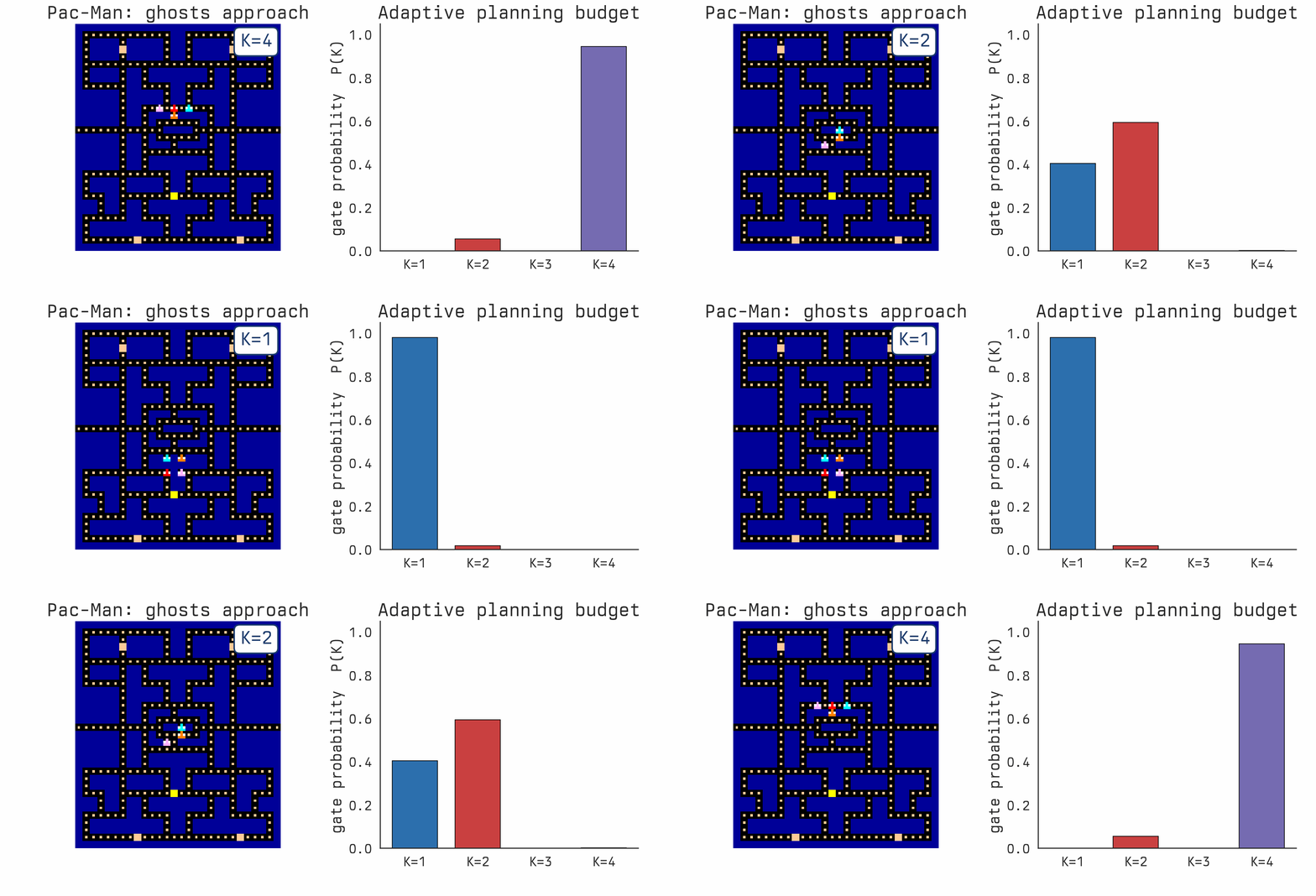
TL;DR — In real-time RL the environment keeps moving while the agent plans, so thinking longer changes the state you act in. We train a lightweight gating policy on top of a frozen AlphaZero-style planner that picks a state-dependent MCTS budget at each decision — thinking deeply when it can afford to, reacting instantly when it must. It beats every fixed-budget and heuristic baseline across five games and transfers to a two-GPU real-time deployment with no retraining.
This is the official code release. The paper trains a lightweight gating policy on top of a frozen AlphaZero-style planner that selects state-dependent MCTS planning budgets at each decision point. Five environments split across two regimes:
| Regime | Environments | Source |
|---|---|---|
| Committed-action (real-time) | Pac-Man, Tetris (real-time), Snake | Jumanji |
| Clock | Speed Hex (11x11), Speed Go (9x9) | pgx |
Plus a two-GPU real-time deployment for the committed-action environments (paper Section 6).
.
├── committed_action/          # Pac-Man, real-time Tetris, Snake (Jumanji)
│   ├── jumanji/               # vendored Jumanji library (Apache-2.0)
│   ├── train/
│   │   ├── base_planner/      # AlphaZero base-planner training launchers
│   │   └── gating_policy/     # PPO gating-policy training launchers
│   ├── eval/
│   │   ├── base_planner/      # always-K cross-evaluation launchers
│   │   └── gating_policy/     # gating-policy evaluation launchers
│   └── deployment/            # two-GPU real-time deployment (Section 6)
│
├── clock/                     # Speed Hex, Speed Go (pgx)
│   ├── envs/                  # speed_hex.py, speed_go.py, speed_hex_timeout.py
│   ├── networks/              # AZNet variants
│   ├── train/{base_planner, gating_policy}
│   └── eval/{base_planner,  gating_policy}
│
├── checkpoints/               # model checkpoints (git lfs)
├── scripts/
│   └── download_checkpoints.sh  # optional google drive mirror
├── requirements.txt
└── README.md  (this file)
committed_action/jumanji/ is a vendored snapshot of the upstream
Jumanji library extended with the
real-time Pac-Man (PacManKT), real-time Tetris (TetrisRTKT), and Snake
(SnakeKT) variants. The pgx side imports
pgx as a normal pip dependency.
python -m venv .venv && source .venv/bin/activate
pip install -r requirements.txt
Hardware: paper experiments used H100 / A100 / A40 GPUs. Single-GPU is sufficient for everything except the two-GPU real-time deployment. CPU-only execution has not been tested.
One base planner + one gating policy checkpoint per environment (about 200 MB total), stored in the repo with Git LFS. A normal clone pulls them:
git lfs install        # one-time
git clone git@github.com:Aneeshers/realtime-rl-code.git
If you cloned before installing LFS (so checkpoints/*.pkl are pointer stubs),
run git lfs pull.
./checkpoints/ then matches the layout the launcher scripts expect. See
checkpoints/MANIFEST.md for the file list. scripts/download_checkpoints.sh
is an optional Google Drive mirror of the same files.
All launcher scripts are run from the repo root and accept overrides via environment variables (no SLURM dependency). Defaults reproduce the paper's numbers when paired with the shipped checkpoints.
bash committed_action/eval/gating_policy/eval_pacman_gating.shExpected: ~2370 mean episode return (vs. 2149 for the best fixed-K baseline; paper Section 5).
bash committed_action/eval/gating_policy/eval_tetris_gating.shExpected: ~45.6 mean (vs. 27.6 fixed-K).
bash committed_action/eval/gating_policy/eval_snake_gating.shExpected: ~16.5 mean (vs. 14.9 fixed-K).
bash clock/eval/gating_policy/eval_hex_gating.shExpected: averaged over T in {300, 1200, 2300, 3500, 4100}, expected
score ~0.58 (vs. 0.43 fixed-K, 0.46 greedy).
bash clock/eval/gating_policy/eval_go_gating.shExpected: same clock budgets, expected score ~0.59 (vs. 0.51 fixed-K, 0.50 midpeak).
Fixed-budget baseline bars for both clock games come from
clock/eval/gating_policy/eval_clock_baselines.sh (ENV_KIND=hex or go),
which re-runs the eval with --force_gate_choice set to each budget. The
greedy/midpeak heuristics run as opponents only
(--opponents ...,midpeak,proportional), not as the evaluated player.
bash clock/eval/gating_policy/eval_hex_gating_timeout.shBacks the appendix control (Appendix H) where running out of time = immediate
loss. Uses the shipped strict-timeout gate
(clock/hex/gating_timeout/gate.pkl) paired with the
same clock/hex/base AlphaZero planner, and evaluates against the
midpeak / proportional heuristic opponents reported in the appendix.
Requires two visible GPUs. Each committed-action game has a per-game launcher
(thin wrappers over deploy.sh):
FPS=9 bash committed_action/deployment/deploy_tetris.sh
FPS=9 bash committed_action/deployment/deploy_pacman.sh
FPS=9 bash committed_action/deployment/deploy_snake.sh
Equivalently, drive the generic launcher directly:
GAME=tetris FPS=9 bash committed_action/deployment/deploy.sh
GAME=pacman FPS=9 bash committed_action/deployment/deploy.sh
GAME=snake  FPS=9 bash committed_action/deployment/deploy.sh
The single Python entrypoint jumanji.training.deploy_tetris_rt_realtime
handles all three games via --game (TetrisRTKT-v0, PacManKT-v1,
SnakeKT-v1).
The released deployment is configured and verified for H100 GPUs (the
default GPU_TYPE=h100). The paper also reports A100 and A40 results; if you
want to reproduce those, you can configure other GPU classes yourself by
overriding GPU_TYPE (and adjusting the FPS sweep to taste) - those paths
are left unsupported here.
Base AlphaZero planners (multi-day on a single H100):
K=1 bash committed_action/train/base_planner/train_pacman.sh
K=1 bash committed_action/train/base_planner/train_tetris.sh
K=3 bash committed_action/train/base_planner/train_snake.sh
NUM_SIMULATIONS=32 SEED=3 bash clock/train/base_planner/train_hex.sh
NUM_SIMULATIONS=16 SEED=0 bash clock/train/base_planner/train_go.sh
Gating policies (frozen base planner; faster than base):
bash committed_action/train/gating_policy/train_pacman_gating.sh
bash committed_action/train/gating_policy/train_tetris_gating.sh
bash committed_action/train/gating_policy/train_snake_gating.sh
bash clock/train/gating_policy/train_hex_gating.sh
bash clock/train/gating_policy/train_go_gating.sh
bash clock/train/gating_policy/train_hex_gating_timeout.sh   # appendix
Each launcher exposes hyperparameters via env vars (SEED, NUM_EPOCHS,
SIM_OPTIONS, etc.). See the script bodies for the full list and defaults.
- Reproducibility is GPU-class-sensitive. Expect ~1 SE noise across H100 / A100 / A40; deployment latencies tighten on H100.
- The committed-action evaluators emit some matplotlib side-effect figures
that are not used in the paper. They are harmless and write to
--output_dir. clock/eval/base_planner/tournament.pyperforms a head-to-head sweep rather than reproducing a specific paper table; it is included for completeness of base-planner evaluation.- W&B logging is on by default. Committed-action evaluators and deploy scripts
log unless you pass
--no_wandb; clock evaluators default to--wandb_mode online(pass--wandb_mode disabledto turn off). Set theWANDB_ENTITY/WANDB_PROJECTenv vars to control where runs land.
@inproceedings{muppidi2026findingtime,
  title     = {Finding the Time to Think in Real-Time RL},
  author    = {Muppidi, Aneesh and Darwish, Firas and Cope, Dylan and
               Henriques, Jo\~ao F. and Foerster, Jakob Nicolaus},
  booktitle = {Advances in Neural Information Processing Systems (NeurIPS)},
  year      = {2026},
  url       = {https://arxiv.org/abs/2606.26463}
}The vendored committed_action/jumanji/ is released under Apache-2.0 by
its upstream authors; see the in-tree license header. All paper-specific
code is released under the same license.
