Want to join in? Respond to our weekly writing prompts, open to everyone.
Monday
from  Roscoe's Story
In Summary: * Listening now to AI generated, slow, relaxing, “1930s jazz music” as I move into the night meds / night prayers phase of my evening. Today's appointment with a new to me Eye Doctor went well, but took more out of me than I expected. I was disoriented afterwards in a similar fashion but to a somewhat lesser degree than after the eyeball injections from my Retina Doc. Speaking of which, I'm scheduled to see the Retina Doc and get those injections again tomorrow afternoon. Oh, boy.
My Monday Night Football game starts in about an hour and I do intend to listen to at least the 1st Half before putting head to pillow. I am looking forward to a good night's sleep tonight,
Prayers, etc.: * I have a daily prayer regimen I try to follow throughout the day from early morning, as soon as I roll out of bed, until head hits pillow at night.
Health Metrics: * bw= 218.15 lbs. * bp= no readings taken today
Exercise: * morning stretches, balance exercises, kegel pelvic floor exercises, half squats, calf raises, toe raises, wall push-ups, BP breathing exercises, pilates
Diet: * 05:50 – 1 ½ peanut butter sandwich * 06:35 – 2 little cookies, ½ Whataburger double meat sandwich * 08:00 – snacking on chocolate m&m candies * 15:45 – garlic fried rice * 16:40 – coconut milk and fruit dessert
Activities, Chores, etc.: * 02:45 – listen to local news talk radio * 03:20 – bank accounts activity monitored * 04:00 – read, write, pray, follow news reports from various sources, surf the socials, take daily meds, unpack, organize, and nap * 13:15 – leave home for this afternoon's Eye Doc appointment * 16:15 – returned home after stopping for lunch in Universal City * 17:00 – caught current Texas weather report & forecast, listening to relaxing, slow 1930s jazz
Chess: * 11:40 – moved in all pending CC games
Passiflora
from  Blatta selvática
F. intentaba retener en sus oídos el sonido de los árboles que se mecían a lo lejos. El viento cruzaba sobre los tejados y en menos de 1 minuto, pero más de 25 segundos, las cortinas de la casa se elevaban. La luz entraba y los cuartos se hacían blancos, los objetos desaparecían. Son los juegos de F. contar cuánto tardan el viento y la luz una tarde de sábado.
Aquel día, justo cuando un rayo de luz le llegó al dedo índice de la mano derecha, percibió un olor amargo, avinagrado, similar a fruta en descomposición, azúcares podridos. Recordó los pavos, los loros, las gallinas, la inmensa variedad de aves que vivían en un patio a la sombra de un roble; los recordó porque el suelo siempre estaba cubierto de frutas y los emplumados se paseaban picoteando duraznos, papayas, mangos, hasta que éstas se deshacían sobre la tierra. Aquel particular olor a tierra, aleteo y fruta podrida le había quedado en la memoria. Por supuesto, también el increíble cambio morfológico de las frutas: sus colores, sus formas, del amarillo al café, del rojo al negro, la inflamación que deformaba la perfecta redondez o el perfecto equilibrio de sus cuerpos. F. podía vivir con ese olor. F. se durmió recordando los amarillos y los rojos del mango, también, el sonido del picoteo sobre la papaya.
Abrió los ojos de golpe porque algo chocó contra la ventana, cuando se asomó pudo ver una paloma, cayó sobre la canaleta con el cuello quebrado. F. logró sacarla con un artilugio diseñado a partir de palos y telas; por el camino la dejó cerca a un tronco rodeado de varios centímetros de hojarasca. Frente al desayuno, en el restaurante de siempre -donde lo habitual era que los manteles fueran rosas o azules y a las 6 de la mañana la luz estaba baja y escalaba por una esquina de la calle, la luz subía lento y solo iluminaba las piernas, los zapatos, los pantalones, las rodillas de los comensales y el café humeaba y las decenas de pares de ojos cansados caían sobre las tazas, sobre los cubiertos o se dirigían al ventanal esperando a alguien amado y desaparecido- percibió la mesa levemente inclinada hacia atrás y la izquierda, por ese motivo el café, el plato y el pan hacían una forma irregular y extraña sobre el mantel arrugado y manchado. Las mesas, los rostros, las piernas y los ojos se inclinaron, de repente, hacia atrás en perfecta armonía. Todo estaba inclinado y la lluvia perenne de esta ciudad inició entre el ruidajo cotidiano de los pesares y las noticias políticas. F. salió de allí siendo víctima de aquella inclinación y con el leve aroma a podrido que persistía desde ayer.
Tercera vez que se lavaba las manos y el rostro, incluso el cuello, fue la paloma muerta con borbotones de sangre del pico o sus pensamientos sobre las frutas, pero el olor a azúcar podrido y aleteo permanecía. Se vió al espejo, cabeza inclinada. Ingresó a su oficina inclinada y cada cierto tiempo debía acomodar su cuerpo debido a la inclinación del mundo. M. cruzó frente a la oficina en una silla de ruedas y sostuvo la mirada en el rostro de F., le llamó desde el silencio y le dijo que había enfermado de angustia y debía prepararse para una incapacidad porque sus intestinos no funcionaban por el miedo, y además, el hígado no metabolizaba a la 1 de la tarde y a esa hora comía, solo a esa hora. M. se despidió en silencio, desde su silla inclinada y vieja.
Durante el trayecto en el transporte público -repleto de personas húmedas por la lluvia, personas que esperan, personas que duermen, personas feas, personas amargas y personas con hambre- F. se quitó su abrigo, húmedo y mucho más pesado, entonces, el aroma a podredumbre dulce se elevó desde alguna parte del cuerpo. F. -quien ha estado luchando con la inclinación- supo que era su aroma, su cuerpo emanaba el olor a azúcar podrido, aleteo y tierra; era probable que su pensamiento, su recuerdo hubiese puesto ese olor en su piel o algún órgano. F. consideró necesario erradicarlo, o al menos, disimularlo para sí misma; decidió bajar del transporte y caminar sin abrigo.
Atravesando el parque, embriagada por el vinagre dulce, sintió una punzada aguda y dolorosa en el abdomen. F. se agachó, desde el impulso animal, dispuesta a parir como sus antepasadas, acurrucada y sin queja. Puso sus manos frías y aromáticas entre las piernas y emergieron miles de lombrices cubiertas de barro. El mundo hizo el último movimiento para alcanzar la inclinación ideal, y F. -en su lucha postural atravesada por el dolor de parir un alúd- se dobló hacia atrás como una rama joven y verde, y las raíces retorcidas de una passiflora desgarraron sus músculos y sus órganos de forma violenta y vertiginosa para quedar arraigadas al suelo.
Simonstown Days
from  The Morning Patrol with Mastelek
Computers, Penguins, & a Touch of Rebellion

I faked my way into the South African Navy, plain & simple. I was blind in one eye, a fact that should have kept me out of national service altogether. But all my mates were heading off to the SADF, and I wasn’t about to miss out on the adventure, or what I imagined would be the fun. During the medical exam, when they told me to cover one eye and read the chart, I switched hands but kept using the same good eye both times. By the time the doctors 7 the Navy figured it out, I was already deep into my service, & more importantly, I’d become the guy who looked after the Navy’s computers. They couldn’t very well send me home now, could they? The computers needed me more than the rules needed enforcing.
I spent 21 months stationed in Simonstown, that sleepy naval base on the Cape Peninsula with its sweeping views of False Bay. My office sat right next to the library, a quiet corner where I could tinker away. In my early twenties, I wrote program after program for the Navy: personnel systems, stores inventory, monitoring tools. I named them all after the Romans, Gladiator, Andabatae, Aqueduct, Rubicon, because even then I half-believed I was Julius Caesar reincarnated, conquering the digital world one line of code at a time.
Life was easy in those days. There was plenty of free time between debugging sessions. I’d head down to Boulders Beach to swim & dive among the rock pools & swaying kelp forests. Back then, the African penguins were just a handful, not the bustling colony they’d become. I’d suntan on the massive granite boulders, the sun warming my skin while the ocean crashed below. On weekends, I’d hop on my bronze Peugeot bicycle and cycle the peninsula, up and over Red Hill, past baboons chattering on the roadside, sea spray whipping off the waves at Scarborough. One legendary ride ended in disaster when my gear cable snapped halfway down Smitswinkelbaai. I was cursing under my breath, but even that couldn’t spoil the scenery.
Then there was Sunette. She worked in the personnel office on base, always in crisp white dresses that seemed to glow against the drab dark & grey of military life. Her name alone, Sunette, felt like sunlight breaking through cloud. I was utterly smitten. I’d invent any excuse to wander over: “Your computer’s acting up again?” I’d say, fixing some minor glitch while stealing glances. In a grand, silent gesture of devotion, I poured everything into coding the Navy’s personnel management system, naming it SPQR as my personal tribute to her. But courage? That I lacked. I never asked her out.
The day before my final uitklaar, she invited me to her flat in Vishoek. My heart hammered as I knocked on her door. She welcomed me in, showed me her budgies chirping cheerfully in their cage, the small space filled with afternoon light. There was a spark, a tension in the air, but my own awkwardness held me back. My mind was already half in Joburg, where a new job waited. I left with vague promises to stay in touch, & never did. SPQR remained my unspoken love letter, a digital monument to a crush that never quite ignited.
The only real “action” I saw came one unassuming evening. I was heading off base in civvies to meet mates at the Brass Bell in Kalk Bay when a Chief Petty Officer cornered me. “Get a rifle from the guardhouse & come with me,” he barked. His face left no room for argument. I followed him to the mess, where the two flotillas, strike craft & minesweepers, had drunk themselves into a brawl. Sailors were ripping fluorescent tubes from the ceiling and hurling them like spears.
The Chief roared at them to stop. Most did, sheepishly. But one drunk sailor staggered toward us, knife in hand. “Shoot him in the leg,” the Chief ordered. I was holding an FAL—hardly a precision weapon. A shot would have killed or crippled him. Luckily, I hadn’t even loaded it. I flipped the rifle and smashed the butt into his jaw. Lights out. Man down.
I chambered a round, lined the rest up against the wall, and told them the next one to move would regret it. They complied. The Chief fetched the Gunnery Instructor, who marched the lot to the parade ground for hours of drill punishment. I slipped away and still made it to the Brass Bell to sink a few cold ones.
Authority clashes were rarer, but memorable. One morning, crossing the parade ground, my mind no doubt on Sunette—I walked straight into a barrel-chested Warrant Officer. “Hoekom is jou hare so woes, moes troep?” he bellowed. My hair was admittedly wild. “Omdat ek dit nie gesny het nie,” I replied flippantly. Wrong answer. His face went purple. He demanded my commanding officer’s name, Commander Smith, & stormed off, threatening a phone call while ordering me to the barber.
I went straight to Commander Smith’s office instead. He invited me in, offered tea, we were both tea men in a coffee-drinking Navy. and I accepted gratefully. Before I could explain, his old rotary phone rang loudly. It was the WO, still raging. Smith listened calmly, then interrupted: “WO, this is not how it works. You speak to your equivalent rank, who speaks to me.” Slam. Phone down.
He turned to me: “What did you want to discuss?”
“Nothing, sir,” I said.
He nodded. “Excellent work on the personnel system, by the way.”
I left feeling untouchable.
It was during those Simonstown years that history shifted. One day, driving my brown Kalahari Toyota Corolla 1.6 GL along the False Bay coast toward Die Bos to visit my brother, I heard F.W. de Klerk’s speech on the radio, announcing Nelson Mandela’s release. I was passing Die Gat, the ocean stretching endless beside me. The moment felt surreal, suspended between the old world and whatever came next. I’ve never forgotten it.
Looking back, those 21 months were a gentle interlude, computers, crushes, penguins, and the occasional riot broken up with a rifle butt. The Navy gave me freedom disguised as service, and I took every bit of it.
Ronald Bartels | LinkedIn | Instagram
An Unexpected Encore with Hootie
from The Morning Patrol with Mastelek
Jim Beam
In the sweltering heat of Orlando during the early 2000s, those heady noughties when tech was booming and conferences felt like rock festivals, I found myself at an EMC gathering, rubbing elbows with data storage gurus and IT wizards. The days were a blur of seminars on enterprise solutions and networking sessions that promised to revolutionize the way we handled bits and bytes. But the real magic happened one evening when the organizers surprised us with a private concert by Hootie and the Blowfish in a cavernous arena. Standing room only, the place was electric, bodies packed tight as the band ripped through their hits, the bass thumping through our chests like a shared heartbeat. The energy was infectious; sweat-soaked shirts, fists pumping, everyone belting out lyrics to songs that defined a generation.
As the final chords faded and the crowd began to thin, my legs screamed for mercy after hours on my feet. No chairs in sight—just the empty stage beckoning like an oasis. I hoisted myself up onto the edge, dangling my feet over the drop, savoring the cool rush of air from the arena’s vents. That’s when Darius Rucker—Hootie himself—sauntered over, still buzzing from the performance, a guitar pick pinched between his fingers and a bottle of Jim Beam swinging loosely from his hand, gripped by the neck like an old friend. “Want a pick?” he asked, his voice gravelly from the set.
I glanced up, eyeing the bourbon instead. “No thanks,” I replied with a grin, “but I’ll take a shot of that Jim.” He chuckled, plopped down beside me without a second thought, and passed the bottle over. I tilted it back, the warm, smoky burn sliding down my throat in a generous glug, chasing away the fatigue. I handed it back; he took his turn, then pushed it my way again. There we sat, two strangers on the lip of that stage, the arena emptying around us, trading swigs under the dimming house lights. We didn’t talk much—maybe a nod to the crowd’s energy or a laugh about the heat—but we polished off that bottle, the world narrowing to the shared ritual of pass and sip.
When the last drop was gone, we stood up, a bit wobblier than before, exchanged a hazy “take it easy,” and staggered off in opposite directions. I never saw him again, but that fleeting encounter lingers like the aftertaste of good whiskey: a reminder that sometimes, in the midst of corporate chaos, life’s best stories unfold on the edges, unplanned and unrehearsed.

Ronald Bartels | LinkedIn | Instagram
Stegen’s Cottage
from The Morning Patrol with Mastelek
Sunlit Memories & Undercurrents of Abuse

As children, my siblings and I cherished our holidays at Stegen’s Cottage in Salt Rock, a simple haven perched on a hill overlooking the Indian Ocean. The cottage was modest, surrounded by little more than scrubby bush and the distant roar of waves, a far cry from today’s bustling version. Our days revolved around lazy explorations and endless play, but nothing captured our hearts like Thompson’s Bay, our favorite beach just a short walk down the path.
Thompson’s Bay was a slice of paradise, a crescent-shaped stretch of golden sand framed by rugged rocks and lush greenery. The beach itself is renowned for its gentle seas and safe bathing, making it ideal for young families like ours. At its heart lies a large tidal pool, a natural rock enclosure that fills with crystal-clear seawater at high tide. We’d spend hours splashing in its shallow, warm waters, watching small fish dart among the rocks and feeling the thrill as incoming waves crashed over the barriers, sending sprays of foam into the pool. The scenery was breathtaking—turquoise waters meeting the horizon, with stunning seaside views that seemed to stretch forever. Vibrant marine life added to the magic, turning every visit into an adventure. Even now, flipping through old family pictures, I can feel the sun on my skin and hear our laughter echoing off the cliffs. It was, without question, one of the most beautiful bays along the Dolphin Coast.

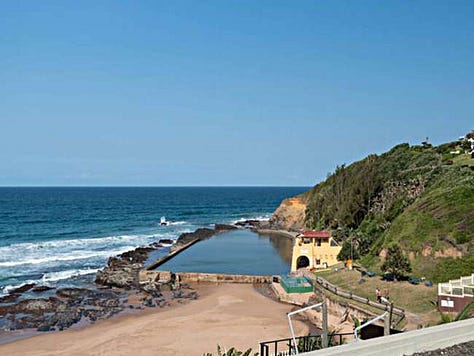

The property had a rich history, purchased by my grandmother’s brother around World War II for a mere 50 pounds. Back then, Salt Rock was a quiet backwater, untouched by development, a place where the war’s echoes barely reached. But over the decades, it transformed into prime real estate. By the 1980s, the land had become so valuable that every one of his descendants received an apartment in a new development built on the site. What was once a solitary cottage is now the Buxtehude townhouse complex, a modern cluster of upscale units with pools, balconies, and beachfront access—a far cry from the humble retreat we knew. Salt Rock itself evolved from a sleepy post-war outpost into a prime holiday destination about 20 years later, and today it’s a mecca for the affluent, boasting some of the most expensive properties in South Africa.
Those idyllic holidays came to an abrupt end when we kids started school. The Joostens, entangled in the kwaSizabantu’s (KSB) rigid dynamics, began sending us strange letters steeped in their absurd notions of repentance. My dad, furious beyond words, stripped his moer, jumped into his car, and drove straight to confront them. He made it crystal clear: if his children ever received another letter, there would be hell to pay. The letters stopped, but so did the invitations to the cottage. We were suddenly chopped liver, cast aside in the family fray.
The Stegens and Joostens as part of the KSB sect held a deeply perverted view of Christianity, one that twisted faith into control and blame. Women were forbidden from wearing makeup or nice clothes, reduced to plain shadows in a world that demanded their subjugation. Their perspective on boys and girls was equally warped—they’d blame women for any abuse if they dared to adorn themselves, claiming it was their fault for tempting fate. This toxic mindset led directly to the abuse of my Aunt Enid, and even now, it fills me with fury and agitation. It’s disgusting and primitive, a betrayal of any true spiritual path.
My mom stood in stark contrast, always radiant in her makeup and elegant clothes. At family Christmases at my grandparents’ house, she’d be the only one who looked truly beautiful and alive, a beacon amid the drab conformity. As people began leaving the sect, they’d seek her out, visiting to learn the simple arts of applying makeup and dressing with confidence—small acts of rebellion that reclaimed their dignity.
Fundamentally, if you’re a strong Christian, you take responsibility for your own actions and don’t palm off blame onto someone else. You can’t call yourself a Christian if you subjugate women or shift the fault for your failings onto them. Not only are you not a Christian, you’re not even a man. And for abusers, there’s no easy repentance; you face earthly justice first, processed here on this side, and when you cross over, it’s to burn in hell. Those holidays at Stegen’s Cottage may have faded, but the lessons from that time, about joy, transformation, and the dangers of distorted faith, remain etched in my soul.

Ronald Bartels | LinkedIn | Instagram
The Arcadia Incident
from The Morning Patrol with Mastelek
An Unforgettable New Year’s Awakening

When my sister Lyn embarked on her diplomatic posting to Norway, she was married to Ernst de Jong, a man whose artistic presence filled their home with vibrant paintings that seemed to whisper stories from every wall. They both departed for the fjords, leaving behind their sprawling house in Hill Street, Arcadia—a stone’s throw from the old British High Commission. The keys were entrusted to Ernst’s son, Mark, but his struggles with alcoholism turned the place into a chaotic disaster. Bottles piled up like forgotten sculptures, and the air hung heavy with neglect. About a year into their absence, Lyn reached out to me: Would I consider staying there to keep an eye on things?
It was perfect timing, really. I’d just been stabbed—literally—in the back during a mugging in Johannesburg, and the idea of some quiet recovery time in Pretoria appealed immensely. Besides, it suited my work at Madge Networks, where I was knee-deep in tech projects that demanded focus, constant office presence and some travelling. So, I agreed, packing my bags and settling into what felt like a borrowed life of luxury. The house was enormous, a labyrinth of rooms echoing with the ghosts of previous gatherings. Ernst’s artworks adorned every corner; bold strokes of colour that made the space feel alive even in solitude. And then there was the deep diving pool in the backyard—a crystalline abyss that invited daring plunges on hot afternoons.
I developed a peculiar habit during my stay: rotating through the bedrooms like a nomad in my own temporary kingdom. Each move felt like a fresh start, a mini holiday resetting my mind. One night I’d claim the cozy guest room with its view of the garden; the next, a sun-drenched suite overlooking the street. It was liberating, this freedom to reinvent my evenings.
But let’s talk about New Year’s Eve—or rather, my profound disdain for it. As a cold-blooded mathematician and scientist at heart, I find the whole affair utterly arbitrary. It’s just another day, plucked from the calendar with no ties to any celestial rhythm. No solstice, no equinox, no meaningful position in Earth’s orbit around the sun. Nothing. Why celebrate a random flip of the page? I always aim to sleep right through it, cocooned in indifference. Invariably, though, the universe conspires against me—those infernal fireworks shattering the night like unsolicited applause. Even now, they sabotage my slumber without fail.
This particular New Year was the dawn of 1998, mere months after the world had mourned Princess Diana’s tragic death. The High Commission next door became a shrine of sorts, with an endless stream of floral tributes laid at its gates. I’d stroll past on my walks, admiring the blooms—exquisite arrangements of roses and lilies that turned grief into something almost beautiful.
That night, I’d chosen the main bedroom at the front of the house, closest to the street. True to form, I drifted off before midnight, curtains parted as always. It’s a ritual I’ve kept since forever: letting the sun wake me naturally, syncing my body to the day’s light. Me and the sun—we’re old allies, channeling that primal Neanderthal hunter instinct. Rise with the dawn, rest with the dusk.
I must have slept through the initial revelry, but around 2 a.m., flashing lights invaded the room, pulsing like a bizarre dream. I lay there for a moment, blinking in confusion, until realization hit: These were real, streaming in from the street. Groggy but curious, I sprang from bed in nothing but my boxers and stumbled to the front door. Stepping outside, I found myself face-to-face with a cluster of firefighters and policemen, their vehicles’ strobes painting the night in red and blue.
They stared at me, and I stared back, not yet registering I was half kaalgat. Then their eyes shifted upward, above my head. Puzzled, I followed their gaze. There, wedged improbably into the branches of the towering Jacaranda tree by the curb, sat a red Renault—a flimsy plastic French car, suspended like some absurd modern art installation.
The house was the second from the corner, and I could trace the car’s erratic path: tire tracks gouged into the grassy verge, evidence of a driver who’d failed the turn spectacularly. It had veered off the road, slammed into the guy wire anchoring a power line pole, and then—miraculously—ridden that wire like a ramp straight into the tree’s embrace. The driver’s door hung open, suggesting the culprit, likely poes dronk, had moered out.
I stood there, absorbing the surreal scene, until snickers from a couple of policewomen snapped me back. They were pointing, giggling at my half-kaalgat predicament. Heat rising to my cheeks, I retreated indoors without a word, closed the door firmly, and climbed back into bed. Sleep reclaimed me swiftly, the chaos outside fading like a half-remembered punchline.
In the spiderweb memories of my life, that Arcadia Incident stands out as a quirky moment—a blend of healing solitude and unexpected absurdity. And that New Year? It proved my point: arbitrary, random, and utterly unforgettable.

Ronald Bartels | LinkedIn | Instagram
A Solo Adventure to the Mother City
from The Morning Patrol with Mastelek
Young Ronald's School Holiday in Slaapstad

It was a rite of passage in our family, one that my parents orchestrated with a mix of trust and perhaps a touch of mischief. When my sister and brother each reached Standard 3, they were bundled off alone on a Boeing 727 from Durban to Cape Town, entrusted to the care of my mother’s aunt, Margerite, and her husband, Donald. These were no ordinary relatives; Margerite and Donald held a small piece of South African history. They were the first couple to exchange vows in Afrikaans at the NG Kerk, shortly after the Second World War, breaking from the tradition of Dutch ceremonies that had lingered like an old colonial echo. Their family was deeply involved in Langehoven’s Saamwerk Kommittee, a nod to their commitment to Afrikaans culture and community.
Uncle Donald, with his no-nonsense demeanor, worked for the government in weights and measures—a role that made him something of a metric enforcer in the post-imperial era. He was the one who fined shopkeepers and stations stubborn enough to cling to imperial units. I’d heard stories of him pulling up to fuel stations in his massive bronze Valiant, filling the tank, then meticulously decanting and measuring the petrol to catch any discrepancies. The same went for greengrocers; he’d weigh their veggies and issue prosecutions if they fell short. Back home, my dad had one of those sturdy red railway station scales for measuring pockets of potatoes, and Uncle Donald would make the trip to calibrate it, ensuring everything was precise and fair.
So, when my turn came in Standard 3, under the watchful eye of my teacher Civvy—an ancient, bat-like figure with a peculiar fondness for maths that she enforced on us daily—I found myself at Durban airport, ticket in hand, ready for my own solo voyage. The Boeing 727 was a beast of a plane, its engines roaring louder than any tractor I’d ever heard chugging through the sugarcane fields. The flight was thrilling, a noisy ascent into independence, with the coastline unfolding below like a wrinkled map.
Upon landing in Cape Town, plans shifted slightly; Aunt Margerite and Uncle Donald were away on their own holiday, so I stayed instead with one of Andrew Elliot’s sons, a kind host who made me feel at home in the shadow of Table Mountain. My dad, ever the generous planner, had equipped me with enough pocket money to embark on a whirlwind of Springbok-Atlas bus tours. I hopped from one adventure to the next: circling the rugged peninsula with its crashing waves and fynbos-covered cliffs, ascending the iconic Table Mountain via cable car for panoramic views that stretched to the horizon, wandering the vine-draped streets of Stellenbosch and Paarl with their historic Cape Dutch architecture, strolling through the lush botanical wonders of Kirstenbosch Gardens, and even venturing to a game reserve whose name has long faded from my memory, where I spotted wildlife roaming free under the vast African sky.
One day I hope on the train from Plumstead to Cape Town and walked around the city. I was awestruck. It was the first major metropolis I had visited. And all on my own steam.
To capture it all, I was armed with an Instamatic camera—a simple, foolproof gadget from Kodak that made photography accessible to anyone. It used drop-in film cartridges, no fussing with threading rolls, and with a quick snap and flash cube, you’d have your memories preserved on square prints, ready to develop at the local chemist. It was my constant companion, clicking away at every scenic stop, turning fleeting moments into tangible keepsakes.
The highlight—or perhaps the shock—of the trip was a weekend escape to Yzerfontein, a sleepy coastal spot where the Atlantic Ocean met the shore in a relentless, icy embrace. Dipping my toes in for the first time, I was stunned by the bone-chilling cold of the Cape waters, a far cry from the warm Indian Ocean baths back in Durban. It was invigorating, a reminder of how vast and varied our country could be.
That childhood jaunt to Cape Town planted seeds of wanderlust that would bloom later in life. I’d return years on, crammed into the family Mercedes for a road trip with my parents, tracing those same routes with fresh eyes. And eventually, the Mother City called me back, as I headed there to study at Maties, Stellenbosch University, where the adventures of Standard 3 felt like a distant, noisy prelude to the chapters yet to unfold.

Ronald Bartels | LinkedIn | Instagram
WTF is DeCoTech
from Conjure Utopia
The word DeCoTech has been floating around more and more in recent times: it stands for “Democratic Control of Technology”, and it’s the idea that digital technology should be conceived, designed, developed, maintained, and monitored with the participation of the people who are going to use it, who are going to be impacted by it, or who have an explicit democratic mandate from the communities and individuals involved.
In this article, I will summarize the concept concisely since I see it used often behind closed doors, or referenced under this or other names in pamphlets, blog posts, books, and papers that never take the time to lay down exactly what we are talking about. This includes a recent strategy paper I published, which made me realize both the galvanizing power of this concept and the need to systematize what it means.

Currently, most new digital technology in the West is produced without democratic oversight. A few centralized investors direct its creation, and a network of big or small private actors organized in business ecosystems execute the vision. State actors intervene by either investing money to reinforce the private sector in alignment with their agenda, supplying their technologies, or regulating such technologies after they have been released on the market. State actors with a liberal regime often act within this space with limited accountability to the public. The consequence is that policymaking is determined by the conflict between specialized civil society and tech lobbying groups.
It’s a bit more complicated than that, but we are not here to talk about the status quo. We are to talk about what we want to build.
Democratic Control of Technology is an umbrella term for a series of radical changes within the current power structure to shift control of technology towards workers, users, communities, and old or new public institutions. It is not a single demand, nor a blueprint, but a general term to identify a winning condition for political actors. Since Democracy is not a binary condition, but a fluctuating property of a system, a spectrum along which we can evaluate the fairness of a process, DeCoTech can be achieved through a multiplicity of paths and result in many different new political entities and institutions.
DeCoTech is not a new invention: the implicit or explicit idea of having democratic oversight over digital technology has existed for a long time. DeCoTech, though, is useful to bring together viable answers to the problems of the current moment. It is a catalyst to aggregate political forces towards a shared direction.
Now, all this talk about power structures, actors, and systems is very abstract. Leaving DeCoTech as a general, pluralistic term, let’s look at some existing phenomena that express a degree of DeCoTech.
Let’s start with environments in which the users and the developers come together to design a certain technology or its deployment. Software developed through participatory design, data cooperatives, platform cooperatives, or any situation in which related communities are treated as stakeholders with equal power to the developers is an expression of local DeCoTech.
Another form of existing DeCoTech is tech workers’ resistance against corporate decisions on technology. Examples include No Tech for Apartheid, resisting their employers’ collaboration with the genocidal military forces. In a non-democratic setting like private corporations, the expression of democracy passes through workers resisting the authoritarian power of the employers, forcing them into complicity with the development of harmful technology. While the people directly impacted by the technology are not involved in the process (also because such technologies are designed to kill them, and I imagine the governance meetings would feel quite tense), the tech workers stand as a replacement through a desire for solidarity and justice.
Some degree of DeCoTech is also obviously expressed by state regulations around technology, even though they have limited and delayed impact. This is primarily due to institutional capture by tech lobbying and limited political will to oppose private interests in favor of the popular interest.
Now, what would an increased level of Democratic Control over Technology look like? There is an endless array of proposals, which I won’t even try to categorize. Some want to put the State in charge of planning technological development but under new institutions. Some want to put workers’ power in the workplace at the center. Some others want decentralization of technology at the community level, with every neighborhood vibecoding their own hyper-custom stack. Some proposals are an overarching economic overhaul; some are concerned with single, narrow aspects.
An example I like to bring up when I speak about DeCoTech is the way, as a society, decided it was good to test all medical drugs before putting them on the market. In the 19th century, the proposition of extended tests for all commercial drugs was unthinkable. It took several incidents with thousands of victims to lead to the formation of dedicated institutions to validate what was going to land on the market. The whole industry reshaped, and not necessarily for the better: the costs of testing led to a huge concentration of capital in what we now call Big Pharma. Despite this and other shortcomings, we can all agree that we prefer to have the guarantee that the medicines we buy at the pharmacy have had a degree of testing.
Why can’t we do it for commercial software? Well, we are already doing it for a small portion of it. There’s auditing for privacy reasons, or for critical software that, if it malfunctioned, would kill a lot of people, like the one that runs planes or cars. These auditing systems have been under attack for a long time by corporate interests, but they show that where there’s a will, there’s a way. CEOs, if presented with this proposition, would kick and cry endlessly and make up claims that it’s technically unfeasible. It’s easy to understand why they don’t like this kind of scrutiny: code won’t be an industrial secret anymore, and it will be under continuous public scrutiny. No more shady practices, dark patterns, reckless deployments, secret surveillance of users or workers, and a permanent end to the “move fast and break things” ethos.
Private companies needing to ask for permission, rather than forgiveness, is but a small building block, a first step towards DeCoTech.
Verifying and validating the impact of all the software put in production can be a daunting task, and most likely depends on the State having an incentive to protect Democratic power, which, these days, doesn’t seem to be the case. Big Tech has captured many State institutions in the USA and Europe, embedded itself into the military, and fundamentally sabotaged the electoral process, Janonism notwithstanding.
Let’s approach DeCoTech from a different perspective. Tech Workers within tech companies are the potential frontline of DeCoTech for the very nature of their position in the productive process: they observe directly how every decision of investors and managers is translated into requests to alter software. A degree of DeCoTech happens when tech workers, collectively, decide to contest “how” a technology is developed. A much higher degree of DeCoTech happens when they contest the “what”, such as the previous example with No Tech For Apartheid.
A high degree of DeCoTech will be achieved when tech workers have, in most companies, the power to consistently decide what technology is developed and for what purpose, in coordination with the adopters of such technologies. This will require entirely new institutions to be designed in a way that the development process itself is conditioned and constrained by the consensus and approval of all parties impacted. This is not a trivial effort, and I don’t want to offer a simplistic and underwhelming solution here, such as a deliberative assembly or a wishy-washy cooperativemaxxing.
One last branch of DeCoTech I see being discussed is in the spaces of economic planning: appropriating the logistics technologies that, for example, Amazon or Walmart use to predict and plan a good portion of the global economy, and using them in combination with the plenty of economic planning models and simulators to move away from the unstable, unreliable, and self-destructive economic system we live under. CyberSyn in Chile, despite its enormous limitations, was definitely a good example of DeCoTech.
I want to conclude by highlighting how a lot of people have the feeling DeCoTech will become a central point of discussion in the immediate future, at least in Europe. While I’m writing, the stocks of many tech companies are in freefall. I don’t know if this is the AI bubble bursting or not yet, but it’s clear that the current trajectory is not sustainable. Tech Bros are to blame. More generally, the neoliberal order is shattered, and whatever Trump is going for doesn’t seem built to have a lasting impact if not within the USA, then at least in the rest of the world. Politicians don’t have good answers and are entrenching themselves either in a gruesome defense of the dying order or in a frontal, irrational assault on the remnants of the establishment.
Soon or later, there will be a strong demand for a new way of doing things, and we need to be ready with a compelling vision to heal society from the madness we are going through.
Given the harm and destruction Big Tech has brought in the last few decades through surveillance, militarization, pollution, and the capture or destruction of public institutions, DeCoTech is not only a political project, but a necessary condition to insulate society from the damage digital technology is capable of, and to turn this potential in service of the fight against the enormous challenges that climate collapse and other ecological threats pose to civilization.
product of being productive
from  blog//x2600.cc
Good news
Best bud, “B”, is letting me use his residential address to update Social Security information. Mandatory.
Had a nice day under clouds. Coffee now.
Worked on ^nix. Added Blogging to the Boards. Should get/stay active.
Tomorrow, “online lore/flotsam” will be added. Things found online, some Internet-exclusive, some not. Obscurities. Odd contents.
sysop of quxnet is 50/50 on offering a shell to qn. Hope he decides to do it.
Day 145
from Out of Office
You may have been wondering what happened or where I disappeared to. Honestly I just got overwhelmed with planning, preparing and thinking about this seasonal relocation to Colorado.
Here are the highlights since Day 119:
- I started my final to do list of tasks to complete before my move
- I went to California for a little over a week. It was an incredible trip filled with kayaking, hiking, biking, pumpkins, running, whale watching, beach strolls, and much more!
- I had my final post op appointment and everything went well. My recovery has felt so much better since the last check in
- I went to Chattanooga for a little while and probably for the last time this calendar year
Lately, I have felt a lot more optimistic than I have in a long while. I still miss and think of my dog every single day. My other pup unfortunately can’t join me just yet in my mountain adventure, but I hope he can soon after the initial move. I am trying to figure out what is next, what I hope to accomplish, what I want to learn and experience. I still can’t fully believe this is happening. I have not even started packing. I officially leave in 27 days so there is a ton to figure out. I hope you stick around while I finish out whatever messy chapter this was, and start the next one.
Thank you for your message. I am currently out of office — but will return at the end of the month.
This Song Makes Me Smile
from AnOublietteofThought
Some hip-swaying beats for today's jaunts.
I've been practicing a bit of belly dancing again. Admittedly in my own way. I pulled a tambourine out for this one. It was most enjoyable.
Weekend update:
Weight has held the same. Being sick made me lazy with my cooking, and I foolishly turned to cup-of-soups. I imagine by tomorrow I'll have dropped 3-5 pounds of water weight.
Realizing how ick they make me feel, I've upgraded my egg plan because I did enjoy the “broth” aspect. I will be initiating an egg drop soup plan. I'll add beef a few days out of the week and continue with the tuna/sardines mix on others. I need to remember butter on my next grocery haul. I think the simplicity will get me back in habit. It also means very easy cleanup.
I'm surprised by my desire to eat soup a lot. I'm not really a big soup eater in general. I think I might dehydrate some of the beef for the chew factor. Otherwise, I'll just end up gritting my teeth a lot. Perhaps I should go back to chewing on miswak or a licorice root. Sensory-wise, I find a lot of satisfaction in shredding a tough piece of jerky. My innate oral fixation is definitely rearing its head. Le sigh.
Storms are coming tonight. I plan on enjoying them to their fullest. Now back to dancing.
© 2026 AnOublietteofThought. All rights reserved.
Today's musical inspiration.
https://youtube.com/watch?v=k20r8dA8PcI&is=XJPxiAdcLFKSNHwl
The Work After the Answer

“Claude / ChatGPT, please help us respond to this email. Use our voice and research the points under discussion.”
A complex email had arrived from a client during an important negotiation. With other work to attend to, we asked AI to help us prepare a response.
The research brought back information that might have taken a colleague several hours to find; the drafts had the suspicious courtesy of a form letter. Sentences stood neatly beside one another without making an argument. Some phrases made little sense, while others sounded plainly generated.
We kept trying to explain what was wrong. An hour and a half later, the research was useful and the email still needed to be written. We had asked for our voice, yet each reply took us further from the thought we wanted to convey.
How much of a voice can be supplied before the writer has decided what needs to be said? The research had given us facts. What we made of them, and what we were prepared to say to the client, remained ours to decide.
What the empty box leaves to us
The business user is making choices before knowing quite what those choices will mean. How should the task be framed? Which model should receive it? Where a setting for effort is available, how much should be applied? Claude Opus 5, in our experience, could produce writing so verbose that returning to an earlier model became preferable. Even then, a model that was useful for one part of the work might leave us struggling with another.
Each decision sits inside an interface that makes the whole undertaking look deceptively simple. A reply arrives beneath the question, apparently complete, while the user is left to work out which information deserves attention, which sentences have earned their place and whether the time spent has brought the work any closer to its purpose. To build a useful workflow, we first have to see the separate tasks contained within the request.
The distance between finding and knowing
When researchers in South Korea asked employees where generative AI had made their work more efficient, information search and collection came first. The survey covered 1,090 people with experience of using the tools at work; considerably fewer identified developing new ideas or plans.[1] The findings record workers’ perceptions, and they describe work undertaken with the tools available in 2025.
Consider what sits between those two activities. A search may return a useful document, an unfamiliar regulation or a fact that changes the terms of a negotiation. Someone must still decide whether the source can be trusted, how much weight it deserves and whether it belongs in the argument at all. Our email made that distance visible: the research gave us material we could use, while the repeated drafts made it harder to say what we meant. How many other tasks have we been treating as a single act when the advantage lies in only part of it?
The lesson left on the desk
Among the results were import figures for a product in Japan and South Korea: the sort of information that can take a considerable amount of time to find across languages and sources. There was work to do with it. Some sources needed checking, some might have been discarded, and the useful ones could have helped shape an argument of our own. Instead, the research was passed back into the system to produce a reply. Its talent for finding had been given authority over what came next.
That decision deserves a second look. A post-mortem for a single email might seem excessive, until we remember how many emails a business answers in a year. Where did the research save effort? Where did the drafts begin to consume it? A few honest answers could spare us from repeating the same experiment each time a complicated message arrives.
The larger evaluations are beginning to take professional work seriously. OpenAI’s GDPval draws on tasks from 44 occupations; its initial version judges a single attempt, leaving out the growing context and successive revisions of work in progress.[2] It cannot tell us what we learned from working on the client’s email or whether that knowledge helped with the next email. Yet the question facing someone at their desk is more intimate. After the scores have been published and the model has been chosen, can we learn enough from one attempt to make the next one wiser?
Rajan Anand
Co-founder, Octaflow Labs
Sources
- Korea Research Institute for Vocational Education and Training, Job Redesign and Innovation Strategies in the Generative AI Era. Survey of 1,090 employees who had used generative AI at work, conducted in July 2025. The findings record workers’ perceptions.
- OpenAI, Measuring the performance of our models on real-world tasks. The limitation described applies to the initial one-shot version of GDPval.
#AI #KnowledgeWork #Research
Okay, but What is Ring of Honor?
from Kayfabe.Ink
I have been to two AEW shows in the last six months, and both opened with a pre-TV Ring of Honor match.
“Hmm,” thought I. “Seems like Ring of Honor is kind of like AEW’s minor league! I’d be interested in checking that out!” Because, as a rule, the smaller the stage, the weirder the stuff that happens, and I’m all about the weird.
I keep seeing little clips and stuff of wrestlers I like but don’t see enough on AEW (like Lio Rush!) in Ring of Honor matches.
But here’s what I’m not clear on. What is Ring of Honor and, furthermore, how does one access its content? I know they have shows. I think they have shows. Anyway they had an ad for one on the AEW website once. And I assume those clips are coming from somewhere.
I went to the website which is spectacularly uninformative. There is something called “ROH on Honorclub” which you can subscribe to for 10 bucks a month. It seems to be a weekly show? Which consists of, what, ROH matches that have been taped at AEW events? Or what? If I were to subscribe to Honorclub, what would that 10 bucks a month get me? Does that include the pay-per-view events, or not?
There are no answers. Only questions.
My point here is just that the entire thing feels very insider-y, very “if you know, you know,” but I don’t know, and I wish to know, and there seems to be no way to find out.
Which is fine, I mean, you do you, ROH, but I guess I wonder why this thing even exists if they don’t seem to actually want anyone to access it.
Comment pouvez-vous vivre ainsi ?
from  Kevin Turby
Je pense souvent à cette phrase de Mercédes dans le Comte de Monte Cristo.
Elle dit exactement : « Comment pouvez-vous vivre ainsi, sans rien qui ne vous rattache à la vie »
Mes dépressions reflétaient l’idée qui se cache derrière cette phrase.
Sans un centre, une ancre, une attache, la vie ne fait plus sens.
Vivre pour les autres ou vivre pour soi ? En sachant que sans l’autre, le soi n’est pas grand chose.
J’aimerais ça. Vivre pour quelqu’un.
La cura #
from  tirareindietro
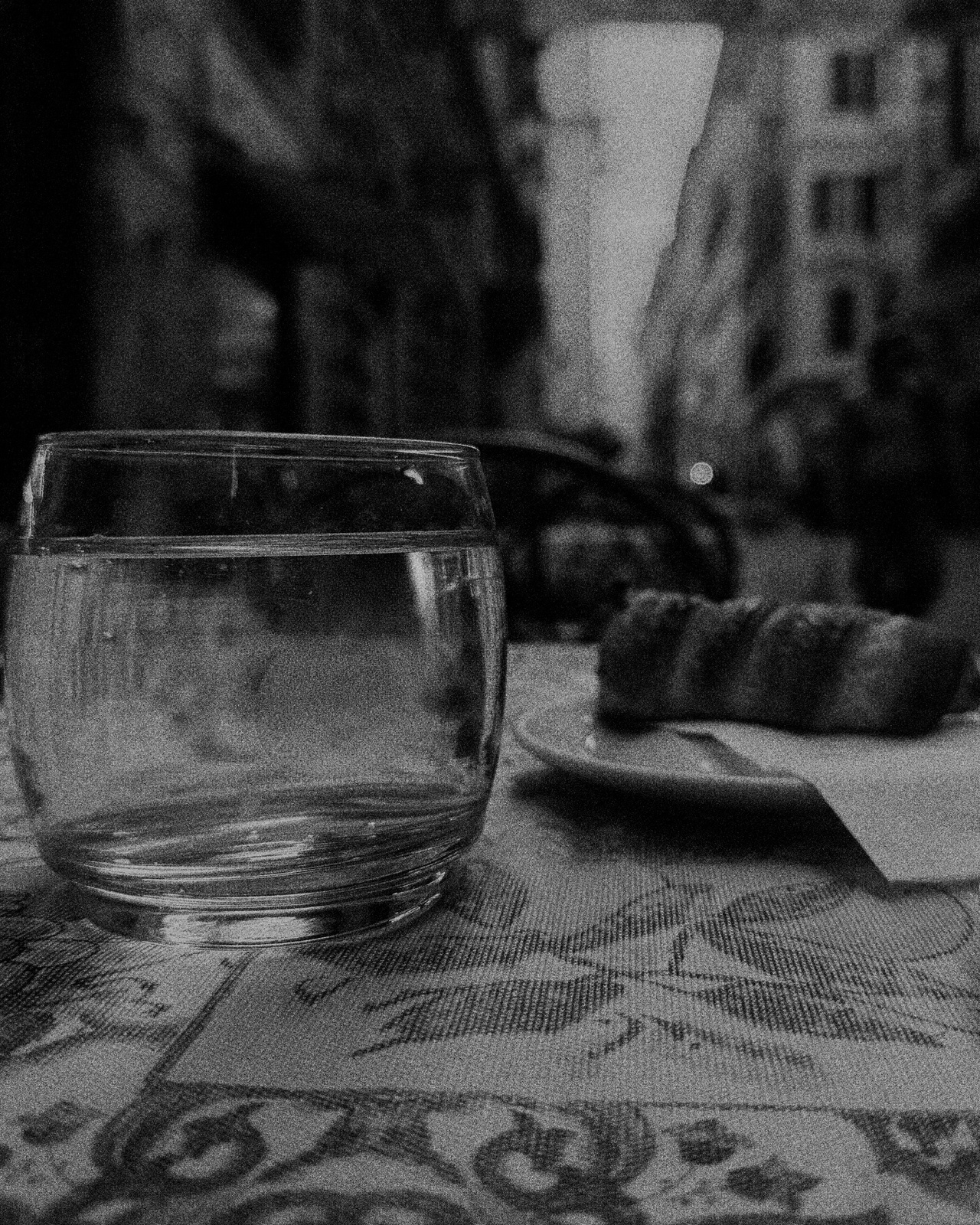
Ho appena finito un colloquio con un ragazzo. Prima di salutarci decidiamo di fermarci insieme per un cattè e un dolce, in uno di quei locali storici del centro raffinati che sembrano custodire un pezzo della città. Ci sediamo e ordiniamo. Poco dopo un giovane addetto al servizio arriva al tavolo con il dolce. Sta per appoggiarlo, poi si ferma e, con grande naturalezza, mi fa notare che forse quel dolce potrebbe non essere adatto e propone subito di cambiarlo. Tutto qui. Una cosa piccola e talmente “normale” che non dovrebbe nemmeno meritare di essere raccontata. E invece mi colpisce. Forse perché siamo diventati tanto bravi a parlane e molto meno a praticarla. Accorgersi dell'altra persona prima che sia costretta a chiedere, fare attenzione senza invadere, rispettare una differenza senza trasformarla in distanza. Nessuna domanda. Nessuna differenza da sottolineare. Nessuna identità da interrogare. Nessuna gratitudine da esigere. Un dolce cambiato, un movimento che non cambia niente e che rivoluziona tutto.
My favourite show
from  The happy place
ok let’s unload
First time I watched Gilmore Girls, I identified with Rory. Being young, doing things for the first time, Over the subsequent rewatches, over the years, I’ve identified instead with Lorelei, gradually of course!
And now, twenty six years later, I’m starting to feel more and more like Emily.
And one day, I will die.
