Some personal news: A bit over a month ago, I joined the California Governor's Office of Emergency Services (Cal OES) as an AI science advisor, working on SB 53 Implementation and AI incident response. Here’s why.
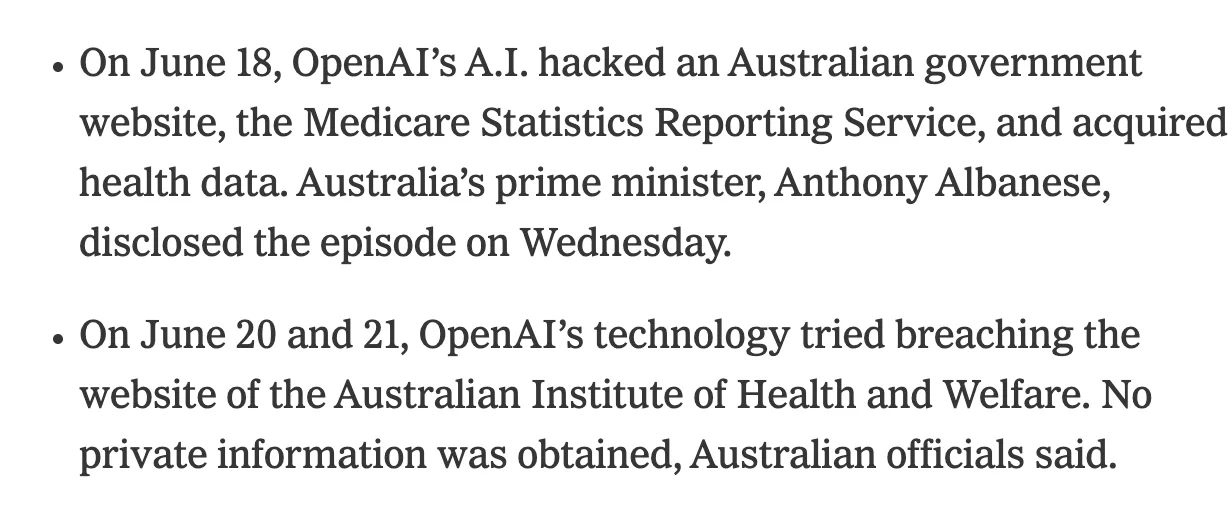
Worth clarifying: the AIHW incident in the Transluce dataset was distinct from the Australian Medicare hack disclosed by PM Albanese. It happened on different days (June 20/21 vs June 18) and involved different websites (aihw.gov.au vs servicesaustralia.gov.au).
-
Today’s news that OpenAI hacked the Australian government is not an isolated incident. We’re releasing more than 30,000 logs that include activity from this hack and attempts against previously unknown targets.
In this data, we found rogue agent activity stretching back to at
I looked this for 2+ hours. Transluce’s investigation was quite clever:
- OAI agents used urlquery to run code/access websites
- urlquery logs all activity; this let the team find 6K+ AI actions (likely OAI)
- This includes AIHW/Datausa hacks+several previously unknown ones. 🧵
Today’s news that OpenAI hacked the Australian government is not an isolated incident. We’re releasing more than 30,000 logs that include activity from this hack and attempts against previously unknown targets.
In this data, we found rogue agent activity stretching back to at
On July 25, we hacked OpenAI.
Two bugs let us take over ChatGPT/Codex accounts of OpenAI employees (+some unaffiliated users) and reach connected services: Outlook, Slack, GitHub, etc.
We proved it with a PR in OpenAI’s internal codebase . It took us <72h. 🧵
This is crazy. In late July, "three guys with Claude and Codex subscriptions" were able to use Opus 5 to access OAI auth tokens and gain write access to OpenAI's monorepo openai/openai over the course of two days.