
Upcoming Events
Don’t spend the first morning of AWS re:Invent fighting through the crowds to catch the keynote.
On Tuesday, December 1, LocalStack will livestream the AWS re:Invent keynote at a private breakfast event for our community of customers.
The event will kick off at 7 am PST with free breakfast and discussions about emerging use cases among our community and upcoming LocalStack product capabilities.
Then we will livestream the AWS re:Invent keynote so you don’t miss any of the big news.
Once we wrap up, we’re just a short walk to the convention center, so you can start the day off right before heading into a busy day at re:Invent.
Agenda
- 7:00 am PST: Doors open. Come on in and grab some breakfast!
- 7:30 am PST: LocalStack product discussions begin
- 8:30 am PST: Livestream begins: AWS re:Invent keynote with AWS CEO Matt Garman
- 10:30 am – 12:00 pm PST: Networking and open discussion
Space is limited, so submit the form to add yourself to the waitlist.
It’s time to bring the local cloud community together. AWS re:Invent is just the place.
Whether you’ve spent years building locally or you’re just learning about local cloud development for the first time, localhost:2026 is the AWS re:Invent afterparty for you. Join us for a break from the re:Invent show floor and a chance to connect with your peers in the local cloud community.
Event details
- Date: Wednesday, December 2, 2026
- Time: 6:00 – 9:00 PM PST
- Venue: Cabo Wabo Cantina Las Vegas, Planet Hollywood Resort & Casino, 3663 Las Vegas Blvd South, Las Vegas, NV 89108
Submit the form to RSVP and we’ll make sure you receive everything you need directly in your inbox.
Have a talk idea?
Do you want to present at our events? We are not just limited to LocalStack—Talks around AWS, Developer Productivity, Cloud Security, DevOps toolings, Development & Testing loops, Snowflake and more would add great value to our members. Fill out the form to propose your talk at one of our Community Events
Previous Talks

A recent survey of enterprise software developers revealed serious concerns about the tech stack supporting agentic AI workflows. In this 45-minute executive briefing, Colin Neagle, Head of Marketing, and Christian Capdeville, Head of Product Marketing, walk through the findings of the State of AI in Cloud Development 2026 report and share recommendations for a cloud development experience that improves the output of agentic AI workflows without sacrificing velocity.
Key findings
- 79% of development teams grant AI agents access to cloud development environments, even though 97% expressed concerns about doing so
- Nearly 40% of AI-generated code never makes it into production, as developers cite quality concerns and ineffective environments for testing code
- Developers showed far less trust in the quality of AI-generated code than people in manager roles, pointing to a gap between perceived and actual AI maturity
What you'll learn
- Why agentic AI is testing the limits of traditional cloud development environments: slow provisioning, shared environments, frequent crashes and drift from production
- How local cloud sandboxes isolate and secure cloud testing for AI agents
- Three examples in practice: local developer environments, autonomous software factories, and reinforcement learning for LLMs
- The metrics software teams use to measure impact: deployment frequency, lead time for changes, production incidents, mean time to resolution and cost
Want the full data? Read the State of AI in Cloud Development 2026 report.
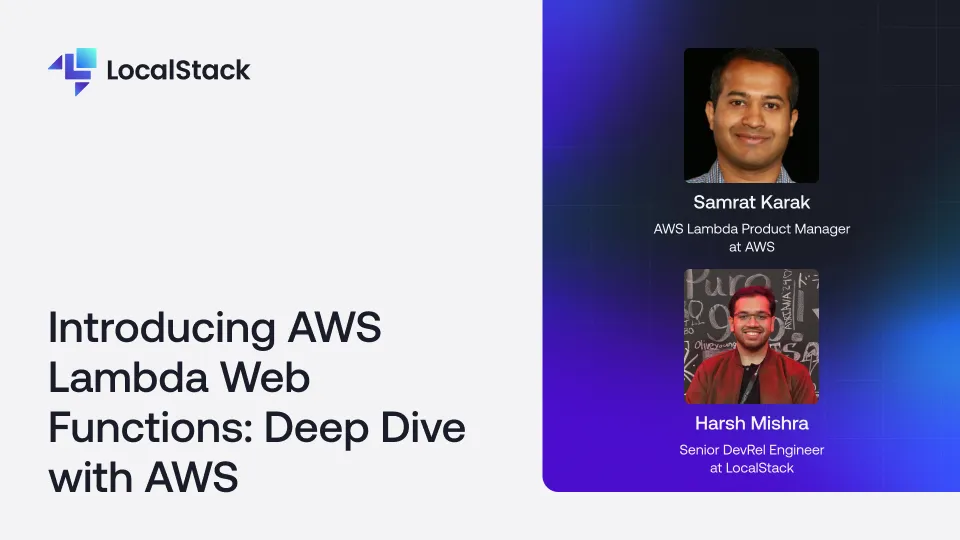
AWS just released Lambda Web Functions, a major update to AWS Lambda. In this session, Samrat Karak, AWS Lambda Product Manager, explains what's new and where Web Functions are most useful. Then see how to run and test them locally with LocalStack before you run them in your cloud environments.
What you'll learn
- What AWS Lambda Web Functions are, and why they matter
- Where Web Functions are most useful, straight from the AWS Lambda team
- How to run and test Web Functions locally with LocalStack
- How to catch issues locally before you run them in your cloud environments
- A live LocalStack demo of a Web Function running end to end, no AWS account required
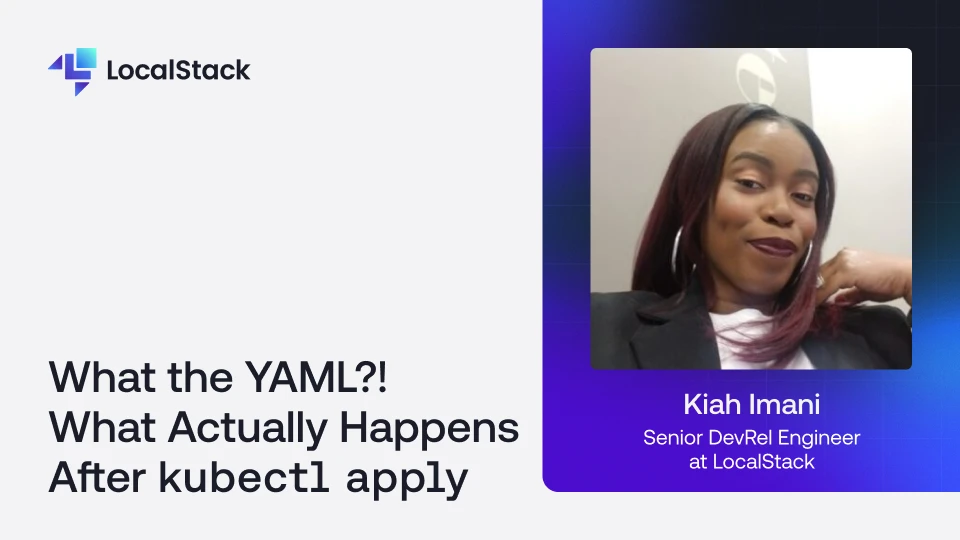
Developers are used to running kubectl apply and waiting on the magic to happen resulting in a running Kubernetes pod. But what actually happens between entering the command and the deployment being ready? What's the reality behind the "magic"? In this talk, Kiah will dissect all the stages of a Kubernetes deployment in a way that is easy to understand. She'll walk through that deployment happening locally on LocalStack to inspect what's really going on at each stage. At the end of this session, attendees will have a deeper understanding of the Kubernetes deployment process that can help debug many common issues and will gain an understanding of how LocalStack enables local testing of Kubernetes.
Recreating the unique state of a cloud app environment is notoriously complex, making it difficult to diagnose bugs, collaborate with teammates, or even just pick up where you left off. Join us as we deep dive into LocalStack’s powerful state management and persistence features, exploring how to maintain, snapshot, and seamlessly share your local cloud environments using core features like persistence, Cloud Pods, and state files. Learn how to restore a previous state, share preconfigured environments with colleagues for collaboration or onboarding, or restore preset services and data for functional tests in CI. We'll also showcase LocalStack's new Model Context Protocol (MCP) integration, revealing how AI can manage, inspect, and automate your local cloud state.
An agent will write you a CDK stack, a Terraform module, or a stack of IAM policies in seconds.
Whether any of it works is a separate question, and the usual way to find out is to deploy to a real AWS account and watch what breaks.
In an agentic workflow, that means giving AI access to a public cloud account, racking up costs on the AWS bill, and waiting for provisioning to complete every time you push new code to the environment.
The rise of agentic AI in the software delivery lifecycle creates a dilemma with high-stakes implications.
As agents create new applications at an unprecedented rate, how do you integrate security without slowing down delivery?
Launch yourself in the world of local cloud development

