-
-
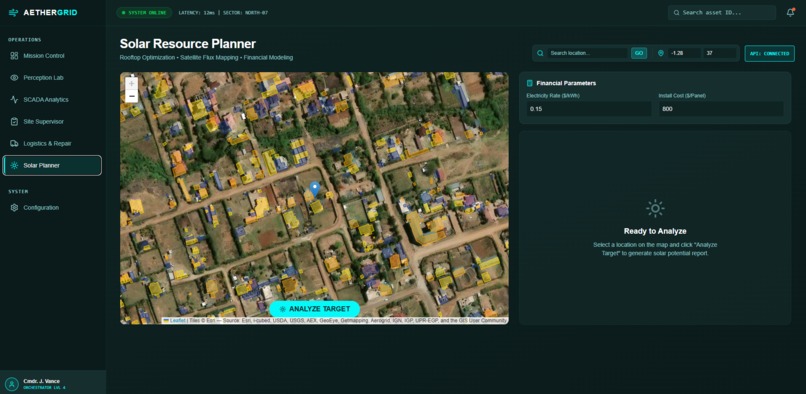
Optimizing the grid, one rooftop at a time

Inspiration
Renewable energy operations are still largely reactive. Despite having access to rich data—SCADA telemetry, drone inspections, weather forecasts—operators rely on manual analysis and fixed inspection schedules, leading to unnecessary truck rolls, higher costs, and preventable energy loss.
AetherGrid was inspired by this gap. We asked: what if renewable infrastructure could monitor, reason, and act on its own? By fusing multimodal data with long-context AI reasoning, we set out to transform maintenance from reactive to predictive.
What it does
AetherGrid is an autonomous AI system for renewable energy operations and maintenance.
It:
Analyzes high-resolution drone video to detect physical defects in wind turbines and solar arrays
Correlates findings with real-time and historical SCADA telemetry
Predicts failure risk and performance degradation before critical thresholds
Automatically generates repair strategies with cost, downtime, and ROI tradeoffs
Dispatches repair crews and manages logistics end-to-end
By connecting visual, sensor, and temporal data, AetherGrid reduces unnecessary site visits by up to 60% and increases annual energy yield by 1–3%.
How we built it
AetherGrid is a multi-agent, production-grade system built on Gemini 3 Pro.
Mission Control Orchestrator coordinates autonomous workflows and maintains long-horizon context using Thought Signatures
Multimodal Perception Lab processes 4K drone and thermal imagery to detect micro-scale defects
SCADA Telemetry Analytics identifies anomalies by comparing actual vs. expected performance:
Δ
𝑃
𝑃 actual − 𝑃 expected ΔP=P actual
−P expected
Dynamic Supervisor Dashboard generates Budget / Balanced / Luxury repair plans with ROI analysis
Logistics & Repair Manager automates scheduling, parts procurement, and crew dispatch
Key Gemini features used:
2M-token context window
thinking_level: high for root-cause analysis
media_resolution: high for visual defect detection
Dynamic View for actionable UI outputs
Challenges we ran into
False positives in visual data caused by shadows, dust, and reflections
Maintaining context across long, multi-step autonomous workflows
Balancing autonomy and safety for critical maintenance decisions
Fusing heterogeneous data (video, sensors, weather, logs) into a single reasoning loop
We solved these through cross-modal correlation, strict schemas, confidence thresholds, and human-in-the-loop safeguards.
Accomplishments that we're proud of
Built a fully autonomous, end-to-end maintenance pipeline, not just detection
Achieved >95% defect detection accuracy with low false positives
Demonstrated real-world impact:
60% truck roll reduction
30–40% O&M cost savings
50% faster mean time to repair
Leveraged advanced Gemini capabilities in a real infrastructure setting
What we learned
Multimodal reasoning is far more powerful than isolated analysis
Long-context AI is essential for industrial workflows
Trustworthy autonomy requires transparency and confidence scoring
Infrastructure AI must be engineered for safety, auditability, and scale
What's next for AetherGrid
Next, we plan to:
Expand predictive failure modeling using multi-year historical data
Add battery energy storage (BESS) monitoring
Scale to fleet-level optimization across hundreds of sites
Open APIs for ERP, CMMS, and GIS integrations
AetherGrid turns renewable infrastructure into a self-monitoring, self-optimizing system—unlocking cleaner energy at lower cost.
Built With
- css
- css-**frameworks:**-react-19
- google-gemini-api
- html
- javascript
- lucide-react
- postgresql
- react
- react-leaflet
- react-testing-library
- react-three-fiber
- recharts
- sql
- supabase
- supabase-auth
- supabase-auth-**databases:**-postgresql-**libraries:**-three.js
- tailwind
- tailwind-css-v4
- three.js
- typescript
- vite
- vite-**platforms:**-supabase-**cloud-services:**-google-gemini-api
- vitest


Log in or sign up for Devpost to join the conversation.