-
-
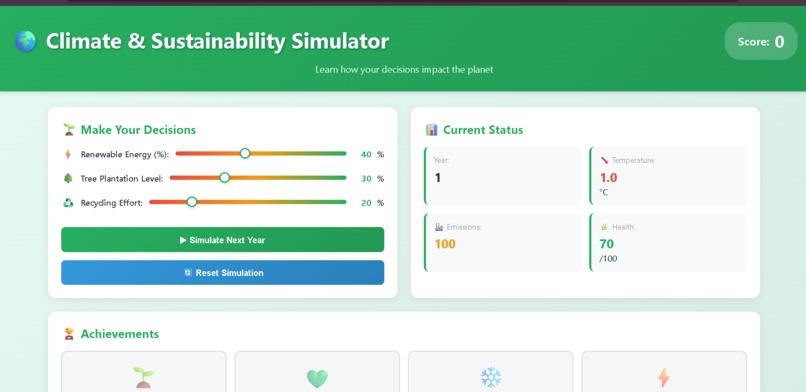
climate simulator dashboard

Inspiration
Climate change is often taught through textbooks and lectures, which makes it difficult for students to understand how everyday human decisions affect the environment. We wanted to create a tool where learners could experiment with choices and immediately see their impact, making climate education more engaging and practical.
What it does
Climate Simulation is a web-based interactive platform that allows users to adjust sustainability factors such as renewable energy usage, tree plantation, and recycling. Based on these inputs, the simulation dynamically updates CO₂ emissions, global temperature, and environmental health, helping users visualize cause-and-effect relationships.
How we built it
The project was built using HTML, CSS, and JavaScript. JavaScript handles the simulation logic, where environmental indicators are updated using simplified formulas such as: Δ𝑇∝CO₂ Emissions. Chart.js was used to visualize CO₂ emission trends, while a scoring and badge system was added to encourage sustainable decision-making.
Challenges we ran into
1)Designing climate logic that is scientifically meaningful yet simple
2)Keeping the UI intuitive for first-time users
3)Balancing educational accuracy with performance and clarity
Accomplishments that we're proud of
1)A fully functional climate simulation using only basic web technologies
2)Real-time graphs and gamification features
3)A clean, judge-friendly UI suitable for educational use
What we learned
1)How simulations can improve learning through interaction
2)Practical use of JavaScript for modeling real-world systems
3)Effective data visualization for educational platforms
What's next for Climate Simulation
1)Adding more climate indicators such as sea level rise and biodiversity
2)Introducing scenario-based challenges
3)Expanding the platform for classroom and curriculum integration.
Built With
- chart.js
- css
- flexbox
- html
- javascript
- vscode


Log in or sign up for Devpost to join the conversation.