-
-
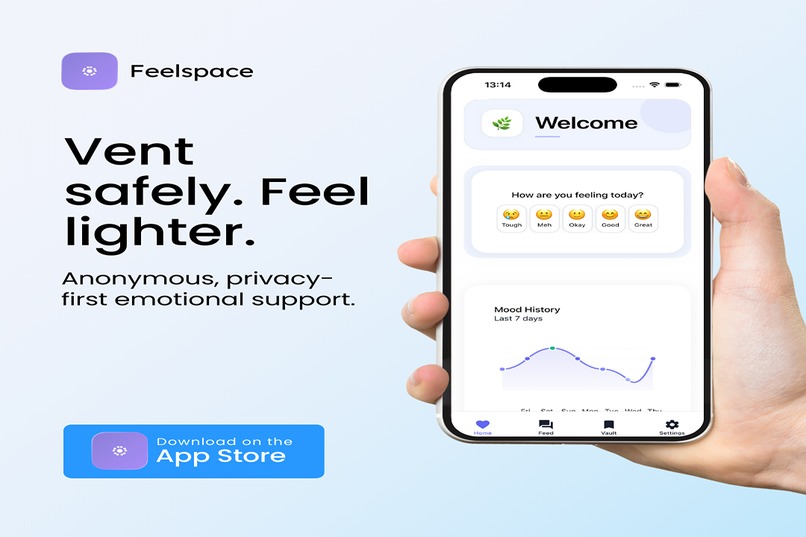
Feelspace Flyer

Most mental health tools ask people to open up after they are already comfortable sharing. My experience was the opposite. When I was struggling with stress and anxiety, the hardest part wasn’t finding help, it was finding a place where I could admit how I felt without being judged. That gap is what led me to build Feelspace.
Feelspace is an anonymous, privacy-first app designed to make emotional expression feel safe before it feels public. There are no profiles, no personal data, and no pressure to present yourself a certain way. Users can vent anonymously in themed rooms, track their mood over time, and reflect privately before choosing whether to engage with others. The core idea is simple: if people feel protected, they are more honest and honesty is where healing starts.
Building Feelspace taught me that mental health technology is as much about restraint as it is about innovation. Every feature had to earn its place. AI, for example, is used not to diagnose or replace professional care, but to gently prompt reflection using principles inspired by DBT. The system recognizes emotional patterns and responds with context-aware reflections designed to slow users down and help them process what they just shared. The challenge was designing AI that supports users without overstepping, especially in a space where trust is fragile.
From a technical perspective, I built Feelspace using Expo and React Native with TypeScript, focusing on performance, accessibility, and reliability. The app supports offline use with automatic syncing, a draft vault for private journaling, and a fully anonymous authentication model. One of the most complex parts of development was creating a moderation and reporting system that protects users while preserving anonymity. This includes layered content filtering, rate limiting, and automatic redirection to crisis resources when necessary: all without collecting personal data.
The biggest challenge I faced was deciding what not to build. Early versions of the app were more complex, but they felt heavier emotionally. Simplifying the interface, tightening animations, and refining language made the experience calmer and more human. That process taught me that good mental health design is invisible when done well.
Feelspace represents the intersection of my interest in computer science, ethical AI, and mental health advocacy. It is not meant to replace therapy or professional support. Instead, it serves as a first step—a quiet space where people can unload their thoughts, notice patterns, and feel less alone. Building this project pushed me to think not just about what technology can do, but about what it should do when real people are vulnerable on the other side of the screen.
Built With
- asyncstorage
- custom-ai-reflection-system-inspired-by-dbt-principles
- custom-content-moderation-pipeline
- eas
- expo-haptics
- expo-notifications
- expo-router
- expo.io
- express.js
- firebase-anonymous-authentication
- javascript
- javascript-frontend-framework:-react-native-(expo)-routing-&-navigation:-expo-router-animations-&-ui:-react-native-reanimated
- mixpanel-(privacy-first-and-optional)
- node.js
- offline-first-sync-architecture
- react-hooks
- react-native-(expo)
- react-native-reanimated
- sqlite
- typescript


Log in or sign up for Devpost to join the conversation.