-
-
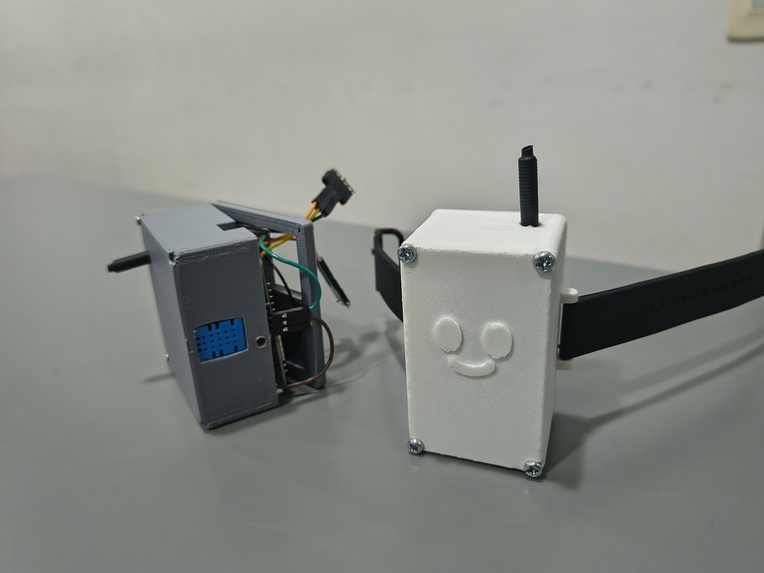
Master and slave nodes: 3D-printed physical prototypes used to validate LoRa communication and system roles in real-world conditions.

Inspiration
SIESPRO was inspired by a recurring tension in educational environments: the need to improve student safety without normalizing surveillance. Many existing solutions rely on GPS tracking, cameras, or continuous connectivity, which introduce privacy, ethical, and legal concerns. We wanted to explore whether it was possible to detect unauthorized exits while not knowing anyone’s location.
The guiding question was deliberately minimal:
Is a device inside or outside a permitted area?
What it does
SIESPRO is a LoRa-based presence monitoring system that classifies whether a device is inside or outside an authorized perimeter.
It does not perform localization, triangulation, or tracking. Instead, it uses:
- LoRa radio link metrics (RSSI, SNR)
- Environmental sensor data
- A machine learning classifier
The system outputs a simple binary result: inside or outside.
How we built it
The system uses a star topology with one master node and multiple slave nodes.
- Slave nodes are passive and anonymous. They only listen and respond with ACK packets.
- The master node polls slaves sequentially and collects link metrics and sensor data.
- Data is sent to a backend API where a Random Forest classifier performs inference.
Training is done offline using labeled data collected on-site, allowing the model to adapt to specific environments without requiring physical coordinates.
Challenges we ran into
- Designing a detection system that explicitly avoids localization
- Dealing with environmental variability that affects radio signals
- Collecting and labeling reliable training data
- Balancing system simplicity with classification accuracy
- Enforcing privacy at the architectural level, not as an afterthought
Accomplishments that we're proud of
- A working system that detects unauthorized exits without GPS, cameras, or Wi-Fi
- A privacy-by-design architecture where sensitive data is never generated
- Demonstrating that radio link characteristics can be used for contextual classification
- A low-power, long-range solution suitable for real deployments
What we learned
We learned that:
- Presence detection does not require precise location data
- Physical-layer signals can encode meaningful environmental information
- Privacy constraints can drive better system design
- Machine learning can adapt simple signals to complex real-world conditions
What's next for SIESPRO
Next steps include:
- Expanding datasets across multiple buildings and environments
- Evaluating lightweight on-device inference
- Improving model explainability
- Integrating with institutional safety workflows while maintaining strict privacy boundaries
Built With
- api
- c
- c++
- csv
- esp32
- fastapi
- flask
- html5
- javascript
- lora
- python
- render
- rest
- scikit-learn
- sx1278
- tailwindcss


Log in or sign up for Devpost to join the conversation.