-
-
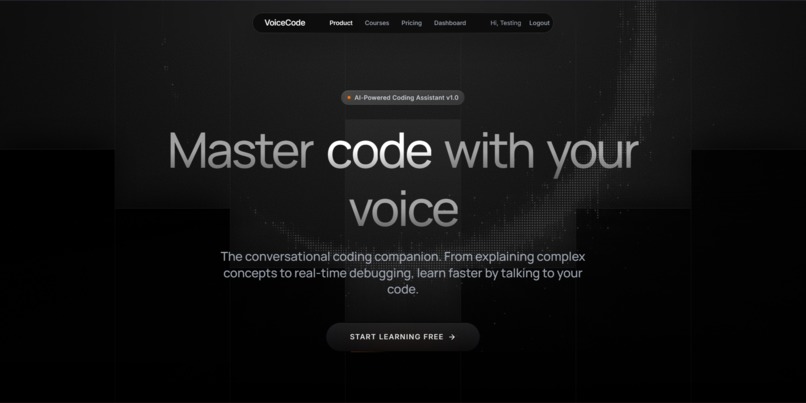
Hero section of the landing page with modern design and 3D Animation.
-
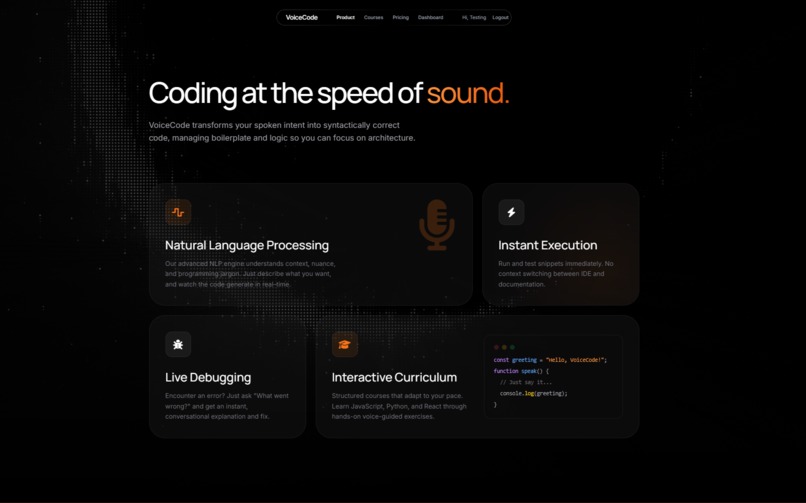
Landing page with more project details.
-
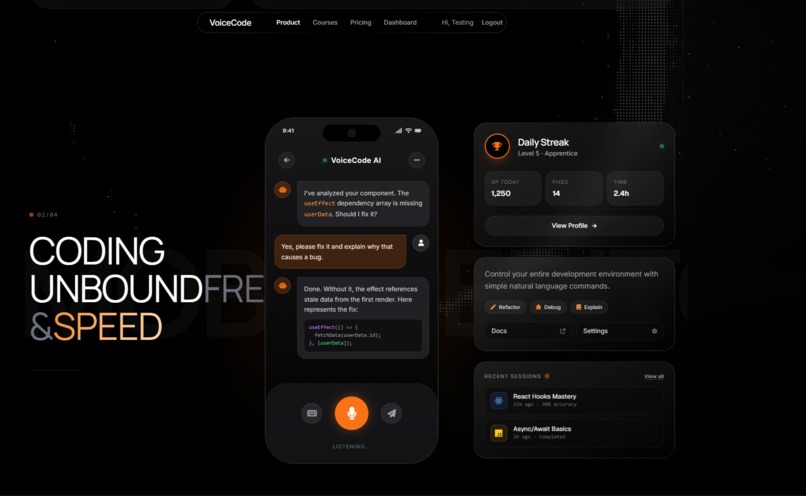
Mobile version look and other stats.
-
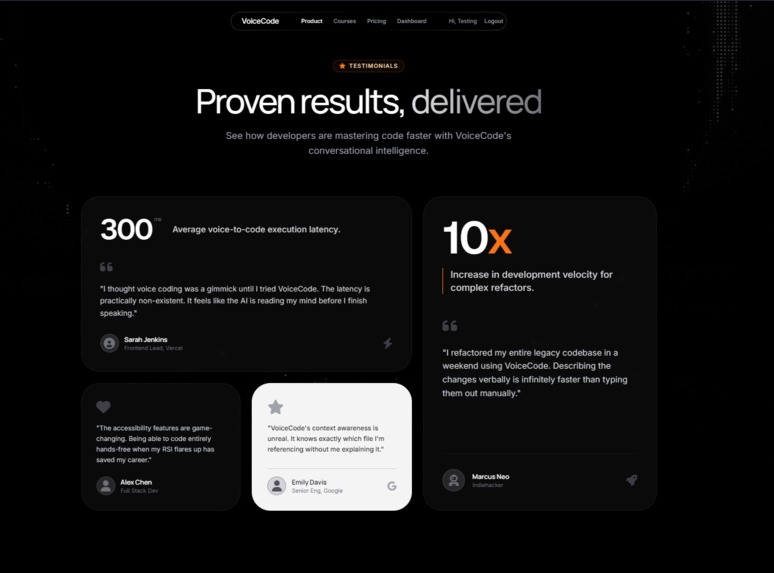
Features and specialties of our product.
-
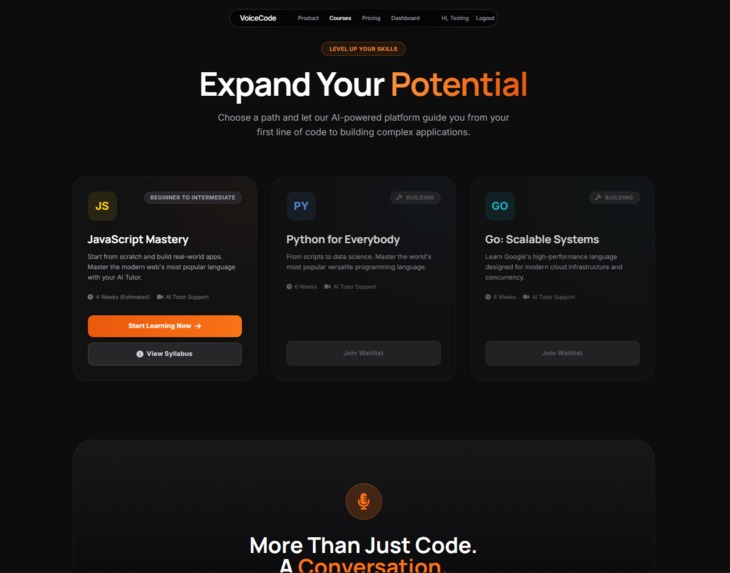
Real project page.
-
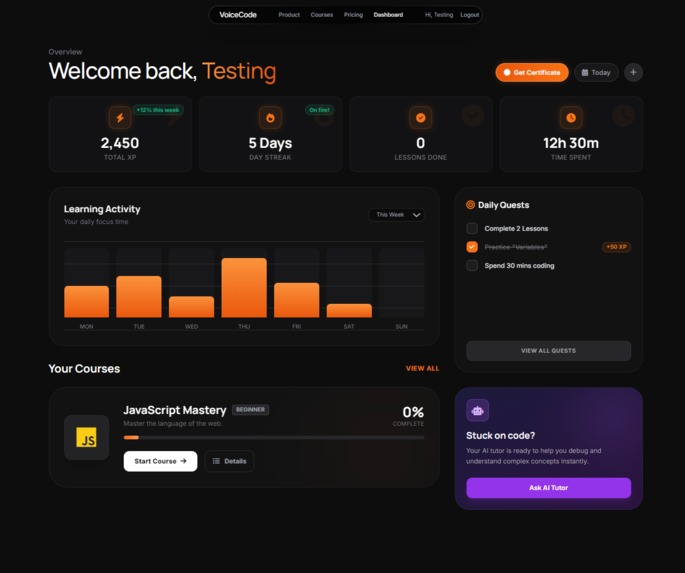
Modern and minimalistic Learning Dashboard.
-
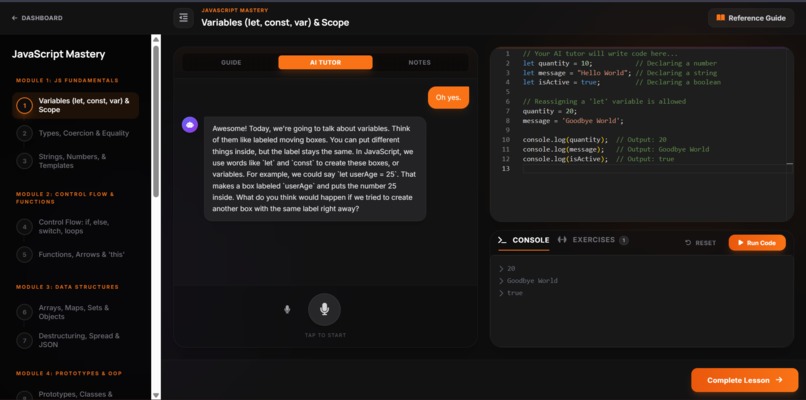
Real Ai powered learning Page with real time voice recognition and Browser-IDE access.


Inspiration
Learning to code is often framed as a purely visual activity—staring at a screen, reading documentation, switching between tabs, and typing continuously. While this works, it creates friction for beginners and cognitive overload for many learners. The inspiration behind VoiceCode.ai came from a simple question:
What if learning and writing code could feel like a natural conversation instead of a constant context switch?
We were inspired by the way humans learn best—by asking questions out loud, receiving immediate feedback, and iterating in real time. Existing coding assistants are powerful, but they still require users to stop, type, and search. We wanted to remove that barrier and create a hands-free, conversational coding tutor that feels more like a mentor sitting next to you than a tool you query.
What it does
VoiceCode.ai is a conversational, voice-powered coding tutor that allows users to:
- Ask programming questions using natural speech
- Get step-by-step explanations of code and concepts
- Generate, refactor, and debug code through voice commands
- Learn programming concepts interactively without breaking flow
It transforms coding from a silent, keyboard-bound task into an interactive dialogue, helping learners focus on thinking rather than searching.
How we built it
VoiceCode.ai was built by combining multiple complex systems into a single seamless experience:
Voice Input Pipeline
We implemented real-time speech recognition to accurately convert spoken language into structured programming queries.Conversational AI Layer
The transcribed input is processed using an AI reasoning layer that understands both:- Natural language intent
- Programming context (syntax, logic, errors)
- Natural language intent
Code Intelligence Engine
The system generates contextual responses such as explanations, examples, or corrected code, adapting the output based on user intent.Response Delivery
Answers are returned in a structured, beginner-friendly format that prioritizes clarity, correctness, and learning value.Frontend Integration
A clean, minimal interface was designed to keep the focus on conversation and learning rather than UI complexity.
Each component had to work together with low latency and high accuracy, which required careful orchestration across the stack.
Challenges we ran into
Building VoiceCode.ai was significantly harder than it looks on the surface.
Speech-to-Code Accuracy
Spoken programming terms (like symbols, function names, or syntax) are notoriously difficult to transcribe correctly. We had to fine-tune how queries were interpreted to avoid semantic errors.Context Preservation
Coding is stateful. Ensuring the AI remembered prior questions, code snippets, and learning context was a major challenge.Balancing Simplicity and Power
We had to ensure explanations were simple enough for beginners while still being technically accurate.Latency & Responsiveness
Voice interactions demand fast feedback. Optimizing the pipeline so responses felt conversational rather than delayed required multiple iterations.Designing for Learning, Not Just Output
Generating code is easy; teaching through code is not. We focused heavily on explanation quality and learning flow.
Accomplishments that we're proud of
- Successfully built a fully voice-driven coding assistant
- Created a system that explains why code works, not just what to write
- Reduced learning friction by eliminating constant typing and searching
- Designed a project that is both technically complex and genuinely useful
- Delivered an end-to-end product within hackathon constraints
What we learned
This project taught us far more than just technical skills:
- How to design AI systems around human behavior and learning
- The importance of context in conversational interfaces
- That building intuitive tools often requires more complexity behind the scenes
- How to rapidly prototype, test, fail, and iterate under time pressure
Most importantly, we learned that good developer tools don’t just speed things up—they change how people think.
What's next for VoiceCode.ai
We see VoiceCode.ai as just the beginning. Next steps include:
- Multi-language programming support
- IDE and editor integrations
- Personalized learning paths based on user skill level
- Voice-based debugging and code walkthroughs
- Accessibility-focused features for visually impaired learners
Our long-term vision is to make coding as natural as conversation, lowering the barrier to entry for millions of future developers.
Built With
- browser-ide
- cloud-based-api
- database
- firebase
- google-drive-api
- google-gemini-api
- google-gmail-oauth
- google-slides-api
- google-web-authentication
- javascript
- make.com
- next-js
- node.js
- online-code-compiler
- react
- react-js
- real-time-speech-recognization
- realtime-data-analysis
- realtime-web-search
- stt
- tailwind-css
- tts
- typescript
- webhook
- webhooks


Log in or sign up for Devpost to join the conversation.