-
-
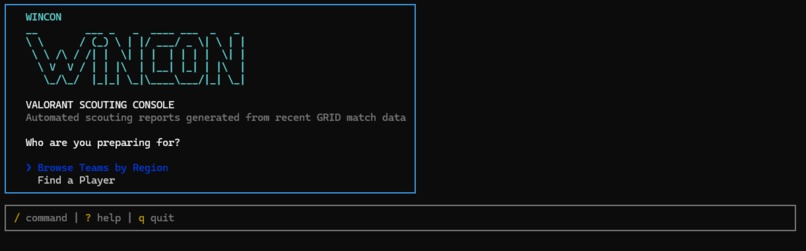
Landing Page
-
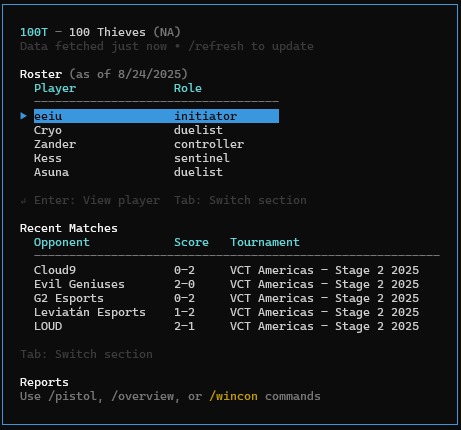
Team Page
-
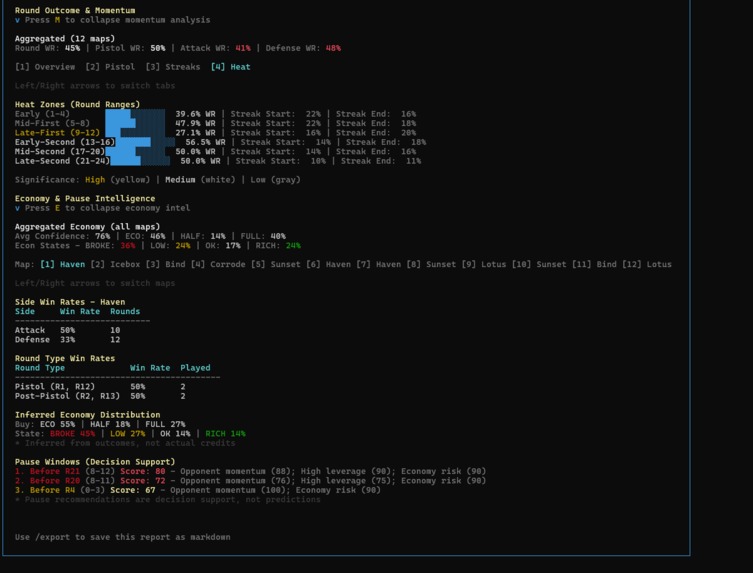
Team Overview
-
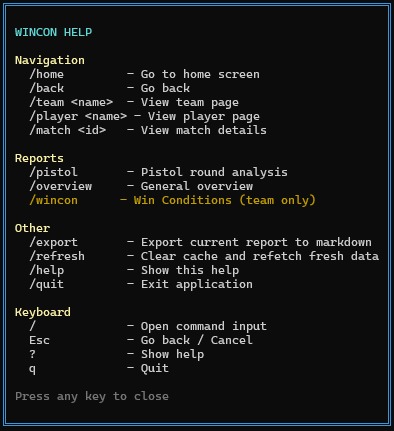
Help page


Inspiration
WinCon came from two complementary perspectives.
The first is an analyst’s perspective. In analytical work, clarity matters more than volume. The goal is not to surface every possible metric, but to surface the right information, consistently, without distraction. Analysts care about reliability, repeatability, and speed. You want to be able to fetch data quickly, trust that it is computed the same way every time, and see it presented in a stable format across different views.
That mindset shaped WinCon’s design philosophy. The inspiration here came less from consumer dashboards and more from tools built for professionals, where information density and discipline matter. Systems like the Bloomberg Terminal or the Counter-Strike developer console are not designed to be flashy or friendly. They are designed to expose power and control to users who know exactly what they are looking for. Experienced Counter-Strike players often bypass menus entirely and use the console, not because it is easier to read, but because it is precise, predictable, and unopinionated. WinCon adopts that same philosophy. This is not a fan-facing product. It is a tool built for coaches and analysts.
The second perspective comes from competitive play itself. After spending extensive time playing and studying VALORANT, one pattern becomes clear: many commonly presented stats are technically correct, but strategically unhelpful. Knowing that a team wins more often when a star player gets an opening kill is true, but it is also obvious. Information like that rarely changes how a coach prepares or reviews a match.
WinCon was intentionally built to prioritize non-obvious, high-leverage signals instead. Instead of asking “who is the best player?”, it asks questions like which player’s performance actually shifts round outcomes the most, or which player quietly stabilizes a team when they show up. These are not always the players at the top of the scoreboard. Sometimes the most impactful player is the one whose success turns fragile rounds into reliable wins.
That distinction is rarely visible in public stat tools, but it is exactly the kind of insight that drives real preparation and review. WinCon exists to surface those insights. It is built on the belief that not all good performance is equally important, and that meaningful analysis should help teams understand what actually decides rounds, not just describe what already happened.
What It Does
WinCon is a report-driven competitive analytics system that identifies where rounds are won, where momentum shifts, and where intervention has the highest leverage, within a defined competitive window.
Instead of treating rounds as independent events or relying on surface-level statistics, WinCon models round sequences, economic pressure, and outcome sensitivity using only observable match data.
WinCon is structured around two primary reports:
Team Overview Report: how rounds unfold, where momentum forms, and where pressure accumulates
Win Condition Report: which conditions actually separate wins from losses
Team Overview Report
The Team Overview Report is where most of WinCon’s computation lives.
It models round flow, momentum, economy stress, and pause value using deterministic logic grounded entirely in round-level outcomes.
Round Outcome and Momentum Modeling
Rounds are modeled sequentially, not independently.
For each map \( m \), side performance is computed as:
$$ WinRate_{side}(m)=\frac{RoundsWonOnSide}{RoundsPlayedOnSide} $$
A side is only labeled as meaningfully stronger if:
$$ |AttackWinRate-DefenseWinRate|>0.05 $$
This prevents small-sample noise from being misclassified as identity.
Pistol and Post-Pistol Impact
WinCon explicitly tracks pistol rounds (Rounds 1 and 13) and post-pistol rounds (Rounds 2 and 14).
Conditional map win rates are computed as:
$$ P(MapWin|PistolWin) $$
$$ P(MapWin|PostPistolWin) $$
All conditional rates are surfaced alongside sample sizes to avoid overinterpretation.
Streak and Momentum Behavior
Momentum is measured using observable win streak behavior.
For a streak of length \( k \), WinCon computes the probability of continuation:
$$ P(Win_{r+1}|k\ consecutive\ wins)=\frac{WinsAfterStreak}{Opportunities} $$
This distinguishes true momentum continuation from noise-driven streaks.
Economy Intelligence (Outcome-Driven)
WinCon does not assume hidden credit values.
Economy state is inferred strictly from observable signals such as round outcomes, win and loss sequences, and pistol and post-pistol structure.
Each round is classified as:
$$ E_r \in {BROKE,LOW,OK,RICH} $$
WinCon evaluates performance under economic stress by computing distributions such as:
$$ P(E_r=BROKE) $$
$$ P(E_r=RICH) $$
All economy outputs are explicitly labeled as inferred, not actual credits.
Pause Intelligence
Pause intelligence is modeled as decision support, not prediction.
Opponent momentum is computed as:
$$ Momentum=(0.6\cdot RecentWinRate+0.4\cdot MaxStreak)\times 100 $$
Economy risk is mapped from inferred state:
$$ EconRisk=90 \quad \text{if } E_r=BROKE $$
$$ EconRisk=60 \quad \text{if } E_r=LOW $$
$$ EconRisk=30 \quad \text{if } E_r=OK $$
$$ EconRisk=10 \quad \text{if } E_r=RICH $$
Final pause score is computed as:
$$ PauseScore=\frac{w_m\cdot Momentum+w_l\cdot Leverage+w_e\cdot EconRisk+w_s\cdot SideSwap}{100} $$
Only pause windows exceeding a strict threshold are surfaced.
Win Condition Report
The Win Condition Report measures outcome sensitivity relative to the team’s own baseline.
For each condition \( C \):
$$ Impact(C)=P(Win|C)-P(Win) $$
Bayesian smoothing is applied using a Beta posterior:
$$ p \sim Beta(w+1,n-w+1) $$
This framework is applied to side identity, closing ability, and player outcome dependence.
How I Built It
WinCon was built as a report-driven analytical system, not as a traditional dashboard.
The core design principle was separation of concerns. Data ingestion, computation, reporting, and rendering are all handled independently so that analysis remains stable and repeatable.
At a high level, the system works as follows:
- Raw match data is fetched and normalized into a consistent round-level format
- Deterministic logic computes economy state, momentum behavior, and outcome statistics
- Reports are generated from these computations without altering the underlying logic
- The interface renders reports and supports export without reinterpreting results
All analysis is derived from observable match outcomes only. No hidden game state or unavailable variables are assumed.
This architecture keeps WinCon focused on correctness, transparency, and analyst trust.
Challenges I Ran Into
One of the biggest challenges was working with incomplete public data.
GRID does not expose per-player economy values, which meant economy had to be inferred using observable signals such as round results, streaks, and known structural rules. Designing an inference system that was useful without being misleading required conservative assumptions and clear labeling.
Another challenge was avoiding overinterpretation. Small sample sizes can easily produce convincing but fragile insights. WinCon explicitly filters conditions by sample support and effect size to reduce false signals.
On the product side, balancing information density and usability was difficult. The solution was not to add more features, but to remove anything that did not directly support preparation or review.
Accomplishments That I'm Proud Of
- Built a competitive analytics tool focused on decision support, not stat presentation
- Designed a deterministic economy and momentum inference system without access to hidden data
- Surfaced non-obvious leverage points, not just top performers
- Delivered consistent, exportable reports designed for real coaching workflows
WinCon intentionally avoids overstating certainty. That restraint is a core design choice.
What I Learned
One major lesson was that clarity matters more than complexity.
Adding more models or metrics does not automatically produce better insights. What matters is whether the output meaningfully changes preparation, review, or intervention decisions.
We also learned that analysts and coaches value tools that:
- make assumptions explicit
- admit uncertainty
- stay consistent across views and time windows
Finally, WinCon reinforced that esports analytics works best when it respects the structure of the game. Economy, momentum, and round flow are systems with rules, and modeling those rules directly leads to more trustworthy insights.
What’s Next for WinCon
Future work on WinCon focuses on depth rather than breadth.
Planned improvements include:
- Refining economy inference using additional round-level signals
- Improving momentum modeling around resets and stabilization
- Adding cross-snapshot comparisons to track identity changes over time
- Allowing analysts to select specific game ranges for analysis, enabling timelines that align with current metas, roster changes, and competitive phases
Long term, the goal is to make WinCon a scouting and review companion that teams return to as metas, rosters, and playstyles evolve.
WinCon is not a prediction engine. Its value lies in helping teams understand what actually matters, right now.
Built With
- bash
- graphql
- ink
- java
- node.js
- react
- typescript
- zustand


Log in or sign up for Devpost to join the conversation.