
Elite: Dangerous
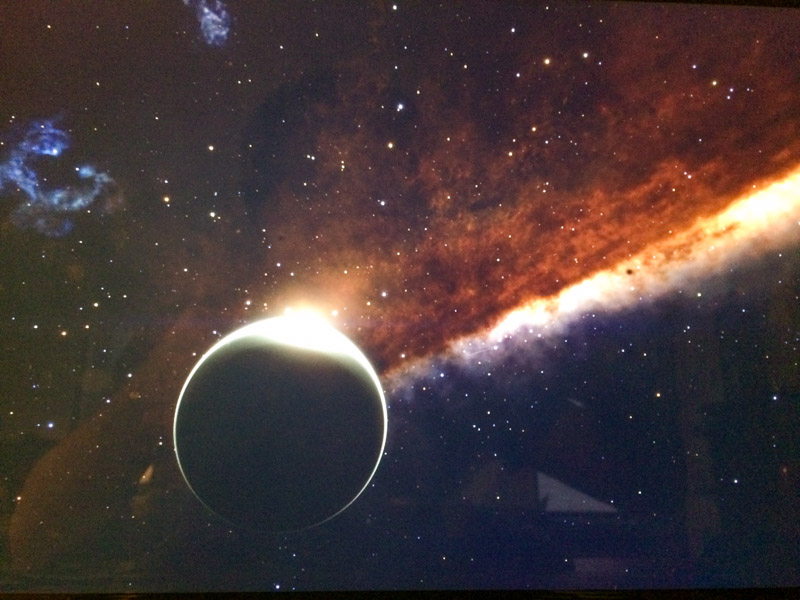

In 1984 two friends fit a simulated galaxy into 22 Kilobytes, a programming feat that inspired the creation of the first internet newsgroup as well as a generation of programmers.
After a successful crowdfunding campaign in 2013 one of them brought the classic Elite video game to a new generation, this time simulating part of what we know about the galaxy we live in with programming techniques based on real-world data filling in what we don’t.
Hypertexthero Elite: Dangerous videos
Elite: Dangerous is a particularly important work to me because I’ve always loved looking at and thinking about the stars at night, and because I began to play shortly after my dad died, returning to them.
I wanted to escape the planet during that time, and it let me do it.
Elite’s Milky Way is a place to play, to imagine, and could be considered a testing platform for future space exploration ideas from engineering to everything else. A holistic education about the cosmos that the human species are still a living part of, even if it feels at times only barely.

I’ve come to think of the title, Elite: Dangerous, as a subtle powerplay on the idea of elites and the nationalism and organized religion they exploit as a danger to the well-being of the rest of Earth’s inhabitants.
Perhaps when we stop fighting over lines on maps here on Earth, we may well begin fighting over them in space.
‘SteveWilds’ in the comments of The New Yorker’s article about Elite:1
You can also explore this reconstructed galaxy in David Braben’s game. In fact the first and biggest player group in the game will be the First Great Expedition, whose goal is to travel as far into the simulation as possible, mapping and recording their discoveries as they go, as virtual scientific endeavour.
No other computer game has given people the opportunity to do this, let alone in a theoretically accurate simulation of this scale.

Frontier Developments’ work is art fused with science and engineering in the spirit of the Renaissance, exploring human themes of curiousity, communication and commerce, loneliness, fear and love, through our greatest medium of communication so far.
Elite brings me joy because like the internet, it shows that humans are capable of creating beauty during and despite of our continuing mass-stupidity.

I’ve written about the experience of flying in a spaceship, which has to do with sound and music, the language of the soul, and having done that leave you with Kurt Vonnegut:2
I sometimes wondered what the use of any of the arts was. The best thing I could come up with was what I call the canary in the coal mine theory of the arts. This theory says that artists are useful to society because they are so sensitive. They are super-sensitive. They keel over like canaries in poison coal mines long before more robust types realize that there is any danger whatsoever.
And Carl Sagan, the great teacher and astrophysicist, and leader of the Voyager program:
For we are the local embodiment of a Cosmos grown to self-awareness. We have begun to contemplate our origins: starstuff pondering the stars; organized assemblages of ten billion billion billion atoms considering the evolution of atoms; tracing the long journey by which, here at least, consciousness arose. Our loyalties are to the species and the planet. We speak for Earth. Our obligation to survive is owed not just to ourselves but also to that Cosmos, ancient and vast, from which we spring..

See a music video for one of my songs improvised during an Elite: Dangerous Odyssey play session with my friend Yootsvik. See you out there, Cmdr!

Children of stardust…
Say not that we are leaving:
We are going home.
—Jay Reynolds Freeman via Ctein
· ˖ ✦ . ˳
Come with me in creative journeys through music and play by subscribing to my YouTube and Twitch channels. ❤︎ Did you enjoy this post? You can buy me a moment of time.
Possibly Related:
- Atmospheric landings in Elite Dangerous soon?
- Music video for E44 Stream End Piano Synth Improvisation
- Operation Sol Raxxla
- Delta V: Rings of Saturn
- Star Citizen
˳ · ˖
Prior entry: George Orwell Politics and the English Language
Next entry: Doom Versus Windows, Hierarchy
