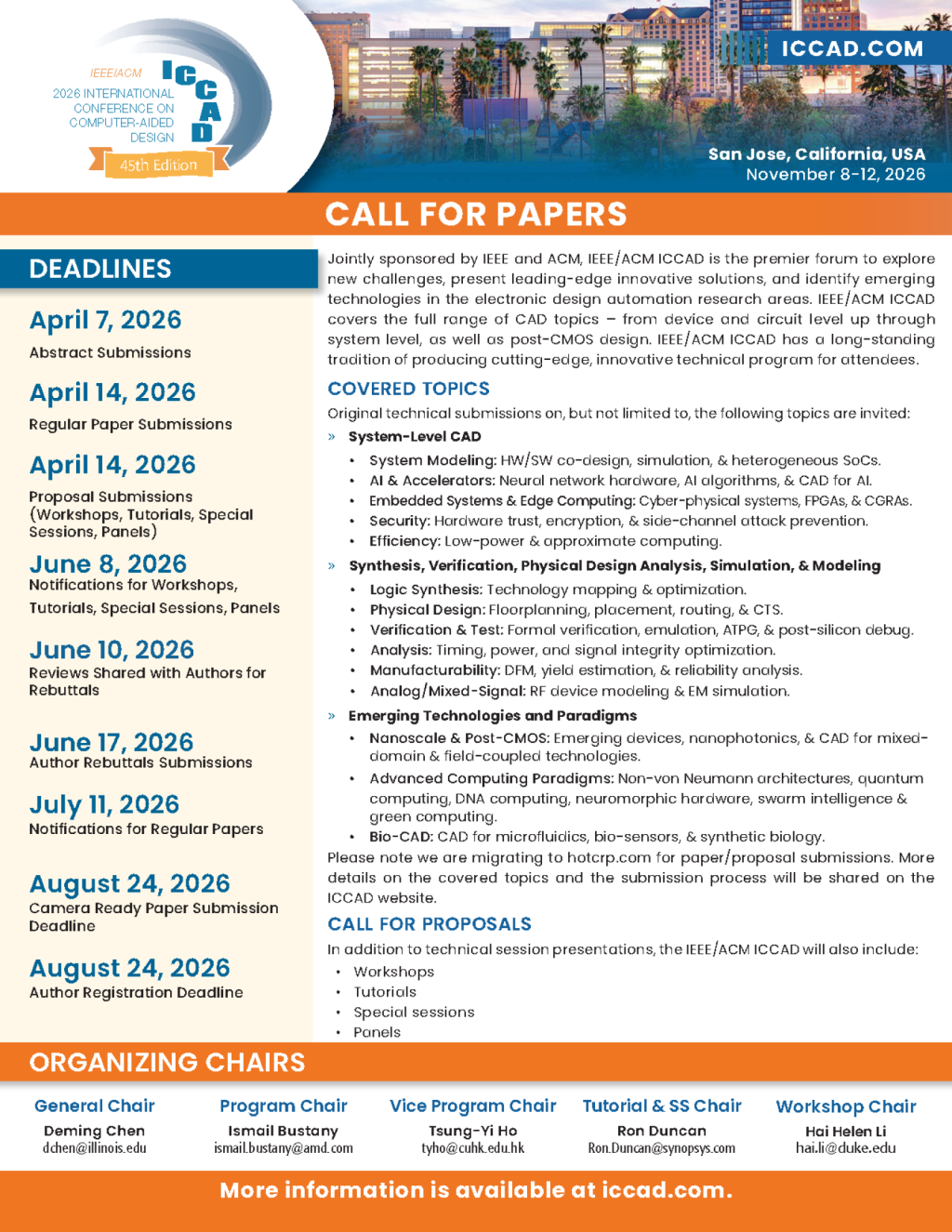
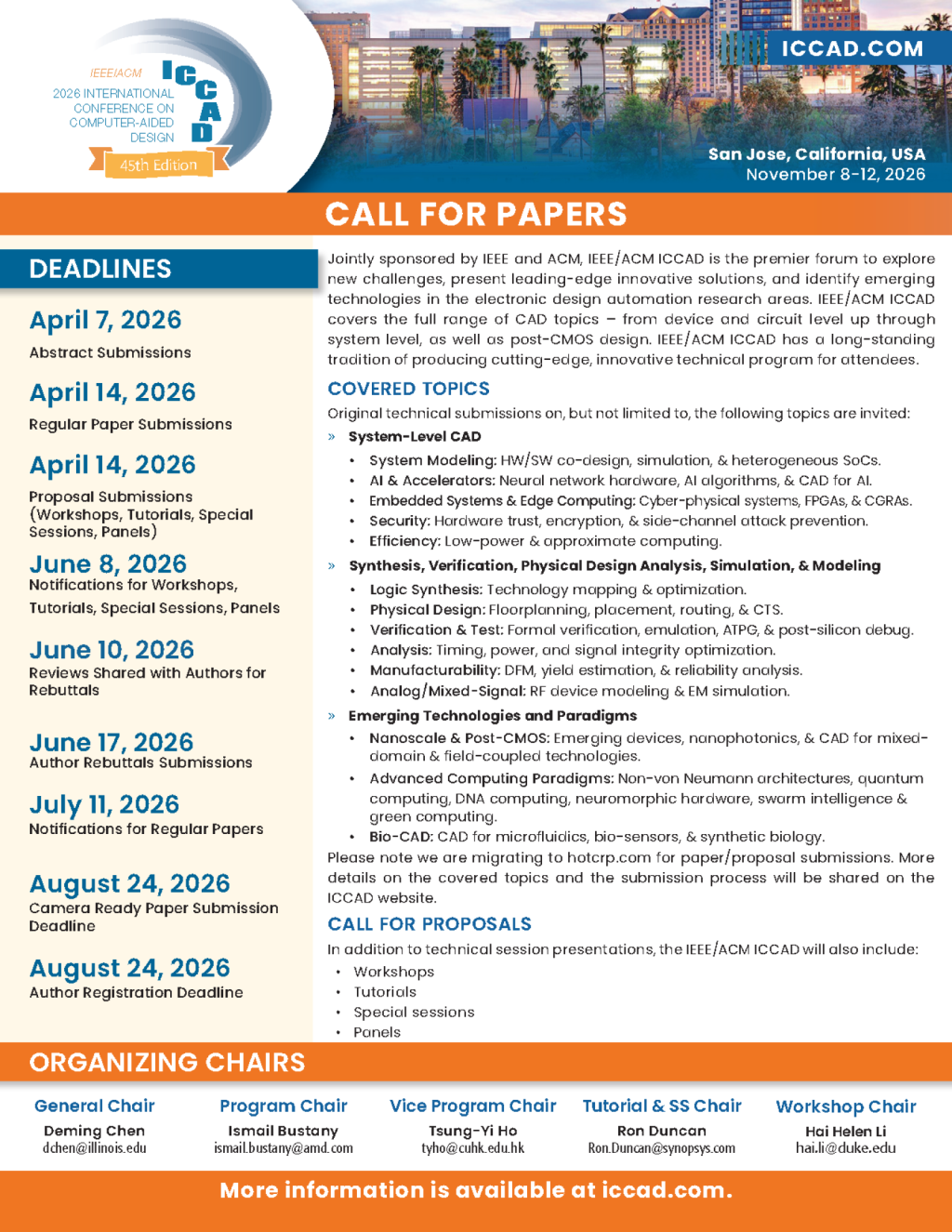
November 8-12, 2026 | San Jose, California, USA
IEEE ICCAD 2026
Mark Your Calendar
Important Dates & Deadlines
Proposal Submissions (Workshops, Tutorials, Special Sessions, Panels)
April 14, 2026Notifications for Workshops, Tutorials, Special Sessions, Panels
June 8, 2026Authors
Call for Papers
Jointly sponsored by IEEE and ACM, IEEE/ACM ICCAD is the premier forum to explore new challenges, present leading-edge innovative solutions, and identify emerging technologies in the electronic design automation research areas. IEEE/ACM ICCAD covers the full range of CAD topics – from device and circuit level up through system level, as well as post-CMOS design. IEEE/ACM ICCAD has a long-standing tradition of producing cutting-edge, innovative technical program for attendees.
Special Thanks
Conference Supporters
IEEE
Sponsor
Conference
IEEE is a global network of over 500,000 engineering and STEM professionals. Our core purpose is to foster technological innovation and excellence for the benefit of humanity.

Council on Electronic Design Automation (CEDA)
Sponsor
Conference
The Council on Electronic Design Automation (CEDA) was established to foster design automation of electronic circuits and systems at all levels. The Council’s field of interest spans the theory, implementation, and use of EDA/CAD tools to design integrated electronic circuits and systems. This includes tools that automate all levels of the design, analysis, and verification of hardware and embedded software up to and including complete working systems. CEDA enables the exchange of technical information by means of publications, conferences, workshops, and volunteer activities.
As an organizational unit (OU) of IEEE, CEDA has seven member societies, namely: Antennas and Propagation, Circuits and Systems, Computer, Electron Devices, Electronics Packaging, Microwave Theory & Techniques, and Solid-State Circuits Societies.
To assure grounding in the major technology activities of the electronic design automation field, the Council has Member Technology Organizations from specific conferences, publications, and organizations. These Organizations bring information on the activities and directions of the EDA/CAD field.As CEDA is an IEEE Technical Council, individuals cannot be members of CEDA itself. However, they can register as CEDA participants and receive newsletters and updates on activities in design automation.
SIGDA
Sponsor
Conference
SIGDA is committed to advancing the skills and knowledge of electronic design automation professionals and students throughout the world. We do so in a variety of ways: sponsoring and organizing international workshops, symposia and conferences; leading the way in capturing archival electronic design automation publications; providing travel grants to sponsored workshops, symposia and conferences; pioneering the maintenance and distribution of electronic design automation benchmarks; hosting university and government researchers for software demonstrations at the University Research Demonstration at DAC; publishing the SIGDA Newsletter; maintaining a World Wide Web access site on Internet; creating the webinar series SIGDA LIVE, and managing the ACM Transactions on Design Automation of Electronic Systems. Highlights of our recent activities can be seen via our website and scoial media accounts.

CAS
Sponsor
Conference
The IEEE Circuits and Systems Society is the leading organization that promotes the advancement of the theory, analysis, computer-aided design and practical implementation of circuits, and the application of circuit theoretic techniques to systems and signal processing. The Society brings engineers, researchers, scientists and others involved in circuits and systems applications access to the industry’s most essential technical information, networking opportunities, career development tools, and many other exclusive benefits.
Electron Devices Society (EDS)
Sponsor
Conference
EDS began in 1952 as a committee of the Institute of Radio Engineers (IRE). With the merger in 1963 of the IRE and the American Institute of Radio Engineers, EDS became a technical group under the newly formed IEEE. In 1976, EDS became a society of IEEE.
Mission: To foster professional growth of its members by satisfying their needs for easy access to and exchange of technical information, publishing, education, and technical recognition and enhancing public visibility in the field of Electron Devices.
Vision: Promoting excellence in the field of electron devices for the benefit of humanity.
