The @keyframes at-rule sets the value of properties at different points during an animation, so instead of defining how each property should behave at each frame of an animation, we set its keyframes, and CSS will figure out (i.e., interpolate) the values between them.
The @namespace at-rule can make a stylesheet target a specific code dialects, such as MathML, SVG, and XML. It works by declaring which dialect to scope using a namespace, which can be prefixed to match specific selectors, or non-prefixed to match every selector in the stylesheet.
Going from the most basic ways to style lists directly in HTML to advanced customization techniques that are even capable of making things that aren't lists look like lists.
The @import at-rule merges a CSS file into another one. It’s written at the top of the document, before any other CSS (except @charset and @layer rules), so if we try to write any other rule before @import, it …
The @page at-rule lets us style a site when presented as a paged media, that is, when printed or displayed as a PDF. Specifically, it allows us to set the page’s size, orientation, and margins. In supporting browsers, we …
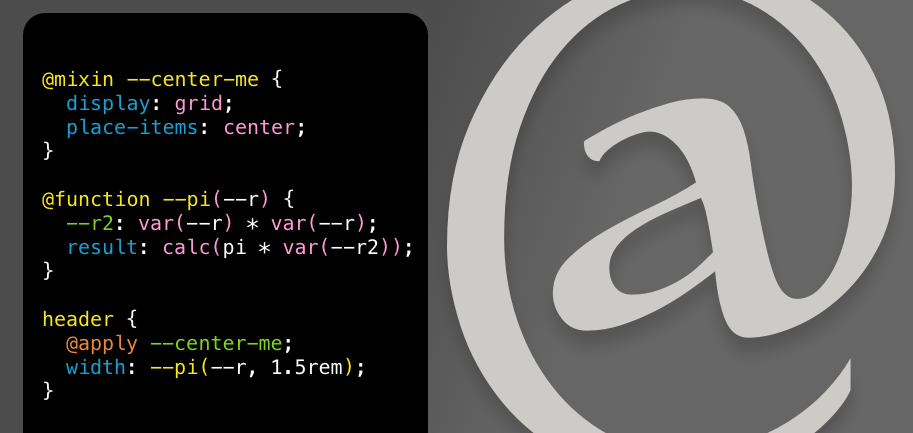
Arguments?! Return values?! What's crazier, you can use functions right now in Chrome Canary! So, after reading and playing around, here are my key insights on what you need to know about CSS Functions.