
About the Workshop
Uncertainty quantification has long been a core aspect of robotics. It has improved the reliability of all components of the robotics pipeline, from perception, to state estimation, control, and planning. However, in the past five years, all these components have started to rely on–or be replaced with–extremely large pre-trained AI models, raising the question: what does uncertainty quantification mean in this new era? For instance, foundation models (e.g., LLMs, VLMs, VLAs, and world models) are trained on internet-scale datasets, typically lack explicit probabilistic representations, and their enormous parameter sizes make established uncertainty quantification techniques (e.g., ensembling) computationally impractical. Furthermore, even when these models are deployed as components within a modular autonomy pipeline, it remains difficult to understand how uncertainty at the component level influences overall system-level performance.
This workshop revisits the foundational problem of uncertainty quantification in light of these “modern robotics paradigms.” We aim to bring together a diverse group of academic, industrial, and government researchers focusing on uncertainty across all components of robot autonomy. Our goal is to chart a comprehensive roadmap for the next generation of uncertainty-aware robotics: (1) establishing a rigorous understanding of the new sources of uncertainty that can influence next-generation robotic systems, (2) exploring methods to quantify and mitigate uncertainty in the era of robotics foundation models, and (3) examining key challenges and future directions for building reliable, uncertainty-aware robotic systems.
Discussion Themes
- How should we quantify, calibrate, and mitigate uncertainty in robotic systems built on large pretrained models, including VLAs, VLMs, and world models?
- Are traditional uncertainty frameworks, such as Bayesian methods, still scalable and meaningful for modern robotics foundation models?
- What forms of verification, statistical guarantees, and reliability assessment are practical for learning-based robotic systems deployed in open-world settings?
- How should we reason about component-level versus system-level uncertainty, and which uncertainties actually matter for safe and reliable robot operation?
Talk Recordings
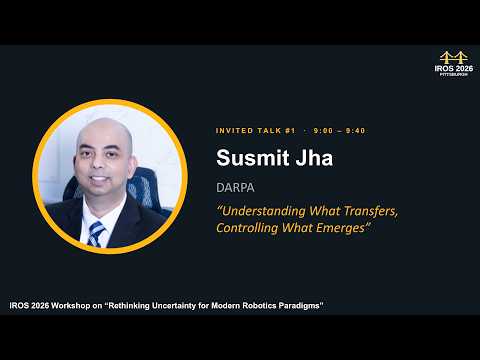
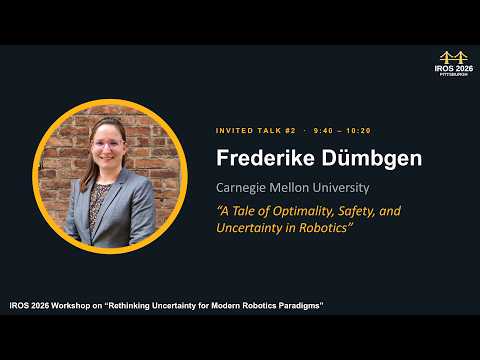
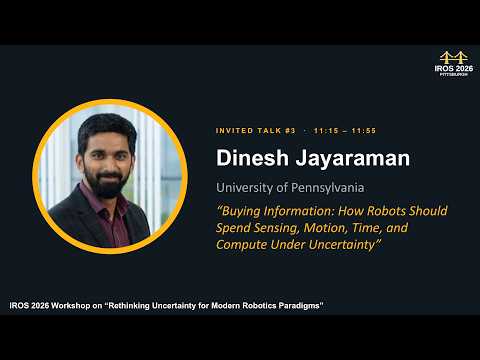
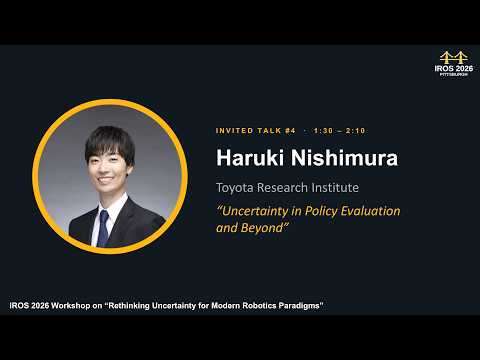
Missed the workshop? All invited talks and the panel discussion are available on YouTube.
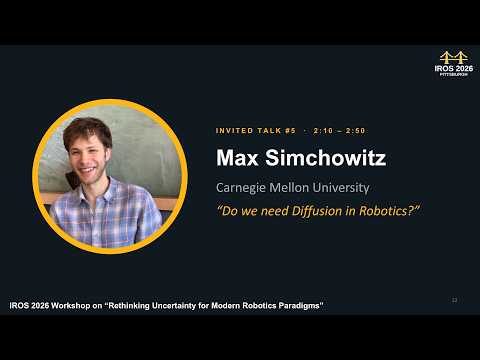
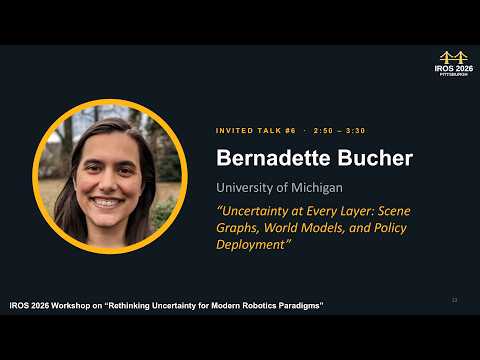
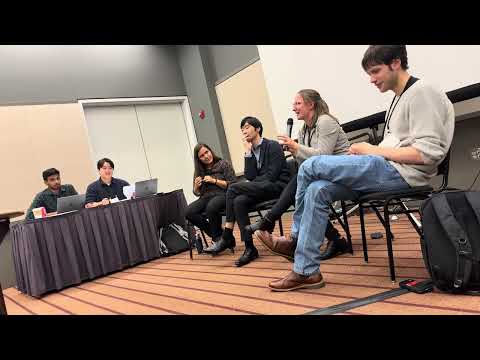
Moderators: Prasanna Sriganesh, Junwon Seo
Schedule
Full-day program · September 27, 2026. All times are tentative.
| Time | Talk | Comments |
|---|---|---|
| 8:45 am – 9:00 am | Welcome and opening remarks | |
| 9:00 am – 9:40 am | Speaker Talk #1 ▶ Video | Susmit Jha |
| 9:40 am – 10:20 am | Speaker Talk #2 ▶ Video | Frederike Dümbgen |
| 10:20 am – 11:15 am | Coffee Break · Poster Session #1 | All papers |
| 11:15 am – 11:55 am | Speaker Talk #3 ▶ Video | Dinesh Jayaraman |
| 11:55 am – 12:30 pm | Oral Session #1 | 5 papers × 7 mins each |
| 12:30 pm – 1:30 pm | Lunch Break | |
| 1:30 pm – 2:10 pm | Speaker Talk #4 ▶ Video | Haruki Nishimura |
| 2:10 pm – 2:50 pm | Speaker Talk #5 ▶ Video | Max Simchowitz |
| 2:50 pm – 3:30 pm | Speaker Talk #6 ▶ Video | Bernadette Bucher |
| 3:30 pm – 4:20 pm | Coffee Break · Poster Session #2 | All papers |
| 4:20 pm – 5:00 pm | Panel Discussion ▶ Video | Bucher, Nishimura, Dümbgen, Simchowitz · moderated by Sriganesh and Seo |
| 5:00 pm – 5:30 pm | Closing Remarks and Awards |
Invited Speakers


Call for Papers
We invite short papers (4+n pages) submissions to share their findings with the community and engage in discussions on the past, present, and future directions of uncertainty-aware methods in robotics. We aim to bring together a diverse group of researchers—spanning machine learning theory, statistics, computer vision, mapping, decision-making, reinforcement learning, control theory, and robot learning—across all levels of embodied AI systems, with the shared goal of understanding and mitigating uncertainty for safe, trustworthy, and reliable robot operation. Topics of interest include, but are not limited to:
- Uncertainty Quantification for Robotic Foundation Models (VLAs, VAMs, World Models, etc.)
- Out-of-Distribution Detection
- Active and Continual Learning for Large Robotic Foundation Models
- Failure Detection and Recovery
- Verification, Calibration, and Reliability Assessment of Robotic Systems
- Statistical Guarantees of Robotic Systems
- Safety and Robustness of Learning-based Robotic Systems
- Evaluation for Robotic Foundation Models
- Planning and Control under Partial Observability
Submission
- Portal: Submit via OpenReview.
- Length: 4 + n pages (4 pages excluding references and appendices).
- Format: Submissions in PDF (IEEE conference templates). Reviewing is single-blind, so submissions need not be anonymized.
- Supplementary: Optional supplementary material (e.g., additional results, videos) may be uploaded as a single zip file.
Review & Presentation
- All accepted papers will be presented as posters at the IROS 2026 workshop.
- A subset of accepted papers may be selected for short spotlight talks.
- Visibility: Submissions and reviews will not be public. Only accepted papers will be made public.
- Accepted work must be presented in person.
Non-archival: Sharing papers in this way does not constitute formal proceedings, i.e., this workshop is a non-archival venue that will not restrict later renditions of the work from being published in archival conferences or journals.
Accepted Papers
33 accepted papers · 5 selected for oral presentation. Titles link to OpenReview.
Oral Session #1 · 11:55 am – 12:30 pm
- Robust Task-Aware State Estimation from Pretrained Perception
- Spatial-Semantic Uncertainty in VLM-Based Target Search: Balancing Exploration and Identification
- Joint Uncertainty-Aware World Modeling and Latent Parameter Estimation for Multi-Finger Manipulation Best Paper Runner-up
- Closed-Form Failure Prediction for Learned Policies with the Inverse Christoffel Function 🏆 Best Paper Award
- Confidence-aware Articulated Object Manipulation
Poster Session #1 · Morning, 10:20 am – 11:15 am
- Evaluating Data Attributes of Egocentric VLA Models
- Benchmarking Heterogeneous and Compositional Continual Learning for Vision-Language-Action Models
- Uncertainty-Guided Active Gaussian Reconstruction with Explicit-Implicit Fusion
- The Bellman License: Minimax Real-Transition Audits for World-Model Policy Improvement
- Adaptive Action Horizon Selection via Flow-Field Uncertainty
- From Perturbation Variance to Detection Risk: Learned Calibration of Localized Evidence for Robotic Perception
- Calibrated Vision-Language Perception for Risk-Aware Action Selection in Urban Driving
- Decoded and Generated Actions in Vision–Language Spatial Planning
- Risk-Aware Kinodynamic Motion Planning Under Uncertainty For Safe Navigation on Planetary Environments
- Show Me What You See: Analyzing Visuomotor Policy Attention for Human-Facing Feedback in Interactive Robot Learning
- Invariant Adaptive Observer for Fault Detection, Identification, and Recovery in Wheeled Robots
- Joint Uncertainty-Aware World Modeling and Latent Parameter Estimation for Multi-Finger Manipulation Oral
- Conversational VLM and Deep Learning Pipeline for Robotic Multi-Spectral Motor Response Classification
- CalVLA: Shaping Native Confidence in Vision-Language-Action Policies with Outcome Supervision
- Contact Makes It Multimodal: Learning Probabilistic Skill Effects from Partial Point Clouds
- Marginal Calibration Does Not Compose: Hidden Dependence in Modular Robot Navigation
- Calibrated Multimodal Beliefs for Online Goal Recognition via Diffusion Posterior Inference
Poster Session #2 · Afternoon, 3:30 pm – 4:20 pm
- RAISE: Robust Batch Acquisition for Sequential Uncertainty Reduction in Robot Perception
- Reasoning over Fully-occluded Obstacle for Visual Non-prehensile Loco-manipulation
- HERE: Hierarchical Active Exploration of Radiance Fields with Epistemic Uncertainty Minimization
- Contraction-Certified Sampling-Based MPC for Quadrotor Flight Among Moving Obstacles
- IFG: Internet-Scale Guidance for Functional Grasping Generation
- Spatial-Semantic Uncertainty in VLM-Based Target Search: Balancing Exploration and Identification Oral
- Winner Uniformity: Mode Probabilities Carry Almost No Scene Information in Trajectory Prediction
- Noise-Informed Conformal Prediction for Trajectory World Models
- Adaptive Surface Cleaning under Uncertain Cleaning Response
- Confidence-aware Articulated Object Manipulation Oral
- Robust Task-Aware State Estimation from Pretrained Perception Oral
- Adaptive Rollout Truncation Based on Epistemic Uncertainty for Efficient Offline World Model Training
- Window-Level Dynamics Nonconformity for Robot Failure Detection with Flow-Matching World Models
- Betting for Sim-to-Real Performance Testing
- Closed-Form Failure Prediction for Learned Policies with the Inverse Christoffel Function Oral
- Reasoning Before Grounding under Video Temporal Uncertainty
Important Dates
All deadlines are 23:59 AoE (Anywhere on Earth).
Organizers
Brought to you by researchers across academia and industry.


Acknowledgements
We thank our reviewers, whose thoughtful and timely feedback shaped the program.
- Sankalp Agrawal
- Rohan Baijal
- Xiaoyi Cai
- Divyam Goel
- Hyeongchan Ham
- Juyeop Han
- Minsik Jeon
- Hyun Joe Jeong
- Hoseong Jung
- Sachin Sunil Kelkar
- Junyoung Kim
- Lukas Lao Beyer
- Albert Lin
- Zhiting Mei
- Kensuke Nakamura
- Junwon Seo
- Prasanna Sriganesh
- Kai S. Yun
- Dingqi Zhang
