×

Blockchain Versions

Blockchain Versions

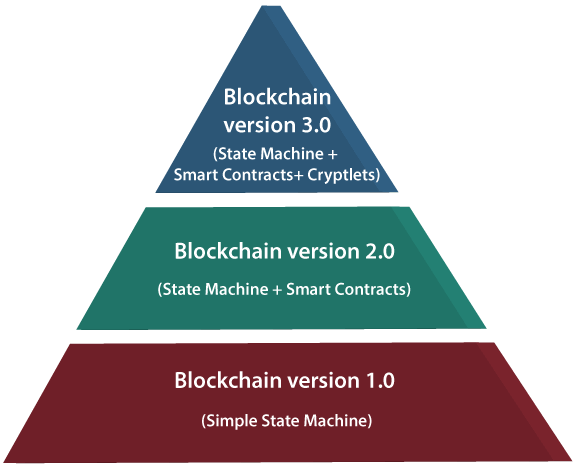
Blockchain technology has gained popularity because it offers decentralized and transparent storage to record transactions and data. Generally  Blockchain relates with the bitcoin and cryptocurrency. Since 2009, Blockchain technology has been growing and developing; it is now more than the bitcoins and cryptocurrency. The following  description is demonstrating the evolution of blockchain technology, including the progression of blockchain technology from version 1.0 to version 3.0.
Blockchain Versions

Blockchain Version 1.0: Cryptocurrency

Blockchain 1.0 is the first cryptocurrency, which records the bitcoin transactions on the public ledger in a secure method. The implementation of Distributed ledger technology was the reason behind its first version. It is a permission-less blockchain where any participant can perform a valid transaction of bitcoins.

It works as a simple state machine, which can be used as a platform for the bitcoin transaction. State machine manages the transition between valid states similarly Blockchain records and manages the bitcoin transactions between valid participants of the network.

Blockchain Version 2.0: Smart Contract

The new concepts in the blockchain are Smart Contracts,  it is a small self-executing computer programs that exist in the blockchain. In Blockchain 2.0, Bitcoin is replaced by ethereum. The smart contract is one of the most successful blockchain applications, it helps in reducing transactions cost-effectively. Ethereum network is the best platform for creating and executing smart contracts. This is used as a replacement for the traditional contracts.

Blockchain Version 3.0: Dapps

The Dapp is a short form for Decentralized application. Decentralized applications run  opposite to centralized applications running on a single computer. A Dapp is like a conventional app, it can have frontend (written in any language) that can make calls to its backend. A Dapp can host its frontend on decentralized storages, including Ethereums Swarm.

Decentralized apps do not need to run on top of a network of blockchains. There are many decentralized applications running on a P2P network, like BitMessage, BitTorrent, Tor, Popcorn, etc.

Blockchain Version 4.0: Blockchain For industry

The objective of the fourth generation blockchain is to resolve the entire issue with the previous three generations. Blockchain 4.0 explains the strategies and methods that make blockchain technology available to business demands. Various companies are trying to bring a scalable, adaptable, and affordable blockchain to the world. Businesses are willing to adopt the blockchain technology, but we need a safer and more robust blockchain.

We don't have a clear picture of what it looks like as the fourth blockchain generation is not yet here. Some developers feel a mix of third-generation blockchain and AI is going to spawn Blockchain 4.0.


Related Topics

Kerberos in Cryptography and Network Security

Kerberos is a system that is used for managing user authentication. With the help of Kerberos, the user can access their service without remembering multiple authentication passwords. It is not...

3 minutes read.

DNA cryptography

What is DNA Cryptography? DNA Cryptography is the branch of science that is used to encrypt and decrypt the data for hiding propose. It has a significant role in the field...

3 minutes read.

How to choose Bitcoin Wallet

This section will walk you through the process of selecting a Bitcoin wallet. If you wish to participate in Bitcoin, you'll need a wallet. You may receive Bitcoins, transmit Bitcoins,...

3 minutes read.

Consensus Algorithms in Blockchain

We all know that Blockchain is a decentralized distributed network that provides immutability, privacy, security, and transparency. Considering the absence of a central authority to authenticate & verify transactions, the...

4 minutes read.

History of Blockchain

History of Blockchain: Satoshi Nakamoto modeled the first Blockchain and explained the details of how a technology was well-found to enhance digital trust, given the immutable and decentralization aspect that...

2 minutes read.

Need of Blockchain

Blockchain is an open and decentralized network, which stores redundant data at multiple sites called nodes (computers). Its properties, such as immutability, distributed control, highly secured encrypted blocks, and anonymity, make it ideal...

3 minutes read.

What are the steps to becoming a Blockchain developer

What do you need to do to become a Blockchain Developer? Blockchain is one of the most rapidly emerging technology and industry in today's IT market. The world market for Blockchain...

5 minutes read.

Blockchain Cryptocurrency

As we know, cryptocurrencies are digital assets which can also be exchanged between two parties. For securing, verifying the transfer of assets & to have control over the creation of...

3 minutes read.

ElGamal Algorithm

What is ElGamal Algorithm? ElGamal Algorithm is an asymmetric key encryption technique for communicating between two parties and encrypting the message. With the help of cryptography, the employee can communicate securely....

3 minutes read.

How can Blockchain Technology help IoT to reach its full potential

The Blockchain technology has huge potential to speed up the IoT's efficient operation. Since then, security has been a big worry with IoT, which has hampered its widespread adoption. IoT...

4 minutes read.

Working of Blockchain

How Blockchain Works A Blockchain is simply a collection of records of time-stamped transactions that are managed by a group of servers. There is no central authority who controls the database....

2 minutes read.

HMAC Algorithm in Cryptography

HMAC stands for Hash-Based Message Authentication Code. It is a type of message authentication code that is obtained by executing a cryptographic hash function that is used to be authenticated...

3 minutes read.

Introduction and Features of Cryptography

What is Cryptography? Secret coding has been a part of military activities for many years. In old times people know how to communicate privately. So we can say that private communication...

3 minutes read.

Blockchain Merkle Tree

The Merkle tree is an essential component of Blockchain technology. It is a mathematical data structure composed of hash of various data blocks that serves as an overview of all...

4 minutes read.

Elliptic curve in cryptography

What is Elliptical Curve Cryptography (ECC)? Elliptic Curve Cryptography (ECC) is public key cryptography based on elliptic curve theory. It can be used to create smaller, faster and more efficient public...

4 minutes read.

Basic Component of Bitcoin

As we know that Bitcoin is a digital currency (cryptocurrency). It is a virtual currency or digital token, as well as it is a network on which all such digital...

3 minutes read.

Format String Vulnerabilities in Cryptography and Network Security

Format String Vulnerability problem was first found in C language. The problem refers to a bug found in the printf function. The printf function is widely used for the transmission...

3 minutes read.

Sending and Receiving Bitcoin

The goal of this part is to show you how to get started with Bitcoin in a simple way. 1. Get to Know Bitcoin Bitcoin has certain unusual characteristics. It behaves similarly...

4 minutes read.

Top 10 Blockchain Project Concepts

A platform for Trusted Crowdfunding Using a Smart Contract According to reliable studies, 85% of firms delay delivery, and 14% never fulfill the promises made to angel investors. Currently, there are...

4 minutes read.

IP Security in Cryptography

IPsec (Internet Protocol Security) is a collection of algorithms and protocols used to secure the data transmitted over a public network. The Internet Engineering Task Force (IETF) was developed in...

6 minutes read.