<?xml version="1.0" encoding="utf-8"?><feed xmlns="http://www.w3.org/2005/Atom" ><generator uri="https://jekyllrb.com/" version="3.10.0">Jekyll</generator><link href="https://breakfastscot.ch/feed.xml" rel="self" type="application/atom+xml" /><link href="https://breakfastscot.ch/" rel="alternate" type="text/html" /><updated>2026-06-30T01:24:22+00:00</updated><id>https://breakfastscot.ch/feed.xml</id><title type="html">breakfastscot.ch</title><subtitle>Real knowledge is to know the extent of one’s ignorance. I&apos;m mapping mine through essays that wander across disciplines. Views are 100% my own. References to breakfast or scotch are completely coincidental.</subtitle><author><name>J.Reynolds</name></author><entry><title type="html">Interesting Objects: Toby Mugs</title><link href="https://breakfastscot.ch/posts/2026/06/29/interesting1.html" rel="alternate" type="text/html" title="Interesting Objects: Toby Mugs" /><published>2026-06-29T00:00:00+00:00</published><updated>2026-06-29T00:00:00+00:00</updated><id>https://breakfastscot.ch/posts/2026/06/29/interesting1</id><content type="html" xml:base="https://breakfastscot.ch/posts/2026/06/29/interesting1.html"><![CDATA[<p>As I get older, I have been more conscious of the stuff I own. As I collect mementos through my journeys in life, I have the growing concern that I have too much stuff. One day, as I was looking through some of my things it occurred to me that the reason that I have some of these items is because of the story behind them. To clarify, I do not mean merely a souvenir from a trip I took, but something that has a deeper meaning. I could part with all the refrigerator magnets that I have collected to represent the places I have travelled, but not these objects. At least, not with some deeper reflection on the value they hold. Some of those items I will never part with such as my Grandfather’s pipe stand. What follows is my attempt to catalogue a few of these interesting things.</p>

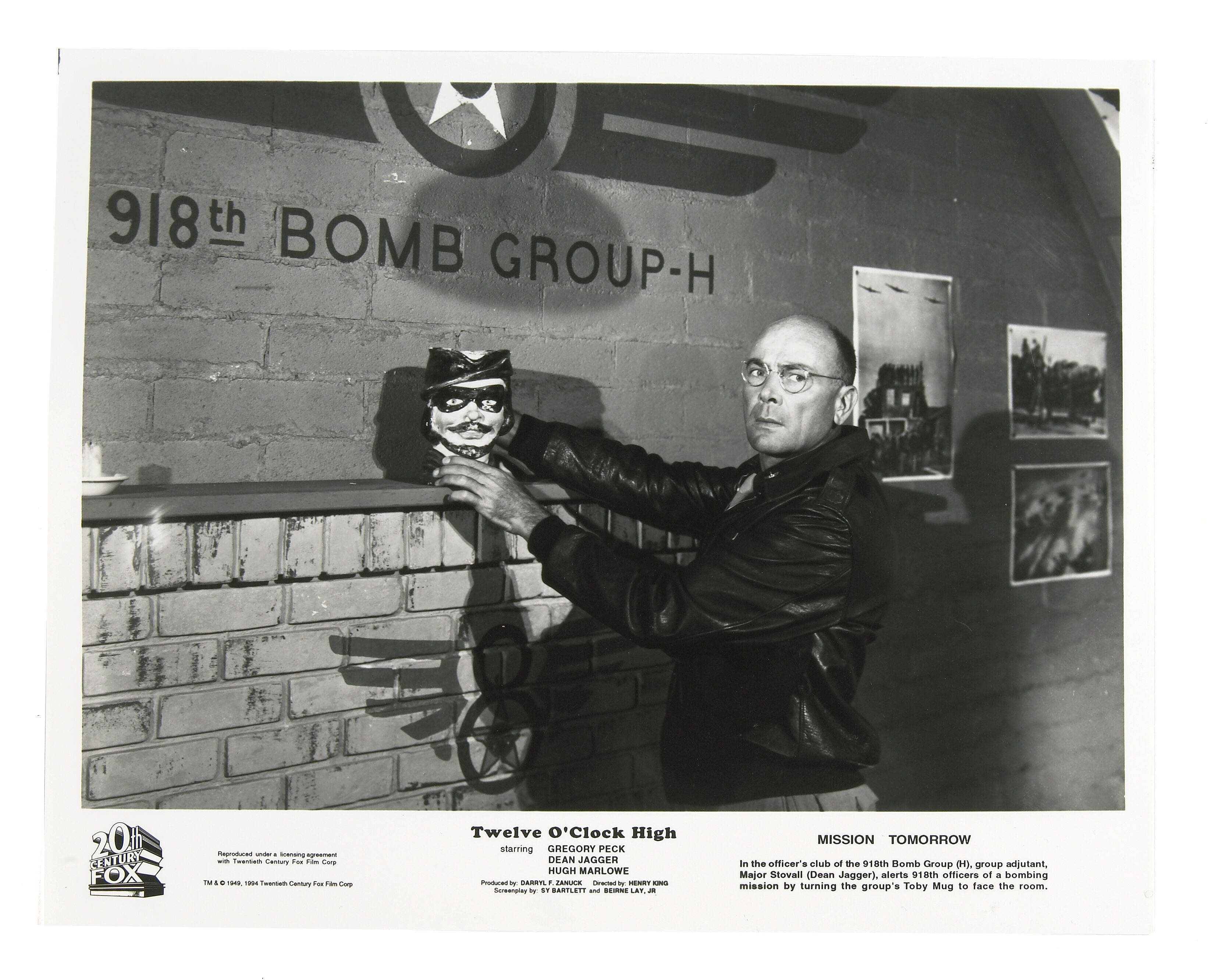
<p>In the movie <em><a href="https://www.imdb.com/title/tt0041996">Twelve O’Clock High</a></em>, Dean Jagger’s character Major Harvey Stovall finds a toby mug in a shop window identical to the one in the 918th Bomb Group’s officer’s club. The toby mug, a masked Robin Hood, sits on the mantle and is the indicator to the room if there will be a bombing mission tomorrow or not. If Robin is facing the wall: no mission. If Robin is facing the room: mission.</p>

<p><img src="/assets/img/toby.mug.png" alt="Toby Mug" /> <em><a href="https://img2.bonhams.com/image?src=Images/live/2008-11/07/7741894-14-1.jpg">Dean Jagger and the Toby Mug</a></em></p>

<p>Back when I was an instructor we did something similar before every flight. Or rather, our students (who were instructor pilots) would as part of their pre-flight duties, turn Zeke around to face the wall. If they forgot to turn Zeke to face the wall that was a monetary fine that went into the funding of their graduation party. The astute reader may ask why did we change up the facing of the toby mug from the obvious inspiration of the 918th? Zeke was to be turned to face the wall so he could not see our students’ ensuing buffoonery in the aircraft.</p>

<p>As for Zeke, he was not a toby mug, but a bust of an aviator looking skyward made by Michael Garman in 1973, called “Flying Leather”. A previous instructor donated Zeke to the squadron and as to why the “Flying Leather” bust is called Zeke. No one seems to know.</p>

<p><img src="/assets/img/zeke.jpg" alt="Zeke" /> <em>Zeke on a bookcase</em></p>

<p>Today, a fellow former instructor has the original Zeke on a shelf of memorabilia in his basement. My Zeke was a going away gift when I left the squadron and rests, always facing outward, on my bookcase.</p>

<p>__________</p>

<p>King, Henry, dir. 1949. Twelve O’Clock High (United States: 20th Century Fox, 1949), Theatric Release.</p>

<p>__________</p>

<p>© 2026 Jeremy Reynolds, all rights reserved.</p>

<blockquote>
  <p>Back to <a href="https://breakfastscot.ch/">Blog Index</a></p>
</blockquote>]]></content><author><name>J.Reynolds</name></author><category term="posts" /><summary type="html"><![CDATA[Interesting objects that I have found or own and the stories behind them.]]></summary></entry><entry><title type="html">What I Read…Reviewing Len Deighton</title><link href="https://breakfastscot.ch/posts/2026/03/01/read.this2.html" rel="alternate" type="text/html" title="What I Read…Reviewing Len Deighton" /><published>2026-03-01T00:00:00+00:00</published><updated>2026-03-01T00:00:00+00:00</updated><id>https://breakfastscot.ch/posts/2026/03/01/read.this2</id><content type="html" xml:base="https://breakfastscot.ch/posts/2026/03/01/read.this2.html"><![CDATA[<blockquote>
  <p>“In the Control Tower the Duty Officer, the Group Captain, and a Flying Control WAAF stood transfixed at the sight of a complex alloy parcel packed with high explosive, phosphorus, fuel, and magnesium being steered directly towards them at a hunder miles an hour.” - from Bomber by Len Deighton.</p>
</blockquote>

<p><a href="/read/">I read books</a>. I recently discovered Len Deighton, a British author in the same theme as John Le Carré. In the span of less than two weeks I have read three Len Deighton books. I am beginning to think that I prefer British authors above all others without an understanding, as of yet, what makes British authors writing style different in a way that makes me gravitate toward them. Perhaps I should say United Kingdom authors as I also include Alistair Maclean and John Buchan, both Scottish writers, in my list. Reading Len Deighton requires a swap from the <em>New Oxford American Dictionary</em> to the English version with a dose of British pop culture. His writing is filled with the grammatic that make the subtle differences between American English and British English (is that proper English?) and references that one can only really get if they lived in 1960’s Britian. I think that is part of the appeal of Len’s writing: the novelty of it all.</p>

<blockquote>
  <p>Dawlish leaned forward confidentially, ‘you’ll be in charge, you know, and you don’t want these blighters nipping below for a crafty smoke.’ - from Horse Under Water by Len Deighton.</p>
</blockquote>

<p><img src="/assets/img/len.deighton.jpg" alt="Len Deighton" /> <em>Len Deighton <a href="https://groveatlantic.com/author/len-deighton/">Grove Atlantic currently publishes his novels</a></em></p>

<p>Len Deighton is probably most known for his spy without a name, ushered into reality with the book <em>The IPCRESS File</em>. Written in 1962, it kicks off a series of novels with the unnamed spy, followed by <em>Horse Under Water</em> and <em>Funeral in Berlin</em>. Who only gets a name, Harry Palmer, when <em>The IPCRESS File</em> gets made into a <a href="https://www.imdb.com/title/tt0059319">movie starring Michael Caine</a>. The books written from a first-person perspective keep the reader in the dark and at times confused as to what is going on without the omniscient narration. I will admit to being a bit lost at times when the action picks up in <em>The IPCRESS File</em>, especially during Harry’s visit to an Atoll and an encounter with his friend Barney of US Intelligence.</p>

<blockquote>
  <p>‘Don’t fool, because I’m sticking my neck right out, but I can rack it in, but very fast. We knew each other well once, but people change, and I just need to look, to see. Have you changed?’ ‘Probably I have.’ There was a long silence. I didn’t know what Barney was talking about, or what Barney was getting at. - from IPCRESS File by Len Deighton.</p>
</blockquote>

<p>I re-read the pages of dialogue between Harry and Barney and then skimmed the previous chapter thinking I had missed something in the plot. I was as lost as Harry was as to what was going on at the top of the shot tower where his friend Barney confronts him as if Harry is some kind of double agent. Perhaps that is the appeal of this book, the first-person narration, where the plot unfolds like a jigsaw puzzle all scrambled upon a table and you work through the matching of the pieces with the protagonist in real-time. Coming from John Le Carré novels, reading a Len Deighton spy thriller is a bit jarring. The plot speeds over details and reaches conclusions ahead of the reader. I am curious if this is just a symptom of <em>The IPCRESS Files</em> being Len’s first spy thriller. I just started reading the sequel, <em>Horse Under Water</em> and it is too early to tell, but so far Len has done a better job of setting up the story.</p>

<p>The first book I read was actually <em>Bomber</em> a graphically somber account of the night bombing campaign by the British during World War Two. The book provides a 360 degree view of a night raid through the eyes of Luftwaffe pilots and the citizens of a German town below. The all-encompassing fidelity of war from all sides is both technically accurate (Len Deighton actually flew on the aircraft he writes about) and reminiscent of the all-encompassing storytelling of <em><a href="https://www.imdb.com/title/tt0056197/">The Longest Day</a></em>. A movie that accurately portrayed both sides of that historic event to a level of realism that some of the scenes were acted out by the very individuals who lived them (Joseph Lowe re-enacting his climb of the cliffs at Pointe Du Hoc or Richard Todd at Pegasus Bridge).</p>

<p><img src="/assets/img/bomber.deighton.jpeg" alt="Bomber" /> <em><a href="https://groveatlantic.com/book/bomber/">Bomber by Len Deighton</a></em></p>

<p>The book <em>Bomber</em> would not be for those that found <em>The Hunt for Red October</em> or <em>The Martian</em> overly technical and specific. Reading Len Deighton’s book gives you a rundown of the start sequence of a Lancaster bomber to the step by step vectoring of night fighters by a Freya radar installation. When the British make a raid on Krefeld during the climatic action sequence of the book, he describes the graphic realities of bombs dropping on a German town, Altgarten. Traditionally, we think of the destruction of buildings and people from a night bombing attack, but in <em>Bomber</em> Len describes the second and third order effects. Never were the technical descriptions of a town’s water supply so captivating or connected to characters in a story. What really strikes me about this book is that, because Len spends considerable time to the buildup of the Krefeld raid in getting to know all the characters (from Flight Sergeant Lambert, to August Bach, to Altgarten’s Burgermeister) we are heavily invested in their experiences, emotions, and outcomes from this night raid.</p>

<blockquote>
  <p>“Close master fuelcock for starboard outer,’ ordered Sweet. ‘Starboard outer off,’ said Murphy. The vibration slowed but only a little. ‘It won’t feather and I can’t get her to fly level.’ ‘We’re losing fuel from the port tanks. That’s unbalancing the trim,’ said Murphy.” - from Bomber by Len Deighton.</p>
</blockquote>

<p>There is a certain sympathy you develop for the inhabitants of Altgarten or for the crew forced to fly with that insufferable Flight Lieutenant Sweet. Len Deighton is able to capture war in a way that the reader can see both sides of the conflict. The good, the bad, the ugly and the plain weird of it all. The book is touted as an anti-war novel. A book that vividly illustrates the futility and waste of the blanket destruction that strategic bombing of cities (area bombing) caused in World War Two. I think it is easy to sit in our 21st century arm-chair quarterback seats and speak of the bloody results that area bombing caused and look down in disgust and call the air leaders murderers. It is the de rigueur thing to do showing your distaste of decisions and actions of our past that would be unthinkable today. There is a fine detail missing in all this virtue signaling and that of the powerful narrative (notice I say narrative instead of idea) that strategic bombing would allow a country to offensively bring an opponent to their knees by destroying their cities, factories, infrastructure and ultimately the <em>will of the people</em>.</p>

<p>This narrative was born as an idea in the writings of Giulio Douhet in the early post-World War One years. Fresh off the horrors of trench warfare, military thinkers turned their attention to the air as a means of salvation to escape a repeat of that stagnant hell. Consider that during the Battle of Verdun in 1916 the French field artillery fired 10 million rounds over a three-month period with virtually no change in the front lines. A single assault could create thousands of deaths such as a British assault in early July that yielded 60,000 casualties to include 20,000 dead - in a single day. <em>What new ideas would you embrace to escape that hell as a soldier?</em></p>

<p>The veterans of World War One, the air-minded individuals who saw the future of warfare in the sky embraced Guilio Douhet’s ideas as a means to achieve strategic ends with less sacrifice in blood and treasure. It would be close minded of us to not consider that, at the time, the narrative was powerful enough to convince the air leaders that strategic bombing promised outcomes were worth the costs. I have no basis in knowing Air Chief Marshal Harris, but I can understand how in the after math of World War One how he and others like him embraced the narrative that strategic bombing could break the will of the people. Even if the British embarked on the same strategic bombing campaign that the Americans did, with attempting to precisely target German infrastructure - the technology of the day did not allow anyone to get consistently on or near the target. In the <em>Strategic Bombing Surveys</em> conducted after the war, the findinds were that only 20% of bombs fell within a 1,000-foot radius of the target area (13). For example, to take down the Leuna synthetic oil plant required 6,552 bomber sorties, 18,328 tons of bombs dropped over the course of an entire year (22-23).</p>

<blockquote>
  <p>It is easy to armchair quarterback 80-years removed where we have frictionless information fidelity and the technical capability to accurately put a bomb through a window.</p>
</blockquote>

<p>Len Deighton wrote an authentic telling of the air war in Europe from all sides. The book illustrates, quite accurately, the effort required to bomb a city and all the things that could go wrong with it. Reading <em>Bomber</em> is a lesson on the futility of war and that is a good thing. A good thing to be reminded of the costs that come with failing to work out our differences in a civil manner.</p>

<p>Len Deighton’s books are some of the best British writing I’ve come across. He is more economic with his choice of words than Le Carré, more common man than Buchan and a bit more ’60s British TV than theatrical action flick. I look forward to reading through his catalog of thrillers.</p>

<p><em>Michael Cain, starred in the film adaption of <a href="https://www.imdb.com/title/tt0059319/">The IPCRESS File</a> in the role of Harry Palmer. He reprised the role in additional productions of Len Deighton’s novels to include <a href="https://www.imdb.com/title/tt0060437/">Funeral in Berlin</a> and <a href="https://www.imdb.com/title/tt0061405/">Billion Dollar Brain</a>.</em></p>

<p>__________</p>

<p>Deighton, Len. 1970. <em>Bomber.</em> New York: Grove Press.</p>

<p>Deighton, Len. 1962. <em>The IPCRESS File.</em> New York: Grove Press.</p>

<p>Furie, Sydney, dir. 1965. <em>The IPCRESS File</em> (United Kingdom: Rank Film Distributors, 1965), Theatric Release.</p>

<p>Department of War. <em>The United States Strategic Bombing Surveys: Summary Report</em>, September 30, 1945.
__________</p>

<p>© 2026 Jeremy Reynolds, all rights reserved.</p>

<blockquote>
  <p>Back to <a href="https://breakfastscot.ch/">Blog Index</a></p>
</blockquote>]]></content><author><name>J.Reynolds</name></author><category term="posts" /><category term="pop.culture" /><summary type="html"><![CDATA[Book review exploring the novels of Len Deighton.]]></summary></entry><entry><title type="html">My Favorites from 2025</title><link href="https://breakfastscot.ch/posts/2026/01/19/favorites.2025.html" rel="alternate" type="text/html" title="My Favorites from 2025" /><published>2026-01-19T00:00:00+00:00</published><updated>2026-01-19T00:00:00+00:00</updated><id>https://breakfastscot.ch/posts/2026/01/19/favorites.2025</id><content type="html" xml:base="https://breakfastscot.ch/posts/2026/01/19/favorites.2025.html"><![CDATA[<p>In no particular order and because I am stuck in a <a href="/posts/2024/05/15/Age.html">pop culture time loop</a> not everything below is original to the year 2025. These are the things that I read, heard, watched, or discovered in 2025 that resonated and I still remember at the end of the year.</p>

<p><strong>Favorite Books</strong></p>
<ul>
  <li><em>The Big Hop</em> by David Rooney: David is a historian that worked at the London Science Museum where the first plane to make the transatlantic flight resides. This historic race between teams to be the first to cross the Atlantic in 1919 is lost to history and overshadowed by the first solo transatlantic flight taken by Charles Lindbergh. 
<br /></li>
  <li>Kotaro Isaka novels: Obviously <em>Bullet Train</em> is this Japanese author’s best known work, but it is actually part of a series. I use the term ‘series’ loosely, there is some character overlap in the form of cameos or references to certain characters and events, but each novel stands on its own. I am impressed at Kotaro’s ability to weave so many points of view into a climatic overlap at the end. It is a jigsaw puzzle of plot complexity that just works. One of the only authors that I pre-order without thinking about it.</li>
</ul>

<p><strong>Interesting Things I Read</strong><br /></p>
<ul>
  <li><a href="https://www.mlb.com/news/the-longest-professional-baseball-game-ever-played">“The Longest Baseball Game Ever Played”</a> by Brian Murphy: About the 1981 Triple-A baseball game between the Rochester Red Wings and the Pawtucket Red Sox that went for 33 innings.
<br /></li>
  <li>“Who Named the Red Baron?” by Michael Terry: Explores the origins of Manfred Albrecht Freiherr von Richthofen’s nickname <em>The Red Baron</em> and the interesting connection to Snoopy. Article was published in <em>Contact!</em> a publication of the <a href="https://greatwaraviation.org/">The Great War Aviation Society</a> and available to members (I recommend if you are interested in aviation history).
<br /></li>
  <li><a href="https://www.wsj.com/business/the-cracker-barrel-logo-mess-c57d23e8?st=HNJHxC&amp;reflink=desktopwebshare_permalink">“The Cracker Barrel Mess Isn’t Over Yet”</a> by Heather Haddon and Suzanne Vranica: I do not care about Cracker Barrel or their silly logo. The only reason I read this article was two things. First, highlighted how important nostalgia is to people (probably because the world is changing so fast around them they need something to feel stable). Second, because it gave a concerning insight about AI. 32% to 37% of the online activity critical of the logo announcement came from bot accounts. People keep asking when is the singularity going to happen - it already has. AI bots drive the conversation and thus drive society. Consider that the next time you think about piling into a polarizing online discussion.</li>
</ul>

<p><strong>Favorite Songs</strong></p>
<ul>
  <li>“Honey” by The Lone Bellow: Heard this on <a href="https://www.wttsfm.com/">92.3 WTTS</a> It’s like a rock song that is a country song that is a blues song. A combination I would not normally like, but this one works.
<br /></li>
  <li>“Kokomo, IN” by Japanese Breakfast: Another song I heard while listening to 92.3 on the radio. This song feels nostalgic while being fresh. 
<br /></li>
  <li>“Follow You (Life in Vegas)” by Imagine Dragons: I love this song and now I like it even more in this live recording. The crowd particpation in the beginning takes this to a new level of immersion and sense of being there. 
<br /></li>
  <li>“Situation” by Yaz: How did I miss this 1982 synth-pop hit? Reminds me of when I discovered “Rainbow in the Dark” by Dio or the band Zebra, decades after they were big.</li>
</ul>

<p><strong>Favorite Films</strong></p>
<ul>
  <li><em><a href="https://www.imdb.com/title/tt0037343/">Tall in the Saddle</a></em> Directed by Edwin Marin, 1944: John Wayne, Ella Raines in a Western murder mystery of sorts. I have seen many John Wayne films, but had never seen this one till 2025. Now, it is one of my favorites. The bravado and confidence that John Wayne’s roles portray can be seen solely in the non-verbal interactions in this film or how to win a gunfight with a stare.</li>
  <li>AppleTV Films: Watched a few movies this year and found them pretty entertaining on AppleTV. Titles such as: <em>Fountain of Youth</em>, <em>Greyhound</em>, <em>The Gorge</em> and <em>Argyle</em>.</li>
  <li>Burnt out on sequals, prequals and spinoffs. Not bothered to watch <em>John Wick 4</em> and stopped watching Marvel movies, <em>Jurassic Park</em> movies and just about any other franchise out there. Disney squeezed every last dollar out of <em>Star Wars</em> that I’m so over it that for the rest of my life if I never see another <em>Star Wars</em> flick…I’m good with that. This should resonate since I’m part of the generation that grew up on the original trilogy: it is in our DNA. Yet, because of Disney, I’ve lost interest. Hopefully Disney does not do the same with <em>Tron</em>. I think 3 films is enough.</li>
</ul>

<p><strong>Favorite Quotes</strong></p>
<ul>
  <li>“In the beginners mind there are many possibilities, but in the expert there are few.” - Shunryu Suzuki</li>
  <li>“The main lesson I’ve taken away from this is that if you’re only going to be successful in one half of your career, make it the second half. If it’s the first half, that’s a tragedy. But the second half is a happy ending.” - Nick Herron</li>
</ul>

<p><strong>Scotch</strong></p>
<ul>
  <li><em>Lagavulin Offerman Edition Charred Oak</em> is by far my favorite so far. The campfire smoke is right on top and it tastes like s’mores with that peaty finish but…well…charred.</li>
  <li>For 2026 I am seeking out a bottle of <em>Port Charlotte 18-year</em> produced by the Bruichladdich Distillery along Loch Indaal. Call it a grail find cause it will be a miracle if I can find it.</li>
  <li>Breakfast: Despite being an Islay man, I think the Speyside <em>Macallan 18-year</em> or a Scottish blend like <em>Johnny Walker Blue</em> are better suited for breakfast instead of a peaty <em>Lagavulin</em>. The <em>Macallan</em> compliments over-medium eggs without drowning out the hashbrowns.</li>
  <li>Eggnog: No other option but Islay. My favorite is the <em>Port Charlotte 12-year</em> followed by the <em>Offerman Edition Charred Oak</em>. The eggnog + scotch combination with a roaring fire and Dutch butter cookies while watching Christmas movies is pure holiday perfection.</li>
</ul>

<p><strong>2026</strong></p>
<ul>
  <li>I plan to continue my series of <a href="/tag/decisions">Mandelbrot, Boyd &amp; Musashi</a> with another installment as I continue to think about decision cycles.</li>
  <li>Write more; wrapping up my second masters degree this spring should help with that.</li>
  <li>Read more Len Deighton novels</li>
  <li>Get back into learning the guitar</li>
</ul>

<p><strong>Addendum</strong></p>
<ul>
  <li>Since writing <a href="/posts/2023/06/29/forty.hour.work.html">40-Hour Workweek</a> I have come upon probably the most likely reason for its continued status as the driving framework and metric for work: <em>organizational theater</em>. Organization theater is found in large organizations (private, public, government…especially government) where success is largely about optics. Being seen is more important than getting any actual work done. If you find yourself in constant meetings or concerned about the up channel messaging of your department’s projects…your job is about optics. This is why CEOs are pushing for return to the office. It’s not about lack of productivity, it is about optics.</li>
</ul>

<p>__________</p>

<p>© 2026 Jeremy Reynolds, all rights reserved.</p>

<blockquote>
  <p>Back to <a href="https://breakfastscot.ch/">Blog Index</a></p>
</blockquote>]]></content><author><name>J.Reynolds</name></author><category term="posts" /><summary type="html"><![CDATA[Favorite things I read, heard, watched, discovered in 2025.]]></summary></entry><entry><title type="html">Words Matter: Better Definitions, Better Collaboration</title><link href="https://breakfastscot.ch/posts/2025/08/15/define.html" rel="alternate" type="text/html" title="Words Matter: Better Definitions, Better Collaboration" /><published>2025-08-15T00:00:00+00:00</published><updated>2025-08-15T00:00:00+00:00</updated><id>https://breakfastscot.ch/posts/2025/08/15/define</id><content type="html" xml:base="https://breakfastscot.ch/posts/2025/08/15/define.html"><![CDATA[<blockquote>
  <p>“Don’t you see that the whole aim of Newspeak is to narrow the range of thought? In the end we shall make thought crime literally impossible…Every concept that can ever be needed will be expressed by exactly one word, with its meaning rigidly defined and all its subsidiary meanings rubb out and forgotten.” - from George Orwell’s 1984.</p>
</blockquote>

<p>What is the most important book on the bookshelf? The answer is the dictionary, for it is the database of words and their meaning. Words are power, for in manipulation of their definitions exists the opportunity to mold them to whatever one wants them to be, thereby changing the reality of things. This is most apparent in the book <em>1984</em> by George Orwell where Winston’s coworker Syme, expresses excitement for his job in taking <em>Oldspeak</em> and converting it to <em>Newspeak</em>. Syme states his job in building the Newspeak dictionary is the active deletion of words, thereby changing their meaning - giving them multiple and contradictory meanings leading to doublethink. Doublethink takes a word with contradictory definitions (because we have fewer words to define things by) and uses whichever is convenient for the desired result. One can weaponize a word, where the word now means something that it does not to convince and persuade. The destruction of words and their meanings reduces the need for conscious thought, discussion or debate become unnecessary - discourse becomes untenable. Therein lies the power of the printed dictionary and why it is the most important book on the bookshelf.</p>

<blockquote>
  <p>“Doublethink means the power of holding two contradictory beliefs in one’s mind simultaneously and accepting both of them. To tell deliberate lies while genuinely believing in them, to forget any fact that has become inconvenient, and then, when it becomes necessary again, to draw it back from oblivion for just so long as it is needed…” - from George Orwell’s 1984.</p>
</blockquote>

<p>The power of a printed dictionary is a fixed record of words and their definitions, immutable. Whereas, an online dictionary lacks permanence, able to be rewritten on the fly to suit shifting narratives or agendas. In an era where words can be weaponized, a printed dictionary is an unalterable reference point acting as a bulwark against the erasure of the past. On my bookshelf, I keep a copy of the New Oxford American Dictionary, preferring its hybrid blend of American and English words better fitting that of a writer or professional as compared to the Merriam-Webster or Oxford English. I would compare the three dictionaries with this analogy. The Merriam-Webster is <em>USA Today</em>, New Oxford American is the <em>Wall Street Journal</em>, and the Oxford English is the <em>Financial Times</em>.</p>

<p>**</p>

<p>Why discuss this? Because shared definitions to include the context and semantics of words across teams, divisions and organizations is hard - technology makes it harder. First, words are now more corruptible due to digital sources (as opposed to printed dictionaries) and they can be altered in the blink of an eye. Second, Generative AI, has the power to completely remap the systems, protocols, policies and procedures of an organization. The rapid automation of tasks, interactions with customers, clients and coworkers through the interpretive effects of AI raises concerns.</p>

<p>For words are more than just definitions, words are also about context and semantics. The semantics are the logical aspects of meaning such as sense, reference, and implications; while, context is what immediately precedes or follows to give the word meaning (Lindberg, Stevenson, 1587, 375). Finnish comedian Ismo illustrates this in <a href="https://www.youtube.com/watch?v=RAGcDi0DRtU">his skit about the word <em>ass</em></a> rather well as he talks through semantics and context. Like, adding <em>ass</em> to the word <em>bad</em> changes the entire meaning of the word.</p>

<p>On the surface, this just sounds like understanding slang, but in the context of the organizational framework (systems, processes, protocols, procedures) and the specific words used to define this framework - misalignment in definition can change the context and semantics as well which can trickle down into the individual employees and customers. Because words matter; a weak foundation in the words, their context and semantics can distort the organizations messaging. This messaging can lead to internal confusion, operating at cross-purposes across divisions and teams (especially when there are physical boundaries such as geography between them). Further, it can influence the customer and their perception of the brand and its product.</p>

<p>To illustrate, I will highlight some common terms thrown about in any number of business magazine articles discussing organizational behavior &amp; development. These articles throw around terms like “systems”, “protocols” or “processes” to describe the novel method to create value through better teamwork. The initial issue is what I have already highlighted - words matter. <em>The author may have different definitions.</em> Along with different definitions is the terms may be taken out of the context &amp; semantics to how those same terms are used in your organization. Worse still if the author conflates the terms and uses them interchangeably to make it more murky. Essentially, do these terms directly translate? Will implementing the author’s solutions work if there is not shared meaning? Perhaps, this analogy will help.</p>

<p>In the movie <a href="https://www.imdb.com/title/tt0151804/"><em>Office Space</em></a>, the Initech <em>principles</em> are the company’s tenets (paradigm) and way of thinking. Initech, is a software company, its theme is contained in its name based on the words <em>initiative</em> and <em>technology</em> (you could substitute <em>innovative</em> as well). Initech at its core is about lines of code, which requires buy-in by its employees into the Initech <em>system</em>, the injection of the company’s tenets in the execution of innovative code writing. We see this in banners hung around the office stating, <em>“Is it good for the company”</em> and reminders that Initech is about “Initiative” combined with “technology” that broadcast the system that Initech is on the forefront of technology through the proactive efforts of its employees.</p>

<p>When Peter Gibbons, Samir Nayeenanajar (Samir N-Eleven) and Michael Bolton are working on the quality assurance of the company code, mainly to ensure it is Y2K-compliant, they do so within the <em>protocols</em> of Initech work environment. When Peter is promoted and decides to show up late to work and dismantles his cubicle wall and tear down the <em>“Is it good for the company”</em> sign - he is rebelling against the company’s <em>protocols</em>. Yes, there is similarity between <em>system</em> and <em>protocol</em> - I think of it as the <em>system</em> is the overstory and the subplot is the <em>protocol</em>.</p>

<p><img src="/assets/img/peter.cubicle.drill.png" alt="Peter Drill" /> <em>Peter demonstrates destruction of Initech systems</em></p>

<p>When Bill Lumbergh asks Peter Gibbons where his Test Procedure Specification (TPS) cover sheet is, he’s referencing the company <em>policy</em> distributed to all employees. The Initech company <em>policy</em> is that all employees when submitting a TPS report must include a cover sheet. <em>The series of actions performed when submitting a TPS report is to attach a cover sheet to it - this is the company procedure.</em> Almost interchangeable with <em>processes</em> which is a series of steps to achieve a particular end (1392). It’s a subtle nuance in the definition of words and a clear example of how easy it is to quickly move away from shared definitions in an organization, particularly one with several departments and divisions (or silos). If the definitions of these terms are not shared, it becomes difficult for individuals and teams to understand their meaning and relationships - ultimately leading to barriers to integration. Thus, the importance of dictionaries.</p>

<ul>
<li>Principle is a fundamental truth or proposition that serves as the foundation for a system of belief, behavior or for a chain of reasoning (1388).</li>
<li>System is a set of principles or procedures according to which something is done; an organized scheme or method (1763).</li>
<li>Protocol is an accepted or established code of procedures or behavior in any group, organization, or situation (1404).</li>
<li>Policy is a course or principle of action adopted or proposed by a government, party, business or individual (1353).</li>
<li>Procedure is a series of actions conducted in a certain order or manner; established or official way of doing something (1392).</li>
</ul>

<p>What if we introduce Generative AI into the mix? Organizations need to think critically about the lexicon of words they input, their context, and intended semantics. Illustrating the existing difficulties of shared meaning, now imagine how integrating Generative AI increases the difficulty in keeping the definitions and context to key words and phrases shared across an organization and the external stakeholders (to include customers), not to mention difficulties in capturing cultural nuances or emotional context.</p>

<p>When speaking of semantics, this goes beyond just the definition of the word but how that word conveys meaning depending on the context, and without shared meaning we will have issues in context. These issues can balloon due to the penetrative manner in which AI can be integrated into the organization across all divisions to include customer-facing engagements. Worse outcome, internally the company is charging forward based on a set of definitions that are completely different from what is being broadcast to the customers and in-turn what the customers think the semantics of those terms are. Imagine if the word “privacy” had different context and semantic meaning inside versus outside the organization? Look at the <a href="https://techcrunch.com/2021/09/03/apple-csam-detection-delayed/">backlash against Apple</a> over a difference of opinion of what “privacy” meant. Organizations are going to charge ahead and fully integrating AI despite the pitfalls. Why?</p>

<p>Efficiency. The hope of outsized efficiency gains drives organizations to embed AI into their systems. Turning employees loose on AI in research and development of products and service, or in creating digital prototypes to put in front of customers. Employees use AI to create advertising or analyzing past campaign performance and curating customer feedback. AI is augmenting and automating processes and procedures that used to be done manually by individuals. <strong><em>It’s not just about getting employees to buy into the company culture anymore, it’s AI as well.</em></strong></p>

<p><em>This is a bit of a sidebar:</em></p>

<p><img src="/assets/img/vector1.png" alt="Word Vectors" /> <em>clustering of vectors</em></p>

<blockquote>
  <p>Large language models (LLMs) are really about statistics. LLMs turn words into numbers and then use statistics to predict the next word in the sequence. To do this, LLMs turn words into vectors, the more vectors, the more context, the more the LLM can “predict” the next word in the sequence. This ability greater depends on the transformer, not the 1980’s variety, the transformer architecture which allows the LLM to handle longer (larger) word sequences, long enough to gain context. The statistical predictive capability depends on words and tokens which are represented as vectors.</p>
</blockquote>

<blockquote>
  <p>The more these vectors cluster in dimensional space, “bank”-“shot”-“court”-“hoops” - the more semantic similarity in vector space supports prediction. So, in this case, when using words as input into an LLM, words very much matter as word selection leads to vector representations that cluster away from the intended context and thus desired meaning. For example, offer up the words “bank” and “shot” and the LLM could interpret this as either a bank robbery or basketball game. It needs additional data (words) to derive the context of the words. More context adds “court” and “hoops” and now the LLM knows how to respond with words associated with basketball rather than a bank robbery. All of this requires learning and fine-tuning, further refined by human feedback (when ChatGPT asks you which of the two answers you prefer) to improve the statistical prediction capability of the LLM. Something that will be harder to accomplish without a foundational framework of shared definitions for the key words and phrases across the organization.</p>
</blockquote>

<p>Again, the value of the dictionary and the tediousness of trying to be precise and truly believing in the mantra, <em>words matter</em>. One definition lead to another, leads to another - to truly know the meaning of an idea one must research many associated things and their meanings. This process does not lend itself well to rapid fire exchanges between individuals in organizations where the potential that shared meaning does not exist. Differences in bias, perspectives and context of problems wrapped in disparity in the definitions of words prevent shared meaning and ultimately conflict interfering with organizations ability to build and employ effective teams to solve problems.</p>

<p>^Employees that have job roles that deal with <em>relationships</em>, <em>communications</em>, <em>advising</em>, <em>liaison</em>….these roles are the conduit for shared meaning across organizations (both internal and external). They should be paid well. They likely are not because their role lacks metrics to gauge their value against other roles where there are clear quantifiable metrics to analyze job performance. This is a foul, organizational leaders need to recognize the intangibles and value them accordingly. It is not always about tangible physical output or hours worked - it is about impact.</p>

<p>__________</p>

<p>Judge, Mike. dir. 1999. <em>Office Space.</em> 20^th^ Century Fox, 2018, Blue-ray Disc.</p>

<p>Lindberg, Christine, Stevenson, Angus, ed. 2010. <em>The New Oxford American Dictionary</em>, 3rd ed. New York: Oxford University Press.</p>

<p>Mims, Christopher. 2025. “How the Owner of Hidden Valley Ranch Learned to Love ChatGPT.” <em>The Wall Street Journal</em>, July 4 2025. https://www.wsj.com/tech/ai/clorox-ai-hidden-valley-ranch-e997d3dc?st=Gc7rXF&amp;reflink=desktopwebshare_permalink</p>

<p>Orwell, George. 1977. <em>1984</em>. New York: Signet Classics.</p>

<p>__________</p>

<p>© 2025 Jeremy Reynolds, all rights reserved.</p>

<blockquote>
  <p>Back to <a href="https://breakfastscot.ch/">Blog Index</a></p>
</blockquote>]]></content><author><name>J.Reynolds</name></author><category term="posts" /><category term="innovation" /><summary type="html"><![CDATA[Shared definitions, context and semantics are hard and tech makes it harder.]]></summary></entry><entry><title type="html">Masculinity Unplugged: Beards</title><link href="https://breakfastscot.ch/posts/2025/07/01/beards.html" rel="alternate" type="text/html" title="Masculinity Unplugged: Beards" /><published>2025-07-01T00:00:00+00:00</published><updated>2025-07-01T00:00:00+00:00</updated><id>https://breakfastscot.ch/posts/2025/07/01/beards</id><content type="html" xml:base="https://breakfastscot.ch/posts/2025/07/01/beards.html"><![CDATA[<blockquote>
  <p>“I speak Spanish to God, Italian to women, French to men, and German to my horse.” - Charles V, a man with a beard</p>
</blockquote>

<p>After decades of conformity to being clean-shaven either from society norms or regulations I am beginning to see that perhaps the lack of facial hair is reason for the lack of masculinity in the modern male, the downfall of empires and the root cause in failing to appreciate the acoustic tracks of <em>Stone Temple Pilots</em> discography. I do not know exactly when I came to this conclusion. Perhaps, it is when I noticed my facial hair turning gray or when I realized how the beard gives strength and a sense of otherworldly regalness to <a href="https://www.reddit.com/r/JamesBond/comments/1if9uft/pierce_brosnan_at_wimbledon_2024/">aging James Bond actors</a> and that I want to preserve my male vitality as I begin to feel the effects of middle age.</p>

<p>Historically, we find that beards are at the center of some of the greatest armies and upon shaving them off, their eventual decline. The 300 Spartans at Thermopylae in 480 BC are lost to history as is the Roman Empire after (supposedly) the barber took over the region <a href="https://www.loebclassics.com/view/pliny_elder-natural_history/1938/pb_LCL352.649.xml?readMode=recto">arriving from Sicily into Rome</a> in 300 BC. The British Empire’s decline mirrored the decision to restrict facial hair to moustaches. In the States, the Union Army failed to do more than drill in place under the risk adverse General McClellan. The Union Army did not make it off the parade field until a <em>bearded</em> President replaced the shaven McClellan with a <em>bearded</em> general named Grant.</p>

<blockquote>
  <p>“…were the picture of real fighting men…They all had their long beards and were heavily laden with large knapsack.” - Queen Victoria, 13 March 1856</p>
</blockquote>

<p>Facial hair was synonymous with regimental colors in Napoleonic times. One’s facial hair identified one’s affiliation and eliteness by the amount of facial hair one sported with the beard being preserved for the truly elite. Brigadier Gerard, while traversing the French countryside to deliver a message for Napoleon would know a fellow French Hussar by their manicured moustaches and would certainly not mistake a bearded Sapper for a lesser Grenadier. In today’s militaries the history of facial hair has long been forgotten ever since the necessity of gas masks made the practicality of facial hair obsolete more than 100 years ago. Despite evidence today that <a href="https://pubmed.ncbi.nlm.nih.gov/29283316/">facial hair is of minimal impact</a> to gas masks, the belief that beards are uncouth and lacking in competence dominates the narrative - unfounded claims by men who fear their facial hair.</p>

<p>The anti-beard argument is that service demands discipline, conformity and a willingness to subordinate oneself and thus a willingness to shave is a sign of readiness to make greater sacrifices. This is nonsensical, it tries to create causality when at best there is only correlation. <em>Would you judge an airline pilot’s ability to maintain altitude in the flight from Detroit to Minneapolis based on how straight their tie is?</em> The compentencies are not the same and the ability to shave or not shave has nothing to do with a willingness to follow policy or regulation.</p>

<p>The anti-beard crowd will also cite that beards are lacking in seriousness and detract from competent appearance. Such statements reak of bias, subjectively playing with words that lack universal meaning and are easily manipulated and contorted to whichever narrative desired…such as the word…<em>professional</em>. To focus on beards is to focus on the minutia, an inability to differentiate between the macro and the micro. No different than citing canvas sneaker wearing employees as the root cause for missed deadlines and cost overruns rather than the more likely, corporate systems or protocols (or dare I say, corporate leaders who cannot bridge between the tactical and strategic). In truth, the only reason to force men to be clean-shaven is to establish submission to arbitrary rules as if channeling Louis XIV and his desire to wield control over his court of prima donna nobles. <em>Tell me you are insecure without telling me.</em></p>

<p>Is a beard merely growth of hair on the chin and lower cheek or something more (Lindberg, Stevenson, 2010, 144)? To me, the beard is so much more than that simple definition - <em>the beard is the acoustic album of masculinity</em>. There is something raw and untamed about beards that symbolize the unfiltered masculinity that has been lost in a crowd of clean-shaven men wearing slim fit chinos and a sling bag (the artist formerly known as <em>fanny pack</em>, worn in a different location to cleverly disguise its Richard Simmons neon heritage). <strong>Beards personify all that is flannel, faded denim, rugged leather, hidden tracks wrapped in the scent of teakwood and your grandfather’s pipe</strong>.</p>

<p><img src="/assets/img/pother2.jpg" alt="Aaron Smith, &quot;Pother&quot;, 2013" /> <em>Aaron Smith’s “Pother”, 2013, oil-panel, 40”x30”; from his <a href="https://sloanfineart.com/2013-2/nggallery/2013/Past-the-Pillars-of-Hercules">“Past the Pillars of Hercules”</a> exhibit at Sloan Fine Art in New York, 26 Oct to 17 Nov, 2013</em></p>

<p>The beard has the quality of being in a superposition of both Victorian aristocratic ascots and anti-establishment grunge flannels. The wearing of the beard can be both liberating in its unpretentious and rugged appearance while harking to a time of gentlemen possessing manly strength, courage and dignity. Greek philosophers, such as Socrates were known for their beards, as if it conveyed vigor of mind. A beard will make any man with gray hair appear wise.</p>

<p>The beard conveyed a warrior’s strength and power on the battlefield and are synonymous with Vikings and mythological heroes. Several United States Presidents, the highest office of the western world, sported the beard - from Abraham Lincoln to James Garfield and even Harry Truman (while on vacation). Perhaps, Theodore Roosevelt would have been even more cool <a href="https://www.wired.com/story/teddy-roosevelt-on-a-moose-fake-news-or-fake-fake-news/">riding a moose</a> if he had sported a beard.</p>

<p>Would Chuck Norris be the badass that he is, if he did not rock a beard? The astute reader will recall that a clean-shaven Chuck Norris means certain defeat, as when he faced Bruce Lee in <a href="https://www.imdb.com/title/tt0068935/"><em>The Way of the Dragon</em></a>. Would Mr. T, from the <em>A-Team</em>, truly be <em>Mr. T</em> if he was clean shaven? Would the <em>A-Team</em> have been anything more than a MacGyver montage without Mr. T, his beard and that 80’s cool GMC Vandura? I think not. Would Clint Eastwood be as bulletproof in the final duel at the end of <a href="https://www.imdb.com/title/tt0058461/"><em>A Fistful of Dollars</em></a> without a beard? Was <em>Die Hard 2</em> entertaining? Yes, but the original <em>Die Hard</em> has the better antagonist. Hans Gruber is a more sinister and competent villian compared to the clean-shaven continental Colonel Stuart.</p>

<blockquote>
  <p>They say under Chuck Norris’s beard there is not a chin - only another fist.</p>
</blockquote>

<p>Beards are symbols of strength, virility and power. Consider, you are at your favorite bookseller looking for a book on leadership. There is a display of two different books profiling the leadership of Abraham Lincoln. The book on the left features a portrait of Lincoln without his beard and the book on the right a portrait of him with his signature beard. Which book do you buy?</p>

<p><img src="/assets/img/lincoln.jpg" alt="Abraham Lincoln" /><em>Which Lincoln on leadership book would you buy? The left or the right?</em></p>

<p>The portrait of Lincoln with a beard on the right exudes virility and confidence in contrast to the portrait on the left which implies sickly weakness - even though the bearded Lincoln’s bowtie is crooked…in a <em>“I do what I want cause I have this awesome beard”</em> way. Of course you would buy the book with the bearded Lincoln.</p>

<p>Returning to the anti-beard argument that the beard is about non-conforming, rebellious individuality and unsavory appearance. This could not be further from the truth, the beard is not about individuality or lack of conformity. First, <em>this implies that we have too much individuality and too little conformity now.</em> <strong><em>Prove it.</em></strong> This is a solution in search of a problem. Do we really want to live in a George Orwell novel of obedient conformity? Unsavory appearance, is all a matter of perspective. If beards are truly unsavory in appearance, then explain <a href="https://www.pinterest.com/pin/256494141262875992/">Brosnan’s beard</a> or <a href="https://en.wikipedia.org/wiki/Sam_Hartman#/media/File:Sam_Hartman_2024.jpg">Hartman’s beard</a> - manly beards that they are.</p>

<p>Nor, is the beard lacking in seriousness nor is it synonymous with incompetence, cowardness or ill-discipline. The beard is mighty and masculine and perhaps rebellious only against a world full of clean-shaven men wearing skinny jeans. Would the Spartans have made such a valiant stand <em>to the death</em> against the Persians if Leonidas had the clean-shaven boyish face of an actor selling Bleu de Chanel perfume? Unlikely. If the beard is truly the tool of beatnik non-conformist that exude an air of superior individuality where sacrifice and discipline are thrown away - then centuries of beard-wearing fighting sailors that won decisively at the battles of Gravelines (1588), Trafalgar (1805), Lake Erie (1813), Lake Champlain (1814), Jutland (1916), Midway (1942) or Leyte Gulf (1944) are what exactly? The anti-beard argument lacks gravitas, just as a clean-shaven face lacks gravitas.</p>

<p>In the end, the anti-beard establishment are just men who lack an appreciation for acoustic tracks, flannel shirts and believe digital music is superior to the warmth of analog vinyl records. Men who feel the art of making a mix tape is meaningless in a world of convenient AI curated digital playlists. Perhaps, ultimately, they are men scared of their manhood.</p>

<p><em>Beards are the acoustic tracks of the manly soul.</em></p>

<p>*Speaking of <a href="https://www.youtube.com/watch?v=JiZ1cVP4hNE">acoustic tracks</a>.</p>

<p>*Speaking of beards, the most appropriate <a href="https://youtu.be/HzLdu2fVink?si=gbUILXxcmV4reDw5">Yule Log</a> is the bearded, flannel wearing Nick Offerman admiring a glass of Lagavulin by roaring fire.</p>

<p>__________</p>

<p>Lindberg, Christine, Stevenson, Angus, ed. 2010. <em>The New Oxford American Dictionary</em>, 3rd ed. New York: Oxford University Press.</p>

<p>__________</p>

<p>© 2025 Jeremy Reynolds, all rights reserved.</p>

<blockquote>
  <p>Back to <a href="https://breakfastscot.ch/">Blog Index</a></p>
</blockquote>]]></content><author><name>J.Reynolds</name></author><category term="posts" /><category term="pop.culture" /><summary type="html"><![CDATA[Beards are the acoustic album of masculinity]]></summary></entry><entry><title type="html">Mandelbrot, Boyd &amp;amp; Musashi: Part 3 - Risk</title><link href="https://breakfastscot.ch/posts/2025/05/05/risk.html" rel="alternate" type="text/html" title="Mandelbrot, Boyd &amp;amp; Musashi: Part 3 - Risk" /><published>2025-05-05T00:00:00+00:00</published><updated>2025-05-05T00:00:00+00:00</updated><id>https://breakfastscot.ch/posts/2025/05/05/risk</id><content type="html" xml:base="https://breakfastscot.ch/posts/2025/05/05/risk.html"><![CDATA[<p>Previously in <a href="/posts/2023/08/10/Fractals.html"><em>Part 1-Fractals</em></a> we discussed operating at a faster tempo would yield a faster decision cycle. This led to the conclusion of the importance of guarding against things that might mess with one’s perceptions - slowing down the ability to act or re-act. In <a href="/posts/2024/07/01/asymmetric.html"><em>Part 2-Asymmetry</em></a> we discussed the asymmetric cycle where a symmetric force is countered with an asymmetric force and this creates an imbalance - a disruption in the rhythm. This disruption in rhythm introduces a vulnerability that can be exploited. This could be an exploit that has physical dimension or an exploit that is temporal - something that disrupts the decision cycle. This is the footballer fake out mentioned in <a href="/posts/2023/08/10/Fractals.html"><em>Part 1-Fractals</em></a> or the Spartans slow reaction to the Thebans asymmetric formation described in <a href="/posts/2024/07/01/asymmetric.html"><em>Part 2-Asymmetry</em></a>. For <em>Part 3</em>, I will be looking into risk. For every decision in the cycle carries some level of risk that needs to be considered.</p>

<p>Writing about risk is problematic because there is a plethora of existing material that has provided an endless number of perspectives on risk. No matter how much one reads, learns, or experiences inform views of what risk is and how to measure and mitigate it - there exists some alternative process - there is not one universally agreed methodology. To start, let us define risk.</p>

<p>Risk, a situation involving exposure to danger; a person or thing regarded as likely to turn out well or badly, as specified, in a particular context or respect; a person or thing regarded as a threat or likely source of danger; expose (someone or something valued) to danger, harm, or loss; act or fail to act in such a way as to bring about the possibility of (an unpleasant or unwelcome event); incur the chance of unfortunate consequence by engaging in (an action) (Lindberg, Stevenson, 2010, 1507). The key takeaway is that <em>risk happens when an action is taken, one that has some ambiguity to outcome, whereby the result may be undesired</em>.</p>

<p>Organizations take, in some cases, an inordinate amount of time assessing risk to mitigate it. It is one of the reasons why people are forced to spend hours in countless meetings throughout the day. Consider the company going through the process of making a key decision that will impact their future operations. The final decision on whether to proceed is set for a meeting with the company leadership. This meeting will ultimately decide if risk will be taken in pursuit of the defined objective (whether that is a new product launch, acquisition, et cetera). <em>One meeting</em>, yet this one meeting will generate dozens more at every level of the company. Every level of the company that is funneling up information to that one meeting will put effort into identifying, assessing and mitigating risk. When information is pushed up, this will generate question back down, driving more engagement - all to assess and mitigate risk so ultimately when the company leadership makes the decision, that decision is informed of the risks. No one wants to be caught “flat footed”, and everyone wants to get “out ahead of the problem” to look effective to their boss, but it is all about mitigating risk. This is the reason why countless individuals find themselves in 10 hours of Zoom meetings each day - risk assessment and risk mitigation - to ultimately provide the perception that the manager is ahead of the problem and reducing risk for their boss.</p>

<p>What do I use to assess risk? I prefer to keep things simple as one can drive themselves into analysis paralysis (or endless meetings) attempting to quantify risk. I also believe that risk happens at the tactical or micro level despite the decision to take risk being made at the strategic or macro level. Therefore, one needs a way to quickly assess and act. I like to use Conley’s Spectrum of Risk (David Conley, pers. comm.). On the left side of the spectrum exists risk tolerance: <strong><em>“press forward until...”</em></strong> and on the right side of the spectrum exists risk aversion: <strong><em>“step forward when...”</em></strong> What does this mean exactly? Risk tolerant means that we are on the offensive - leaning forward on the project until we hit a point where we cannot continue. Risk aversion means that we are on the defensive - acting only when the threat requires action.</p>

<p><img src="/assets/img/Conley.Risk.png" alt="Conley's Spectrum of Risk" /> <em>Conley’s Spectrum of Risk</em></p>

<p>A more common framework for risk assessment would step through the following questions:</p>
<ol>
<li>Risk to What?</li>
<li>Risk from What?</li>
<li>How much Risk?</li>
<li>How much Risk is ok?</li>
<li>What to do about the Risk?</li>
</ol>

<p>Of course, before one can use the spectrum or any other assessment tool, one needs to define what is an acceptable risk level (this is done in the <em>How much Risk is ok?</em> step above). The acceptable risk level is the point where the risk is acceptable to the organization and anything beyond this point is unacceptable. The final decision meeting referenced above is the event where the risks outlined are accepted by the principals of the company. Certainly, when Apple’s leadership gave a green light to the Apple Vision Pro, they did so accepting a level of risk to the project’s ability to meet its objectives. This risk level, I suspect, is assessed regularly and influences decisions at Apple regarding the future of Vision Pro and any expansion of the VR product line. The risk level for VR is probably not the same for a more established product line such as the MacBook Pro. Risk levels need not be universally applied, they can be as granular as needed, and they can shift as the environment or situation changes.</p>

<p>If the hardest part of risk assessments is the initial actions at determining what the risk is, the second hardest is dealing with events that drive changes in the risk level and risk tolerance. What if the accepted risk level is shifted left (as in Conley’s Spectrum above) with high risk tolerance, but changes in the environment drives a need to shift to the right and lower risk tolerance? Similarly, a startup (or early adopter market product such as AR sunglasses) may be oriented toward a high-risk posture, but then the market matures driving a lower risk posture. How would this shift be recognized, tracked, and adjusted? In two words: clear criteria.</p>

<p><strong><em>Risk tolerance is a metric based off perception. Risk capacity is a metric based off finite parameters.</em></strong></p>

<p>Picture the following scenario: There is a humanitarian crisis developing around a civil war inside a country. The international community is rallying to respond not only in interests of assisting the local populace, but also in self-interest in extracting their diplomatic teams and other citizens living and working in the host country’s capital city. A decision is made to conduct an air evacuation out of the capital city’s international airport. Through diplomatic channels, the assessment is that any flights into the country to extract foreign citizens or deliver humanitarian supplies will be safe from attack by host country air defenses. The acceptable risk level has been set with the defined parameter that the host country’s air defenses lack the intent to interfere with the airlift package (military or civilian transport). What if this changes?</p>

<p>In this scenario, the airlift package would need to be supported by ISR (intelligence, surveillance, reconnaissance) assets that could detect a change in posture of the host country’s air defenses and then relay this change to the airlift package. The airlift package would then know that they exceeded the risk tolerance that was defined for the mission and be able to make the decision to abort. Without adequate and clear criteria - the airlift package would exceed the risk tolerance unknowingly. This does not just have to be a military operation to apply. A football game where the home team is up 27 to 10 and it is the start of the fourth quarter. The coach decides that a 17-point lead is an acceptable risk level to pull the starters and put in the second-string players. When the coach made this decision was there clear criteria on when risk tolerance would be re-assessed? What if the visiting team scores two touchdowns in 5 minutes of play bringing the lead to within a single field goal?</p>

<p>Any organization needs to have clear risk tolerances defined and <strong><em>be able to assess where on the risk spectrum they are through clear criteria.</em></strong> Clear criteria will tell the organization, or in this case, the football coach, when the team has moved from the point on the risk spectrum deemed acceptable to a point it no longer is. The coach could have stated criteria as follows: <em>we will put starters back into the game if the visiting team is able to get within 7 points of us at any time in the fourth quarter or within 10 points of us with more than 5 minutes of play remaining or time sufficient for the visiting team to complete two possessions from end of the field to the other</em>.</p>

<p>How do you identify and assess risk? For the football coach, they probably are conducting this process real time off visual information in the stadium supplemented by the voices of their coaching team heard through their headset, but what of a more ambiguous, unclear (and perhaps mundane) environment? Do you create a register listing the risks and determine the exposure to the risk by multiplying the probability of it happening with the impact (in time or some other metric) to the project? Do you transfer this register into a graphical risk burndown chart to visually see where risk is decreasing or increasing?</p>

<p>I suggest using the simple and straightforward <em>Criteria Wheel</em> below, it visualizes the process of defining clear and specific criteria. Without clear and specific criteria, the situation can arise where the perception that conditions are set but in reality, are not. Identify where inappropriate, ineffective effects are applied leading to unplanned outcomes and ramifications such as inadvertent risk escalation.</p>

<p><img src="/assets/img/criteria.wheel.png" alt="Criteria Wheel" /></p>

<p>As an example, below is the application of the <em>Criteria Wheel</em> to a fictitious cyber event and working backwards from the desired ending point:</p>

<p>Effect (DDoS attack ineffective)-&gt; Action (Adversary attacks)-&gt; Trigger (network ready)-&gt; Condition (network hardened)-&gt; Effect (vulnerabilities removed)-&gt; Action (patches applied)-&gt; Criteria (identify specific network layers to protect, specific vulnerabilities to patch)</p>

<p>Having clear criteria to understand where one is on the spectrum of risk is an important step, but just as important is the ability to track this risk real-time. If you look up the term “battle tracking”, you will likely find some explanation that it is a tool to provide situational awareness of the battlefield and track the progress of the tactical objectives.
Battle tracking is the key component of assessing risk real-time. For without it, knowing if the criteria for establishing the acceptable risk level is met will be problematic. Battle tracking will provide the who, what, where and relay this information to those that need to know.</p>

<p>Let us put this together. First, we determine where we are on the spectrum of risk - the left side (risk tolerant) or right side (risk adverse). Startup project? Probably high risk on the left side. Incremental update to a long-term stable and mature project? Probably low risk on the right side. Second, how do we define the acceptable risk level we want to be at on the spectrum? Using the <em>Criteria Wheel</em>, we define criteria to set the conditions that allow us to operate at the desired risk level and no higher. Third, how do we know if the criteria are met or that we have exceeded our risk level? We “battle track” the project, checking off criteria as it is met, noting when it is not, and getting that information to the stakeholders and teams that need to know.</p>

<p>This drives a detour into discussing capacity and contingencies - specifically, building capacity versus building contingencies. When we conduct risk mitigation, we are building contingencies (this is the <em>What to do about the Risk?</em> from the risk assessment steps listed above). If-then-else type statements designed to mitigate a defined risk. For the football coach and their assistance coaches, they are always building contingencies to counter the visiting team’s offensive and defensive lines. The other scenario, of an airlift package knowing when the host country’s air defenses have changed their intent driving increased risk - this is more ambiguous and difficult to discern due to the fog of war (as would entering a new and undefined market space). Defining contingencies can quickly outpace the ability to implement said contingencies due to the sheer number of potential variables (due to the level of ambiguity of the environment).</p>

<p>Why do we have contingencies in the first place? <em>You do not know what you do not know</em>. Every operational plan will have ambiguous or unknown information. These unknowns must be addressed in the planning cycle and the first step is making certain logical assumptions. These logical assumptions are determined after some critical analysis is applied to these unknowns. What if our assumptions are wrong? What do we do then? One aspect of the planning cycle is discussing what happens when these assumptions are not met. This is usually done during the analysis and wargaming of the proposed game plan where the primary plan is tested against possible contingencies.</p>

<p>For example, maybe you assumed how the host country’s air defenses would react to the influx of aircraft and now are asking <em>what if you are wrong – what do you do?</em> You did not expect your actions during the evacuation to trip the air defenses to start shooting at the aircraft. The football coach did not expect the visiting team to score two touchdowns in the fourth quarter to bring the game to within a field goal of a tie. Now, you must figure out the contingency plan. If the air defenses start shooting, the airlift package changes their ingress or egress routing to avoid the air defenses (if they do not abort outright). The football coach brings back in his starters or instead of playing a defensive ‘burn the clock down’ strategy - goes on the offensive to score points. (this is the coaching strategy of <em>“to not lose the game”</em> versus the coaching strategy of <em>“to win the game”</em> - fight till the clock stops, never give up, maximum effort…this is the way).</p>

<p>The downside of contingency plans is you can what if things into a black hole. The contingency plan can become so elaborate and spaghetti code-like that the execution bogs down. What is the alternative? Building <em>Capacity</em>. What does building capacity mean? It means we build the capability to flex and absorb the unknown. This is not the same as <em>being an athlete</em>. This is a term used in my world where when things go sideways - we become an athlete with <em>no alternate and no contingency (NANC)</em> - tackling the problem in real time. A plan that lacks contingencies will typically result in the team needing to be athletes during execution when risks change. Building <em>Capacity</em> first requires clear and specific criteria (see above).</p>

<p>It would be a fallacy to think that building <em>Capacity</em> requires more of everything - more aircraft, more skilled football players. Building <em>Capacity</em> is not about building a deeper bench to draw from when things do not go as planned and changing risk levels. Rather, it is the ability or power to do - to experience and understand - to adapt (Lindberg, Stevenson, 257). A football team that has <em>Capacity</em> has a greater ability to experience the events transpiring on the field, understand them, and adapt or flex meeting the change - mitigating the risk. This is the quarterback calling plays real time without reference to the sideline. This would be unworkable without clear criteria framing the conditions, actions and effects. Think of building the <em>Criteria Wheel</em> as creating blueprints, now the construction crew has a framework reference to be able to discern variations from the blueprint. The speed at which the crew can discern these variations, react to and mitigate, the faster their decision cycle will be. This connects back to the original discussion of decision cycles where we channel Boyd and Musashi.</p>

<p>The decision cycle is disrupted by applying an asymmetric counter, this is an unexpected action; this creates distortion where the perception filter of the opponent is altered; this drives time deformation bunching into irregular segments driving time scales to be perceived differently thus slowing decisions (the variability of the multi-fractal environment); leading to the opponent under/over-reacting or inaction. The football player fakes out the defender, where the defender either fails to react appropriately or reacts in the wrong direction, allowing the football player to score.</p>

<p><img src="/assets/img/decision.cycle.disruption.png" alt="Disruption of the Decision Cycle" /></p>

<p>When we have <em>Capacity</em>, we can avoid things that disrupt our perceptions - the ability to process information and adapt at a time scale that drives disruption in the opponent’s decision cycle. In effect, we are operating at a faster tempo and be able to effect change faster to mitigate changes in risk. This is the football coach perceiving a change on the field in the visiting team’s posture and actions before they score that touchdown. Not surprisingly this comes back to understanding risk. When the visiting team, down by 17-points, starts to take risks by performing no-huddle offense (getting inside the home teams time scales), flea flickers (disrupt perceptions), or 4th-and-long conversion plays - these tactics should highlight that the visiting team has changed their acceptable risk level, which should trigger the home team to reassess theirs. If the opposing team scores and they proceed to perform an onside kick - they are embracing risk - failing to respond will elevate risk for the home team (if not already). This is where a foundation of clear and specific criteria will help the football coach (and team) to better process real-time changes, understand the risk implications, and react accordingly.</p>

<p>I have presented risk in the context of decision cycles. Initially discussing Conley’s Spectrum of Risk as a potential tool to assess risk tolerance, then discussed defining clear criteria using the <em>Criteria Wheel</em> and then discussed the concept of <em>Capacity</em>. Connecting this back to the concepts discussed in the previous essays from asymmetry to multi-fractal time deformation and the writings of Col Boyd and Musashi. Where do we go from here?</p>

<p>I think the <em>key</em> to all of this - the decision cycle and the ability to operate at a faster tempo and thereby avoiding things that disrupt our perceptions - ultimately requires an understanding of consciousness. Consciousness is the state of being awake and aware of one’s surroundings; the awareness or perception of something by a person; the fact of awareness by the mind of itself and the world (Lindberg, Stevenson, 369). I do not think understanding consciousness is an understanding of Descartes:</p>
<blockquote>
  <p>“dubito, ergo cogito, ergo sum”</p>
</blockquote>

<p><img src="/assets/img/descartes.jpg" alt="Rene Descartes" /></p>

<p>Rather, to understand consciousness is to understand and perceive that without consciousness there is no time. If time is the measurement of change, for there to be change, there must be an observation of the before and after state (the change) and without consciousness there are no observable events (or states). Think of the mind as a series of events - conscious observations. This can be seen in the observations of an electron, the observation determines if the electron is a particle or a wave. What am I saying? That time exists because of consciousness, without it, there is no observable time.</p>

<p>The mind is measuring time through the observation of the present and is storing, cataloguing events (or states) to inform the present and predict the future. We learn to judge distances and closure rates through experience as we learn to drive (or fly) by using past impressions to calculate the future position of the observable objects around us based on the given parameters. In other words, the football defender reacts based on past observations that are selected based on the perceived observations of the ball carrier’s actions. One’s mastery of consciousness drives one’s mastery of perceptions -&gt; making one a maestro of tempo and rhythm. Ergo Decision Cycles.</p>

<p>Where do we go from here? My initial thought is that this is where physicality enters the room. Physical conditioning, diet, meditation, actions to build the body and purify the mind to combat distractions. Distractions that prevent the discernment, or sensing required to be at a conscious state to operate in and out of an opponent’s time scales.</p>

<p><em>If you always assess risk with every single decision regardless if it has strategic (negative) ramifications, two things happen. First, you see risk in everything. Second, your risk spectrum gets distorted and trends toward risk aversion (step forward when…). Stop doing that. Or you will be exposed to far greater strategic risk from a competitor who has just a bit more risk tolerance than you have. I see this in “leaders” who are primarily careerist. They tend to lean into risk aversion for fear of upsetting their (perceived) career vector. When in reality they are taking on greater future risk and the associated increased probability of negative outcomes by refusing to take some risk now to build resilency in the organization.</em></p>

<p>__________</p>

<p>Boyd, Colonel John. 1976 “Destruction and Creation.”</p>

<p>Conley, David. 2017. Personal communication, 11 June 2017; Reynolds, Jeremy. 2017. “Conley’s Spectrum of Risk, 2017, Digital Image.</p>

<p>Lindberg, Christine, Stevenson, Angus, ed. 2010. <em>The New Oxford American Dictionary</em>, 3rd ed. New York: Oxford University Press.</p>

<p>Mandelbrot, Benoit. 2006. <em>The (Mis) Behavior of Markets.</em> New York: Basic Books.</p>

<p>Musashi, Miyamoto. 1992. <em>The Book of Five Rings.</em> trans. Bradford J. Brown, Yuko Kashiwagi, William H. Barrett, and Eisuke Sasagawa. New York: Bantam Books.</p>

<p>Rovelli, Carlo. 2017. <em>The Order of Time.</em> trans. Simon Carnell, Erica Segre. New York: Riverhead Books.</p>

<p>__________</p>

<p>© 2025 Jeremy Reynolds, all rights reserved.</p>

<blockquote>
  <p>Back to <a href="https://breakfastscot.ch/">Blog Index</a></p>
</blockquote>]]></content><author><name>J.Reynolds</name></author><category term="posts" /><category term="decisions" /><summary type="html"><![CDATA[A multipart study exploring concepts of time scales, observations, perceptions and consciousness to discern decision cycles. Part 3 explores how every decision in the cycle carries some form of risk.]]></summary></entry><entry><title type="html">What I Read…Reviewing John Le Carré</title><link href="https://breakfastscot.ch/posts/2025/01/02/read.this.html" rel="alternate" type="text/html" title="What I Read…Reviewing John Le Carré" /><published>2025-01-02T00:00:00+00:00</published><updated>2025-01-02T00:00:00+00:00</updated><id>https://breakfastscot.ch/posts/2025/01/02/read.this</id><content type="html" xml:base="https://breakfastscot.ch/posts/2025/01/02/read.this.html"><![CDATA[<blockquote>
  <p>“At that moment, Karl seemed to hear some sound, sense danger; he glanced over his shoulder, began to pedal furiously, bending low over the handlebars. There was still the lonely sentry on the bridge, he had turned and was watching Karl. Then, totally unexpected, the searchlights went on, white and brilliant, catching Karl and holding him in their beam like a rabbit in the headlights of a car. “ - from The Spy Who Came in From the Cold by John Le Carré.</p>
</blockquote>

<p><a href="/read/">I love books</a>. For books contain potential - potential to learn, to gain perspective, to encourage creativity and to escape. I tend to gravitate toward non-fiction books due to my thurst for knowledge, but find that reading fiction keeps me more balanced in my routine - I spend less time in front of screens. I also find I am more critical of cinema, especially for studios that produce live action versions of animated classics or prequal-this and prequal-that (hell, lets just create a prequal for each character!). Lacks originally, lacks effort, in a word…lazy. It would appear at these studios that the marketing department is dictating to the writers (or conspiracy theory version - AI is writing their scripts for them). I digress.</p>

<p>My routine of reading trends toward the mornings and then may continue throughout the day in chunks of time, but only if I get to reading in the morning. So, I end up getting more reading done during breaks such as over the holidays when I have a chunk of downtime. For instance, I am skimming through <em>Tribe of Mentors</em> by Tim Ferriss today. A takeway is that Tim knows a lot more people than I do (and does a much better job of keeping those connections warm), I think I counted 15 names in the book that I recognized. That number would have been 16, but apparently Tim Urban is not the country musician I thought he was, that’s Keith Urban. So it is just 15 people. I picked up this book because I had picked up Tim’s other book, <em>Tools for Titans</em> a few years ago and found it filled with interesting nuggets of perspective, advice and hacks.</p>

<p>I first heard of Tim in a Fast Company article, and I immediately made two connections. First, I believe Tim and I are the same age meaning we likely share the same pop culture references (for whatever that is worth). Second, he is the opposite of me, extroverted, high energy, go, go, go all the time (at least he appears to be). People with these personalities fascinate me, but that was not always the case. I spent several months rooming with a friend while going through instructor pilot upgrade. He was an extrovert, high energy person who wanted to get out and explore on the weekends instead of sit around the apartment. I realized that, although I need my space from these personality types, I should work to incorporate them into my life to maximize the potential of exposing myself to things that put me out of my introverted comfort zone - <em>extroverts introduce high entropy into my life</em>. So, Tim’s books get space on my bookshelf.</p>

<p>But, Tim’s books are not the reason I decided to write. That author would be John Le Carré. Le Carré is a man who came on the scene in the early 1960’s as an author with the pedigree of an intelligence officer in the British Secret Service during the height of the James Bond craze. <a href="https://www.imdb.com/title/tt0055928/"><em>Dr. No</em></a> with Sean Connery had just came out and if you wanted to be like JFK, you bought some Ray Bans and headed to the beach (or yacht club) to lounge reading Ian Fleming.</p>

<p><img src="/assets/img/ttss.jpg" alt="Tinker Tailor Soldier Spy" /></p>

<p>The first Le Carré book I read was <a href="https://www.penguinrandomhouse.com/books/309826/tinker-tailor-soldier-spy-by-john-le-carre-cover-art-by-coralie-bickford-smith/"><em>Tinker Tailor Soldier Spy</em></a>, drawn to it in part by the quirky title and in part by a trailer I saw some time ago of the movie version (which I have yet to watch). I was immediately hooked by Le Carré’s writing style and key character, George Smiley. The short, podgy man wearing ill-fitted expensive clothes was the opposite of James Bond in appearance, but his better at analytical brilliance. After reading <em>Tinker Tailor Soldier Spy</em> I was caught as to the absurdity that Iam Fleming is the more well known author. Of course, I am also more likely to pick up a novel by Alistair MacLean over Clive Cussler.* Cussler’s books feel more formalistic, catering to a more modern generation of action readers than MacLean.</p>

<p>Perhaps it is Le Carré’s prose, wordy monologues, drawn out scenes that lack the action packed speed that audiences require. A Le Carré novel compared to an Ian Fleming novel is similar as comparing the movie <a href="https://www.imdb.com/title/tt0280707/"><em>Gosford Park</em></a> is to <a href="https://www.imdb.com/title/tt0095016"><em>Die Hard</em></a>. From that perspective, it makes sense that Ian Fleming and James Bond have the place that they do in pop culture. A John Le Carré novel may just be too subdued and intellectual for movie audiences demanding more explosions and stunts.</p>

<blockquote>
  <p>“When Smiley had left the Islay for Grosvenor Square that morning, the streets had been bathed in harsh sunshine and the sky was blue. Now as he drove the hired Rover past the unlovable facades of the Edgware Road, the wind had dropped, the sky was black with waiting rain…” - from Tinker Tailor Soldier Spy by John Le Carré.</p>
</blockquote>

<p>Le Carré is the type of author that you read while sitting in a wingback chair, sipping on your favorite scotch. The type of person who channels Victorian values, appreciates the newsprint on their fingertips after a careful review of the Opinion Page of the <em>Wall Street Journal</em>. Not the person who absorbs information in bursts of 280 characters while slamming their second Monster of the day, all before noon. I would put Le Carré in the same category as Sir Arthur Conan Doyle, (whether the story of choice is Sherlock Holmes or Brigadier Gerard) authors best appreciated when one has the luxury of ignoring the clock and a desire to get lost in a book during the morning rain. A reader with a penchant for British writing at its most subtle, and at its most cerebral.</p>

<p><img src="/assets/img/spy.jpg" alt="The Spy Who Came in From the Cold" /> <em>Richard Burton and Michael Hordern in The Spy Who Came in From the Cold, released in 1965.</em></p>

<blockquote>
  <p>“The clatter as it barges into the crescent, the metric tick-tick as the bass notes die. The cut off: where has it stopped, which house…the slam of the door the explosive anti-climax: if you can hear it, it’s not for you. But Smiley heard it, and it was for him.” - from Tinker Tailor Soldier Spy by John Le Carré.</p>
</blockquote>

<p>Le Carré’s characters tend to ramble and draw out scenes, but that is part of the appeal of a Le Carré novel over another. The scene where George Smiley is interrogating Gerstmann draws out the whole concept of “Would you like a cigarette?” to several pages of prose (Le Carré, 2021, 269-272). The reader finds themself standing in the room over Smiley’s shoulder, holding one’s breath not from the swirling puff of smoke floating out of the freshly lit cigarette but from the anticipation of the next words to be spoken. The scene leaves one to wonder who is interrogating who. It is all very cerebral, requiring the reader to pay attention. John Le Carré, was (he died in 2020) and is one of the best, especially if you have a wingback chair.</p>

<p>Visit <a href="/read/">Books I (am) Read(ing)</a> for a list of books I have read, am currently reading or plan to read.</p>

<p><em>Interestingly enough, Richard Burton, who starred in the film adaption of <a href="https://www.imdb.com/title/tt0059749/">The Spy Who Came in From the Cold</a>, also starred with Clint Eastwood in an Alistair MacLean novel turned theatrical release called <a href="https://www.imdb.com/title/tt0065207">Where Eagles Dare</a>. Which, happens to have a very Le Carré-esque “who’s the real spy?” scene that gets me every time I watch it. Great movie.</em></p>

<p>__________</p>

<p>Ferriss, Tim. 2017. <em>Tribe of Mentors.</em> New York: Houghton Mufflin Harcourt.</p>

<p>Ferriss, Tim. 2017. <em>Tools for Titans.</em> New York: Houghton Mufflin Harcourt.</p>

<p>Le Carré, John. 2021. <em>Call for the Dead.</em> New York: Penguin Books.</p>

<p>Le Carré, John. 2021. <em>The Spy Who Came in From the Cold.</em> New York: Penguin Books.</p>

<p>Le Carré, John. 1974. <em>Tinker Tailor Soldier Spy.</em> New York: Penguin Books.</p>

<p>Ritt, Martin, dir. 1965. <em>The Spy Who Came in From the Cold</em> (United Kingdom: Paramount Pictures, 1965), Theatric Release.</p>

<p>__________</p>

<p>© 2025 Jeremy Reynolds, all rights reserved.</p>

<blockquote>
  <p>Back to <a href="https://breakfastscot.ch/">Blog Index</a></p>
</blockquote>]]></content><author><name>J.Reynolds</name></author><category term="posts" /><category term="pop.culture" /><summary type="html"><![CDATA[Sort of book review exploring the novels of John Le Carré or why some books are better in a wingback chair.]]></summary></entry><entry><title type="html">Mandelbrot, Boyd &amp;amp; Musashi: Part 2 - Asymmetry</title><link href="https://breakfastscot.ch/posts/2024/07/01/asymmetric.html" rel="alternate" type="text/html" title="Mandelbrot, Boyd &amp;amp; Musashi: Part 2 - Asymmetry" /><published>2024-07-01T00:00:00+00:00</published><updated>2024-07-01T00:00:00+00:00</updated><id>https://breakfastscot.ch/posts/2024/07/01/asymmetric</id><content type="html" xml:base="https://breakfastscot.ch/posts/2024/07/01/asymmetric.html"><![CDATA[<p>Previously in <a href="/posts/2023/08/10/Fractals.html"><em>Part 1-Fractals</em></a> we discussed operating at a faster tempo would yield a faster decision cycle. This led to the conclusion of the importance of guarding against things that might mess with one’s perceptions - slowing down the ability to act or re-act. I alluded to in that essay a connection with asymmetry. What seems like forever ago, but was only about eight years, I wrote a research paper dealing with asymmetric threats and how to carve out a limited window in both time and space for air superiority. The argument being asymmetric threats (think anti-access and area-denial advanced threat missile systems that prevent maneuver into and within a theater of operations) would make achieving <strong><em>permanent</em></strong> air superiority unlikely and it is better to think in terms of air superiority localized to a specific geographic three-dimensional space for a specific time window for exploitation of a specific effect. This temporary lane concept was derived from my research into symmetric and asymmetric threats. In this essay I connect the idea of how asymmetry relates to decision cycles and other concepts such as classical mechanics.</p>

<p>I have been a student of Colonel John Boyd long before I became a practitioner and (fellow) <a href="https://upload.wikimedia.org/wikipedia/commons/5/57/USAF_Weapons_School_graduate_patch.png">patch wearer</a>. It was one of his papers that gave me the spark to see the connection between what appear to be unrelated principles of different scientific genres. Colonel Boyd wrote about order and disorder, and he connected this to such things as the Heisenberg’s Principle or the Second Law of Thermodynamics and then back again to decision models. This paper encouraged me to consider other concepts and principles when searching for a way to address the asymmetric threat problem and air superiority. I came up with classical mechanics and Newton’s Third Law of Motion, but first let us start with the concepts of asymmetry and symmetry.</p>

<p>There is a dictionary definition of asymmetric warfare that I do not want to confuse with the asymmetry I am discussing in this essay. That definition is warfare involving surprise attacks by small and simply armed groups against a modern high-tech weaponry equipped nation (Lindberg, Stevenson, 100). Also, discussing asymmetry should start with what symmetry is so as to understand the departure. Symmetry is the similarity or exact correspondence between different things, the quality of being made up of exactly similar parts (Lindberg, Stevenson, 1760). In contrast, asymmetry is having parts that fail to correspond to one another in shape, size or arrangements or having parts or aspects that are not equal or equivalent (Lindberg, Stevenson, 100). <strong><em>Asymmetry is something that is different or unequal to what it is counter to.</em></strong></p>

<p>Thinking militarily, two opposing forces, one unequal to the other, create a dissimilarity that makes balance difficult or impossible. Thinking like Bud Fox, two opposing prices, one the bid and one the ask, where if the dissimilarity is too strong creates a wall that places a barrier and manipulates the price in a determinate direction. Think of symmetry as being in balance and being the same thing or being made up of the same thing, while asymmetry is out of balance and made of dissimilar things. Two opposing forces, in symmetry with each other, could be merger of the bid and ask or two equally matched tank columns. In the first, this is good for the buying and selling of a stock, but in the second this symmetry is likely bad leading to a drawn out conflict resulting in at best a draw. It would be the same in the consumer electronics markets where two products do the exact same thing such as OLED TVs - the differentiation becomes perceived value for money (price-quality relationship). No clear advantage. Does this mean that a dissimilarity or lack of balance is a negative or positive?</p>

<p>I imagine everyone has heard of the Spartans and the Battle of Thermopylae where 300 Spartans led by Leonidas made a last stand against the Persians. Little acknowledged was this last stand was supported by other Greeks to include the Thebans. A little over a hundred years later the legendary Spartans faced off against these same Thebans in the Battle of Leuktra. The historical details leading to this conflict are less important for this discussion, rather it is the application of asymmetry by the Thebans on the battlefield with their use of an imbalance and unequal force distribution.</p>

<p>The Thebans distributed their troops in an imbalanced manner, giving the Spartans the impression, that the Thebans had an inferior sized force. They deviated from warfighting tactics of the time and placed their strength to the left, while leaving their center and right forces small. The strength, the best soldiers, were normally placed on the right wing (the symmetric thing to do). The Thebans also made this left wing (column) much deeper in number of men to the Spartan’s right wing (column). The Thebans also placed their phalanx behind the light infantry and cavalry, something armies of the time did not do. This asymmetric troop formation that was contrarian to the traditional symmetry of a Greek troop formation created an imbalance or disruption on the battlefield and messed with the Spartan’s perception filters.</p>

<p>This disruption was a fake out - similar to the footballer fake out mentioned in <a href="/posts/2023/08/10/Fractals.html"><em>Part 1 - Fractals.</em></a> The Thebans unorthodox formations and deceptions of their strength led to an observation distortion for the Spartans. Uncertainty is introduced in the Spartan’s orientation and thus their decisions and reactions are incorrect to effectively counter the Thebans. The Thebans left wing smashed through the Spartan’s right wing and <em>Spoiler Alert</em>……the Spartans lost. A proper historian might argue this was simply because the Thebans had four times the number of men in their column than the Spartans did; however, if this was true then the Spartans should have recognized this numerical mismatch and compensated earlier enough to have some impact on the outcome of the battle (nevermind the fact the Spartans had roughly 4,000 more troops on the field). Yet, the point is not so much a granular breakdown of the battle, but the Thebans decision to employ something different, unequal, asymmetric instead of a traditional Greek formation that would have been in balance and symmetrical to the Spartan’s formation.</p>

<p><img src="/assets/img/battle.leuctra.png" alt="Leuktra" /></p>

<p>Perhaps this asymmetry concept is an advantage in adversarial confrontation, but not always preferred in other realms (trade imbalances for example). For consideration in the concept of decision cycles, asymmetry appears to be a key advantage in creating friction in an opponent’s cycle - regardless of if that opponent is a Sith Lord (or a 12-year-old pretending to be one) or football team. The Theban force was asymmetric in its organization and contents as opposed to the more traditional and thus symmetric Spartan forces. The Spartans incorrectly surmised this asymmetry as a disadvantage rather than a difference designed to exploit Spartan formation weaknesses. Even if the Spartans had picked up on what the Thebans were doing, who is to say they could have implemented a change. Sparta was not only dealing with asymmetric formation, but also asymmetric thinking about that formation. In other words, Sparta would have had to identify an asymmetric change to the physical formations and an asymmetric change in the thinking about the employment of the formations.</p>

<p>As alluded to earlier, where does classical mechanics fit into this discussion? Newton’s Third Law defined that for every object that exerts a force on a second object, the second object exerts a force on the first object. Now think about symmetric forces, equally opposed, in the form of two opposing navies. These two navies are equally matched in size, capability, lethality, manpower, skill and are likely to slog it out into a draw or war of attrition. How do two equally matched groups of surface warships stake out an advantage? Thicker armor plating, speed, longer range naval guns, radar – some of these are asymmetric and others simply symmetric variations. Perhaps the most asymmetric counter to the surface warship was the airplane. As we saw in WWII, some of the most feared battleships met their end at the hand of airpower. Or in the case of the numerically inferior Thebans, an asymmetric formation that in the end, nullified the Spartan’s right wing.</p>

<p>An asymmetric force is unorthodox and may appear weaker, but capable of disrupting the balance. For example, the submarine was an asymmetric threat to the symmetric surface warship. In cases of symmetric forces countered by symmetric forces, where there exists a desire and capability to create an asymmetry, we see a cycle begin. The cycle starts with a disruptive capability, an asymmetry, that creates an exploitation, and results in an immediate advantage soon to be counter-balanced by new asymmetric force. The cycle of symmetric force versus symmetric force followed by an asymmetric force versus a symetric force and then an asymmetric force versus a new asymmetric force.</p>

<p><img src="/assets/img/asymmetric.cycle.png" alt="The Asymmetric Cycle" /></p>

<p>For the asymmetric submarine it was countered by depth charges (enabled by sonar), which is certainly disruptive to the submarine – it is asymmetric. This asymmetry continues within the submarine community where one submarine is quieter than another until a new ability to detect that quieter submarine leads to further development of an even quieter submarine. What was once asymmetric becomes symmetric once it has been effectively countered by a new asymmetry. Much like Newton’s third law, there is an object exerting force, only to be countered by an opposing force. Of note is that the Third Law of Motion used the term “equal” when describing the forces acting on both objects and using a basic application of this law, we could overlook this, but I think what an asymmetric force may be is not a superior or unequal force, but a different force. One out of polarity with the force it is opposing. In other words, <strong>the force is at a different rhythm to the force it is opposing</strong>. This difference is enough to create a mismatch between the two forces - an imbalance in their rhythms. Thus an unequal force within the confines of this asymmetry discussion is not necessarily unequal in force but <em>in the quality of the force.</em></p>

<p>As discussed in <a href="/posts/2023/08/10/Fractals.html"><em>Part 1 - Fractals</em></a>, operating at a different
rhythm and thus time cycle is attacking an opponent with a rhythm they do not expect. This asymmetric rhythm, in the context of Musashi, is not necessarily weaker, but it is disruptive of the balance. Balance is an even distribution, where different elements are equal or in the correct proportion. Balance is also a counteracting force or the stability of one’s mind (Lindberg, Stevenson, 124). This disruption to balance is the same as an asymmetry - it drives an unequal nature between the two opposing forces, but <em>this is not necessarily an inequality in physical force, but an imbalance in the rhythm that creates an exploitable weakness.</em> I think a specific encounter in Musashi’s travels may better illustrate this concept. Of note, this dual was written about in different texts, the most vivid being the fictional account by Eiji Yoshikawa. As such, there is some potential that this dual did not happen exactly as written, but I believe it is still illustrative of the concept.</p>

<p>To understand the context, it is helpful to understand the weapons being used. Musashi’s opponent was using the kusari gama, it is a chain connected on one end with a sickle and the other a weight. An attacker would be faced with the wielder able to parry their strikes with the chain and with the spinning weight – able to grapple the sword gripped hand to pull the attacker within striking
distance of the sickle. This may not make much sense, so I will offer this reference. Indiana Jones would typically use his whip to repel an attack and then use the whip to wrap around a beam to make it across a pit. The kusari gama’s employment was in the latter, wrapping the spinning weight around the sword hand of an opponent thereby immobilizing the weapon and the opponent’s ability to strike and provide the leverage to pull them close to strike with the sickle end of the weapon. Of course, this would work against symmetric sword wielding opponents of the day that carried only a long sword - not necessarily those that practice <em>niten ichi ryu</em>.</p>

<p>In Musashi’s travels he met such a wielder of the kusari gama in the
form of a man named Shishido (called Baiken Shishido in Yoshikawa’s
<em>Musashi</em>). Musashi, yielding two swords, already had a potential
counter to the kusari gama attack. If Shishido was able to grapple his
long sword, he could parry the sickle attack with his short sword (or in
the case of Yoshikawa’s interpretation, release his grappled long sword
while maintaining some semblance of defense with his second sword). As explained in the <em>Nito
ryu o kataru,</em> Musashi observed Shishido’s spinning weight and began to
spin his short sword above his head. As he did this, he synced the
spinning of the sword with the spinning weight. This technique would
appear to match the rhythm of the weight. This sounds in contradiction to
what Musashi wrote about operating at a rhythm the opponent would not
expect, but in truth it was an unexpected rhythm to what Sushido
expected an accomplished swordsman to do with their sword.</p>

<p>Whether it was the use of two swords or Musashi’s spinning sword that
created the asymmetry matters less than the fact that it did create
asymmetry. Musashi’s use of two swords was not very common for the time
and alone would require Shishido to alter his tactics, but a spinning
sword likely compounded this tactical problem by creating a distraction that needed mental energy to process its role in the tactical situation, further slowing down
Shishido’s decision cycles.</p>

<p><img src="/assets/img/chobbes.balloon.jpeg" alt="Calvin and Hobbes Comic Strip for July 01, 1986
" /><em>Asymmetry in practice: traditional water balloon vs water balloon innovation</em></p>

<p>There is another theme emerging in this discussion of asymmetry and that of innovation. To innovate is to make a change to something established, to introduce a new method, idea or product (Lindberg, Stevenson, 896). When we take something symmetric and derive an asymmetric counter to it, we are innovating a new method, idea or product. A symmetric force in the form of a cellphone meets the asymmetric force of a smartphone and everything changes. Decision cycles where the passing of information was done first from a fixed location with a traditional land-line phone, then to a mobile phone speeding up the passing and processing of this information, and then again with a smartphone. Where the smartphone increased the speed of passing and processing information, but also the sourcing of that information and it also increased the pathways that the information could be transmitted and distributed into different applications (phone call, text, email, apps) creating a dramatic change in decision cycles. Just consider the buying and selling of a stock from the 1980’s to today - the speed that information can flow about a company, the real-time stock quotes, real-time sentiment (social media) and the ability to place trades real-time on a smartphone. Gone are the analog days of researching the stock by mailing off for their quarterly report and then calling your broker up to place a market order for a block of shares.</p>

<p>I have presented the concept of asymmetry initially from the framework of military application; fundamentally, asymmetry applies to everything - it can be the game changer in a person’s daily routine or what drives innovation and market share for a company. One just must connect the dots.</p>

<p>Where do we go from here? Discussions about decision cycles and the application of asymmetry to disrupt an opponent, whether that opponent is an individual, corporate adversary or nation-state, cannot happen without some discussion on risk. Every decision in the cycle carries some level of risk that needs to be considered. This leads us into exploring risk in <a href="/posts/2025/05/05/risk.html"><em>Part 3</em></a>.</p>

<p>__________</p>

<p>Boyd, Colonel John. 1976 “Destruction and Creation.”</p>

<p>Mandelbrot, Benoit. 2006. <em>The (Mis) Behavior of Markets.</em> New York: Basic
Books.</p>

<p>Musashi, Miyamoto. 1992. <em>The Book of Five Rings.</em> trans. Bradford J. Brown,
Yuko Kashiwagi, William H. Barrett, and Eisuke Sasagawa. New York:
Bantam Books.</p>

<p>Cartwright, Mark. 26 June 2013. “Battle of Leuctra,” <em>Ancient History Encyclopedia.</em> webpage https://www.worldhistory.org/Battle_of_Leuctra/</p>

<p>Lindberg, Christine, Stevenson, Angus, ed. 2010. <em>The New Oxford American Dictionary,</em> 3rd ed. New York: Oxford University Press.</p>

<p>“The Battle of Leuktra,” Department of History, U.S. Military Academy,
2013, Digital Image. Available from: http://www.ancient.eu/image/1338/</p>

<p>Tokitsu, Kenji. 2004. <em>Miyamoto Musashi: His Life and Writings.</em> Massachusetts:
Weatherhill.</p>

<p>Watterson, Bill. 1 July 1986. <em>Calvin &amp; Hobbes.</em> comic strip,
https://www.gocomics.com/calvinandhobbes/1986/07/01.</p>

<p>Yoshikawa, Eiji. 1971. <em>Musashi.</em> trans. Charles S. Terry. New York: Kodansha USA.</p>

<p>© 2024 Jeremy Reynolds, all rights reserved.</p>

<blockquote>
  <p>Back to <a href="https://breakfastscot.ch/">Blog Index</a></p>
</blockquote>]]></content><author><name>J.Reynolds</name></author><category term="posts" /><category term="decisions" /><category term="perceptions" /><summary type="html"><![CDATA[A multipart study exploring concepts of time scales, observations, perceptions and consciousness to discern decision cycles. Part 2 focuses on defining asymmetry and how it relates to decision cycles.]]></summary></entry><entry><title type="html">The Pop Culture Time Loop</title><link href="https://breakfastscot.ch/posts/2024/05/15/Age.html" rel="alternate" type="text/html" title="The Pop Culture Time Loop" /><published>2024-05-15T00:00:00+00:00</published><updated>2024-05-15T00:00:00+00:00</updated><id>https://breakfastscot.ch/posts/2024/05/15/Age</id><content type="html" xml:base="https://breakfastscot.ch/posts/2024/05/15/Age.html"><![CDATA[<blockquote>
  <p>“…feeling ‘progressively out of it’ is an unavoidable consequence of growing older.”</p>
</blockquote>

<p>I am having trouble finding the source for this; however, it rings true in my Gen X ears. At least, how I interpret this quote to mean - out of touch with current pop culture. Case in point - Taylor Swift - I do not get Taylor Swift. Yes, I have heard of this person and seen her in TV commercials, but I cannot recall any of her music. Maybe I have heard a few songs and did not know it was Taylor Swift (this seems likely given her popularity). I checked my music library just in case….and…no…no Taylor Swift songs sprinkled in between my collection of <em>Weezer</em> albums or rare b-sides of <em>Nirvana</em> or acoustic <em>Stone Temple Pilots</em> (<em>STP</em> has one of the coolest album names in their inventory with <em>Tiny Music…Songs from the Vatican Gift Shop</em>). Essentially, I’m stuck in a time loop that only gets more pronounced as I age.</p>

<p>Swifties to me is either an adult weight-loss protein shake or brand name for a Yoga pant bought by middle-aged women on Temu. I thought Lady Gaga and her Little Monsters were still all the rage and every time I hear them mentioned it reminds me of that Fred Savage movie called <em>Little Monsters</em> despite the fact I never saw the movie. Probably cause in 1989 I was too busy playing <em>Ninja Gaiden</em> or catching the new <em>Batman</em> movie or <em>Indiana Jones and the Last Crusade</em> (best of the 5 films) to be bothered watching a Fred Savage movie. <em>Fred Savage…oh how my twelve-year-old self envied you and your 30 Nintendo game collection (how did you find the time in-between smooching Winnie Cooper to play all those games!?).</em></p>

<p>I think we all experience this phenomena where we hit a point in our aging where we take a mental snapshot of the culture around us and from that point forward are frozen in it - <strong>the pop culture time loop</strong>.</p>

<blockquote>
  <p>In <em>Quantum Leap</em> terms…a string that represents our pop culture life, at one end our indoctrination in pop culture and the other end the point we stopped paying attention to new pop culture; we tie the ends of the string together creating a loop, we ball the loop up to where all the points of pop culture touch each other and the rest of our lives we leap between all those points of pop culture.*</p>
</blockquote>

<p><img src="/assets/img/quantum.leap.time.png" alt="Quantum Leap" /> <em>Foundation of Quantum Leaping</em></p>

<p>New pop culture is lost to us or is forever something we associate to youth - what are those darn kids listening to these days? I am perplexed when I see <em>Harry Potter</em> themed stick figure families or random adults discussing which Hogwart’s house they would belong to - <em>Isn’t that a kids movie?</em> (<em>full disclosure: I do enjoy the movies</em>) Yet, I see one of those <a href="https://www.reddit.com/r/StarWars/comments/swoa74/not_your_typical_stick_figure_family_sticker/"><em>the Empire doesn’t care about your stick figure family</em></a> stickers on a minivan and laugh. My pop culture string was tied into a loop before <em>Harry Potter</em> was a major cultural phenomena and thus I did not grow up with <em>Harry Potter</em>. As for <em>Star Wars</em> - I grew up on it and adamantly believe <em>Han shot first.</em></p>

<p>The reason I am putting words to screen about this, is lately I have had a lack of interest in seeing new movies or TV shows. This is a concerning thing for me as I consider myself a cinephile. As long as the criteria for being a cinephile is that I’ve watched more than a dozen <a href="https://www.criterion.com/">Criterion Collection</a> movies and have the ability to randomly point out fun facts about guest actors in 1960’s TV shows or recognize the subtle references made in dialogue. Like in <em>Will Success Spoil Rock Hunter?</em> when the <a href="https://www.imdb.com/title/tt0051196/trivia/?item=tr1676780&amp;ref_=ext_shr_lnk">TV announcer states that Jayne Mansfield’s character had just completed filming a movie with Cary Grant</a>. I lept out of my seat yelling “He’s talking about <a href="https://www.imdb.com/title/tt0050599/"><em>Kiss Them for Me</em></a>!” disappointed that no one shared my excitement of this meta-referrence between Jayne Mansfield’s two acting roles.</p>

<p>There are exceptions to my disinterest, to include <a href="https://www.hulu.com/series/shogun-5422a5f9-e4f1-475e-9217-65e8249388d0"><em>Shogun</em></a> on Hulu or <a href="https://tv.apple.com/us/show/franklin/umc.cmc.6etw1ja7p37ygnpdttyy4nryc"><em>Franklin</em></a> on AppleTV+. It is a simple explanation, the former due to reading the <a href="https://www.goodreads.com/book/show/52382796-sh-gun">James Clavell novel</a> and seeing the Richard Chamberlain version and being mildly disappointed despite Toshirô Mifune (cause every movie is good that has Toshirô Mifune in it (see <a href="https://www.imdb.com/title/tt0055630/"><em>Yojimbo</em></a> or <a href="https://www.imdb.com/title/tt0078723/"><em>1941</em></a>); the latter because I am an avid history buff. Yet, there are other examples of cinematic art I have largely ignored. I would like to watch <a href="https://www.imdb.com/title/tt5463162/"><em>Deadpool 2</em></a> as I found <a href="https://www.imdb.com/title/tt1431045/"><em>Deadpool</em></a> refreshing in its humor and poking fun at the superhero genre (which is overdone). The scene in the movie trailer where Ryan Reynolds references One-Eyed Willy in Josh Brolin’s presence was a twist on actor allusion and an intertextual easter egg that brought a laugh. Yet, it just made me want to watch Josh Brolin in <a href="https://www.imdb.com/title/tt0089218/">The Goonies</a>. Maybe the lack of interest is due to my superhero movie burn out?</p>

<p><strong>Maybe it is all due to entropy.</strong> Low entropy is orderly, predictable, more stable in comparison to high entropy that is more messy, unpredictable and unstable. <em>Low entropy could be considered simple, while high entropy could be seen as complex.</em> Applying entropy to human behavior, the pop culture loop drives low entropy in my daily life. New TV show, new music? No thanks, I’ll stick with the known, the reliable instead of increasing the entropy in my life to experience new pop culture. This makes sense considering the older one gets the less time one has left on this planet, thus a desire to maximize time spent only on proven things. Things that are a known quality from previous experience. So maybe that newish three-hour <a href="https://www.imdb.com/title/tt1877830/"><em>Batman</em></a> movie with that guy from those vampire movies is pretty good, but I’ll never know as I will not get around to watching it. This is not to say I do not introduce high entropy for a few hours in my weekends watching something new. I took the time to watch <a href="https://www.imdb.com/title/tt15398776/"><em>Oppenheimer</em></a> recently due to my interest in history and Chris Nolan directed pictures (despite the Oscar wins, I felt <a href="https://www.imdb.com/title/tt5013056/"><em>Dunkirk</em></a> was soo much better).</p>

<p>Maybe the trick to increasing exposure to new pop culture is to wrap it in a blanket of familiar. <em>I can introduce high entropy by using mediums that traditionally represent low entropy.</em> <a href="https://www.wttsfm.com/"><em>WTTS 92.3</em></a> is my default radio station (read: greatest radio station in Indiana…<em>ever</em>) - the music they play, the hosts and shows is a staple of familiarity and low entropy for my radio scanning (I miss the <em>Hangover Cafe</em> on Sunday’s…<em>Overeasy</em> just seems less fitting with its lack of ambient diner noises reminding me of memories of pre-Biglari Holdings Steak ‘n Shake). Yet, <em>92.3</em> frequently plays new music that I would have never heard otherwise creating high entropy with an upredictable music shuffle in a low entropy medium. If not for <em>92.3</em> I would never heard of <em>Nathaniel Rateliff &amp; The Night Sweats</em>, <em>Barns Courtney</em> or that <em>Beck</em> made another album after <em>Odelay</em> (after “The New Pollution” and “Loser” what did he have to prove?). Yet, why listen to new when you can listen to “Rainbow in the Dark” by <em>Dio</em> or “Blue Monday” by <em>New Order</em>?</p>

<p>This concept could apply to things outside of pop culture. For the longest time I drank <em>Vitaminwater</em> due to a coworker (low entropy) introducing it to me. I did not experiment (high entropy) with new beverages fortifide with vitamins and minerals as new products were released on the market. No, it was not until another coworker (again low entropy medium) introduced me to <em>BodyArmor</em> that I changed up my hydration routine. So, for now celcius is a temperature, not a beverage. It all comes down to entropy.</p>

<p>This is the difficulty in growing older - the pop culture time loop - progressively growing out of touch as I leap back and forth in the loop. Does this really matter? Perhaps, in relatability with younger generations, but there is always sports. Yet, it is not just relatability, it is being out of sync with the movement of popular opinion (and this is not necessarily a bad thing). For, pop culture, is what shifts opinion, shifts paradigms, shifts society - not governments, politicians, nor legislation or policy.</p>

<p><em>I am speaking of the original <a href="https://www.imdb.com/title/tt0096684/">Quantum Leap</a> with Doctor Sam Beckett played by Scott Bakula and teamed with Al played by Dean Stockwell (who played the son of Nick and Nora Charles, portrayed by William Powell and Myrna Loy, in the film <a href="https://www.imdb.com/title/tt0039853/">Song of the Thin Man</a>, which is a great comedic film noir series) and not that reboot (continuation?) Google keeps thinking I’m trying to learn about. Which I have no idea is any good as <strong>I just cannot get onboard with remaking shows that rocked the first time around</strong> - reference <a href="https://www.imdb.com/title/tt0080240/">Magnum P.I.</a> with Tom Selleck and John Hillerman (who’s character Higgins made that show just as much as the Ferrari 308 did) - there is just no point to remake such a brilliant show that ages like a fine first growth Bordeaux. You thought I was going to say Scotch didn’t you?</em></p>

<p>__________</p>

<p>Switzer, Michael, dir. 1991. <em>Quantum Leap</em>, Season 3, episode 13, “Future Boy-October 6, 1957,”
Aired March 13, 1991, NBC video.</p>

<p>__________</p>

<p>© 2024 Jeremy Reynolds, all rights reserved.</p>

<blockquote>
  <p>Back to <a href="https://breakfastscot.ch/">Blog Index</a></p>
</blockquote>]]></content><author><name>J.Reynolds</name></author><category term="posts" /><category term="pop.culture" /><summary type="html"><![CDATA[Feeling 'out of it' as we grow older; hitting a point where we take a mental snapshot of the culture around us and become frozen in a pop culture loop.]]></summary></entry><entry><title type="html">Why breakfastscot.ch?</title><link href="https://breakfastscot.ch/posts/2024/03/15/Why.html" rel="alternate" type="text/html" title="Why breakfastscot.ch?" /><published>2024-03-15T00:00:00+00:00</published><updated>2024-03-15T00:00:00+00:00</updated><id>https://breakfastscot.ch/posts/2024/03/15/Why</id><content type="html" xml:base="https://breakfastscot.ch/posts/2024/03/15/Why.html"><![CDATA[<p>One might arrive at some assumptions about my references to breakfast and scotch or that breakfastscot.ch directs to this blog. Those assumptions are:</p>

<div class="language-plaintext highlighter-rouge"><div class="highlight"><pre class="highlight"><code>- That I eat breakfast
- That I drink scotch
- That I like to do both at the same time*
</code></pre></div></div>

<p>This implies the following:</p>

<div class="language-plaintext highlighter-rouge"><div class="highlight"><pre class="highlight"><code>- breakfast ۷ scotch
- breakfast ⇒ scotch 
</code></pre></div></div>

<p>While logically correct, this would be an oversimplification. It would also be a generalization about who I am (and how I feel about breakfast and scotch). <em>In short breakfastscot.ch is a bit of an inside joke and thus should not be taken completely literally.</em> Let me get to a better answer to the title of this (short) essay by meandering around a few random, but connected thoughts…but if you are the <strong>TD;DL type person: this blog exists to be a place for me to practice the craft of writing and nothing more.</strong></p>

<p>First, Michel de Montaigne, that prolific writer of 16th century France living near that storied wine region, Bordeaux. Montaigne was born in wealth, schooled in classical Latin, a public servant in the magistrate - all the trappings of European aristocracy. Around the age of 40, Montainge experienced the 16th century equivalent of a traffic accident when on his horse he suffered a near death experience when he collided with another rider. This experience seemed to trigger a more reclusive life where he devoted himself to reading, writing and contemplative thought. Montaigne’s essay have a self-deprecating flavor with his frequent references to “What do I know?” (Que sais-je?). In his essay “On Books” Montaigne states that:</p>
<blockquote>
  <p>“I cannot vouch to other people for my reasonings: I can scarcely vouch for them to myself and am by no means satisfied with them. If anyone is looking for knowledge let him go where such fish are to be caught: there is nothing I lay claim to less. These are my own thoughts, by which I am striving to make known not matter but me. Perhaps I shall master that matter one day;” (Montaigne, 457).</p>
</blockquote>

<p>This theme continues:</p>
<blockquote>
  <p>“What I am obliged to answer for is for getting myself tangled up, or if there is any inanity or defect in my reasoning which I do not see or which I am incapable of seeing once it is pointed out to me.” (Montaigne, 458).</p>
</blockquote>

<p><img src="/assets/img/montaigne.jpg" alt="Michel de Montaigne" /></p>

<p>If one has read Montaigne, you get the sense that his brush with death pushed him into deep reflection and that perhaps his self-deprecation is really Montaigne just laying himself bare for all to see. He is letting those that read his essays to get inside his head and really get to know and understand him - to know him in a visceral sense. Reading Montaigne one gets to know him, but also get to know themselves and gain perspective (or is it understanding) of the human condition. If Montaigne were alive today and I could speak Latin or French, it would be relatively easy to strike up a conversation as I feel like I already know him. In truth, Montaigne did not write his essays for you or me, but for himself (and probably his inner circle). Montaigne was the Renaissance version of a blogger. This is not my original idea, and I have heard various others make mention that Montaigne was the world’s first blogger of sorts, but I think it bears repeating as it is relevant to the reasons why I have this site and why it is named as it is.</p>

<p>My intent for this site is to get inside my own head. I wanted a place to practice my writing and to write about things that deeply interested me. A way to develop and refine my ideas into a logical order from the murky mess that they exist as in my mind. The inspiration of Montaigne is to write to better get to know myself and at the same time offer others a scene of my thinking. This is not an altruistic goal, it is a desire to find one’s self by writing a blog, much as I would expect a modern-day Montaigne would. This leads me to the second thought.</p>

<p>I grew up in a time when the Internet was nothing more than a collection of bulletin board systems (BBS) such as CompuServe and Prodigy. There was no Google to research school projects, getting information required physically visiting a library. <strong>There was real effort in the pursuit of information - a human element in the quality of the information derived and its application to a problem.</strong> Let that sink in for a moment, because it means something. Today, although I do use Google search or ChatGPT-4 to find information and work through problems, my first thought is to work through the problem in my mind and get out a notebook and put words on paper (or use a whiteboard if I have one nearby). In contrast, my exposure to Gen Z, they will immediately go to YouTube (or whatever video social platform they prefer) for solutions. If they cannot find the answer - they revert to Google or maybe try ChatGPT or move on to something else as they (appear to) lack the desire to approach the problem from the analog perspective (probably cause they never learned it or find it slow). I do not think this is an exclusive trait of Gen Z, but a characteristic of generations born in technology and is not a universal truth (I am speaking in generalities when making these statements).</p>

<p>In my professional career I use to fly an aircraft that was very analog as it had 1980’s technology (Commodore 64 version of a flight management system (FMS) on-top of 1950’s engineering.) Such an aircraft could still be employed without the FMS - flying the airplane was primary over programming “the box” and when all else failed one just had to look out the windscreen and be a pilot. This term, <em>be a pilot</em> probably needs explanation: being a pilot is more than just manipulating the controls - it means you are “the box” - real-time data processing - the old school aviator, Jimmy Doolittle, Chuck Yeager, the Right Stuff - you are the athlete that’s going to win the game - you get the idea.</p>

<p>For part of my career, I instructed other pilots that grew up on newer digital aircraft where the FMS was central to the operation and employment of the aircraft. Programming “the box” was the primary means of flying the aircraft and if it broke, you were in for a rough time. The reliance on the technology was evident, when real-time changes happened, changes that an analog pilot would look out the windscreen and be the athlete, these digital pilots would be heads down trying to update “the box” when the solution was to just be a pilot and fly the damn airplane. Granted, lots of newer aircraft are essentially flying computers, but my point is the difference in gathering &amp; analyzing data, actions, decisions, and general habits between generations raised with or without technology. <em>One is not necessarily better than the other, but it is different</em>.</p>

<p>Taking this a step further, growing up with an 8-bit Nintendo where whenever I wanted to play <em>Ninja Gaiden</em>, I would just pop the cart in and push the power button. Now, jumping on an Xbox One (I’m not sure the model cause Microsoft’s naming convention is confusing) to load up <em>Halo</em> I am annoyed at all the friction - <em>there’s an update to download?!</em> - 20 minutes later and I have lost interest. Seems the older I get the less I play games (<em>full disclosure: I have ZERO games on my iPhone</em>) in contrast to when I was a kid growing up in the ’80s where it was ALL I ever did. I am not sure if it is just the fact that aging makes my time seem more valuable that “wasting” it playing a game bothers me or if it is the annoyance over the technology. I think it is both and a <strong><em>perception that video games are for kids and as an adult I should be drinking my scotch, reading the Wall Street Journal and laughing at the subtle nuances of British humor.</em></strong></p>

<p>These examples of my dislike for newer technology stems from growing up in that era where if you wanted to know the weather forecast you either needed a newspaper nearby or waited for the 6 o’clock news. <strong><em>Things seemed slower because information flow had more friction.</em></strong> All of this to say that part of the reason that this site exists - is a more traditional form of self-expression as opposed to newer technology options like Tik Tok, Instagram or any of that social media nonsense (<em>full disclosure: I routingly surf Reddit, such as <a href="https://www.reddit.com/r/suggestmeabook/">r/suggestmeabook</a></em>).</p>

<p><img src="/assets/img/winston.jpg" alt="Sir Winston Churchill" /></p>

<p><strong><em>Breakfastscot.ch is a sort of inside joke, shared amongst a select few scotch drinkers about an unorthodox timing of consuming scotch that feels all very aristocratic of men wearing representative ties and pontificating affairs of state. It is all very aspirational, tongue-in-cheek and maverick at the same time.</em></strong> It harks back to an era of traditional masculinity, toughness, physicality, silent strength and stoic suffering: stop watching <em>Wonka</em> and start watching <em>Rocky</em>, stop drinking sauvignon and start drinking scotch…neat.^ I wanted a blog that openingly reflected my personality and interests without pretense or effort to project a false persona - none of that social media branding or posturing of fakeness - <strong><em>authenticity is what I am going for</em></strong> and I authentically enjoy breakfast and Islay scotch. <strong>This blog is not about branding myself.</strong> After all, this blog exists for me to collect my own thoughts, and makes no pretense to be anything else. <strong>It is a place of iterative practice of learning the craft of writing.</strong></p>

<p>Regardless if you agree with the morning rituals of men like Churchill, you have to admit (at least I do) that someone who can have whiskey (the papa cocktail) for breakfast while reading and handling his correspondence (1940’s version of email) and still be intellectually engaged to run the war effort till late into the night is no ordinary individual. That’s some serious focus and drive and I am all for that (we could use more of that toughness, drive and grit, the whiskey is optional).</p>

<p><em>*In truth, I have only had scotch with breakfast twice (so far) and it happened to be a Port Charlotte 10 year, a very peaty Islay scotch. The nose is a campfire along the coast and palate of oaky pepperness wrapped in a thick fog of peaty smoke with a finish of lingering smoke and hints of woodsy tannins sprinkled with notes of citrus. The aftertaste is like that subtle campfire aroma emanating from your flannel after a night roasting marshmallows. I recommend pairing with smoked salmon, eggs, and hashbrowns. It also works well in eggnog.</em></p>

<p>^ <em>Franz: That’s right, no better person. Arnold’s dream is to create a flabless utopia, but alas girly man is a formidable opponent.<br /> 
Hans: That’s right, but hear me now and believe me later, we can easily crush girly men like grapes.<br /> 
Franz: That’s right, and make a nice dry white wine.<br /> 
Both: sauvignon girly.</em> <br />
 -<em>Pumping up with Hans &amp; Franz</em>, Saturday Night Live, October 26, 1991 <br /><a href="https://snltranscripts.jt.org/91/91dhans.phtml">https://snltranscripts.jt.org/91/91dhans.phtml</a></p>

<p>__________</p>

<p>Bakewell, Sarah. 2010. How to Live — or — A Life of Montaigne in One Question and Twenty Attempts at an Answer. New York: Other Press.</p>

<p>Karlsson, Henrik. 2022. “A Blog Post is a Very Long and Complex Search Query to Find Fascinating People and Make Them Route Interesting Stuff to Your Inbox.” <a href="https://www.henrikkarlsson.xyz/p/search-query">https://www.henrikkarlsson.xyz/p/search-query</a>.</p>

<p>Montaigne,Michel de. 2004. The Complete Essays. Translated by M.A. Screech. New York: Penguin Classics.</p>

<p>__________</p>

<p>© 2024 Jeremy Reynolds, all rights reserved.</p>

<blockquote>
  <p>Back to <a href="https://breakfastscot.ch/">Blog Index</a></p>
</blockquote>]]></content><author><name>J.Reynolds</name></author><category term="posts" /><category term="pop.culture" /><summary type="html"><![CDATA[This blog is just my place to write. It is not a website for breakfast or cocktail recipes.]]></summary></entry></feed>