

Basic Setup
 index.ts
HTML imports
Import HTML files directly into your server code to build full-stack applications with both server-side and client-side code. HTML imports work in two modes: Development (bun --hot): Bun bundles assets on demand at runtime and enables hot module replacement (HMR): when you change your frontend code, the browser updates without a full page reload.
Production (bun build): When you build with bun build --target=bun, the import index from "./index.html" statement resolves to a pre-built manifest object containing all bundled client assets. Bun.serve serves the assets from this manifest with no bundling at runtime.
Configuration
Changing the port and hostname
To configure which port and hostname the server listens on, set port and hostname in the options object.
port to 0.
port or url property.
Configuring a default port
Several flags and environment variables set the default port, which Bun uses when theport option is not set.
--portCLI flag
BUN_PORTenvironment variable
PORTenvironment variable
terminal
NODE_PORTenvironment variable
terminal
Unix domain sockets
To listen on a unix domain socket, pass theunix option with the path to the socket.
Abstract namespace sockets
On Linux, Bun also supports abstract namespace sockets: prefix theunix path with a null byte.
HTTP/3 (QUIC)
HTTP/3 support in
Bun.serve is experimental and may change in future releases.Bun.serve can also listen for HTTP/3 over QUIC. Set http3: true together with tls; HTTP/3 requires TLS.
http3 is enabled, the server listens on the same port over both TCP (HTTP/1.1) and UDP (HTTP/3). HTTP/1.1 responses include an Alt-Svc header advertising the HTTP/3 endpoint so capable clients can upgrade automatically.
To serve HTTP/3 only — no TCP listener at all — set http1: false:
http3 is not supported with unix domain sockets — QUIC requires a UDP port. http1: false requires http3: true.idleTimeout
By default,Bun.serve closes connections after 10 seconds of inactivity. A connection is idle when no data is being sent or received, including in-flight requests where your handler is still running but hasn’t written any bytes to the response yet. Browsers and fetch() clients see this as a connection reset.
To configure this, set the idleTimeout field (in seconds). The maximum value is 255, and 0 disables the timeout entirely.
Streaming & Server-Sent Events — The idle timer applies while a response is being streamed. If your stream goes
quiet for longer than
idleTimeout, Bun closes the connection mid-response. For long-lived streams, disable the
timeout for that request with server.timeout(req, 0).export default syntax
Instead of passing the server options intoBun.serve, you can export default them.
server.ts
<undefined> is the WebSocket data type. If you add a websocket handler that attaches custom data with server.upgrade(req, { data: ... }), replace undefined with your data type.
You can run this file as-is: when Bun sees a file with a default export containing a fetch handler, it passes it into Bun.serve.
Hot Route Reloading
Update routes without server restarts usingserver.reload():
Server Lifecycle Methods
server.stop()
To stop the server from accepting new connections:
stop() allows in-flight requests and WebSocket connections to complete. Pass true to immediately terminate all connections.
server.ref() and server.unref()
Control whether the server keeps the Bun process alive:
server.reload()
Update the server’s handlers without restarting:
fetch, error, routes, and websocket can be updated.
Per-Request Controls
server.timeout(Request, seconds)
Override the idle timeout for an individual request. Pass 0 to disable the timeout entirely for that request.
server.timeout(req, 0) to keep a long-lived streaming response (like Server-Sent Events) alive without raising the global idleTimeout for every request:
server.requestIP(Request)
Get client IP and port information:
null for closed requests or Unix domain sockets.
Server Metrics
server.pendingRequests and server.pendingWebSockets
Monitor server activity with built-in counters:
server.subscriberCount(topic)
Get count of subscribers for a WebSocket topic:
Benchmarks
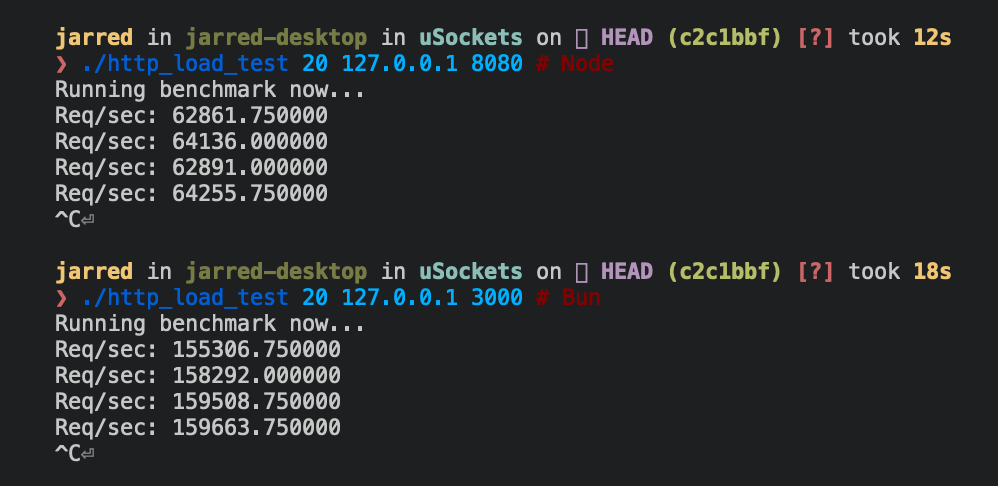
The following Bun and Node.js servers respondBun! to each incoming Request.
Bun
Bun.serve server can handle roughly 2.5x more requests per second than Node.js on Linux.
| Runtime | Requests per second |
|---|---|
| Node 16 | ~64,000 |
| Bun | ~160,000 |
Practical example: REST API
Here’s a basic database-backed REST API using Bun’s router with zero dependencies:Reference
See TypeScript Definitions
