
In a strange garden


This essay is by artist and horticulturist Cortney Cassidy, who stayed in one of our cabins for a month this summer as a gardener-in-residence. Prior to diving in, you may enjoy reading a previous interview with Cortney about her transition from tech-world designer to gardener, as it contextualizes the career switch referenced below. As a final note, know that the diaristic entries in this essay detail light movement in the gardens over one single day. More of her light diary will be published in a forthcoming issue of Mail Blog, the wonderful publication she snail-mails out to subscribers—find past issues and subscribe via Cortney’s website.
☼
9:22 AM
Light broke the forest.
The cypress edges were bushiest where brightest.
While navigating immense grief over the death of an overidealized gardening job, I showed up at Willa’s mountain compound in the middle of summer as a gardener-in-residence. She gave me freedom to do—or not do—whatever I wanted in the overgrown space, which was entangled with non-native plants selected long ago to satisfy the previous property owner’s interpretation of a sprawling Japanese garden.
Like the introduced plants, I arrived a stranger to the land, and to myself. Looking around, I felt that we were all dynamic living organisms in need of restoration after extended periods of untended chaos. On that first morning, there was so much to do that it felt impossible to do anything. So, I turned my attention to the real star of the garden: the light warming my face.
☼
10:05 AM
A beam fell from the roof onto the edge of the slope.
It was unclear if it was truly the edge.
The individual power of wild plants knows no bounds.
To work in a strange garden, you must look beyond the garden. You must absorb the sky and the skyline, the soil, the color of the grass, and the shape and nature of the trees¹. You must know how the light greets the land. A practical exercise of monitoring the sun at regular intervals throughout a single day will help achieve this.
While observing the star in outer space, you may also notice an unexpected impact on your personal inner space. Active attention can open doors to profound reflections, which can then become the missing links needed to turn unprocessed experiences into surprising new ideas and realizations.
In this natural environment, directing my awareness outward tethered me to a physical world where nothing exists in isolation, not even myself—however inescapable my feeling of being alone may be at times. Standing in the sun reminded me that all organisms are working together to make and survive this world².

☼
10:27 AM
The fern mass held out their leaves like cold hands to a fire.
There are some the sun reaches, and there are others who reach for the sun.
You can tell by their body language.
When I left my long-time technology career to work as a gardener, Willa asked me if there was anything in particular I was focused on growing. My answer was myself. There is immense vulnerability when standing at the edge of a new occupation. That insecurity can reveal unexpected strengths and test latent fragilities. You learn quickly how far you’ve come in your personal growth, and how far you have yet to go when challenged in ways you’re not used to.
☼
11:56 AM
The gate was light and the ground was not,
except for the yellow rays of rudbeckia looking back at their own image.
Pivoting from tech to gardening was a vocational choice I made to find peaceful, non-capital value in my daily work. I saw it as a type of protest in the name of existence against the dehumanizing forces of modern industrial society³. I had utopic aspirations for my new pursuit, and assumed the nature of the garden-as-workplace would reflect the same values found in gardening-as-work: patience, support, tenderness, care.
However, in my first full-time gardening job, I struggled to maneuver through the reality of a working environment that was just as susceptible to the problems of ego, hierarchical dysfunction, social cliques, and competitive motivations as any other job. During an emergency leave of absence I took to recover from the exhaustion, dread, and sadness caused by this workplace, I realized peace could not be found there. Sadly and unexpectedly, I had reached the end of my journey in that version of institutionalized horticulture.

☼
1:03 PM
A snake faced me from its hanging bed of shaded cypress branches.
Everything else became another snake watching me from the corner of my eye.
When you love a place, its community, and the outcomes that result from your efforts within that place, work doesn’t feel like work. Without an attachment to a place, though, gardening work can become less energizing, even draining. I gave a lot of myself to the garden workplace which I desperately hoped would nurture my growth as a new gardener, and now, in another strange garden, I felt a little lost trying to rediscover myself, and the joy I once felt in a garden. Before beginning my work in this new garden, though, I realized I needed to expel all the lingering job-related resentment, disappointment, and embarrassment. Then, I hoped to be able to reach for my generous habit of curiosity, and to trust that if I gave myself to this new place, it would help me get myself back⁴.
☼
1:48 PM
There was nothing in the way between the slope and the sun
except where the maple could reach.
After you learn how the light moves in a strange garden, the next step is to remove the plants that are obviously unwanted. Sometimes these are considered weeds, sometimes they are plants that were chosen long ago, and which have now outgrown their horticultural relevance. Regardless, most of them can be found growing in the light. And the longer the garden has lacked attention, the more unwanted opportunists there will be. If it’s been a very long time, for example decades, it might be easier to identify what is wanted instead of what isn’t. Then, you can focus on freeing up space around the wanted. Move slowly—there’s no rush. As plants, debris, and noise are removed, a sense of understanding will replace them.

☼
2:33 PM
How ideal for its occupants that at such a summer hour,
the house was completely under the cover of trees.
The tallest shrub in the back could still reach the light.
That is why it is the tallest shrub.
Emily Dickinson used her beloved garden as a guide to her soul, which she called her unseen garden—with all its needs of cultivation and improvement⁵. If you are in a fragile or stressed state, it may help to think of yourself as a garden. The more attention you give your unseen garden, the more you may come to understand it. Every act of feeding, digging, and pruning will reveal a new truth.
☼
3:45 PM
Bright leaves hovered over dark ones.
Gardening is growing. Growing is slow. And it never stops. A relationship with a garden, in which you are both producer and consumer, makes whole again what has been broken because you can understand how something came to be⁶. When a garden is overgrown, a quick outsourced overhaul can be an option for those who can afford it, but without experimenting at the pace of the earth’s rotation around the sun—the length of days, seasons, years, the fluctuating temperatures in the air and the ground—the valuable opportunities to know more are removed.
☼
4:14 PM
The scale-like cypress leaves still cradled the scale-covered snake
who had a more relaxed posture than before.
Nothing makes me feel more vulnerable
than walking near a snake with my toes out.
You might be afraid to make mistakes in a strange garden, especially if it belongs to someone else. But gardens are quite forgiving places because they will always grow. A mistake is an opportunity to learn something new. My soil knife wasn’t enough to dig out the Japanese flowering shrubs from the rock-filled slope. So instead, I coppiced a small patch to the ground without a plan. It felt risky. I was making a commitment without knowing exactly what would come next. But I needed to see what it would look like if they were no longer shading out other plants.
☼
5:09 PM
The hottest light was on the creek
but stopped at the yellow rays of the rudbeckia.
They got all they were going to get.
The poetic experience of using your full awareness to observe something attentively will unquestionably expand your world⁷. In the garden, it’s important to know what you’re looking at; there is a rhythm that alternates between looking closely before making a decision, and making decisions to be able to take a closer look. I didn’t recognize a large shrub in the strange gardens, until after I’d spent hours clearing the crowds around it, with the help of my friend Mac visiting from Texas. I thought because of the shrub’s size, it was a desired landscape specimen. But when we could see it better, one red berry on a low branch revealed that it was an aggressive, hostile invader that will inevitably become a harder problem to manage with each growing season.
☼
5:35 PM
Dark entered through the gate.
Light and dark come from the road.
As I cut things down or dug them out when the ground cooperated, recognizable plants materialized, and ecosystem relationships began to take shape. The garden’s form emerged and I followed it with a pencil on paper. The longer I looked, the less of a mystery the underlying landscape became. I could better imagine what acts to take next to prepare the garden for its future. While I couldn’t fully see my own future, having a plan, even just an immediate assignment, established meaningful purpose and a grounding sense of direction. And, every act taken proposed the next one worth considering.

☼
6:00 PM
The sun will shine brightly for hours elsewhere
but it was done here.
Gardens are as dynamically alive as we are. And, there is no final perfect state for a garden, or for a person. I haven’t figured out what’s next for my horticulture journey, but my time in a strange garden helped me understand that paths twist and turn and spiral. If you try to force a linear path, the inevitable twisting and turning and spiraling will become very uncomfortable. Instead, we can all learn something from the plants constantly adjusting their growth plans as conditions change. Follow softly as the light shifts, and when needed, take your body into a strange garden.
☼
6:19 PM
I thought I saw more light through the old glass windows.
It was the yellow rays of the rudbeckia,
craving for more and instead shining their own.
𓆤
¹ The Education of a Gardener by Russell Page
² The Mushroom at the End of the World: On the Possibility of Life in Capitalist Ruins by Anna Lowenhaupt Tsing
³ There is a Garden in the Mind: A Memoir of Alan Chadwick and the Organic Movement in California by Paul A. Lee
⁴ Wanderlust: A History of Walking by Rebecca Solnit
⁵ The Gardens of Emily Dickinson by Judith Farr
⁶ Orwell’s Roses by Rebecca Solnit
⁷ “Poetry’s So Common Hardly Anyone Can Find It” by Cortney Cassidy
Related Posts

Submerged in the ecotone
What can we learn from bugs about the tense awkwardness of life on Earth?
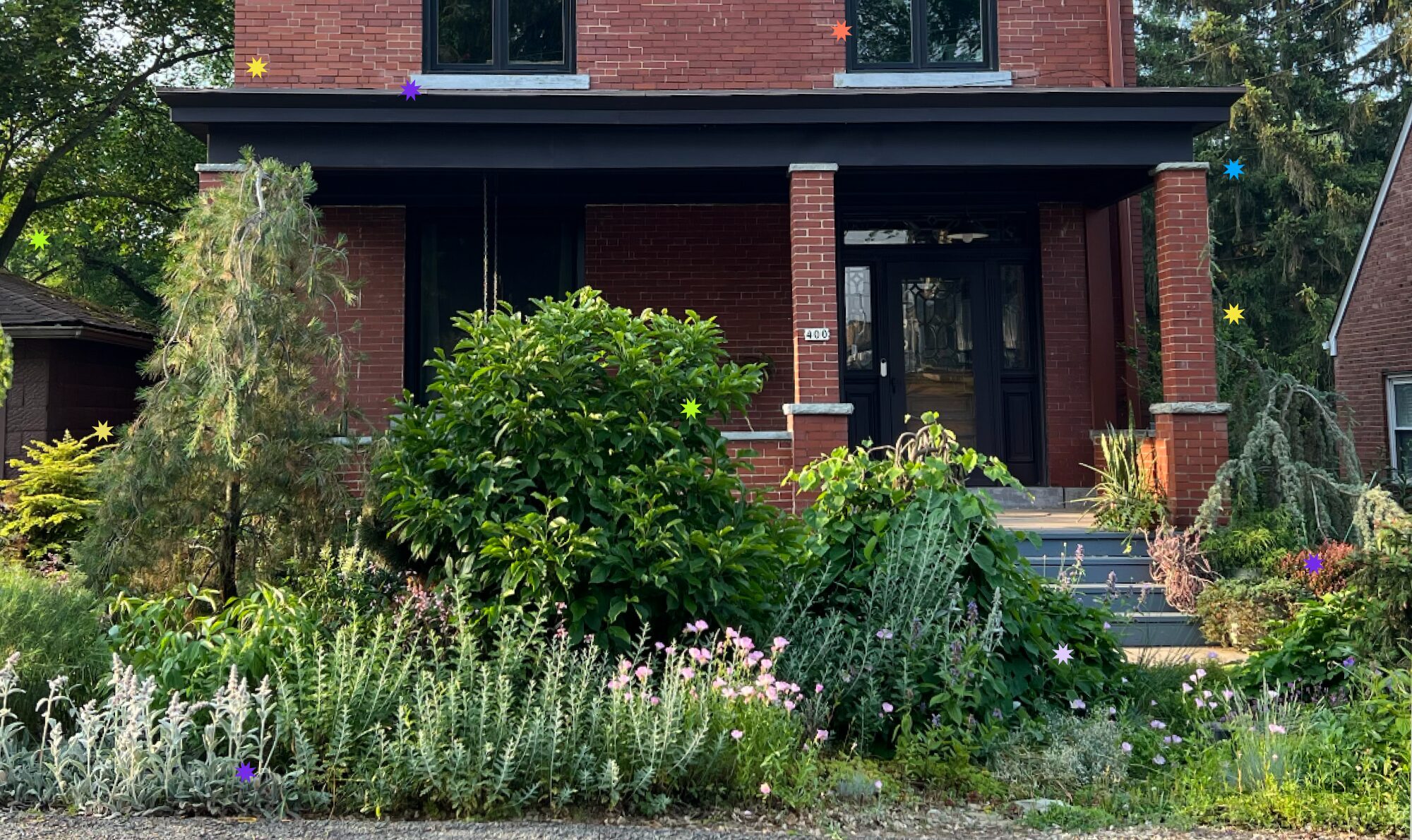
A suburban lawn can be a garden ❁
Designer Elana Schlenker on transforming her Pittsburgh yard into an ecological oasis.

Should healthcare be collaborative?
Eushavia Bogan on pivoting from farmer to doctor, plus tips on empowering yourself within the medical industrial complex.

How do you trust a mystery?
A homeopath’s revelations on healing, career paths, and all the ways we can build knowledge.

Can we get down to earth?
Amirio Freeman and Kate Weiner on following sparks of collaborative resonance, building literacy through embodiment, and why slowing down might save us.

It’s smart to love weeds
Wisdom from the org teaching colleges to prioritize healthy people, plants, and soil over toxic turf lawns.

Can we be more by doing less?
On the impacts of slowing down, a guide for DIY deceleration, and a new interview series.

Embodying an ecological framework
Casey Tang on forest gardening, complex systems, and mapping ecological design onto software methodologies.
