-
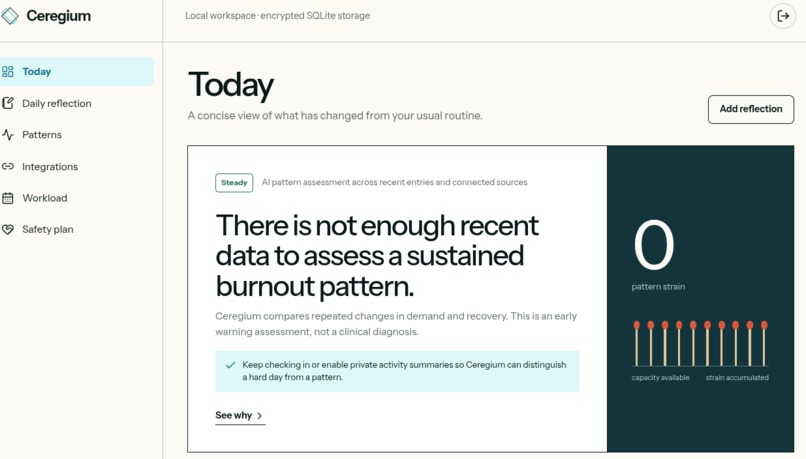
dashboard

About the Project
Inspiration
Ceregium was inspired by the pressure many students feel when schoolwork, burnout, sleep problems, and stress start stacking up. A lot of student tools only track assignments, while wellness apps often ignore the academic side of stress. I wanted to build something that connects both: a student wellbeing tool that understands workload, reflections, patterns, and planning in one place.
The idea was to create an early-warning system for student burnout. Ceregium is not meant to diagnose anyone or replace professional help. Instead, it helps students notice patterns earlier, reflect safely, and make better short-term plans before stress becomes overwhelming.
What It Does
Ceregium is a self-contained student wellbeing product. It supports local accounts, encrypted reflections, assignments, browser pairing, safety-plan data, and personalized wellbeing tools.
Some of the main features include:
- Local email/password accounts with hashed passwords
- Encrypted private reflections
- Burnout-pattern assessment over time
- Workload tradeoff suggestions based on deadlines and grade impact
- Manual assignment tracking
- Optional browser activity monitoring
- A browser companion for importing assignments
- Personalized exercises for breathing, grounding, sleep, recovery, workload, and connection
- AI-generated 48-hour schedule-easing plans with deterministic fallback
- Export and permanent account deletion
- Responsive desktop and mobile UI
A simple way to describe the goal is:
$$ \text{Student Wellbeing} = \text{Reflection} + \text{Workload Awareness} + \text{Actionable Planning} $$
How I Built It
I built Ceregium as a full-stack TypeScript project with a local-first architecture. Instead of depending on services like Supabase, Google OAuth, Redis, Resend, or Twilio, Ceregium stores its core data locally using SQLite.
The app stores accounts, reflections, assignments, settings, browser pairings, and safety-plan information in a local SQLite database. Reflections are encrypted, and user sessions use expiring HTTP-only cookies for better security.
For AI analysis, Ceregium can use OpenRouter to analyze reflections and generate schedule-easing plans. However, I also built deterministic fallback logic so the app still works even without an API key. That was important because I wanted the product to remain functional, testable, and self-contained.
The browser companion was built to connect with the local app through scoped pairing keys. It can detect assignments and recognize learning or productivity services, but it avoids collecting sensitive information like full page text, exact URLs, searches, messages, school passwords, or OAuth tokens.
Challenges I Faced
One of the biggest challenges was balancing usefulness with privacy. Since this project deals with reflections, burnout patterns, and student wellbeing, I had to think carefully about what data should be stored, what should be encrypted, and what the browser extension should not collect.
Another challenge was making the app work without relying completely on AI. AI-generated plans are useful, but if the API fails or no key is provided, the product still needs to work. Building deterministic fallback logic made the system more reliable and safer.
The browser companion was also challenging because it needed to be useful without becoming invasive. I had to design it so that it could import assignment metadata and report coarse activity summaries while avoiding unnecessary personal data collection.
I also had to think about safety-sensitive logic. Since Ceregium is an early-warning and planning tool, not a medical diagnostic service, the app needed clear boundaries and guardrails.
What I Learned
Through this project, I learned a lot about building full-stack applications that handle sensitive user data. I practiced working with authentication, encrypted storage, SQLite, browser extensions, AI API integration, fallback systems, and responsive UI design.
I also learned that product design is not just about adding features. For a wellbeing tool, the most important question is not “How much can this app track?” but “What is actually helpful, safe, and respectful to the user?”
Ceregium helped me understand how to build software that is both practical and careful. It combines technical systems like local databases and browser extensions with human-centered goals like reducing stress, planning better, and recognizing burnout patterns earlier.
What’s Next
In the future, I would like to improve Ceregium with stronger visualizations, better onboarding, more customization, and more polished deployment support. I would also like to continue improving the browser companion so it can help students manage workload while still protecting their privacy.
Overall, Ceregium is a student wellbeing and planning tool designed to help students reflect, understand their workload, and take action before stress becomes unmanageable.
Built With
- css3
- html5
- javascript
- openrouter
- typescript


Log in or sign up for Devpost to join the conversation.