-
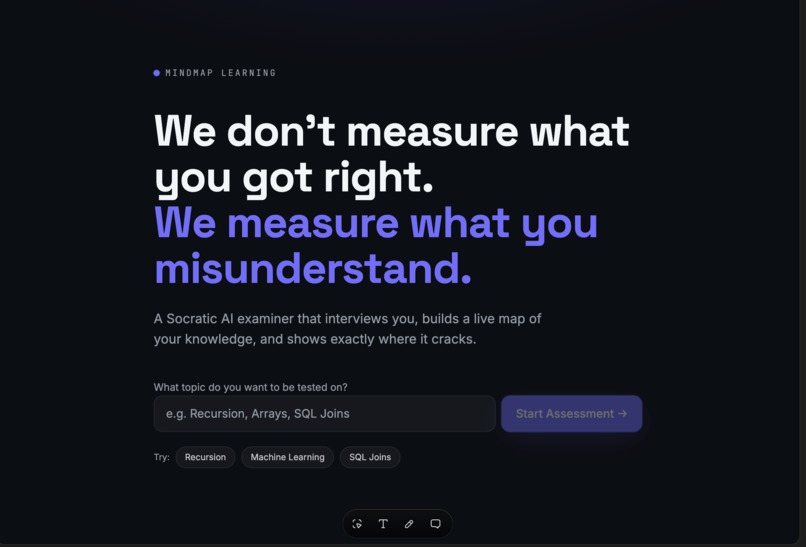
Main interface
-
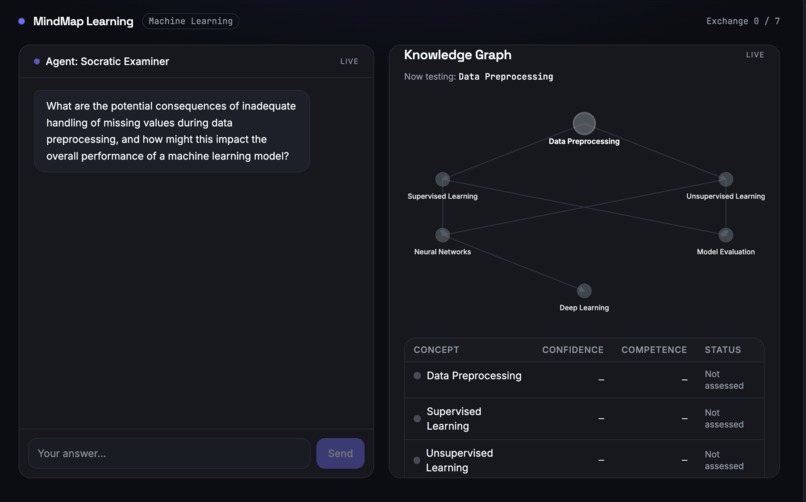
AI agent that talks


Inspiration
Most educational platforms measure the wrong thing.
They track time spent, videos watched, and quiz scores. But none of them measure misconceptions — the gaps that exist even when a student thinks they understand something.
A student says "I know recursion." A standard system asks for a definition. Score: 100%. But ask them what happens in memory during a recursive call and the understanding collapses.
That's the problem MindMap Learning solves.
What It Does
MindMap Learning is a Socratic AI examiner that:
- Takes any topic a student claims to know
- Interviews them with deep, reasoning-based questions (not MCQs)
- Builds a live knowledge graph showing confidence vs competence for every concept
- Detects the exact misconceptions — down to the specific node
- Generates a personalized remediation plan targeting only the weak areas
The key insight: high confidence + low competence is the most dangerous learning state. MindMap makes that visible.
How I Built It
The app uses a 4-agent AI pipeline, each with a distinct role:
| Agent | Role |
|---|---|
| Knowledge Mapper | Builds the concept graph for any topic |
| Socratic Examiner | Asks adaptive, reasoning-revealing questions |
| Misconception Detector | Scores confidence vs competence after each response |
| Remediation Coach | Generates a targeted learning plan at the end |
Tech stack:
- Frontend: React + Tailwind CSS (built with Lovable)
- AI: Groq API (Llama 3 70B) — free, fast, no credits required
- Architecture: Fully client-side, no backend needed
- State: React useState managing the full knowledge graph and session
Challenges
Getting the agents to stay in JSON format was harder than expected. LLMs tend to add explanations and markdown around JSON responses. Solved this by being extremely explicit in system prompts: "Return ONLY valid JSON. No explanation. No markdown backticks."
Graph coloring timing — making sure the knowledge graph node colors updated after the misconception detector returned scores, not before, required careful async state management.
Balancing question depth vs session length — the Socratic Examiner
would sometimes go too deep on one concept. Added a next_concept_to_test
field in the detector's JSON response to guide the flow forward.
What I Learned
- Multi-agent prompt engineering is an art — each agent needs a very tight, specific system prompt or outputs drift
- The confidence vs competence gap is real and measurable even in a short 7-exchange session
- Lovable + Groq is a surprisingly powerful stack for rapid AI app prototyping
What's Next
- Add more subjects beyond CS (Math, Physics, Economics)
- Persistent knowledge graphs across sessions (Supabase integration)
- Teacher dashboard showing class-wide misconception heatmaps
- Spaced repetition reminders targeting detected weak nodes
Built With
- groq
- javascript
- llama-3
- lovabale
- lovable
- react
- tailwind-css


Log in or sign up for Devpost to join the conversation.