


Claire Andreasen Receives Fulbright to Study Solar Batteries
Recent Duke ECE graduate will study redox-flow batteries at the Laboratory of Nanoscience for Energy Technologies in Lausanne, Switzerland with support from the prestigious award.
Duke has long been home to innovators and leading experts in transformative fields like metamaterials, machine learning and artificial intelligence, and quantum computing. With the historic naming of the Department of Electrical and Computer Engineering in recognition of Pierre R. Lamond, Duke is poised to deepen and expand its work in semiconductors, nanoelectronics, and computer engineering—fields increasingly shaping how we live in a smarter society.
Since 1957, Pierre R. Lamond has been at the forefront of the semiconductor revolution. Now, he and his family have looked to Duke to continue that legacy by providing the foundation of a $57 million investment in computing.
Building on Duke’s legacy in high-performance computing and distributed systems, we bring together world-class teams in neuromorphic computing, cloud infrastructures, and AI-enabled hardware.
Patrick Pensabene shares his experience in the Master of Engineering (MEng) program at Duke ECE. A rigorous curriculum plus supportive faculty with industry connections opened the path to the exact career he wanted in high-performance computing.
We stand at a historic inflection point with AI breakthroughs, quantum computing, and next-generation hardware on the horizon. No matter your technology of choice or career goals, Duke ECE’s Masters programs have a study track to help you excel.

Gain expertise in new, resilient hardware architectures for emerging platforms ranging from major data centers to personal mobile devices.

Build strong foundations in programming, computer architecture, and large-scale systems while developing the skills to design and maintain software that powers modern computing platforms.
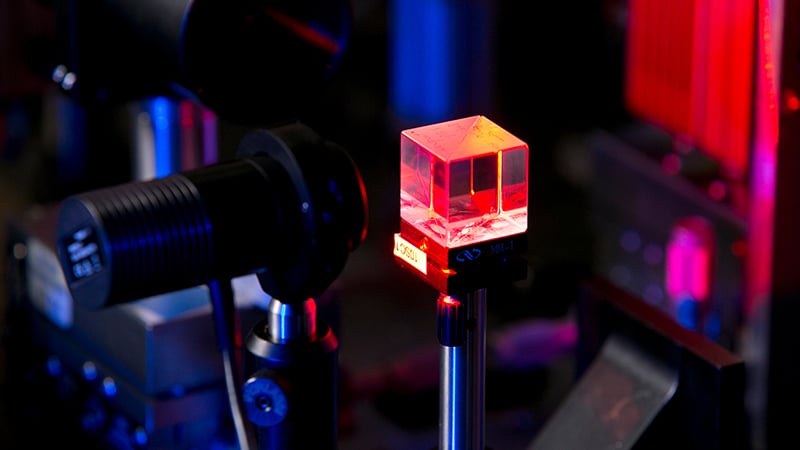
Develop expertise in quantum algorithms and information systems while learning the design, fabrication, and testing of next-generation quantum devices and architectures.

Learn under international leaders in nanoelectronics, optoelectronics, microfluidic systems, integrated optics, sensors, integrated multifunctional devices/systems, energy conversion devices, and quantum sensors.

Develop deep expertise in the mathematical foundations of ML and AI while gaining the practical skills needed to design and deploy AI systems that scale in real-world environments.
Recent Duke ECE graduate will study redox-flow batteries at the Laboratory of Nanoscience for Energy Technologies in Lausanne, Switzerland with support from the prestigious award.
Jul 20
Robust Machine Learning (ML) is arguably the most important technical challenge of current times, to address growing concerns about misuse of AI, violations of data privacy and stealing of trained […]
10:00 am – 10:00 am
Jul 24
Come see the work participants in Data+, Climate+, Code+, CS+, Climate+, and Applied Ethics+ at our end of summer poster session finale! Each project team will share their 10 weeks […]
2:00 pm – 2:00 pm Energy Hub Lobby, Gross Hall 100
Jul 27
Last day to withdraw with W from Term 2 classes (undergraduates only)