
CNIPS is a powerful integration platform enabling you to connect applications, ingest and emit data, apply logic and transformations, and orchestrate workflows — all with clarity, security, and observability.
📦 Use CNIPS to build data pipelines, glue apps together, transform payloads, and automate business logic — without reinventing the wheel.
- Getting Started — understand the core concepts and terminology
- Configuration — manage credentials, API access, and secure resources
- Pipelines — model your data flows and logic
After you finish the Getting Started guide, we recommend exploring Modules & Components for deeper dives.
| Module / Topic | Description |
|---|---|
| Sources | Where data enters your system (webhooks, APIs, files, etc.) |
| Destinations | Where processed data is sent (databases, APIs, queues, storage) |
| Transformations | Logic to modify, filter, map, or enrich payloads |
| Decision Blocks | Branching / conditional logic for dynamic flow |
| Pipeline Editor / Lifecycle | Building, editing, deploying, and triggering pipelines |
| Function as a Service (FaaS) | Running custom code (e.g. serverless functions) within flows |
| User & Access Management | Roles, permissions, multi-tenant contexts |
| API / SDK Reference | Programmatic control and tooling (CLI, SDKs, REST API) |
| Templates & Recipes | Pre-built patterns and sample integrations |
| Monitoring & Observability | Logs, metrics, dashboards, error handling |
| Administration & Operations | Scaling, deployment, backup, secrets, upgrades |
| Security & Compliance | Encryption, auth, secrets, audit trails |
- Getting Started / Intro — main domains and terms
- Configuration — set up credentials and external connections
- Pipelines / Flow Composition — build a basic pipeline
- Explore deeper modules (Transformations, Decision Blocks, etc.)
- Use Templates & Examples to accelerate your work
- Dive into API / SDK / CLI usage
- Read Administration & Monitoring for production readiness
- Changelog / Release Notes — see what’s new (coming soon)
- Contributing Guide — help improve docs and code
- Support / Community — issues, discussion boards, contact
- Examples — end-to-end use cases in different domains
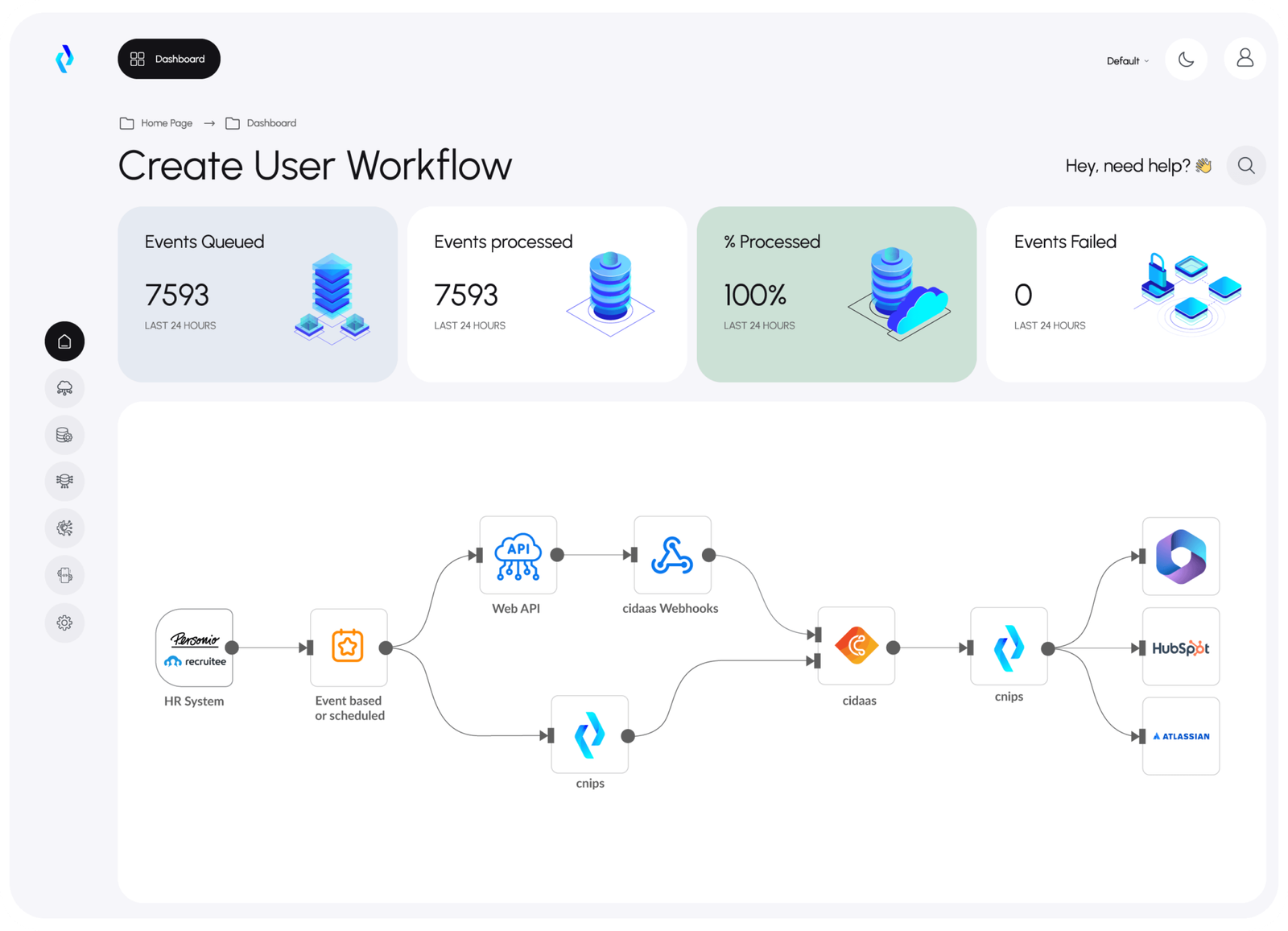
Figure: Integration within CNIPS. The diagram shows how data flows from sources, through pipelines (with transformations and decision nodes), to destinations, while configuration, runtime, and observability are layered across the system.
