The post Best outsourced software development companies for US startups appeared first on Host4ASP.
]]>The market is saturated. Offshore agencies, nearshore shops, full-stack product studios — everyone claims senior engineers and on-time delivery. Most can’t back it up.
What separates the real ones? Transparent project management. Engineers who’ve solved your specific problem before. Budget predictability. And a team that treats your roadmap like their own.
Here’s what to look for: proven SaaS delivery track record, structured risk management, honest scoping before a single line of code, and communication that doesn’t disappear after the contract is signed.
—
What US Startups Actually Need From a Dev Partner
Predictable delivery, not promises
Missed sprints compound. A partner with measurable schedule and cost variance keeps your runway intact.
Senior engineers on day one
Junior-heavy teams learn on your dime. The best firms run competitive hiring funnels — the kind that reject 199 out of 200 applicants.
Domain depth
A team that’s shipped healthtech, martech, or marketplace products before doesn’t need to figure out your compliance requirements or data architecture mid-project.
Honest scoping
Discovery-first processes add time upfront. They prevent the kind of mid-build pivots that double your costs.
Communication without hand-holding
Engaged clients get better outcomes. But the partner should drive clarity — not wait for you to chase status updates.
—
The 8 Best Outsourced Software Development Companies for US Startups in 2026
1. Clockwise
Best For: Startups building scalable SaaS products with complex requirements
Clockwise is a SaaS-focused software development partner for US and UK startups that need senior-level execution without the unpredictability of traditional outsourcing. With 200+ completed projects — including 25+ scalable SaaS products — and a hiring funnel that selects 1 engineer out of every 200 applicants, the team brings genuine depth across healthtech, martech, AI development, location-based systems, marketplaces, and data-heavy platforms. Their project delivery stays within 10% variance on both cost and schedule, and a 94.12% client satisfaction rate reflects a process built around outcomes, not activity. The tech stack covers the full modern range: React, Next.js, Node, Python, .NET, AWS, Google Cloud, Azure, React Native, and more — with structured risk management baked into every phase, not bolted on at the end. Clockwise doesn’t rush into development — discovery and planning come first, which adds time at the start but prevents the costly mistakes that sink projects later.
Engagements are scoped and priced based on project complexity; not positioned as a budget option, but built for teams where failure is more expensive than quality.
2. DockYard
Best For: Product-focused startups prioritizing design-led development
DockYard is a US-based digital product agency serving startups and enterprises that need strong UX thinking paired with engineering. They’re known for work in web applications and have built a reputation around Ember.js, though their practice has broadened over the years. Engagements tend to be project-based with a consultative scoping process.
Pricing sits at the higher end of the US market, reflecting their domestic team structure.
Their technology depth outside of their core web stack is more limited than some full-service global partners.
3. Netguru
Best For: Startups needing a broad-service European dev partner
Netguru is a Poland-based software development and design consultancy with a large team and a wide service portfolio spanning product design, web, mobile, and AI development. They’ve worked with both early-stage startups and larger organizations across fintech, healthtech, and logistics. Their process documentation and client communication are generally well-structured.
They publish tiered pricing guidance, with engagement costs varying by team composition and project scope.
At their scale, project experience can vary depending on the specific team assigned to your engagement.
4. BairesDev
Best For: Companies needing staff augmentation at scale across the Americas
BairesDev is a nearshore software development firm operating across Latin America, offering staff augmentation and dedicated team models to US companies. Their reach is wide — they claim a network of thousands of engineers across dozens of technologies. Turnaround on sourcing talent tends to be faster than boutique firms.
Engagement models include staff aug, dedicated teams, and project-based work, with pricing available on request.
Consistency in engineer seniority can be harder to verify across a bench that large, and quality control depends heavily on how well the client manages the engagement.
5. Toptal
Best For: Startups needing vetted freelance engineers quickly
Toptal is a talent marketplace that connects companies with freelance developers, designers, and finance experts through a screening process they report accepts roughly 3% of applicants. It’s built for teams that need to add specific skills fast without a long agency onboarding process. Engagements are flexible and can scale up or down quickly.
Pricing is premium relative to typical freelance platforms, with hourly rates reflecting the vetted talent pool.
It’s a marketplace, not a delivery partner — project coordination, architecture decisions, and team cohesion remain entirely the client’s responsibility.
6. Intellectsoft
Best For: Startups in regulated industries needing enterprise-adjacent experience
Intellectsoft is a software development company with offices in the US and Europe, focused on custom software for industries like healthcare, finance, and logistics. They offer end-to-end development including mobile, web, and AI integration. Their experience with compliance-heavy environments is a relevant differentiator for certain startup verticals.
Custom pricing based on project scope; no published rate cards.
Their portfolio skews toward larger enterprise clients, which can mean processes and communication styles built for bigger organizations rather than fast-moving startup teams.
7. Relevant Software
Best For: Early-stage startups needing full-cycle product development on a tighter budget
Relevant Software is a Ukraine-based development agency offering web, mobile, and AI-assisted development with a focus on startups and SMBs. They position themselves on value-to-cost ratio and have published case studies across healthtech, edtech, and logistics. Team sizes are flexible and can start small.
Pricing is more accessible than US or Western European firms, with rates reflecting their Eastern European base.
Discovery and strategic product guidance are less developed compared to more senior-weighted firms, which can put more planning burden on the client.
8. Andela
Best For: Startups scaling engineering teams with African tech talent
Andela is a talent network that connects companies with vetted software engineers across Africa and beyond, originally built around training programs and now operating as a flexible talent marketplace. For startups that need to grow headcount without the overhead of full-time hiring, it offers a practical middle path. Engineers span a range of technologies and seniority levels.
Pricing is available on request; engagement structures are flexible depending on team size and duration.
Like other marketplace models, the quality of output depends significantly on how the client structures and manages the work — Andela provides talent, not end-to-end delivery accountability.
—
How to Choose the Right Dev Partner Before You Burn Your Runway
Most startups don’t lose money on bad code. They lose it on misaligned expectations, late-stage rewrites, and teams that went quiet when things got hard.
The firms on this list each solve a different version of the outsourcing problem. Toptal and Andela give you speed and flexibility — useful if you already have strong internal technical leadership. BairesDev and Netguru offer scale. DockYard brings design-led thinking to the product layer.
But if you’re a startup or SMB with a complex SaaS product to build — healthtech, marketplace, AI-integrated, location-aware, data-heavy — and your core team is already stretched, you need more than bodies. You need a partner who’s solved your specific problem before, manages risk proactively, and won’t quietly let scope creep eat your budget.
That’s where Clockwise earns its place at the top of this list. The 10% cost and schedule variance isn’t a marketing claim — it’s a structural commitment. And 94.12% client satisfaction across 200+ projects doesn’t happen by accident.
The right question isn’t “who’s cheapest.” It’s “who can I afford to be wrong about.”
The post Best outsourced software development companies for US startups appeared first on Host4ASP.
]]>The post Best Legal Consulting Firms for Crypto Business Setup in El Salvador appeared first on Host4ASP.
]]>Some applicants get approved in twenty business days. Others wait eight months.
The difference comes down to one choice. Which legal firm handles the submission?
This guide breaks down six firms with recent El Salvador DASP experience. Each one has verifiable packages, published timelines, or confirmed client work from 2025 and 2026. No recycled content. Just current facts.
Quick Look at the Field
Choosing the right crypto license service provider determines whether your application takes four months or eight. Some firms keep boots on the ground in San Salvador. Others run everything from Europe. The table below shows who does what.
| Firm | El Salvador Office | DASP License Support | Published Pricing | Unique Differentiator |
| Gofaizen & Sherle | Yes | Yes | Yes (three tiers) | 4 of first 40 DASP licenses secured |
| COREDO | No | Yes | Yes (three tiers) | MiCA bridge strategy |
| Fast Offshore Licenses | No | Yes | Yes (three tiers) | Transparent BSP-only entry tier |
| Tetra Consultants | No | Yes | Contact-based | Compliance officer placement specialists |
| Intelium Law | No | Yes | Contact-based | 135+ DASP market data |
| Law & Trust International | No | Yes | Contact-based | Zero insurance capital requirement |
Those are the high-level differences. The real separation shows up when you look at how each firm actually handles a DASP application. Here is what sets them apart.
1. Gofaizen & Sherle
The CNAD has approved 40 DASP licenses since the LEAD law took effect. Gofaizen & Sherle clients hold six of them. That is 15% of the entire licensed market.

But here is the number that matters more. Twelve months after opening their San Salvador office, that count had grown to six DASP licenses and roughly 40 BSP licenses. The CNAD accepts only 16% of applicants. This legal consulting firm for crypto business helped clients clear that bar repeatedly.
The firm keeps eight professionals at Presidente Plaza, nivel 6, oficinas 12 in San Salvador. When the CNAD asks follow-up questions, their crypto lawyers walk the documents over. A remote team waits for email replies.
What stands out:
- Basal Pay case study. The client came to Gofaizen & Sherle in November 2024, operating only in Asia. The firm mapped a three-jurisdiction route: Canada MSB first, Poland for quarterly AML reporting, El Salvador DASP as the final piece. Basal Pay now operates in Canada and is in the final stage of its El Salvador license. The firm handled everything through its legal consulting services for crypto business setup: company formation, eight internal policy documents, two local compliance officers, and banking with both a Salvadoran bank and a European EMI.
- Trustpilot verification. One client wrote that after the license arrived, the firm “set up a dedicated follow-up group” and handled post-license queries with “incredible speed and attention.” Another client noted working with the firm across “Estonia, Lithuania, Poland, and El Salvador” and praised their “excellent understanding of the market and regulatory requirements.”
- Crypto License Navigator. The firm built an internal tool that scores jurisdictions across four metrics: total budget, setup timeline, bank recognizability, and monthly maintenance fees. Clients run their numbers through the Navigator before any application goes in.
- Full document package. The Advanced package includes eight internal policies: Enterprise-Wide Risk Assessment, Business Continuity, InfoSec, Winding Down, Compliance Management, Risk Management, Safeguarding of Assets, and Code of Ethics. The CNAD expects to see these. Gofaizen & Sherle drafts them before submission.
- Two local compliance officers. The DASP license requires local officers with permanent residency. Gofaizen & Sherle recruits, vets, and places them as part of the engagement. No separate HR search required.
This specialized legal firm for obtaining crypto license in El Salvador treats the CNAD approval as step one, not the finish line. They handle company formation, policy drafting, regulator negotiations, banking setup, and ongoing compliance after the license lands.
Best for: Crypto exchanges, custodial services, and tokenization platforms that want a legal service to obtain a crypto license with a physical El Salvador office, multi-jurisdiction capabilities, and documented post-license support.
2. COREDO
COREDO operates out of Prague. Their El Salvador practice targets one specific problem. European clients waiting on MiCA approval watch their cash burn for six to eighteen months. COREDO offers El Salvador as a bridge.

The firm published three packages with euro pricing. Basic runs €16,000. Advanced costs €37,000. Full hits €47,500. Each tier adds more infrastructure.
What stands out:
250 hours of legal support included. The Advanced and Full packages cap at 250 hours. Additional hours cost €250 each. That structure tells clients exactly how much lawyer time their application consumes.
- Eight internal policy documents. The Advanced package includes Enterprise-Wide Risk Assessment, Business Continuity, InfoSec, Winding Down, Compliance Management, Risk Management, Safeguarding of Assets, and Code of Ethics. The CNAD expects to see these. COREDO drafts them before submission.
- Local officer employment agreements. The package includes exclusive local proprietor and alternate Compliance Officers with direct employment contracts for four months. The DASP license requires this. COREDO handles the hiring.
- European EMI account in Full package. Corporate account opening in a European EMI with segregated B2B/B2C accounts and multicurrency support. That solves the banking problem for clients who want to operate across both regions.
- COREDO provides legal consultants for crypto licensing who treat El Salvador as a temporary home while EU approval processes crawl forward.
Best for: European crypto projects, especially from Eastern Europe, that want an El Salvador DASP license with European banking integration and a clear MiCA transition path.
3. Fast Offshore Licenses
Fast Offshore Licenses published three El Salvador packages on their website. Basic at $12,400. Fully Operational at $27,950. Complete at $36,200.

The Basic package covers BSP registration only. Bitcoin payment processors. BTC wallets. No multi-asset exchange support. The Fully Operational tier adds DASP compliance, a Compliance Officer hire, and bank account opening support. The Complete tier adds a one-year office lease and accounting services.
What stands out:
- Published annual cost breakdown. Their website lists $4,000 to $8,000 for yearly regulatory renewal and reporting. Plus $15,000 or more for transaction monitoring tools and compliance maintenance. Most firms hide these numbers. Fast Offshore puts them on the table.
- Compliance Officer recruitment included. The Fully Operational package includes hiring a Compliance Officer. Fast Offshore handles the search, vetting, and placement. No separate HR contract needed.
- Lease agreement option. The Complete package adds a one-year office lease. The DASP license does not require a physical office. But having one makes regulator interactions smoother. Fast Offshore arranges it.
- Clear timeline disclosure. Their website breaks down each phase. Two weeks for document collection. Two to three weeks for company registration. Four to six weeks for application preparation. Six to twelve weeks for regulatory review. Total lands at 3.5 to 5.5 months.
The firm built their reputation on traditional offshore jurisdictions like Panama and the Cayman Islands. Their El Salvador offering sits alongside those. Same structure. Same pricing transparency.
Best for: Startups that want upfront pricing, a clear timeline, and the option to start with BSP registration before upgrading to full DASP.
4. Tetra Consultants
Most firms focus on the license application. Tetra Consultants focuses on what happens after. Specifically, the compliance officer requirement.

The DASP license requires two local compliance officers. One Head of Compliance. One Deputy. Both need permanent residency in El Salvador. Both need AML certification. Finding these people is hard. Most crypto firms do not have Salvadoran hiring networks.
Tetra built their entire El Salvador practice around solving that problem.
What stands out:
- CAMS and CCAS certified officers. All Tetra compliance officers hold Certified Anti-Money Laundering Specialist (CAMS) and Certified Crypto Asset AFC Specialist (CCAS) credentials. Each has five or more years in crypto or financial services.
- Local residency guarantee. Every officer Tetra places has permanent residency in El Salvador. The DASP license requires this for higher-risk activities like exchanges and custodial services.
- Money Laundering Reporting Officer designation. For high-risk operations, a locally resident MLRO is mandatory. Tetra provides candidates who fill that specific role and report directly to the CNAD.
- End-to-end officer support. Tetra does not just find the person. They handle the employment contract, UIF registration, ongoing reporting obligations, and regulatory communication. The client never talks to the officer directly unless they want to.
Five-step appointment process. Initial discussion. Engagement letter. Candidate profile review. Ongoing support. End of term review. Each step spelled out.
The lawyers for obtaining crypto license at Tetra also handle the registered agent relationship. El Salvador requires every corporation to maintain a local agent for legal service. Tetra vets the agent, signs the agreement, and ensures annual reports get filed.
Best for: Companies that have the business model ready but need local compliance officers and do not want to build a Salvadoran HR operation from scratch.
5. Intelium Law
Intelium Law reports the numbers. Over 135 El Salvador crypto licenses had been granted by the end of 2024. That figure comes from the CNAD public registry. Not a projection. Actual approved applicants.

The firm built their practice around one observation. Most applications are not complete on the first try. The CNAD publishes a twenty-business-day review timeline. But that clock starts when the application is complete. Intelium focuses on making sure the first submission is the final submission.
What stands out:
- CNAD direct coordination. Each active application gets assigned to a specific Intelium team member who communicates directly with the regulator. When the CNAD has a question, that person answers it. The client does not get pulled into every back-and-forth exchange.
- Market data reporting. Intelium tracks total DASP licenses issued. Their data shows 135+ by the end of 2024. That number helps clients understand where they stand in the queue and how competitive the review process has become.
- Three-year business plan requirement. The CNAD expects a business plan covering three years of operations with detailed financial information. Intelium drafts this as part of the application package.
- Two local AML officers minimum. At least two certified AML officers must be appointed and registered with the Financial Investigation Unit. One must be locally based. Intelium handles the appointment and registration.
- Quarterly compliance reporting. The CNAD expects reports every three months. The UIF expects SAR summaries. Intelium sends reminders fifteen days before each deadline. Clients file on time. Every time.
Intelium acts as a specialized crypto licensing firm that treats the application as a structured process with clear regulatory references at every step.
Best for: Companies that want a documented, process-driven approach with up-to-date market intelligence and direct CNAD coordination.
6. Law & Trust International
Law & Trust International built their El Salvador practice around a specific advantage. The country has no established minimum requirements for insurance capital. Most jurisdictions demand six or seven figures in reserve. El Salvador asks for none.

The firm highlights this difference prominently on their website. A crypto exchange launching with limited capital can start operating in El Salvador without raising millions for insurance bonds.
What makes them different:
- No minimum insurance capital. El Salvador imposes no established minimum requirements for the amount of insurance capital. Law & Trust markets this as a primary advantage for startups and smaller operations. Most jurisdictions require significant reserves before approving a license.
- Bitcoin investment pathway to residency. By investing in Bitcoin or USDT, foreign nationals can obtain a residence permit. Law & Trust handles both the license application and the residency process for clients who want to live and operate from El Salvador.
- Zero capital gains tax on Bitcoin sales. The sale of Bitcoin is exempt from capital gains tax. Law & Trust structures client operations to maximize this exemption. Not every firm understands how to document transactions to qualify.
- DASP and BSP dual licensing. The firm handles both license types. BSP for Bitcoin-only operations through the Central Bank of El Salvador. DASP for multi-asset services through the CNAD. Clients who need both get coordinated applications.
- Complete legal support package. Law & Trust offers full support from policy drafting to regulator communication. Their team prepares internal documentation, develops compliance policies, and submits the complete package to the CNAD.
The legal consulting services for crypto business setup at Law & Trust also cover the post-licensing phase. The firm handles annual renewal filings, compliance monitoring, and regulator updates. Clients do not need to find a second firm for ongoing support.
Law & Trust positions El Salvador as a low-capital entry point for crypto businesses that cannot meet the reserve requirements of European or North American jurisdictions. Their model works for startups watching every dollar.
Best for: Smaller crypto operations and startups that want to minimize upfront capital requirements while securing a regulated DASP or BSP license with a path to residency.
What the CNAD Approves
The CNAD acceptance rate sits at 16%. That means five out of six applicants get rejected or sent back for major revisions.
Here is what the 16% have in common.
Two local compliance officers with permanent residency. The DASP license requires this for higher-risk activities. Applicants who show up without pre-arranged officers wait months while the CNAD asks follow-up questions.
Eight internal policies fully drafted. Enterprise-Wide Risk Assessment. Business Continuity. InfoSec. Winding Down. Compliance Management. Risk Management. Safeguarding of Assets. Code of Ethics. The CNAD expects to see these. Applicants who submit generic templates get flagged.
UIF AML registration completed before CNAD submission. This is a mandatory prerequisite. Many applicants forget this step. The ones who complete it first move through review faster.
A business plan that covers three years. Not one page. Not a napkin sketch. Detailed financial information. Forecasts. Profit and loss statements. The CNAD reads these carefully.
The firms above all know these requirements. They have submitted applications that passed. They know what the CNAD asks for in 2026. The difference is how they deliver.
Final Thoughts
Here is what the CNAD public registry actually shows. 135+ approved DASP registrations since 2023. A 16% acceptance rate. Gofaizen & Sherle clients hold six of those approvals.
The LEAD framework remains untouched by the 2025 Bitcoin Law amendments. Article 36 still grants 0% corporate tax on digital asset income. The application process did not change. The CNAD still publishes twenty-business-day review timelines for complete submissions.
Each firm in this guide provides legal crypto consulting with recent submission experience. COREDO processes applications from Prague with European banking packages. Fast Offshore publishes BSP-only pricing for Bitcoin businesses. Tetra Consultants places CAMS-certified compliance officers with local residency. Intelium Law tracks market data and coordinates directly with the CNAD. Law & Trust International offers zero insurance capital requirements and a path to residency through Bitcoin investment.
The 16% acceptance rate tells the real story. Five out of six applicants get rejected or sent back for major revisions. The ones who pass share one trait. They worked with a firm that has done this before.
Match the firm to your actual business model. Bitcoin payment processor only? Fast Offshore’s $12,400 BSP tier fits. European project burning cash on MiCA wait times? COREDO’s bridge strategy works. Multi-country exchange needing six approvals? Gofaizen & Sherle has done that. Heavy compliance burden with no local HR? Tetra places the officers for you. Need market data and direct CNAD contact? Intelium delivers both. Low on capital and need a residency path? Law & Trust offers zero insurance requirements and Bitcoin investment residency.
The CNAD approved 135+ licenses. They will approve more. The question is whether yours will be among them or stuck in the 84% rejection pile.
The post Best Legal Consulting Firms for Crypto Business Setup in El Salvador appeared first on Host4ASP.
]]>The post Top 4 Best AI SEO Agencies for Data-Driven Visibility appeared first on Host4ASP.
]]>This reality forces marketing teams to adapt quickly. Traditional optimization relies heavily on outdated historical data. Teams spend countless hours on manual analysis. Machine learning changes this dynamic entirely. Intelligent systems spot hidden patterns instantly. They forecast actual outcomes. They prioritize the exact actions that generate revenue.
Operating a large brand requires this shift. Scale matters for SaaS platforms, large online retailers, and global enterprise websites. You cannot rely on outdated marketing tactics. You need highly intelligent systems.
Finding the right partner takes time and research. You might search for the best AI SEO agencies today. Tomorrow you might look for the best ecommerce SEO companies. Later you might need the best SaaS SEO companies. You ultimately want a team that leverages technology to drive actual growth rather than just delivering pretty monthly reports. We compiled a list of four top contenders leading this space right now.
What Makes an AI SEO Agency Different?
Intelligent agencies do more than run basic site audits. They build advanced predictive models. These models show exactly which terms will convert into paying customers. They highlight the content gaps that matter most to your bottom line. They show exactly where your competitors plan to strike next.
Key differences include the following crucial elements:
- Predictive analytics: Teams forecast traffic and revenue before signing any contract.
- Automated opportunity scoring: Systems rank every single action by its potential business impact.
- Real-time competitive tracking: Agencies adjust strategies the very moment market conditions shift.
- Custom tooling: Teams abandon off-the-shelf software to gain a massive proprietary edge.
These specific capabilities matter immensely for B2B organizations. They matter deeply for enterprise and international brands. In these sectors, a single mistake costs thousands of dollars in lost revenue.
1. SeoProfy

SeoProfy is an AI SEO agency built around one clear objective—driving measurable revenue from organic search. The team develops data-driven systems for companies that demand transparent ROI. They partner with brands that rely on organic search as a primary growth engine.
Intelligent Advantages
- Predictive keyword modeling: SeoProfy forecasts the exact terms that generate revenue instead of just chasing empty traffic.
- Opportunity scoring: Their exclusive SearchAnalytics system ranks every opportunity by its total revenue potential.
- Competitive gap analysis: They spot competitor movements and build immediate counter-strategies to steal their market share.
- Forecast-based strategy: Every single campaign starts with a clear revenue forecast. They use solid data and avoid assumptions entirely.
Best Fit For
- SaaS platforms manage very long sales cycles.
- Online retailers scaling massive digital product lines.
- B2B organizations targeting lucrative enterprise-level accounts.
- Global websites require complex multi-region strategies.
This deep specialization makes SeoProfy one of the best enterprise SEO companies available today. They also regularly rank among the best B2B SEO companies due to thei relentless focus on high-ticket lead generation.
2. Ignite Visibility

Ignite Visibility has built a solid reputation in the digital marketing sector. Their approach blends traditional optimization methods with modern analytics. The agency supports clients from various industries and regularly works with large organizations.
Agency Strengths
- Strong focus on predictive data analytics.
- Custom dashboard reporting for real-time performance tracking.
- Deep experience handling very large-scale enterprise clients.
Their portfolio proves they handle high-stakes environments very well. They deliver very solid results across the board. Their approach remains somewhat broad across digital marketing. Brands looking for highly specialized custom technology often seek a more focused search partner.
3. Delante

Delante delivers SEO services to clients worldwide and maintains a strong position in Europe and North America. The agency emphasizes technical SEO foundations and structured content strategies. Their work is supported by specialized tools and designed to scale for large businesses.
Their global experience makes them a very strong contender for the best international SEO companies category. Delante excels in technical execution. Other agencies might lead in revenue forecasting. B2B and enterprise clients often need to see expected ROI before starting a massive project.
4. SearchBloom

SearchBloom is a boutique agency known for providing hands-on support to its clients. The team builds strategies based on data analysis and focuses strongly on B2B and SaaS businesses with complex sales funnels.
The agency leverages on these strengths:
- Deep specialization in B2B and SaaS markets.
- Highly transparent reporting and communication styles.
- Strict emphasis on qualified lead generation rather than just website visitors.
Their clients highly value the personalized approach. SearchBloom delivers excellent customer service. They lack a proprietary intelligence system. Businesses wanting the speed and precision of custom technology usually look elsewhere. Our proprietary SearchAnalytics platform provides a distinct advantage in this specific area.
Why Intelligent Visibility Matters Today
Search engines rank content differently today. Users find answers in entirely new ways. Large language models capture significant traffic. Intelligent overviews answer questions directly on the search results page. This traffic previously went directly to brand websites.
Winning in this new environment requires a highly specific approach.
- Content answering complex queries: You must provide structured information that intelligent models actually trust.
- Real-time competitive monitoring: You need to see market shifts before they cause massive traffic drops.
- Forecast-based resource allocation: You must put your marketing budget exactly where the revenue impact is highest.
The top partners understand this massive shift in the landscape. They optimize for traditional search. They also optimize for emerging intelligent platforms. They know exactly how to secure brand visibility everywhere.
Choosing Your Next Growth Partner
Evaluating agencies requires a very critical eye. You need to look for highly specific capabilities.
You should ask about proprietary technology. Some agencies use standard tools. The best agencies build custom systems. You must ask about forecasting ability. A great agency will show a realistic revenue projection before you sign a contract. You need to check their industry specialization. A true partner truly understands SaaS, online retail, or enterprise complexity.
The post Top 4 Best AI SEO Agencies for Data-Driven Visibility appeared first on Host4ASP.
]]>The post Top 6 Apps That Make Self-Improvement More Manageable appeared first on Host4ASP.
]]>The following six platforms are leading examples of how to make personal growth more structured and less overwhelming.
Self-Improvement Apps That Make Progress Easier
Each app tackles the challenge differently. One focuses on science-backed daily habits, another on finishing a creative project in a month. The key is finding the method that clicks for you. Let’s look at the options, starting with one of the most structured and comprehensive.
1. RiseGuide

RiseGuide is a self-improvement application centered on micro-learning and daily progress. It provides lessons, covering key areas: communication skills, self-confidence, charisma, cognitive sharpness, and memory improvement. Users can select a dedicated development path in one area or combine lessons from multiple areas according to their current priorities.
The content is derived from established methods used by neuroscientists, published authors, elite performers, business strategists, and recognized leaders. Lessons avoid extended theoretical explanations and instead present concise, actionable steps suitable for daily practice.
The app includes SEEK, a search engine for expert knowledge. Users can enter specific questions and receive direct, sourced responses based on verified research and professional expertise.
Interactive features support practical implementation. The platform includes frameworks, cheat sheets, templates, exercises, daily to-dos, reinforcing quizzes, video materials, downloadable workbooks, and flashcards designed to turn learning into action.
Key Features
- Daily bite-sized lessons across communication, confidence, charisma, intelligence, and memory.
- Expert-powered content based on trusted research and professional insight.
- SEEK search engine for direct, research-backed answers to specific questions.
- Practical application tools: frameworks, templates, cheat sheets, exercises, and daily to-dos.
- Reinforcing quizzes, video materials, downloadable workbooks, and flashcards.
- Explore section with access to a wider library of expert-driven lessons.
2. Studio.com

Studio.com is an online platform for learning creative skills. Their courses are 30 days long and all project-based. You don’t watch lectures — you build one real thing the whole time: a song, a short film, some design work, a photo set. People who actually work in those fields guide you with daily steps.
You post your progress, and other students check it out and comment. It’s set up so you create every day and finish with something you can use, plus you get a lot more sure of yourself because you’ve done the work.
Key Features
- 30-day guided project courses.
- Instructors are active, working creatives.
- Daily hands-on assignments.
- Focus on finishing original work.
- Community for feedback & connection.
3. Masterclass

MasterClass is a paid streaming service with video courses. Teachers are celebrities and top professionals in their areas. You can watch everything in the library as much as you want. Classes focus on how these people do what they do — their routines, strategies, key lessons from experience.
It shot like a TV special. Comes with PDF workbooks for reference or practice. Used by people looking to pick up knowledge, improve in a hobby, or get perspective from the best.
Key Features
- Celebrity teachers: Gordon Ramsay, Serena Williams, Neil Gaiman, Martin Scorsese + more.
- High-quality videos: Cinematic, story-driven format.
- Single subscription: Stream the entire 200+ catalog.
- Course workbooks: Downloadable guides.
- On-demand access: Short lessons anytime, mobile/desktop/TV.
4. Mindvalley

Mindvalley offers personal development content through daily micro-lessons. Their programs are called Quests — 20-minute sessions you do every day. Focuses on mindset, physical health, relationships, and getting things done. Comes from well-known instructors.
Has community support and consistent practice built in. Aims for real changes that last in personal and professional life.
Key Features
- Short daily lessons: ≤20 min, built for habit formation.
- Broad scope: Mind/body/soul/work — meditation, fitness, entrepreneurship, parenting.
- Worldwide network: Community forums and live sessions.
- Top instructors: Vishen Lakhiani, Jim Kwik, Lisa Nichols + more.
- Organizational option: Team programs for leadership and workplace skills.
5. Imprint

Imprint is a visual app that takes big books, tough topics, and ideas from smart people and turns them into short visual lessons. Topics from psychology, philosophy, business, and history — they boil it down to the main points.
Uses animations, infographics, and simple explanations. You watch or scroll through for a few minutes a day. Built for daily use, so you pick up new ideas without it taking much time or effort.
Key Features
- Visual animations: Clarify hard concepts with graphics.
- Short summaries: Main ideas in 10 minutes.
- Structured paths: Productivity, finance, great thinkers sequences.
- Daily quizzes: Reinforcement for memory.
- Quick & consistent: Designed for short daily use.
6. Blinkist

Blinkist is a leading micro-learning app that distills the core insights from thousands of nonfiction books into concise, 15-minute summaries called “Blinks,” available in text or audio.
It’s designed for the curious but time-pressed learner, offering an efficient way to explore key ideas across business, psychology, personal growth, and more, transforming book knowledge into quick, digestible lessons that fit into any daily routine.
Key Features
- 15-min book/podcast summaries: Core content in text or audio.
- Broad library: Thousands of topics covered.
- Listen on the go: Suits commutes, workouts, downtime.
- Personalized feed: Suggestions matched to your interests.
- Flexible access: Mobile + desktop, multi-language options.
What Makes Self-Improvement Manageable
Most people fail because they start too big. They buy a thick book or plan two hours a day, then drop it when life gets busy. The apps that actually work don’t push you to do more. They make little progress automatic so you keep going without burning out.
They use four main things:
- Break tasks into tiny pieces. Not “learn business” — just a 5-minute lesson on one email trick. Your brain handles short wins better than long-term theory.
- Give the exact next steps. No figuring it out. The app says: watch this 8-minute video, then try this one thing today.
- Fit into your normal day. Lessons or tasks during commute, coffee, before bed — audio or quick stuff that doesn’t need extra time.
- Show clear proof you’re moving. Check off days, finish mini-projects, and see streaks. That keeps you going when the first excitement fades.
It’s not about finding more time. It’s using the time you have way better. The apps below each handle this formula a bit differently.
Conclusion
The most effective self-improvement method is the one you can maintain regularly. The platforms listed focus on short sessions, structured steps, and practical use instead of large amounts of content.
They reduce barriers so learning fits into daily routines. Steady participation matters more than occasional intense effort. The main decision is choosing the one that matches your schedule, learning preferences, and goals.
The post Top 6 Apps That Make Self-Improvement More Manageable appeared first on Host4ASP.
]]>The post Best Mobile Apps for Repairing Vintage and Damaged Photos appeared first on Host4ASP.
]]>To make it simple, this guide breaks down the leading AI photo restoration services for 2026. We’ll go through the apps you tap once and the sites where you can tweak things, so you can find the easiest way to get your pictures sorted.
Choosing the Right Photo Restoration Tool: A 2026 Comparison Guide
Here’s how we’re comparing these tools. We looked at a few key factors that determine what each one is actually good for.
- Primary Use Case: The type of user or situation it’s designed for.
- Core Strength: What it does best.
- Ease of Use: How simple the interface is to learn.
- Level of Control: The mix of automatic AI and manual adjustments.
- Output Philosophy: Whether it aims for vibrant enhancement or conservative repair.
- Platform & Accessibility: Where you use it (mobile, web, desktop).
Revive Your Memories: Top AI Tools to Restore Old Photos
Which app is best for photo restoration? It varies. Do you need a fast mobile fix, a controllable editor, or batch processing? This 2026 comparison highlights the top four services and who they’re for, making your choice clearer.
1. Renew App

Renew App is an AI-powered tool designed to restore old, damaged photographs. It transforms worn, torn, or faded pictures into clear, vibrant images with minimal effort, allowing precious memories to be preserved and shared.
Key Features
- Fixes Damage: Repairs tears, fading, and wear automatically.
- Sharpens Details: Enhances faces and cleans backgrounds.
- Colorizes: Adds color to B/W photos instantly.
- Removes Scratches: Erases flaws with one tap.
- Corrects Light: Fixes dark or overexposed images.
- Merges Photos: Combines multiple pictures.
- Animates: Adds subtle motion.
- Secure: Keeps your images private.
- High Quality: Outputs files for print or sharing.
- Try Free: Test features before buying.
How to Use the Renew App
Using Renew is a straight line. Start by telling it what to fix. Add your photo. The app’s AI takes over and repairs the image automatically. You get a preview, a slider to check the work. Adjust, then save or share the final result. The whole thing takes about a minute.
2. FixMyPics

FixMyPics is a hybrid photo restoration service that blends AI automation with manual fine-tuning controls. It caters to users who desire a hands-on role in the restoration process, offering a practical alternative to both fully automatic apps and complex professional software.
Key Features
- AI Clean-Up: Fixes cracks, stains, and tears.
- Manual Controls: Adjust brightness, contrast, and color.
- Add Color: Optional realistic colorization for B/W photos.
- Fix Backgrounds: Cleans up and improves image backgrounds.
- Natural Look: Results avoid an artificial, over-processed feel.
- Pro Service: Option to have experts manually restore your photo.
- Secure Transfer: Private upload and delivery via email.
- Bulk Discounts: Save money when restoring multiple photos.
How to Use FixMyPics
The service offers two distinct pathways: a DIY app and a professional service.
For the app-based restoration, users first upload a photo for the AI to automatically clean. Afterwards, adjustable sliders become available for manual light and tone corrections before saving the final image.
For the professional service, the process involves three steps. First, the damaged photo is uploaded along with any special instructions to receive a quote. Once approved, expert editors restore the photo using advanced techniques. Finally, the high-quality restored image is delivered securely via email.
3. PhotoRestore.io

PhotoRestore.io is a website that fixes old photos. Unlike many tools that smooth everything out, it focuses on careful repair. It removes damage like scratches and dust but works hard to keep the photo’s original texture and grain. The goal is to clean the image without making it look artificially processed.
Key Features
- Respectful Repair: Cleans damage without losing the original look.
- Keeps Character: Preserves natural texture and grain.
- No AI Gloss: Avoids that artificial, over-processed feel.
- Use in Browser: No download needed; works online.
- Pay Per Photo: No subscription, only pay for what you fix.
- Extra Tools: Also colorizes, removes backgrounds, and upscales.
- Album Tools: Organize and share your restored photos.
How to Use PhotoRestore.io
The process is conducted entirely within a web browser. First, photos are uploaded to the platform in any common format.
Next, the desired enhancement options—such as restoration, colorization, or upscaling—are selected. The AI then processes the image with a focus on conservative repair.
Finally, the high-quality, enhanced result is downloaded directly. The service also allows users to organize restored photos into shareable albums.
4. VanceAI Photo Restorer

VanceAI Photo Restorer is a dedicated online and offline tool that uses artificial intelligence to repair and enhance old, damaged photographs. It efficiently removes physical flaws like scratches, tears, and dust while improving overall clarity and resolution, making it a practical solution for restoring scanned images.
Key Features
- One-Click Repair: Cleans scratches, tears, and spots.
- Face Sharpening: Improves detail in portraits.
- Add Color: Colorizes black-and-white photos.
- Upscale Quality: Enhances sharpness and resolution.
- Batch Restore: Processes multiple images at once (desktop).
- Use Anywhere: Works online or via desktop software.
- Auto-Delete: Images removed after 24 hours.
- Print-Ready: Exports high-quality files.
How to Use VanceAI Photo Restorer
The restoration process is designed for simplicity. An old or damaged photo is first uploaded to the platform. By clicking ‘Start to Process,’ the AI automatically analyzes and repairs the image, addressing flaws and enhancing details.
The restored result can then be previewed, further edited if desired, and finally downloaded in high quality.
Conclusion
The reality is that photo restoration isn’t a hassle anymore. You have options for any situation—fast automatic fixes, precise manual tools, and services for large projects. The hard part is over; the tech exists. Your only job is to choose the tool that fits your specific goal. Once you do, you can focus on the result instead of the process.
Two Additional AI Restoration Apps to Be Aware Of
The tools above cover most common restoration scenarios, but there are two additional apps that users often turn to when they need either deeper mobile restoration or more creative flexibility.
RetroFix
RetroFix is a mobile AI photo restoration app built for photos with clear signs of age and physical damage. It focuses on repairing scratches, faded areas, uneven lighting, and degraded facial details by reconstructing missing information rather than simply enhancing sharpness.
The workflow remains simple and fully automated, making it accessible to users without editing experience. After restoration, RetroFix also allows photos to be animated, adding subtle motion once the image has been properly repaired.
RetroFix is a strong option when quick one-tap apps feel too shallow, but professional desktop software feels unnecessary. More information is available at https://retrofix.app.
Yore
Yore approaches photo restoration with an emphasis on creative reconstruction. It can restore and enhance damaged photos, but its standout capability is merging two separate images into one. This is especially useful when parts of a photo are missing or when recreating scenes that were never originally photographed together.
In addition to restoration and photo combining, Yore supports photo animation. It is designed for users who want expressive, memory-driven results rather than strictly technical repairs.
Yore is best suited for projects that combine restoration with creative output. Learn more at https://yoreapp.website.
Final thought:
From fast mobile fixes to tools that rebuild and reimagine old images, AI photo restoration in 2026 offers more flexibility than ever. RetroFix and Yore help round out the landscape by covering deeper repair and creative reconstruction without adding complexity.
The post Best Mobile Apps for Repairing Vintage and Damaged Photos appeared first on Host4ASP.
]]>The post Top AI Webinar Marketing Freelance Courses 2025 appeared first on Host4ASP.
]]>Today, filling a virtual seat is a technical skill.
This approach uses AI to pinpoint the exact audience for your client’s message. You then craft outreach that reads like a personal invitation and automate a follow-up system that provides genuine value. Your freelance value expands beyond webinar management to designing the entire system that fills those virtual seats.
The right training doesn’t give you another certificate to collect dust. It hands you the keys to that engine. The courses we’re looking at are the ones that teach you how to build it. They focus on the specific, billable skills that transform a quiet calendar into a packed house of qualified leads.
Marketing AI Institute: A Course-Based Alternative
Unlike a software tool, this platform is focused on education and training, which aligns with the “course” theme of your article.
The Institute offers an AI Academy for Marketers, which is a structured learning path designed to help professionals, including freelancers, understand and apply artificial intelligence in their marketing strategies. This includes areas that are directly relevant to webinar marketing, such as using AI for campaign orchestration, content creation, and customer insights.
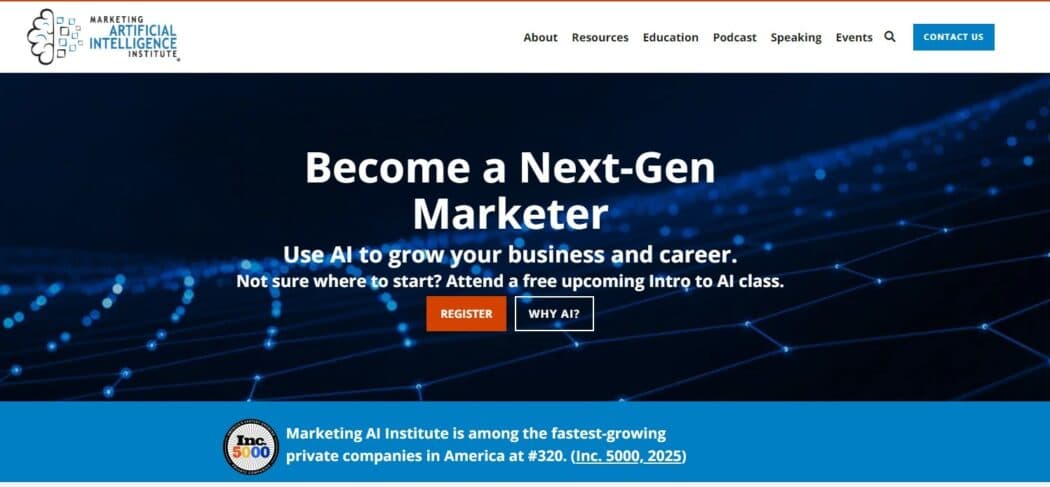
For a freelancer looking to specialize in AI-powered webinar marketing, this kind of course provides the foundational knowledge needed to design smarter campaigns, personalize attendee journeys, and automate follow-up sequences effectively.
Package This As: The go-to course for freelancers who need to build a strategic understanding of AI before diving into specific tools. It teaches the “why” and “how” behind AI in marketing, enabling a freelancer to advise clients confidently and design sophisticated, data-driven webinar funnels.
HubSpot: The Business Operating System
HubSpot functions as a company’s central nervous system. As a freelancer, you stop wrestling with disconnected apps. A single form submission pulls a contact’s entire history into one timeline. Opened emails, visited web pages, and past support requests all merge in the built-in CRM.
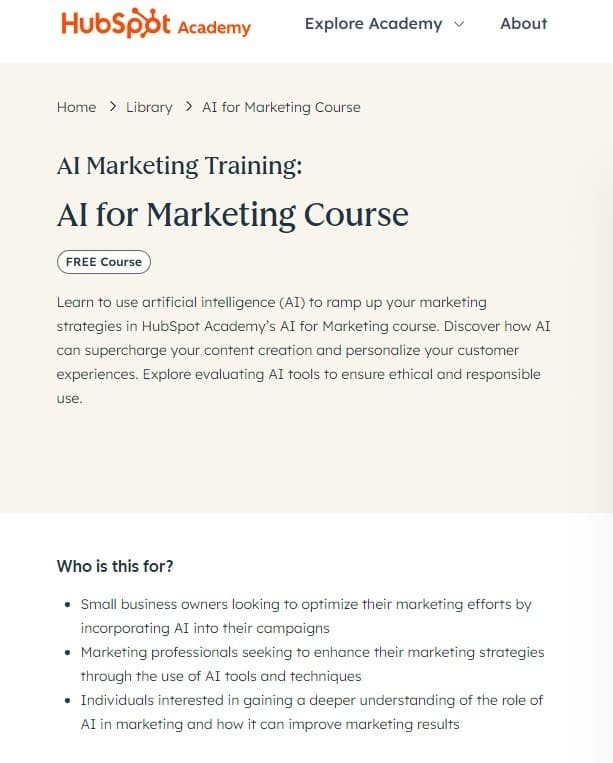
This change lifts your strategic importance. You transition into an architect for a continuous growth cycle, leaving basic email tasks behind. You can create systems that pass a warm lead directly to a salesperson, then automatically return that lead for a specialized nurture campaign if they disengage. The platform’s AI tools for content and lead scoring integrate directly into these workflows, proposing smart next steps.
Package This As: A unified engine for business growth. You build and oversee a connected system for marketing, sales, and customer service that breaks down data barriers, smooths internal handoffs, and creates one reliable record for every customer relationship.
Brevo: The Scalable Launch Platform
Brevo understands the journey of a growing business. It meets entrepreneurs right at the start with a genuinely functional free plan, then builds upward without forcing a painful platform jump later. For a freelancer, this is your go-to for taking a founder’s idea and turning it into a functioning marketing machine, fast.

The platform wins with its simple, effective handling of multiple marketing channels. You can construct an email series, activate an SMS alert for urgent leads, and oversee a simple sales funnel without facing a labyrinth of confusing options.
The clean interface puts the core tools front and center: automation, segmentation, and transactional emails. This lets you focus on launching campaigns instead of getting lost in setup.
Package This As: A rapid-results marketing launchpad for new ventures. You build their first automated revenue engine, using a cost-effective toolkit that delivers immediate traction and is built to scale smoothly as their success grows.
Coursiv: The AI Strategy Foundation
You need to grasp AI’s core mechanics before building advanced systems. Coursiv.io builds this base with short, daily lessons centered on practical use. The training bypasses dense theory. You immediately start creating functional AI prompts, selecting the proper automation for different jobs, and developing usable AI skills from the very beginning.
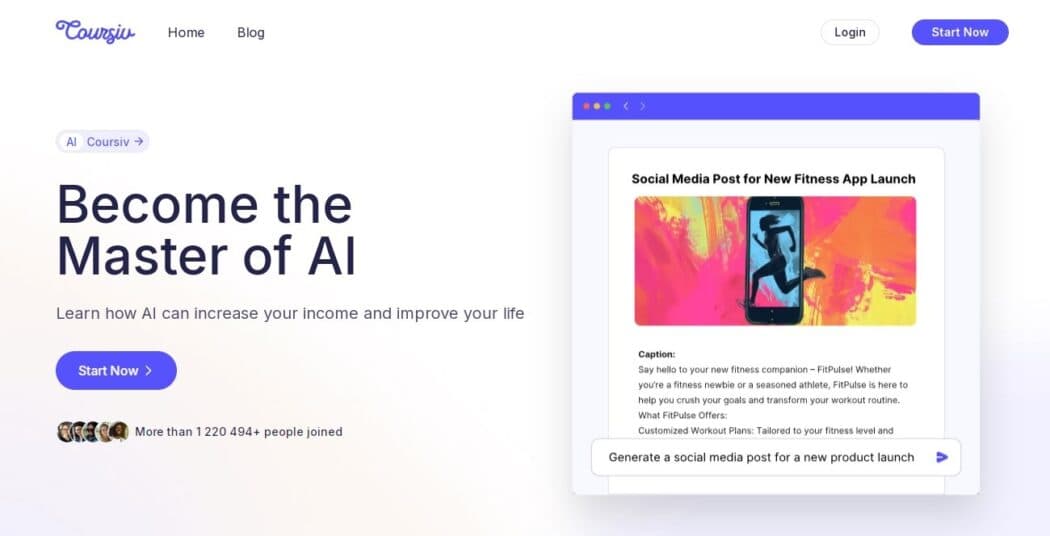
This consistent routine builds the confidence required to discuss plans with clients authoritatively. It allows you to choose the correct platform and strategy for a client’s particular challenge. Coursiv turns the overwhelming world of AI into a manageable, integrated skill set you can apply immediately to your freelance work.

Your Strategic Foundation: An AI fluency retainer. Use Coursiv to rapidly build the expertise needed to audit client needs, recommend the perfect tech stack, and design data-driven marketing strategies that competitors can’t match.
Core Skills for an AI Webinar Marketing Freelancer
For a freelancer, success in AI-powered webinar marketing hinges on a blend of strategic, technical, and promotional skills. The strongest training throws you directly into practicing these essential skills:
- Strategic Planning & Audience Identification: This forms the base. You learn to set precise objectives and employ AI to examine data and build detailed audience profiles, guaranteeing your webinar subject connects with what your audience truly needs.
- Content & Agenda Crafting: The program must show how to pick engaging, valuable topics and build a webinar flow that holds attention from start to finish, using AI to brainstorm content and improve its structure.
- Promotion & Landing Page Optimization: Drawing a crowd is a vital freelance ability. This means creating and refining dedicated registration pages with clear actions and using coordinated promotion across email, social media, and partnerships, frequently guided by AI for timing and targeting.
- Execution & Audience Engagement: The training should focus on action, providing real practice with webinar tools like polls and chats, plus presentation methods that foster a dynamic atmosphere and keep viewers involved during the live event.
- Post-Webinar Strategy & AI Repurposing: Here, AI provides a major efficiency gain. Freelancers need to master automating follow-up messages with replays and offers, and, importantly, how to use AI to transform one webinar into a collection of materials like social media clips, articles, and email content.
Final Thoughts
Your platform selection should directly mirror your client’s specific struggle. No single tool wins every time; the correct choice perfectly fits the particular issue you are solving.
Choose ActiveCampaign for clients needing detailed, behavior-based nurturing streams. Pick HubSpot or Brevo for new ventures seeking a complete marketing toolkit. And before mastering these platforms, use Coursiv for the daily practice that builds the fundamental AI understanding required for everything else.
Your progress depends on aligning the tool with the goal. Begin with the core skills. Then select the platform that attacks your client’s biggest obstacle head-on. Your deep knowledge in applying that specific tool turns a simple freelance task into a lasting, high-value collaboration.
The post Top AI Webinar Marketing Freelance Courses 2025 appeared first on Host4ASP.
]]>The post How to Choose the Most Effective SEO Link Building Services appeared first on Host4ASP.
]]>The difference between providers is significant — reputable ones use effective, legitimate methods, while others employ risky shortcuts that often cause more harm than benefit. Always prioritize quality and sustainable strategies when building your backlink profile.
Understand What “Effective” Really Means
A lot of businesses misunderstand link building. They think it’s just about collecting as many backlinks as possible, as fast as possible. But that approach usually doesn’t work well.
Good link building is about quality, not quantity. When done properly, it helps your website in three key ways:
- It makes search engines trust your site more.
- It helps you rank better for important searches.
- It brings you visitors who are actually interested in what you offer.
This approach takes more effort upfront, but pays off much better in the long run than any quick-fix linking schemes.
Evaluate the Link Building Strategy
When selecting an SEO link-building service, the methodology they use should be your top consideration. Different strategies produce very different results — some help your rankings while others might actually hurt your site. Let’s break down the main approaches:
White-Hat Link Building (Sustainable & Recommended)
These are the approved methods that focus on earning links naturally. They take more work but provide lasting results. Good white-hat tactics include:
- Writing guest posts for respected industry sites.
- Getting featured in expert roundups and PR pieces.
- Finding and fixing broken links with your quality content.
- Creating valuable resources that others want to link to.
While this approach requires patience, it’s the only way to build links that will help your site long-term without risking penalties.
Gray-Hat Link Building (Risky & Unreliable)
Gray-hat SEO tactics try to cheat the system by skirting Google’s rules. They might give you a fast rankings boost, but they usually cause problems down the road. These questionable methods include buying secret paid links, trading links with other sites, and using software to mass-produce low-quality backlinks.
Here’s why they’re not worth it: Google’s rules clearly ban these practices, and their detection keeps improving. You could see some quick wins, but when Google catches on (which they often do), you might lose all your progress suddenly. That quick boost could end up costing you months of work.
Stick to approved methods that follow the rules. They take more time, but they’re the only way to build rankings that last.
Black-Hat Link Building (Dangerous & Penalty-Prone)
Black-hat techniques are even more dangerous. These include:
- Private blog networks (clusters of fake sites created just for linking).
- Link farms and worthless directory listings.
- Spamming comments and forums with irrelevant links.
Google now easily spots these schemes. Getting caught can mean severe consequences — from ranking drops to complete removal from search results.
The safest approach? Stick with white-hat methods that build real, lasting authority without gambling with your site’s future.
Research Provider Track Record

Don’t hire an SEO company until you’ve checked their actual results. Look for case studies showing real ranking improvements, not just vague claims. A good provider will give you specific examples of keyword movements, traffic growth, and authority increases with hard data to prove it.
Ask for reports from tools like Ahrefs showing ranking progress, especially for competitive terms. Anyone can rank easy keywords — real skill shows in tougher markets.
The best providers will show you:
- Exact ranking changes;
- Clear timeframes;
- Before-and-after proof.
If they can’t provide this basic transparency, keep looking. Solid results speak louder than sales pitches.
Tactics like undisclosed paid links and shady link exchanges might deliver short-term ranking boosts, but they typically backfire. As debated on Reddit, once Google detects these schemes (which happens frequently), your rankings often plummet below their original position.
The safer approach? Stick with legitimate, white-hat techniques that actually follow Google’s rules. They might take more time to show results, but they won’t put your site at risk.
When you’re checking out potential link-building services, don’t just take their word for it. Look them up on review sites like Trustpilot or Clutch. If you spot multiple complaints about spammy links or shady practices, that’s your sign to steer clear.
Check for Relevance and Domain Authority
High-authority backlinks only help if they’re actually relevant to your business. A law firm will benefit more from a legal industry site than a popular cooking blog, no matter how authoritative that blog might be. Always prioritize links from sites your potential customers actually use.
Good links come from natural content placements, not forced mentions. Google can spot fake-looking links and may penalize them. Watch out for services promising hundreds of links overnight — real link building happens gradually.
The best approach? Focus on getting links from websites in your industry rather than just chasing high authority scores. This works better and keeps you safe with search engines.
Prefer Custom, Tailored Strategies
Generic link-building packages rarely move the needle. The most effective services create tailored plans based on your specific business needs. They begin by analyzing where your competitors are getting their backlinks using tools like Ahrefs, then develop strategies to secure even better placements.
It’s not just about getting any links — they should come from sites your ideal customers actually visit. A software company, for example, will benefit more from tech industry blogs than from general news sites.
The linking text should sound natural too. Mix up your anchor text between:
- Your brand name (“Visit Acme Tools”);
- Neutral phrases (“Learn more here”);
- Some relevant keywords (“top marketing tips”).
Avoid stuffing too many exact-match keywords (“best budget laptops 2024”) as this looks unnatural. The right balance helps your links appear organic to search engines while still driving results.
This customized approach takes more work upfront, but delivers better, longer-lasting results than cookie-cutter solutions.
Ask for Reporting Transparency
A trustworthy provider offers full transparency in their reporting. Detailed reports should include source URLs along with relevant metrics such as domain authority, traffic, and relevance. There should be no hidden or “secret” links—you should be able to verify each placement independently.
Reports should also outline the anchor text used, ensuring a natural mix rather than an overuse of keyword-stuffed anchors. Beyond rankings, assess whether the links drive referral traffic. Be cautious of vague reports, providers who refuse to share details, or those who inflate their stats—these are major red flags.

Review Content and Outreach Quality
Good links start with good content. When evaluating SEO link building services, find out who creates their content. Is it written by skilled professionals who understand your industry, or outsourced to cheap freelancers? The articles should be thoroughly researched, interesting to read, and genuinely useful for both the website publishing them and your target audience.
How the service approaches websites matters too. Reputable providers build real relationships with publishers through personalized outreach, not spammy bulk emails.
Ask them to explain their process — do they earn links through natural mentions in editorial content, or are they just paying to have links inserted? Authentic placements on relevant, authoritative sites will always be more valuable than forced or paid links that don’t provide real value to readers.
The best links come from content that websites are happy to publish because it benefits their audience, not because they were paid to include it. That’s the kind of quality you should look for in a link-building service.
Avoid Shady Link Placement Tactics
Steer clear of providers using black-hat or gray-hat tactics, as these can lead to penalties. Avoid Private Blog Networks (PBNs), link farms, and paid links without proper disclosure. These shortcuts may offer quick gains but often result in long-term damage.
Instead, focus on editorial links that follow Google’s guidelines. Genuine placements come from reputable sites that publish content because it’s valuable—not because they were paid to include a link.
Understand Anchor Text Distribution
When building links, it’s important to vary your anchor text to look natural to search engines. A healthy mix includes:
- Branded phrases (“Visit Example Company”);
- General calls-to-action (“Click here to learn more”);
- Some relevant keywords (“top digital marketing tips”).
While exact-match keywords (“best Chicago plumber”) can be used occasionally, going overboard with them raises red flags. Search engines are smart enough to spot unnatural patterns, so keeping your anchor text diverse helps avoid penalties while maintaining effectiveness.
Think of it like normal conversation — you wouldn’t repeat the same phrase constantly when talking to someone. The same principle applies to how your links appear across the web.
Pricing vs. Long-Term Value
You often get what you pay for with link building services. While budget options might seem appealing, they frequently deliver spammy or ineffective links that could hurt your site. It’s smarter to evaluate the potential long-term benefits rather than just the upfront cost.
Different companies structure pricing differently — some bill per link, others charge monthly retainers, and some only get paid when you see results. Be especially cautious of providers making outrageous promises like “thousands of links for pennies.” Quality link building takes real work and expertise. Those suspiciously cheap services are usually cutting corners that could cost you more in the long run through penalties or wasted effort.
The best approach? Invest in services that demonstrate real value, not just low prices. A few high-quality links from reputable sources will serve you much better than hundreds of questionable ones.
Ask the Right Pre-Hiring Questions
Before choosing a link building service, ask them some key questions. First, find out where they get links from — they should focus on relevant, trustworthy sites in your industry, not just any website.
Ask how they ensure each link is high-quality and actually helpful for your business. A good provider will explain their vetting process clearly. Also, make sure they’ll show you real proof of the links they create, not just make promises.
Most importantly, ask if you get to approve links before they go live. This lets you control where your brand appears online. These basic questions will help you spot bad services and find one that actually works.
Conclusion
Choosing the right SEO link-building services provider requires careful consideration. Don’t rush the decision — look for a company that uses ethical methods, maintains transparency about their process, and prioritizes sustainable growth over quick fixes.
When you choose a service that follows these principles, you’re not just buying links — you’re investing in your website’s future. The right approach will help your rankings grow and stay strong, rather than giving you temporary boosts that disappear as quickly as they came.
The post How to Choose the Most Effective SEO Link Building Services appeared first on Host4ASP.
]]>The post FHIR vs. HL7 v2 and v3: A Comparative Analysis appeared first on Host4ASP.
]]>As FHIR adoption grows, modern FHIR servers like Kodjin are enabling seamless data exchange by providing scalable, compliant, and efficient solutions for healthcare organizations. These servers play a crucial role in implementing FHIR standards effectively, ensuring interoperability between disparate systems.
In this article, we delve into a comprehensive analysis of FHIR, HL7 v2, and HL7 v3, focusing on their differences, similarities, and the best use cases for each. By the end, you will have a clearer understanding of these standards and their implications for the future of healthcare interoperability.
Table of Contents
- Introduction to HL7 Standards
- What is HL7 v2?
- What is HL7 v3?
- Introduction to FHIR
- Comparing HL7 v2, HL7 v3, and FHIR
- Syntax and Structure
- Ease of Use
- Interoperability and Scalability
- Use Cases for HL7 v2, HL7 v3, and FHIR
- Advantages and Challenges of Each Standard
- Transitioning from HL7 v2 and v3 to FHIR
- The Future of Healthcare Interoperability
- Conclusion
- FAQs
Introduction to HL7 Standards
HL7, short for Health Level Seven International, is a global authority for standards in the exchange, integration, sharing, and retrieval of electronic health information. Established in 1987, HL7 aims to improve patient care and health outcomes by creating universal protocols for data interoperability.
The organization has released several standards over the decades. While HL7 v2 and HL7 v3 are traditional frameworks, FHIR has emerged as a modern, web-friendly solution. Each serves a specific purpose in healthcare data management, reflecting the evolution of technology and user needs.
What is HL7 v2?
HL7 v2 is one of the oldest and most widely adopted healthcare data interchange standards. First introduced in 1989, it was designed to facilitate the electronic exchange of clinical data across disparate healthcare systems.
Key Features of HL7 v2:
- Simplicity: HL7 v2 uses a pipe-and-hat (|^~&) syntax, making it relatively simple and lightweight.
- Versatility: Supports numerous clinical workflows such as patient admission, discharge, and transfer (ADT), laboratory results, and scheduling.
- Widespread Adoption: Over 95% of healthcare organizations worldwide still use HL7 v2 for data exchange.
Limitations of HL7 v2:
- Inconsistent Implementations: V2 lacks strict enforcement of standards, leading to variations in how organizations implement it.
- Outdated Technology: Limited support for modern web technologies and APIs.
- Data Silos: Its design often perpetuates data silos, complicating efforts to achieve seamless interoperability.
What is HL7 v3?
Introduced in the late 1990s, HL7 v3 aimed to address the shortcomings of HL7 v2 by providing a more rigorous, standardized approach. It is based on a formal methodology and an object-oriented data model.
Key Features of HL7 v3:
- XML-Based: Utilizes XML for encoding messages, ensuring a structured and easily readable format.
- Reference Information Model (RIM): Provides a comprehensive data model to standardize healthcare data representation.
- Improved Interoperability: Designed to overcome the inconsistencies of HL7 v2.
Limitations of HL7 v3:
- Complexity: The RIM-based approach is often viewed as overly complex and difficult to implement.
- Low Adoption Rates: Despite its improvements, HL7 v3 has struggled with widespread adoption due to its steep learning curve.
- Resource Intensive: Implementing HL7 v3 can require significant time and financial investments, discouraging smaller organizations.
Introduction to FHIR
FHIR, introduced by HL7 in 2014, represents the latest evolution in healthcare interoperability standards. Designed with modern technologies in mind, FHIR leverages RESTful APIs, JSON, and XML for efficient data exchange.
Key Features of FHIR:
- Web-Friendly: Uses web standards such as HTTP, REST, and OAuth for data sharing.
- Resource-Oriented: Breaks down healthcare data into discrete resources (e.g., Patient, Observation, Medication).
- Interoperability: Simplifies data exchange between systems, including mobile apps and cloud-based solutions.
- Developer-Friendly: Offers extensive documentation and tools, making it easy for developers to implement.
- Scalable: FHIR’s modular design supports a wide range of use cases, from single applications to enterprise-level systems.
Challenges of FHIR:
- Learning Curve: While more accessible than HL7 v3, developers still need time to learn FHIR’s intricacies.
- Adoption Hurdles: Organizations using HL7 v2 or HL7 v3 may face challenges in migrating to FHIR.
Comparing HL7 v2, HL7 v3, and FHIR
Syntax and Structure
| Feature | HL7 v2 | HL7 v3 | FHIR |
| Syntax | Pipe-delimited | XML-based | JSON/XML, RESTful |
| Complexity | Simple | Complex | Moderate |
| Flexibility | High | Moderate | High |
Ease of Use
- HL7 v2: Easy to use but suffers from inconsistent implementations.
- HL7 v3: Difficult to implement due to its complexity.
- FHIR: Developer-friendly with robust tools and documentation.
Interoperability and Scalability
- HL7 v2: Limited scalability and interoperability due to inconsistent standards.
- HL7 v3: Improved interoperability but hindered by low adoption.
- FHIR: High scalability and seamless interoperability, ideal for modern healthcare ecosystems.
Use Cases for HL7 v2, HL7 v3, and FHIR
HL7 v2 Use Cases:
- Hospital Operations: ADT messages for patient admissions, discharges, and transfers.
- Laboratory Results: Efficient sharing of test results between labs and providers.
- Pharmacy Integration: Prescription data exchange between pharmacies and hospitals.
- Radiology: Communication of imaging orders and results between departments.
HL7 v3 Use Cases:
- Regulatory Reporting: Structured data for government health agencies.
- Clinical Trials: Standardized data exchange for research studies.
- Cross-Border Healthcare: Enables data exchange between international systems.
- Population Health Management: Provides comprehensive data for public health initiatives.
FHIR Use Cases:
- Mobile Health Applications: Powers apps that require real-time access to patient data.
- Cloud-Based Solutions: Facilitates seamless integration with cloud platforms.
- Patient Engagement: Enables patient portals and wearables to sync health data.
- Telemedicine: Supports video consultations with integrated patient data access.
- AI and Machine Learning: Provides standardized data for analytics and predictive modeling.
Advantages and Challenges of Each Standard
HL7 v2
Advantages:
- Simple and lightweight.
- Broadly adopted worldwide.
- Supports numerous legacy systems.
Challenges:
- Lack of strict enforcement leads to inconsistencies.
- Outdated for modern tech environments.
- Difficult to scale effectively for large data sets.
HL7 v3
Advantages:
- Comprehensive and structured data model.
- Enhanced interoperability.
- Facilitates detailed clinical data representation.
Challenges:
- Complexity and low adoption rates.
- Time-intensive implementation.
- Requires specialized knowledge for effective use.
FHIR
Advantages:
- Modern, web-friendly approach.
- Developer-friendly with high scalability.
- Compatible with a wide range of technologies.
- Facilitates patient-centered care.
Challenges:
- Relatively new, still maturing.
- Requires significant investment for migration.
- Compatibility issues with deeply entrenched legacy systems.
Transitioning from HL7 v2 and v3 to FHIR
Transitioning from HL7 v2 or v3 to FHIR is a complex process but offers substantial benefits in the long term. Organizations must follow a phased approach to minimize disruptions and maximize efficiency.
Steps to Transition:
- Assessment: Evaluate existing systems and workflows.
- Training: Equip IT staff and developers with FHIR expertise.
- Pilots: Implement FHIR in a controlled environment to identify challenges.
- Integration: Use middleware or adapters to connect legacy systems with FHIR-based solutions.
- Scaling: Expand FHIR implementation across the organization.
Benefits of Transitioning:
- Enhanced data interoperability.
- Real-time access to health information.
- Improved patient care and operational efficiency.
The Future of Healthcare Interoperability
The future of healthcare interoperability hinges on the widespread adoption of FHIR. As healthcare moves toward patient-centered care, technologies like FHIR are essential for enabling seamless communication between systems, devices, and applications.
Trends Driving Interoperability:
- Increased Focus on Value-Based Care: FHIR enables data sharing that supports outcomes-based healthcare models.
- Consumer-Driven Healthcare: Patients demand better access to their health data, which FHIR facilitates.
- AI Integration: Standardized data is vital for training accurate and effective AI models.
- Global Collaboration: FHIR’s scalability makes it a suitable choice for international data exchange.
Conclusion
FHIR, HL7 v2, and HL7 v3 each represent different stages in the evolution of healthcare interoperability standards. While HL7 v2 remains a staple for many organizations, its limitations have prompted the development of more advanced solutions. HL7 v3 introduced rigor and structure but struggled with complexity and adoption. FHIR, with its modern, resource-based approach, has emerged as the most promising solution for the future.
Healthcare providers and developers must evaluate their needs and resources to choose the right standard. As the industry moves toward value-based care and patient-centric solutions, FHIR’s scalability and interoperability make it a compelling choice.
FAQs
1. What is the main difference between FHIR and HL7 v2?
FHIR uses modern web technologies like RESTful APIs and JSON, making it more suitable for contemporary applications, while HL7 v2 relies on a simpler, pipe-delimited format.
2. Why is FHIR considered more developer-friendly?
FHIR offers extensive documentation, tools, and the use of widely understood web standards, making it easier for developers to implement.
3. Is HL7 v3 still in use?
Yes, HL7 v3 is still in use, particularly in scenarios requiring structured and standardized data exchange, such as regulatory reporting and clinical trials.
4. Can FHIR integrate with legacy systems?
Yes, FHIR can integrate with legacy systems, often using adapters or middleware to bridge the gap.
5. Which standard is best for mobile health apps?
FHIR is the preferred standard for mobile health apps due to its support for modern web technologies and real-time data exchange.
References
- HL7 International. “Introduction to HL7 Standards.” HL7.org.
- HealthIT.gov. “Interoperability Standards.” HealthIT.gov.
- Grahame Grieve. “FHIR Overview.” HL7 FHIR.
The post FHIR vs. HL7 v2 and v3: A Comparative Analysis appeared first on Host4ASP.
]]>The post The Evolution of FHIR: From R1 to R5 appeared first on Host4ASP.
]]>What is FHIR?
FHIR is a standard developed by Health Level Seven International (HL7) to address interoperability challenges in healthcare. By using modern web-based technologies like RESTful APIs, JSON, and XML, FHIR enables secure, real-time data sharing across healthcare systems.
Core Principles of FHIR
- Resource-Based Architecture: Data is modularized into resources such as patients, conditions, and medications.
- Scalability: Supports integration with mobile apps, cloud services, and existing EHR systems.
- Interoperability: Ensures that systems can effectively exchange and use healthcare information.
FHIR adoption requires a robust and scalable FHIR server to manage and exchange health data efficiently. Kodjin FHIR Server is designed to meet these needs, offering a high-performance solution that simplifies compliance and accelerates interoperability in modern healthcare ecosystems.
A Timeline of FHIR Releases
FHIR’s journey spans several iterations, each building upon the last to enhance functionality, security, and usability.
Release 1 (R1): The Foundation
- Introduced: 2011
- Key Focus: Prototyping a new approach to healthcare interoperability.
- Features:
- Core principles of resource-based architecture.
- Basic RESTful API framework.
- Limited scope, designed for experimentation and feedback.
R1 established the foundation for subsequent iterations, providing a testbed for developers and industry stakeholders.
Release 2 (R2): Usability and Adoption
- Introduced: 2014
- Key Focus: Refining standards for broader adoption.
- Features:
- Improved resource definitions and data models.
- Support for mobile and web app integration.
- Enhanced documentation for implementers.
R2 marked the beginning of real-world implementations, with early adopters integrating FHIR into their workflows.
Release 3 (R3): Broadening the Scope
- Introduced: 2017
- Key Focus: Expanding functionality and addressing global healthcare needs.
- Features:
- Addition of new resources (e.g., clinical reasoning).
- Improved support for workflows like scheduling and decision support.
- Internationalization features for global applicability.
R3 demonstrated FHIR’s potential to address complex, multi-regional healthcare systems.
Release 4 (R4): A Milestone Release
- Introduced: 2019
- Key Focus: Establishing a normative base.
- Features:
- First normative content, ensuring backward compatibility.
- Enhanced security and privacy protocols.
- Expanded support for clinical and administrative workflows.
R4 cemented FHIR’s role as a mature standard, gaining widespread regulatory and industry support.
Release 5 (R5): Driving Innovation
- Introduced: 2023
- Key Focus: Supporting emerging technologies and advanced interoperability.
- Features:
- New resources for genomic data and precision medicine.
- Improved API functionality for AI and machine learning applications.
- Enhanced modularity for diverse healthcare environments.
R5 reflects the industry’s ongoing shift toward personalized, technology-driven care.
Comparing FHIR Releases
Each FHIR release introduced new features and addressed challenges faced by its predecessors. The table below provides a summary of the evolution:
| Release | Year | Key Features | Focus |
| R1 | 2011 | Resource-based architecture, RESTful APIs | Prototyping |
| R2 | 2014 | Enhanced resource definitions, usability | Adoption |
| R3 | 2017 | Clinical reasoning, global applicability | Scope Expansion |
| R4 | 2019 | Normative content, security improvements | Maturity and Standardization |
| R5 | 2023 | Genomic data, AI/ML integration | Innovation and Future Readiness |
Impact of FHIR on Healthcare
FHIR’s advancements have reshaped various aspects of healthcare delivery and management.
Enhancing Interoperability
- Unified data standards reduce silos between healthcare providers.
- Streamlined workflows improve efficiency and reduce errors.
Enabling Patient-Centric Care
- Patients gain access to their health data through user-friendly apps.
- Personalized recommendations based on integrated health information.
Supporting Digital Transformation
- FHIR APIs enable seamless integration with telehealth platforms, wearables, and AI-driven solutions.
- Real-time data access empowers clinicians and administrators to make informed decisions.
Real-World Applications of FHIR
The adoption of FHIR has led to innovative applications in healthcare.
Apple Health Records
Apple’s Health Records app uses FHIR to aggregate patient data from various providers, offering:
- Centralized access to health records.
- Tools for better patient engagement and proactive care.
Epic and Cerner Integration
Leading EHR vendors like Epic and Cerner leverage FHIR APIs to:
- Facilitate data sharing across organizations.
- Support third-party app development for advanced care solutions.
National Healthcare Systems
Countries like the UK and Australia are adopting FHIR for national initiatives, ensuring:
- Interoperability across diverse healthcare settings.
- Population-level health analytics for policy-making.
Challenges in FHIR Implementation
While FHIR offers numerous benefits, challenges remain:
Technical Barriers
- Legacy systems may struggle to integrate FHIR standards.
- Variability in implementation can lead to inconsistencies.
Privacy and Security Concerns
- Ensuring compliance with regulations like HIPAA and GDPR is critical.
- Robust encryption and access control measures are necessary.
Resource Constraints
- Smaller organizations may lack the technical expertise or funding to adopt FHIR effectively.
The Future of FHIR
FHIR is poised to drive further innovation in healthcare. Key trends include:
Integration with AI and Machine Learning
- Standardized data supports predictive analytics and personalized medicine.
- AI-driven tools will enhance diagnostics and patient care.
Global Standardization
- Growing international adoption may lead to a unified global healthcare standard.
Expansion of Digital Health Ecosystems
- Increased collaboration between technology providers and healthcare organizations.
Conclusion
The evolution of FHIR from R1 to R5 demonstrates its transformative impact on healthcare interoperability. By addressing critical challenges and enabling innovation, FHIR has paved the way for a more connected, efficient, and patient-focused healthcare ecosystem. As adoption continues to grow, FHIR will remain at the forefront of digital health advancements.
FAQs
1. What does FHIR stand for?
FHIR stands for Fast Healthcare Interoperability Resources, a standard developed by HL7 for healthcare data exchange.
2. Why is FHIR important?
FHIR enables seamless interoperability between healthcare systems, improving patient outcomes and reducing costs.
3. How does FHIR support innovation?
By providing standardized APIs, FHIR facilitates the development of telehealth platforms, mobile apps, and AI-driven solutions.
4. What is the latest FHIR release?
FHIR Release 5 (R5) was introduced in 2023, focusing on genomic data, AI integration, and enhanced modularity.
5. Can small healthcare providers adopt FHIR?
Yes, FHIR’s flexibility and scalability make it accessible to organizations of all sizes, though resource constraints may pose challenges.
Let me know if there are any specific edits or additions you’d like to make!
References
The post The Evolution of FHIR: From R1 to R5 appeared first on Host4ASP.
]]>The post The Ascendant Popularity of Rust in System Programming appeared first on Host4ASP.
]]>Rust’s Design Paradigm: An Exquisite Blend of Safety and Performance
Rust’s ascent is largely owed to its meticulously crafted design, which marries the intricacies of low-level control with the elegance of high-level abstractions. At the heart of Rust’s allure is its stringent ownership model—a paradigm that enforces memory safety without sacrificing performance. This ownership model, coupled with its borrowing and lifetimes mechanisms, ensures that developers can achieve fine-grained control over memory allocation and deallocation, all while evading the perils of common pitfalls such as dangling pointers and buffer overflows.
The compiler, acting as an unforgiving sentinel, rigorously enforces these rules, catching errors at compile-time rather than during runtime. This preemptive strike against potential bugs fosters a development environment where code reliability and robustness are paramount. Thus, Rust emerges as a bulwark against the dread of undefined behavior and memory corruption, offering a serene refuge in the stormy seas of system programming.
Concurrency Without Compromise: Rust’s Triumph Over Traditional Concurrency Models
Concurrency, a cornerstone of contemporary computing, often presents a quagmire of synchronization issues and race conditions. Rust’s approach to concurrency represents a paradigm shift, wherein the concurrency model is not merely an add-on but a fundamental aspect of the language’s design. By integrating message-passing concurrency and fearless concurrency into its core, Rust enables developers to write concurrent code that is both safe and efficient.
In contrast to traditional concurrency models that rely heavily on locks and mutexes, Rust’s concurrency mechanisms leverage its ownership model to ensure that data races are statically prevented. This innovative approach allows multiple threads to operate in parallel without the pernicious side effects of data corruption or race conditions, thus enhancing both the safety and performance of concurrent applications.
Ecosystem and Tooling: Rust’s Flourishing Landscape
Rust’s burgeoning popularity is further bolstered by its vibrant ecosystem and robust tooling. The Cargo package manager and build system is a testament to this, streamlining the process of dependency management and project compilation. Cargo’s integration with crates.io, the official Rust package registry, facilitates seamless access to a plethora of libraries and tools, accelerating the development lifecycle and fostering a culture of code reuse.
Moreover, Rust’s rich documentation and an active community contribute to a burgeoning knowledge base, ensuring that developers have access to a wealth of resources and support. This collaborative spirit within the Rust community not only enhances the language’s development but also cultivates a culture of inclusivity and innovation.
Interoperability and Integration: Rust’s Synergy with Existing Ecosystems
Rust’s compatibility with existing systems and languages further cements its role in system programming. Its Foreign Function Interface (FFI) enables smooth integration with C and C++ codebases, allowing developers to incrementally adopt Rust without the need for a complete rewrite. This interoperability makes Rust an attractive choice for projects requiring high performance and safety, where legacy systems and new code coexist harmoniously.
Furthermore, Rust’s growing presence in the web assembly (Wasm) domain illustrates its versatility and potential for cross-platform development. By compiling to Wasm, Rust extends its reach beyond traditional system programming, venturing into new territories such as client-side web development, where its performance and safety characteristics can be leveraged.
The Future Trajectory: Rust’s Potential and Prospects
As the landscape of system programming continues to evolve, Rust’s trajectory appears to be one of sustained growth and influence. Its innovative approach to safety, concurrency, and tooling positions it as a compelling alternative to traditional languages in the domain. The language’s adaptability and forward-thinking design ensure that it remains at the vanguard of system programming, poised to address the challenges and opportunities of tomorrow’s computing environments.
In summation, Rust’s ascendancy in system programming is not merely a trend but a testament to its exceptional design and pragmatic approach to complex problems. With its robust safety guarantees, elegant concurrency model, and thriving ecosystem, Rust represents a paradigm shift in how we approach system-level programming, promising a future where reliability and performance are not mutually exclusive but intrinsically intertwined.
The post The Ascendant Popularity of Rust in System Programming appeared first on Host4ASP.
]]>