How to Choose the Best IOP or PHP Program: 5 Questions Every Client Should Ask

Checklist: 5 Questions to Ask Before Choosing an IOP or PHP Program – Inneractions IOP

How to choose the best IOP or PHP program is an important question for anyone considering treatment. It can be difficult to know where to begin when thinking about an Intensive Outpatient Program (IOP) or a Partial Hospitalization Program (PHP). You can locate a program that genuinely aids in your healing process by asking the right questions.
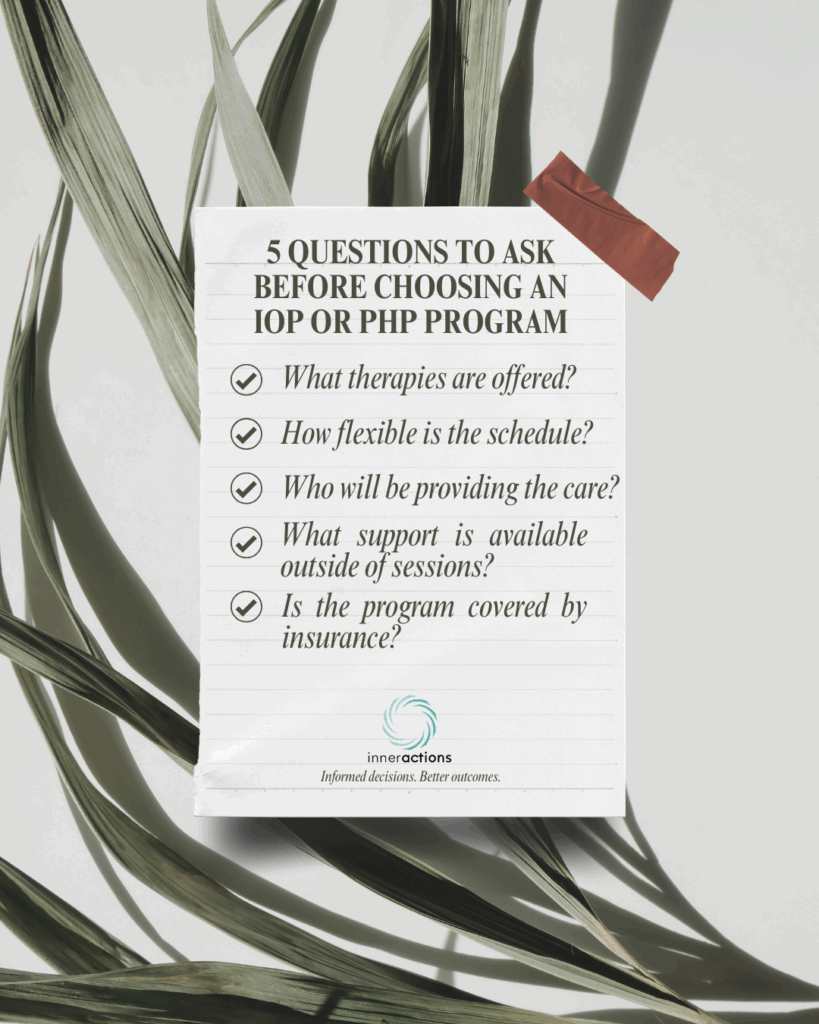
How to Choose the Best IOP or PHP Program
💡 Save this checklist as a quick reference while you explore treatment options — it can help guide conversations with providers and loved ones.

Before choosing an IOP or PHP program, consider these five crucial questions.

What Services and Therapies Are Provided?

Every program uses a different strategy. While some might emphasize evidence-based treatments like Dialectical Behavior Therapy (DBT) or Cognitive Behavioral Therapy (CBT), others might also incorporate more holistic choices like yoga, mindfulness, or dietary counseling.

Why it matters: Your needs should be met by the therapies that are offered. Make sure the program provides trauma-informed care, for instance, if trauma is a part of your story.

How Flexible is the Schedule?

A good IOP will also offer a virtual option that can fit with your schedule and make treatment more accessible. The number of hours per day and days per week that PHPs and IOPs require can vary. Some programs operate in the morning, while others are held in the evening.

Why it matters: Flexibility — whether in-person or virtual — allows you to balance treatment with family, work, or school obligations. To stay committed and consistent, choose a program that offers scheduling options that fit your life.

Who Will Be Providing the Care?

Your experience is greatly influenced by the individuals facilitating both individual and group sessions. Peer support specialists, case managers, psychiatrists, and therapists may be part of the programs.

Why it matters: Seek out qualified, experienced experts who are aware of the particular difficulties you are facing in addition to having credentials. Inquire about the credentials and background of the staff in relation to co-occurring substance use or mental health.

What Kind of Help Is Offline?

The course of treatment doesn’t stop when you leave. Some programs provide access to support in between sessions, alumni groups, or family therapy.

Why it matters: Having a solid support network is essential for recovery. Long-lasting change is facilitated by a program that provides resources outside of formal treatment.

Is the Program Covered by Insurance?

Cost is often one of the biggest factors in choosing a program. Ask if the program accepts your insurance, what your out-of-pocket costs will be, and whether financial assistance is available.

Why it matters: Understanding the financial side upfront reduces stress and allows you to focus fully on your recovery.

Final Thoughts on How to Choose the Best IOP or PHP Program

Choosing an IOP or PHP program is a significant decision, and you should feel secure in your choice. You can locate a program that meets your needs and aids in laying a solid foundation for recovery by posing the appropriate questions.

These and other questions can be answered at Inneractions IOP, a program within the AM Health Care family. Get in touch with us right now if you’re considering treatment options; our staff is prepared to guide you through the steps and assist you in moving forward.

Or call us directly to speak with our admissions team 1-866-780-4046

Frequently Asked Questions About Choosing the Best IOP or PHP Program

What’s the difference between IOP and PHP?

Higher level care is provided by a PHP (Partial Hospitalization Program), which usually entails more therapy hours per day, frequently five days a week. With therapy taking place several days a week for a few hours at a time, an intensive outpatient program, or IOP, requires less time. While IOP can be used as a starting point for individuals who do not require round-the-clock care or as a step-down from PHP, PHP is frequently used as a step-down from residential care.

How long do IOP and PHP programs usually last?

While PHPs may run for 4–6 weeks, IOPs typically last 8–12 weeks, though program length can vary based on individual needs. Your treatment team will evaluate your progress on a regular basis and modify the schedule as necessary.

Can I work or go to school while attending IOP?

Indeed. An IOP’s primary benefit is that it gives you structured support while enabling you to continue with obligations like work or school. PHP’s greater intensity might necessitate more schedule modifications.

Do I need to complete residential treatment before IOP or PHP?

Not all the time. If their symptoms can be controlled without round-the-clock assistance, some people start with IOP or PHP. Others may transition into IOP or PHP after completing residential care. Your clinical needs will determine the best place to start.

Will insurance cover IOP or PHP?

Although coverage varies, many insurance companies offer coverage for both PHP and IOP programs. To find out what your plan covers and what your potential out-of-pocket expenses are, it’s crucial to confirm your insurance in advance.

Let the Healing Begin With Family Drug Rehabilitation

Family drug healing rehabilitation treatment

Substance abuse doesn’t happen in a vacuum and addiction doesn’t just affect the addict.

The reality is that drug addiction and alcohol abuse are messy and as much as the user is suffering, to watch someone you love go through addiction is damaging too – albeit in different ways.

From waning and diminishing trust and the distance that addiction creates which can lead to a sense that all hope is lost, there’s inevitably frustration that the family of someone fighting a substance abuse disorder experiences and the very relationships and familial bonds become strained under the weight of it all.

This is why treatment and ultimately healing from addiction must include the family. For recovery to last, those relationships need to be repaired and strengthened.

What Is Family Drug Rehabilitation?

Family drug rehabilitation is something that takes into account the widespread harm that a substance abuse order creates in the family dynamic. 

At Inneractions, family members and significant others are offered the opportunity to participate in client/family sessions with other families, program therapist and counselor.

As echoed in the Treatment Improvement Protocols series from the Substance Abuse and Mental Health Services Administration (SAMHSA), “family therapy is a collection of therapeutic approaches that share a belief in family‐level assessment and intervention. A family is a system, and in any system each part is related to all other parts. Consequently, a change in any part of the system will bring about changes in all other parts. Therapy based on this point of view uses the strengths of families to bring about change in a range of diverse problem areas, including substance abuse”

Why Is It Important for the Family To Be a Part of an Addicts Recovery?

Despite the injurious and deeply distressing effects of addiction on the family, the role that they play in recovery is a critical one, as SAMHSA drives home, “the family has a central role to play in the treatment of any health problem, including substance abuse”. 

For the addict, family support is a crucial component in the process of creating a firm foundation on which to build sobriety.

There’s a sense of alienation that can come with addiction. A feeling of loneliness that might be exacerbated as drug use gets worse and follows into the early days of treatment. Bringing the family together to deal with this challenge together is a major reassurance for an addict. A way of showing, rather than saying, they’re not alone in this.

Family support is also vital in giving an addict the confidence to carry on through the tough times and valleys they might encounter in a rehab program.

Moreover, family involvement can shed more light on the nature of the addiction, add context about the family unit and how relational dynamics have been affected and ultimately present the therapist or counselor with more information and insight to work with.

It can help inform the treatment program itself, the Treatment Improvement Protocols noting that family therapy “seeks to use the family’s strengths and resources to help find or develop ways to live without substances of abuse.”

For the family, in many ways they need treatment too and reputable rehab centers understand that. While family drug rehabilitation itself isn’t quite therapy or a replacement for it for a family member that may very need it, it is a key component in a holistic and robust treatment plan for someone recovering from a substance abuse disorder.

Let Inneractions Help Your Loved One Today 

At Inneractions in Southern California, we’ve long understood the importance of including family in recovery and know the deep value that repairing the familial support structure brings to an addict over the long run. If your loved one is suffering from substance abuse and you’re not sure what to do, reach out to us and we can offer advice on the next steps.

How Acupuncture Helps in Treating Addiction

Acupuncture Helps in Treating Addiction

Treatment for addiction isn’t a one size fits all proposition. Just as each person is unique, so too are the circumstances of their addiction and, crucially, what will work best in helping them get past it.

Traditional methods of rehab like individual and group therapy, also known as talk therapy or psychotherapy, have been shown to work absolute wonders for those grappling with substance abuse but that’s not the end all, be all of your options.

Alternative and complementary treatments serve to create a more holistic approach to recovery. 

Of these alternatives, few are more well known than acupuncture. 

What Is Acupuncture?

Acupuncture is a practice used in traditional Chinese medicine and is a technique in which specific points on the body are stimulated by inserting fine needles through the skin. Remarkably, the use of acupuncture as a method of treatment dates back roughly 3,000 years.

Traditional Chinese medicine and eastern medicine, in general, have been growing in popularity for years now and acupuncture has certainly seen some of the widest acceptance with more than 10 million treatments administered every year in the United States.

It’s worth noting, and to avoid confusion, that traditional Chinese medicine (TCM) is considered a complementary approach in the United States. TCM is predicated on the concept of Qi, usually translated as “vital energy” and the theory of “yin and yang” or the harmony of all the opposite elements and forces that make up existence. The belief of TCM, therefore, is that:

  • Harmony brings health, wellbeing, and sustainability
  • Disharmony leads to illness, disease, and collapse

So while on the surface it may seem like it’s just sticking needles in the body, there is a concrete and exact intention with each placement. To bring balance to the flow of energy. More precisely, “acupuncture is based on the complex TCM theory that an energy (Qi) flows through meridians in each organ and most acupoints are located along one of these meridians. Because diseases are caused by an imbalance or disturbance of Qi, needling at these acupoints can harmonize Qi and cure diseases”.

That knowledge is all well and good but what’s the benefit of acupuncture for addiction?

How Does Acupuncture Help When Treating Addiction?

Seeing as how addiction throws the body and mind into chaos, or disharmony and imbalance to put it in the language of acupuncture, it stands to reason that any approach that works towards balance and harmony could have a positive effect.

Among the benefits people tend to find with acupuncture are a reduction in cravings and an alleviation of the potential discomfort or pain associated with treatment (i.e., withdrawal symptoms). Additionally, acupuncture can help relieve the stress and anxiety that can creep in when you’re working towards sobriety. With lower stress levels, less pain and reduced cravings, you’ll likely start to get better sleep as well.

It’s been shown that “prominent effects of acupuncture are increases in the levels of enkephalin, epinephrine, endorphin, serotonin, norepinephrine, and dopamine in the central nervous system and plasma [8] that might mediate substance abuse”. “Might” is the operative word here and is extremely important for context. This technique is not intended to be a standalone treatment for addiction in and of itself. It’s defined as complementary for a reason and acupuncture should only be one facet of a more full-spectrum treatment program.

That’s the whole idea behind holistic treatment, to treat the whole person. Drugs and alcohol are an incredibly destabilizing force on your entire being and in order to set yourself up for a long lasting recovery, it’s important to approach treatment with that in mind.

Get Treatment at Inneractions

At Inneractions in the San Fernando Valley, we understand the value that alternative treatment methods offer in overcoming addiction. If you’re curious about acupuncture and whether it’s right for you, get in touch with us and let’s chat about it.