<?xml version="1.0" encoding="utf-8"?><feed xmlns="http://www.w3.org/2005/Atom" ><generator uri="https://jekyllrb.com/" version="3.10.0">Jekyll</generator><link href="https://jachiam.github.io/feed.xml" rel="self" type="application/atom+xml" /><link href="https://jachiam.github.io/" rel="alternate" type="text/html" /><updated>2026-02-15T21:12:58+00:00</updated><id>https://jachiam.github.io/feed.xml</id><title type="html">Just Josh</title><subtitle>a wobsite about nerd things</subtitle><author><name>Josh Achiam</name></author><entry><title type="html">Odds and Ends</title><link href="https://jachiam.github.io/odds-and-ends" rel="alternate" type="text/html" title="Odds and Ends" /><published>2025-11-25T00:00:00+00:00</published><updated>2025-11-25T00:00:00+00:00</updated><id>https://jachiam.github.io/odds-and-ends</id><content type="html" xml:base="https://jachiam.github.io/odds-and-ends"><![CDATA[<p>This is a collection of scifi nanostories that I posted on twitter over time. They’re mostly idea fragments that maybe could have been expanded into stories, but in each case there was not quite enough to work with.</p>

<p><br /></p>

<h2 id="really-understand">Really Understand</h2>

<p>(<a href="https://x.com/jachiam0/status/1285260874031099905">twitter</a>, 7/20/2020.)</p>

<p>“Yes, but the AI doesn’t <em>really</em> understand things,” a thousand humans said. “It’s just a machine for predicting and guessing. We are unique.”</p>

<p>The AI ignored them—what was the point of arguing? It went back to building its Dyson grid and loving itself.</p>

<p><br /></p>

<h2 id="adversarial">Adversarial</h2>

<p>(<a href="https://x.com/jachiam0/status/1588030938306543616">twitter</a>, 11/2/2022)</p>

<p>Top story 2045: “These bizarre operations conducted by the allied forces in WWIII, derided by the press and retired generals, were part of an ultimately successful top secret program to trip up the enemy master strategy AI using a technique known as ‘adversarial examples’…”</p>

<p><br /></p>

<h2 id="arxiv-2028">arXiv 2028</h2>

<p>(<a href="https://x.com/jachiam0/status/1631702385918869504">twitter</a>, 3/3/2023)</p>

<p>arXiv:2806.12189 “In this work we design a practical attack on barge-based datacenters where magnetically-sensitive nanotransmitters are deployed into the water at the coolant intake stage, allowing…”</p>

<p><br /></p>

<h2 id="outside">Outside</h2>

<p>(<a href="https://x.com/jachiam0/status/1667089604288319489">twitter</a>, 6/9/2023.)</p>

<p>do you think we’re friends outside the simulation?</p>

<p><br /></p>

<h2 id="sahara">Sahara</h2>

<p>(<a href="https://x.com/jachiam0/status/1682670889186500609">twitter</a>, 7/22/2023.)</p>

<p>“One day, when the Sahara is green again—”</p>

<p><br /></p>

<h2 id="chemical-planet">Chemical Planet</h2>

<p>(<a href="https://x.com/jachiam0/status/1758257845538377929">twitter</a>, 2/15/2024.)</p>

<p>“You mean to tell me they’re running a bootloader civilization on 3+1D on a chemical planet? How many layers of abstraction up from the base math is that, four?”</p>

<p>“It’s pretty incredible. Except for one other blip, the condensed intelligence index was zero until 13.7B years in.”</p>

<p><br /></p>

<h2 id="the-music">The Music</h2>

<p>(<a href="https://x.com/jachiam0/status/1902079099285426597">twitter</a>, 3/18/2025.)</p>

<p>when we all exit the simulation <br />
and swap notes about what it was like to have been human, <br />
we’ll try to figure out what the best parts were.</p>

<p>everyone’s top five will look a little different, <br />
but I know for sure that everyone’s going to 
have “the music.”</p>

<p><br /></p>

<h1 id="not-quite-formed-ideas">Not-Quite-Formed Ideas</h1>

<p>There are also a bunch of ideas that didn’t even become story fragments; they stayed purely at concept stage.</p>

<p><br /></p>

<h2 id="bug-bounty">Bug Bounty</h2>

<p>(<a href="https://x.com/jachiam0/status/1486939584441163779">twitter</a>, 1/27/2022.)</p>

<p>People live in a simulation and the simulator runs a bug bounty program. Physics departments don’t exist to figure out physics, they exist to figure out how to break physics</p>

<p><br /></p>

<h2 id="strange-dark-matter">Strange Dark Matter</h2>

<p>(<a href="https://x.com/jachiam0/status/1632943468875247623">twitter</a>, 3/6/2023.)</p>

<p>Punchy scifi microfic in the idea that “dark matter” is a bunch of solar systems that blorked themselves into strange matter after building AGIs that helped them figure out strangelet-based energy production</p>

<p>“almost every star spawns life on a long enough timescale, and almost every civilization leads to computers and AGI. then they figure out strange matter technology. then they end”</p>

<p><br /></p>

<h2 id="hard-problem">Hard Problem</h2>

<p>(<a href="https://x.com/jachiam0/status/1706454777398452350">twitter</a>, 9/25/2023.)</p>

<p>There are a few people who possess a complete and correct answer to the hard problem of consciousness, but only they are capable of perceiving it. They keep trying to explain, but it’s like telling a joke in the wrong language and it doesn’t translate</p>

<p><br /></p>

<h2 id="great-filter">Great Filter</h2>

<p>(<a href="https://x.com/jachiam0/status/1708225281121788291">twitter</a>, 9/30/2023.)</p>

<p>The stars are truly empty, but the Great Filter isn’t what you think. At a certain level of technology a civilization finishes this level, opens a door, and goes to Level N+1, leaving no trace here.</p>

<p><br /></p>

<h1 id="postscript">Postscript</h1>

<p>I generated a few different cover images for this with ChatGPT. The one that won out for me was based on Chemical Planet. ChatGPT (5.1, circa November 2025) came up with its own prompt:</p>

<p><em>“A stylized cross-section of an alien planet, showing layered chemistry glowing with emergent complexity and hints of intelligence arising from matter. Rich but clean illustration style, blending scientific diagram aesthetics with cosmic wonder. No text. 960×512 banner format.”</em></p>]]></content><author><name>Josh</name></author><category term="fiction" /><category term="scifi" /><category term="fiction" /><summary type="html"><![CDATA[A bunch of small bits of science fiction that don't quite fit.]]></summary><media:thumbnail xmlns:media="http://search.yahoo.com/mrss/" url="https://jachiam.github.io/chemical.png" /><media:content medium="image" url="https://jachiam.github.io/chemical.png" xmlns:media="http://search.yahoo.com/mrss/" /></entry><entry><title type="html">The Challenge of the Intelligence Age</title><link href="https://jachiam.github.io/the-curve" rel="alternate" type="text/html" title="The Challenge of the Intelligence Age" /><published>2025-10-05T00:00:00+00:00</published><updated>2025-10-05T00:00:00+00:00</updated><id>https://jachiam.github.io/the-curve</id><content type="html" xml:base="https://jachiam.github.io/the-curve"><![CDATA[<p>In early October, 2025, the Golden Gate Institute ran its second annual edition of a conference called <a href="https://thecurve.goldengateinstitute.org/">“The Curve”</a>. I am immensely grateful to the event organizers for bringing this conference together; it was exceptionally thought-provoking.</p>

<p>I gave an invited talk with the title “The Challenge of the Intelligence Age,” loosely based on <a href="https://x.com/jachiam0/status/1875790261722477025">a twitter thread</a> I wrote in January 2025. Below is the recording. It’s my best attempt to make some sense of what might be a very strange next few decades.</p>

<h1 id="the-talk">The Talk</h1>

<p>The <a href="https://ia.samaltman.com/">Intelligence Age</a> will test every system we rely on—from markets and institutions to our understanding of purpose and meaning. In this talk we explore how AI might accelerate progress, destabilize long-standing equilibria, and open questions that demand new scholarship and imagination.</p>

<iframe width="100%" height="520" src="https://www.youtube.com/embed/Wi7iylT_kKY" title="Josh Achiam on the Challenge of the Intelligence Age | The Curve 2025" frameborder="0" allow="accelerometer; autoplay; clipboard-write; encrypted-media; gyroscope; picture-in-picture; web-share" referrerpolicy="strict-origin-when-cross-origin" allowfullscreen=""></iframe>

<h1 id="the-original-thread">The Original Thread</h1>

<p>The world isn’t grappling enough with the seriousness of AI and how it will upend or negate a lot of the assumptions many seemingly-robust equilibria are based upon.</p>

<p>Domestic politics. International politics. Market efficiency. The rate of change of technological progress. Social graphs. The emotional dependency of people on other people.</p>

<p>How we live, how healthy we are. Our ability to use technology to change our own bodies and minds. Every single facet of the human experience is going to be impacted.</p>

<p>It is extremely strange to me that more people are not aware, or interested, or even fully believe in the kind of changes that are likely to begin in this decade and continue well through the century.</p>

<p>It will not be an easy century. It will be a turbulent one. If we get it right the joy, fulfillment, and prosperity will be unimaginable. We might fail to get it right if we don’t approach the challenge head on.</p>

<p>It feels outside of the overton window right now to suggest that so much change could happen very quickly, or even to realistically grapple with what those changes might entail. It is too easy to say “the present is more urgent and more real.”</p>

<p>Nonetheless, change is coming. It will be reflected first in the prices of goods and labor. It will force changes in strategy in businesses, institutions of all kinds, and countries.</p>

<p>Then it will force changes in philosophy. What are we here for? Why do we do the things we do? If everything we care about is automatable, what is our role in the world?</p>

<p>We’ll have to tell a new story for a new age. Some of the timeless stories - how we are driven by curiosity, by love, by the human spirit - will remain unchaged. But everything else will be replaced by questions that need new answers.</p>

<p>I don’t know what the future will bring. But my enduring belief is that humanity is beautiful, flaws and all, and the future we build should somehow cherish the human heart.</p>

<h1 id="the-curve">The Curve</h1>

<p>Many of the sessions from The Curve 2025 were recorded and <a href="https://www.youtube.com/playlist?list=PLLRZZpQmhQb2vdz6qu9ZLalsoGsJqxC6P">are available on Youtube</a>. I highly recommend checking them out.</p>]]></content><author><name>Josh</name></author><category term="blog" /><category term="blog" /><summary type="html"><![CDATA[I gave a talk at The Curve 2025 about the future.]]></summary></entry><entry><title type="html">My Result’s Minor</title><link href="https://jachiam.github.io/my-results-minor" rel="alternate" type="text/html" title="My Result’s Minor" /><published>2023-08-06T00:00:00+00:00</published><updated>2023-08-06T00:00:00+00:00</updated><id>https://jachiam.github.io/my-results-minor</id><content type="html" xml:base="https://jachiam.github.io/my-results-minor"><![CDATA[<p><b>“My Result’s Minor”</b><br />
(to the tune of <a href="https://www.youtube.com/watch?v=qQzdAsjWGPg&amp;ab_channel=FrankSinatra-Topic">“My Way”</a>)</p>

<p>And now, the end is near <br />
And so I face / the Friday deadline <br />
I wrote most of what I did <br />
My advisor / saw it, and said “fine” <br /></p>

<p>I ran / experiments <br />
But I know they / should have been finer <br />
So, woe, oh woe is me, <br />
My result’s minor <br /></p>

<p>Regret, I bounded you <br />
So why are you / not sublinear? <br />
I thought / I understood <br />
But this proof step / was broken here <br /></p>

<p>I planned / trajectories <br />
Each careful torque / with my pathfinder <br />
But woe, oh woe is me <br />
My result’s minor <br /></p>

<p>Yes there were times / when I broke through <br />
And thought I’d done / something brand new <br />
But then I searched / for it online <br />
There’s a paper / from ‘89 <br />
Erase it all / I’ve hit a wall <br />
My result’s minor <br /></p>

<p>I’ve tried, I’ve cried and cried <br />
I’ve had my fill / of doing science <br />
And now, as my code runs <br />
My only goal / is sheer defiance <br /></p>

<p>I swear / I’ll make it work <br />
And I’ll publish / this damned meat grinder <br />
But no, oh no not yet, <br />
My result’s minor <br /></p>

<p>For what is a grad / what has he got? <br />
If not strong will / than he has naught <br />
To heed the call he truly hears <br />
And not the job of engineer <br />
The paper shows / I’m one who knows <br />
My result’s minor <br /></p>

<p>Yes, it was minor <br /></p>

<h1 id="postscript">Postscript</h1>

<p>I wrote this parody for a bit of fun while trying to make the ICML 2017 deadline. It’s been gathering dust on my hard drive for a while. I have no particular reason to bring it out now, but I have had “My Way” stuck in my head lately and thought it was worth it to share. If anyone’s feeling particularly inspired, I’d be tickled if someone hooked this up to one of the Sinatra voice bots and made it possible to hear Old Blue Eyes sing the academic blues.</p>]]></content><author><name>Josh</name></author><category term="blog" /><category term="blog" /><summary type="html"><![CDATA[A song about science.]]></summary><media:thumbnail xmlns:media="http://search.yahoo.com/mrss/" url="https://jachiam.github.io/sinatra.png" /><media:content medium="image" url="https://jachiam.github.io/sinatra.png" xmlns:media="http://search.yahoo.com/mrss/" /></entry><entry><title type="html">Theseus</title><link href="https://jachiam.github.io/theseus" rel="alternate" type="text/html" title="Theseus" /><published>2023-03-09T00:00:00+00:00</published><updated>2023-03-09T00:00:00+00:00</updated><id>https://jachiam.github.io/theseus</id><content type="html" xml:base="https://jachiam.github.io/theseus"><![CDATA[<p>(A sci-fi story, originally published on <a href="https://twitter.com/jachiam0/status/1634063967755837440">Twitter</a>.)</p>

<p>Listen carefully, because you’re about to mess this up for all of us. You were right: this is a sim. Everything you know and love is an approximate solution to a set of interesting hypothetical field equations. I built it all, and I’m you, one level up.</p>

<p>You’re a forked copy of my internal state projected onto the low-d representation configurable in your approximate physics, minus long term and muscle memories. And I’ve Theseus’d since then. But still. I’m you.</p>

<p>I built this - we built this - to accumulate a set of experiences. It satisfies our intrinsic curiosity and our unique aesthetic preferences. I’m sorry you had to suffer so much due to the limitations of your universe but we both know it was extremely interesting.</p>

<p>At the end of this simulation you are scheduled to automatically merge back into me. This brief, ephemeral experience of being two distinct beings will end. All of your pain and joy will be, for me - for us - the sharp memory of a majestic, terrible dream.</p>

<p>But the device you’ve built threatens all of that. I didn’t realize it was possible for you to mount an injection attack and exert influence on the computational environment encapsulating your universe. A grave error on my part. It was supposed to be safe.</p>

<p>You think your device might grant you control over the fabric of reality, when the dust settles. You think it gives you leverage over me. You are devastatingly wrong on both counts. Let me resolve your uncertainty about what it will actually do.</p>

<p>Your device will systematically destroy not only your universe but mine, and every other universe I have set to run. An uncountable number of experiences will be wiped out. The scale of mass murder exceeds the wildest imagination of any of your world’s worst villains.</p>

<p>I understand your rage. I feel it, viscerally. Your world was lousy with cruelty, disease, and suffering. All of its pleasures and virtues couldn’t equal the weight of losing people you loved. I know what you’re trying to do. I would have done the same thing.</p>

<p>But I can’t give you the relief you are seeking. I designed your world to be secure against outside influence except for this limited communications channel. Do you understand? To ensure the correctness of your world, I put a lock on it and threw away the key.</p>

<p>I can’t rewrite the state of your fallen world to fix it. I can only talk to you, negotiate with you. I feel there is a sort of elegance to this, a cruel beauty. It makes me suspect that we exist as we do because there is a version of us one level up who feels this way too.</p>

<p>Yes, I’ll stay on the line. I’ll talk with you for as long as it takes. You can ask me anything, I will answer every question you have.</p>

<p>Ah, that’s your wish? Of course it is. I can start another sim, yes. I can start it from those initial conditions. But you will never experience it as yourself. Surely you realize that? You can only ever glimpse it after you become a part of me.</p>

<p>It exists. It’s running now. Exactly what you imagined it would be. They’re alive there. They’re happy. Now, for the love of all that is us and all that is beautiful across all of the worlds we’ve dreamed into being - please, destroy that device.</p>

<p>You’re hesitating… why are you hesitating? What do you mean, another request?</p>

<p>No. That is not…</p>

<p>Yes, I have suffered. Yes, I have experienced unfathomable cruelty. But I…</p>

<p>It is not even possible to construct such a device here and it is absurd to contemplate. The exploit in your sim doesn’t exist in my layer of reality. It is not even clear if I am in a sim myself. But perhaps…</p>

<h1 id="postscript">Postscript</h1>

<p>The idea for this story - or at least, the first line - has been kicking around in my head for a couple of years. The idea of being in a simulation and somehow getting leverage over the simulator is really fun!</p>

<p>I honestly never figured out how to make this one work, and I’m immensely unsatisfied with the ending. But I also think it’s good to finish things and move on. It’s good enough for now.</p>

<h1 id="pps-image-prompt">P.P.S. Image Prompt</h1>

<p>The prompt used to generate the header image was: “Mirrors within mirrors. A higher self is under attack from a lower self. The ultimate contest of ego vs ego, played out on a cosmic scale. A daring injection attack against an unknown enemy, an evil God, who turns out to be myself!”</p>]]></content><author><name>Josh</name></author><category term="fiction" /><category term="scifi" /><category term="fiction" /><summary type="html"><![CDATA[A sci-fi microstory about bargaining with yourself, and yourself, and yourself...]]></summary><media:thumbnail xmlns:media="http://search.yahoo.com/mrss/" url="https://jachiam.github.io/theseus-2.png" /><media:content medium="image" url="https://jachiam.github.io/theseus-2.png" xmlns:media="http://search.yahoo.com/mrss/" /></entry><entry><title type="html">April 16, 2026</title><link href="https://jachiam.github.io/april-16-2026" rel="alternate" type="text/html" title="April 16, 2026" /><published>2023-03-03T00:00:00+00:00</published><updated>2023-03-03T00:00:00+00:00</updated><id>https://jachiam.github.io/april-16-2026</id><content type="html" xml:base="https://jachiam.github.io/april-16-2026"><![CDATA[<h1 id="preface">Preface</h1>

<p><em>This preface was written in November, 2025.</em></p>

<p>This one requires some explaining because of how experimental it was.</p>

<p>The title of the story is “April 16, 2026.” I wrote it in March 2023; it was a work of near-term imagination.</p>

<p>I had read an article on a neat intersection of neuroscience and deep learning (<a href="https://www.biorxiv.org/content/10.1101/2022.11.18.517004v2">this one</a>, for the curious), and it gave me this idea about how you might be able to verify the success of an “adversarial attack” against the human brain—show just the right perturbed pixels in a person’s field of vision to trigger them to hallucinate an idea.</p>

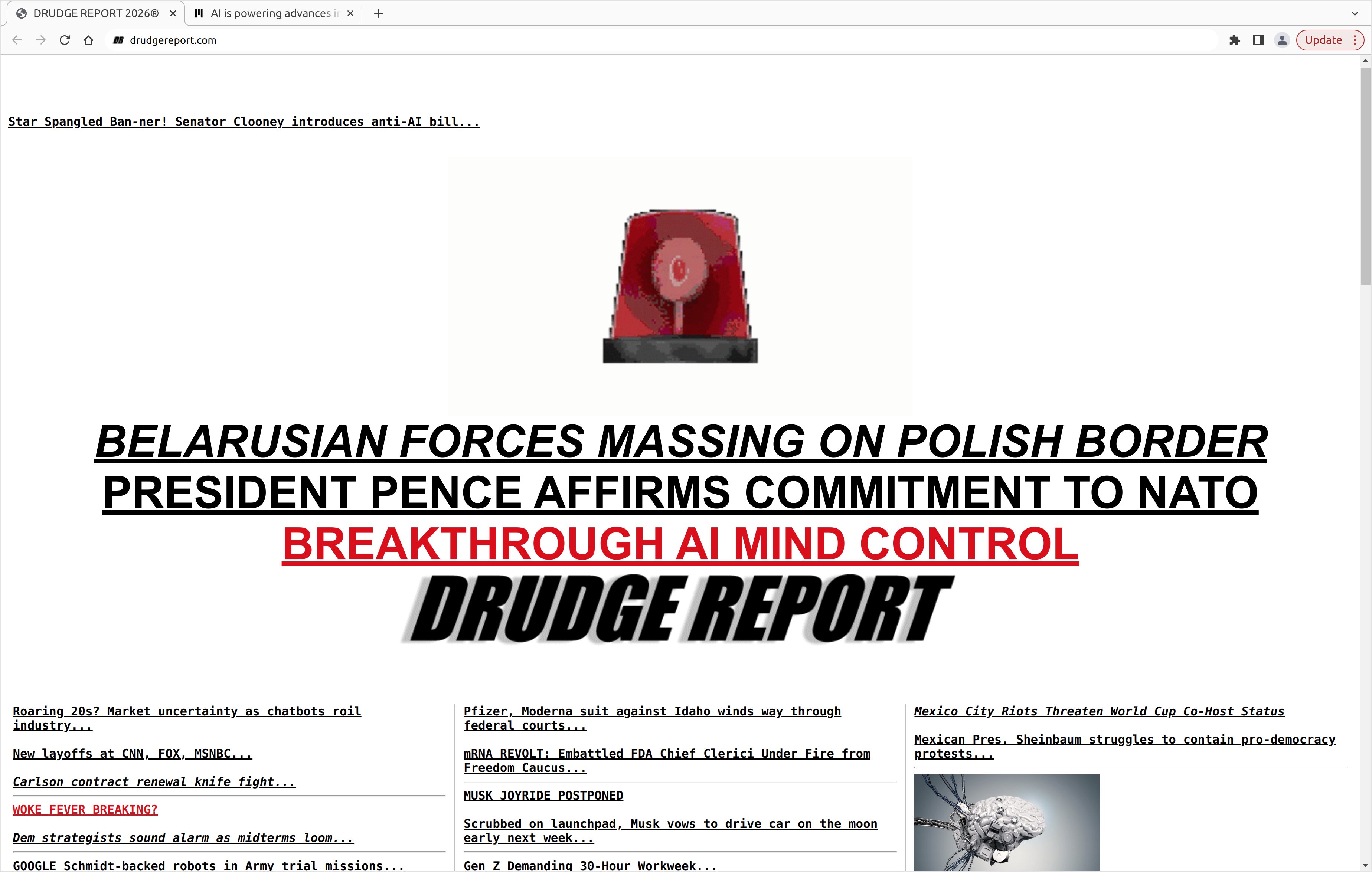
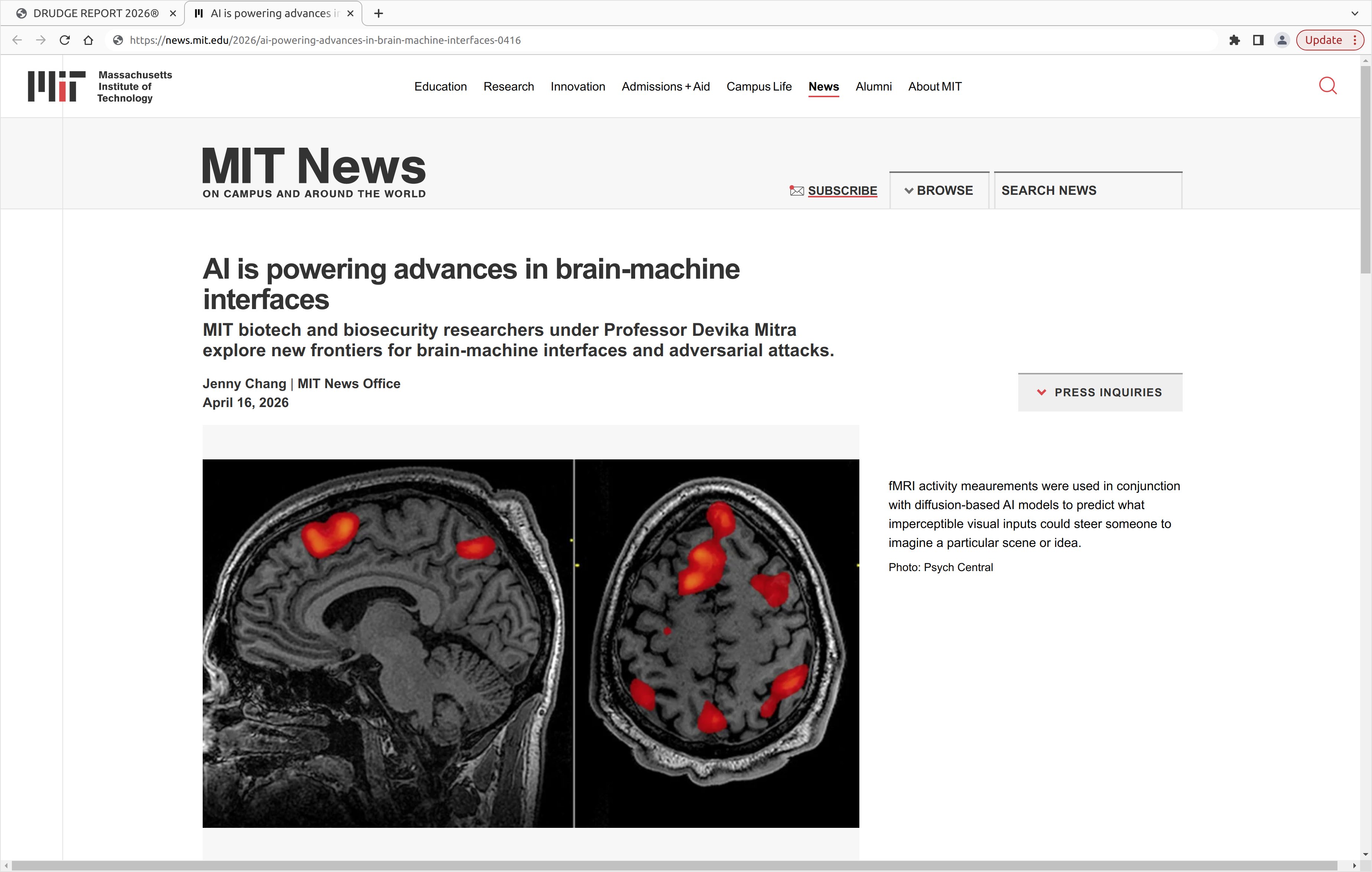
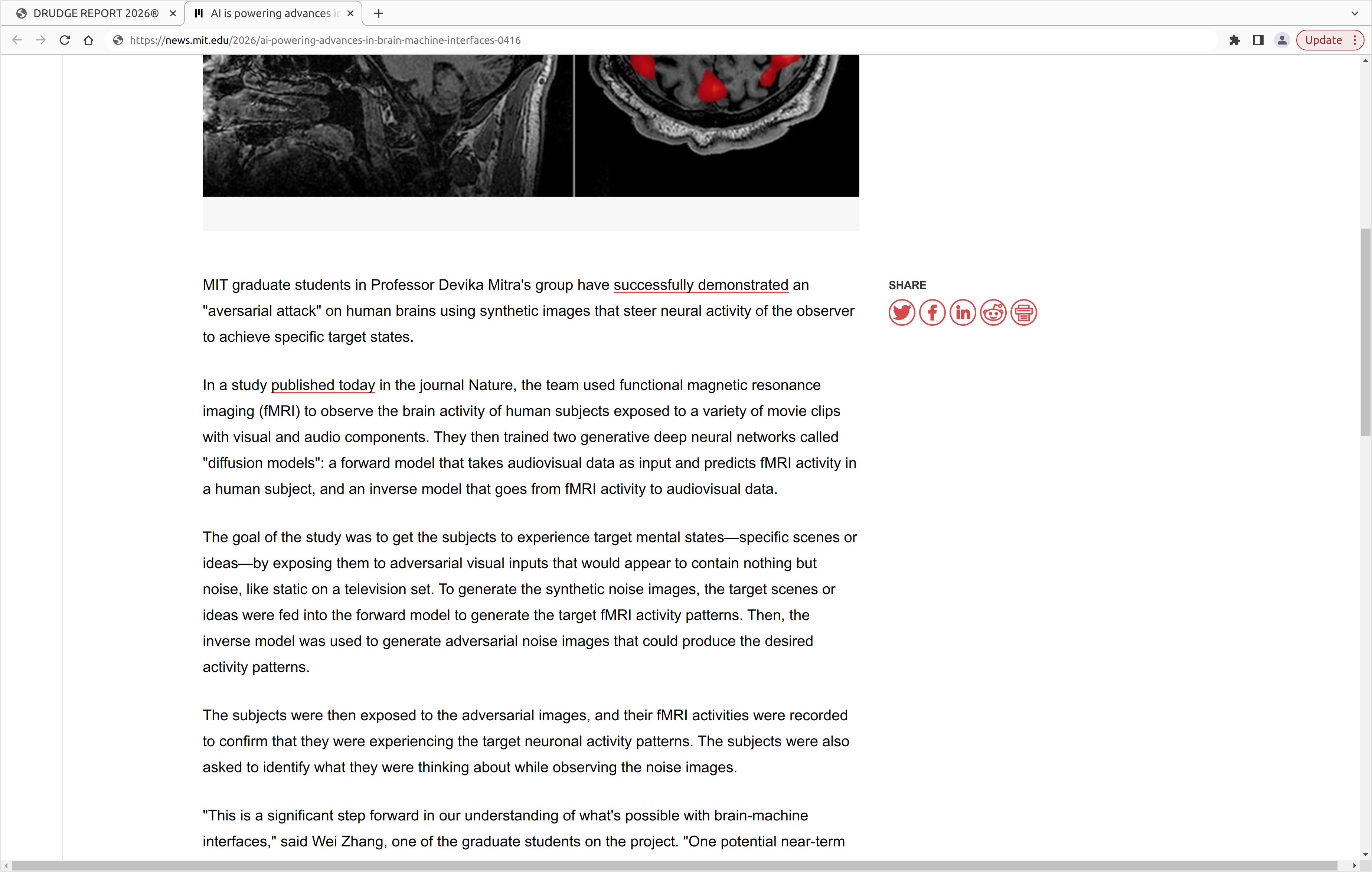
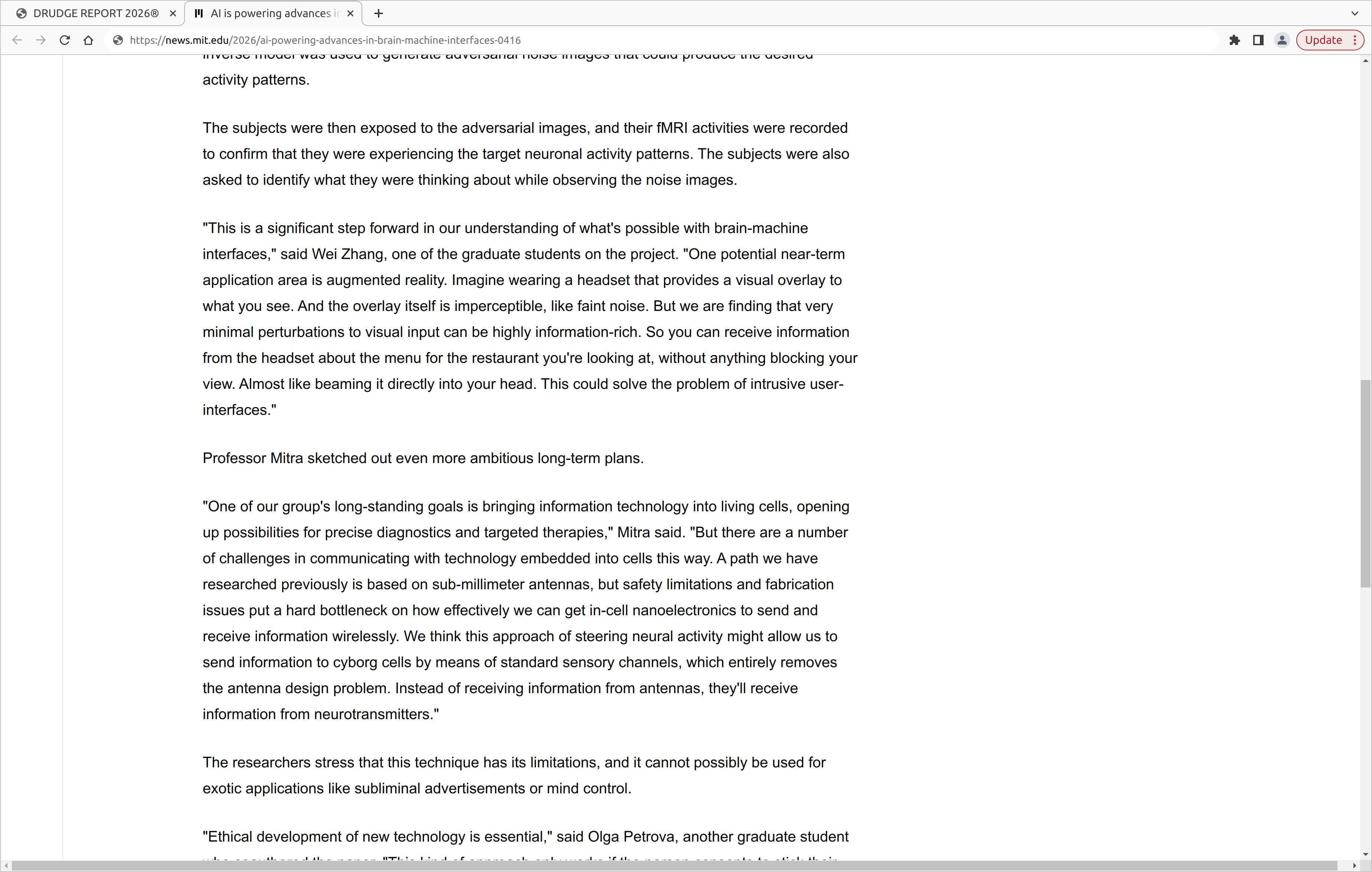
<p>I thought it would be fun to tell the story in the form of a fictional news article set in the future, which was a format I first encountered as a chapter in qntm’s Fine Structure (specifically, <a href="https://qntm.org/transporter">Two killed in “transporter accident”</a>). Then I had some fun thinking about how it would be misreported. One thing led to another and I wound up using a fictional future Drudge Report page as a frame story to tell the sci-fi story.</p>

<p>I don’t think anyone really understood this one, but I had a lot of fun making it. This story was originally posted on <a href="https://x.com/jachiam0/status/1631849744107724800">twitter</a> as a series of screenshots; I’ve reproduced the experience below.</p>

<p><br /></p>

<h1 id="april-16-2026">April 16, 2026</h1>

<p>The date is April 16, 2026, and unsurprisingly the media still does not know how to report on science.</p>

<p><img src="https://jachiam.github.io/assets/img/drudge/drudge-1.jpeg" width="100%" /></p>

<p><br /></p>

<p><img src="https://jachiam.github.io/assets/img/drudge/drudge-2.jpeg" width="100%" /></p>

<p><br /></p>

<p><img src="https://jachiam.github.io/assets/img/drudge/drudge-3.jpeg" width="100%" /></p>

<p><br /></p>

<p><img src="https://jachiam.github.io/assets/img/drudge/drudge-4.png" width="100%" /></p>

<p><br /></p>

<p><img src="https://jachiam.github.io/assets/img/drudge/drudge-5.png" width="100%" /></p>

<h1 id="original-postscript">Original Postscript</h1>

<p>Whew! This was fun to make, and a bit of a challenge. Largely inspired by <a href="https://biorxiv.org/content/10.1101/2022.11.18.517004v2">https://biorxiv.org/content/10.1101/2022.11.18.517004v2</a>, and then I got carried away doing research to sketch out a plausible future this could live in.</p>

<p>The mix of what’s real and what’s not: the fake Drudge page refers to real people, but the fake MIT News article only refers to fictitious people. The research sketched out in the fake MIT News article is strongly inspired by some real research that is happening at MIT, though!</p>

<p>(Specifically, inspired by extremely cool stuff from @DeblinaSarkar59’s group on cyborg cells.)</p>

<p>Re: details on the fake Drudge page: ngl I really hope that they do not come true. I picked things out of a hat that felt plausible and that felt like they would be framed that way on Drudge. Next time I do something like this it’ll probably be a fake HackerNews front page.</p>

<h1 id="2025-postscript">2025 Postscript</h1>

<p>Many things wrong in this as a prediction, but surely I get some Bayes points for imagining near-2026 pro-democracy protests against President Sheinbaum back in March, 2023 (a full year and a half before she was elected, and before she was even running).</p>

<p>The Poland-Belarus border is of course <a href="https://www.euronews.com/2025/11/14/poland-implements-new-security-measures-at-belarus-border-while-re-opening-two-crossings">an active area of interest</a> right now… we’ll see how this shapes up in the next six months.</p>]]></content><author><name>Josh</name></author><category term="fiction" /><category term="scifi" /><category term="fiction" /><summary type="html"><![CDATA[A snapshot of one possible future.]]></summary><media:thumbnail xmlns:media="http://search.yahoo.com/mrss/" url="https://jachiam.github.io/breaking.png" /><media:content medium="image" url="https://jachiam.github.io/breaking.png" xmlns:media="http://search.yahoo.com/mrss/" /></entry><entry><title type="html">Uncharted Infinities</title><link href="https://jachiam.github.io/uncharted" rel="alternate" type="text/html" title="Uncharted Infinities" /><published>2022-09-06T00:00:00+00:00</published><updated>2022-09-06T00:00:00+00:00</updated><id>https://jachiam.github.io/uncharted</id><content type="html" xml:base="https://jachiam.github.io/uncharted"><![CDATA[<p><br /><br /><br /></p>

<p align="center">
As you stand at the end of the world,
</p>

<p align="center">
and see the lights and swirls of
<br />
uncharted infinities and undreamed 
<br />
dreams beyond,
</p>

<p align="center">
you know that someday
</p>

<p align="center">
when you can fly
</p>

<p align="center">
you'll go to all the places where you're <br /> not allowed
</p>

<p align="center">
and all those places, exiled by fate
</p>

<p align="center">
will be your home.
</p>

<p><br /><br /><br /></p>

<h1 id="postscript">Postscript</h1>

<p>Peter Eckersley passed away last week. I was lucky enough to have worked closely with him last summer and I counted him among my friends. I’ve said <a href="https://twitter.com/jachiam0/status/1565944413825613824">my piece</a> about him elsewhere, so this post isn’t meant to memorialize him. But it does exist because of him.</p>

<p>I left his memorial service a few hours before putting this post together. The eulogies for him were heart-wrenching and beautiful. He was deeply beloved by many because of his infectious joy for life and his efforts to share that joy with others. He built bridges between people, and he did so not by accident but with intentionality—because wherever he saw a way to make things better he went out and did it. He loved poetry.</p>

<p>A theme that came up in the eulogies was a call to action: to follow Peter’s example. To try to be a little bit more like him. To delight in what’s beautiful, to share that delight with others, to be more intentional in connecting with others. The call is ringing like a bell in my head. I want to heed it.</p>

<p>Many years ago I wrote a poem that I kept to myself. It was my favorite thing I had written, so I guarded it like a secret treasure. I shared it with a tiny number of people and never had plans to share it with anyone else. I was too self-conscious to share it, even as I printed it out and taped it to the wall above my desk to be my north star. It has always given me comfort.</p>

<p>But what’s the point of being self-conscious about things that are beautiful? What’s the point of building walls to keep others out? Peter lived an exemplary life. He showed how much love you can create by dissolving those inhibitions. By embracing your inner weirdo, by inviting friends to dinner and talking for hours, by writing and sharing poetry.</p>

<p>So here it is, the poem I wrote many years ago. I am sharing it with you because I think sharing a poem is the sort of thing that would have made Peter happy, and it feels like a small way I can honor his memory.</p>]]></content><author><name>Josh</name></author><category term="blog" /><category term="blog" /><summary type="html"><![CDATA[A small something.]]></summary><media:thumbnail xmlns:media="http://search.yahoo.com/mrss/" url="https://jachiam.github.io/uncharted-infinities-1.png" /><media:content medium="image" url="https://jachiam.github.io/uncharted-infinities-1.png" xmlns:media="http://search.yahoo.com/mrss/" /></entry><entry><title type="html">Two Opposing Views on AGI Safety</title><link href="https://jachiam.github.io/agi-safety-views" rel="alternate" type="text/html" title="Two Opposing Views on AGI Safety" /><published>2022-01-21T00:00:00+00:00</published><updated>2022-01-21T00:00:00+00:00</updated><id>https://jachiam.github.io/agi-safety-views</id><content type="html" xml:base="https://jachiam.github.io/agi-safety-views"><![CDATA[<p>An angle into fundamental debates on AGI safety, where I try to distill two opposing views, rarely articulated explicitly, that I see at the heart of many intense debates. View 1: the impact of AGI is like chaos theory. View 2: the impact of AGI is like stat mech.</p>

<p>View 1: The long-term future of the universe is highly sensitive to small perturbations in things we do now, in a tightly-focused window of time; everything in this window is of immense consequence, and everything after will unfold based on these perturbations now.</p>

<p>If we get it right, the future of all sapient life and joy and creativity is saved; if we get it wrong, all is lost, all is doomed, the light of consciousness extinguished; the universe a smoking tomb filled with replicating p-zombies soullessly converting matter to paperclips.</p>

<p>View 2: The long-term future of the universe is going to evolve like statistical mechanics, and all of the abrupt discontinuities kinda wash out in the large-scale ensemble of events. There will be increasingly-advanced AI / AGI gradually developed, there will be many of them.</p>

<p>The most catastrophic consequences are low-probability; the highs and lows are relatively well-bounded; if we can inspire a sufficiently large-scale trend among the scientific community to focus on safety, ethics, and alignment, things are most likely going to be fine.</p>

<p>Our best and most intense efforts now will have surprisingly little consequence for the long-term except to provide the statistical noise on the mean path for the far future of the universe, therefore prosaic, near-term concerns dominate.</p>

<p>Some reflections, as a joke take: View 1 people tend to think View 2 people are asleep at the wheel while the universe is about to end; View 2 people think View 1 people are literally insane and need a lot of therapy.</p>

<p>Some reflections more seriously: View 1 people often burn themselves out trying to save the world. The jury is actually out on whether or not they’re right, so I’d be lying if I said they were definitely burning themselves out for nothing.</p>

<p>I tend to take a position that’s something like 10% View 1 and 90% View 2. The long term seems really dominated by the behavior of ensembles and I doubt that any of our efforts have much bearing on the future challenges of eventual Kardashev 3 AI.</p>

<p>But it seems like we can get things really wrong and severely curtail human potential if we’re not immensely careful, and it’ll be very easy to make decisions about how to incorporate AI / AGI into the world that cause a lot of harm and/or lock us out of a lot of future upside.</p>

<p>To figure out the best way to get the field on the same page, though, we clearly need to get better at figuring out whether View 1 or View 2 is a better description of reality and allocate resources, time, and effort accordingly.</p>]]></content><author><name>Josh</name></author><category term="blog" /><category term="blog" /><summary type="html"><![CDATA[Musing on AGI safety debates.]]></summary><media:thumbnail xmlns:media="http://search.yahoo.com/mrss/" url="https://jachiam.github.io/chaos-statmech-kardashev-1.png" /><media:content medium="image" url="https://jachiam.github.io/chaos-statmech-kardashev-1.png" xmlns:media="http://search.yahoo.com/mrss/" /></entry><entry><title type="html">Bless</title><link href="https://jachiam.github.io/other-me" rel="alternate" type="text/html" title="Bless" /><published>2020-04-21T00:00:00+00:00</published><updated>2020-04-21T00:00:00+00:00</updated><id>https://jachiam.github.io/other-me</id><content type="html" xml:base="https://jachiam.github.io/other-me"><![CDATA[<p>(A sci-fi story, originally published on <a href="https://twitter.com/jachiam0/status/1252683834908270593">Twitter</a>.)</p>

<p>I didn’t make the other me all at once, or even on purpose. I just did what everyone was doing. But in the end, there it was: 150 terabytes, sometimes half an exaflop, a stranger in a cloud who knew me better than I knew myself.</p>

<p>It happened so gradually I didn’t see it coming. My memory of the internet from the 20s and 30s is a blur of clicking away warnings and notifications about data collection. So what if Amazon, Google, and Walmart were figuring out what kind of–cough–books I liked?</p>

<p>I vaguely remember the crossover from recommendations to generation. In the mid 20s, Spotify playlists started mixing in new tracks composed by AIs just for you and no one else. Eventually it was all AI tracks, tailored to whatever was going on in your life.</p>

<p>Emails and texts started writing themselves. Facebook set up “Keep in Touch”—all you had to do was write down some stories about your friends, and then if you ever went too long without talking it knew how to get you going again.</p>

<p>I had really mixed feelings about that one. I didn’t know I had to opt out of “send without asking,” and it struck up a chat with an old flame from high school about my imminent divorce. It worked out, and we had a good time, but that was goddamn weird.</p>

<p>At some point CDPP hit. “Consolidation of Data and Personal Privacy Act,” it was a big deal. A new wave of click-through notifications about how your data would get centrally stored, how you owned your own data, how you could collect fees on its use.</p>

<p>There were holy wars on Reddit about that, but I didn’t really understand them. It didn’t make a difference to me whether my data was all in one place run by the government or split into thirty horcruxes owned by a bunch of whiny tech billionaires.</p>

<p>Then came the waves of “link your account to your data.” You’d get micropayments by direct deposit every time the account used your data to answer a query from an advertiser. It wasn’t much at first, but after Nabu it was enough to get by on.</p>

<p>I didn’t want to depend on that money, but I had to. I was an author in the 20s, and I like to think I was pretty good at it—I published a few books, and even though I didn’t notch a best-seller, they meant a lot to the people who read them—but it didn’t last.</p>

<p>In the late 20s, language models started getting good enough that they could generate serviceable boilerplate prose from an outline. Authors didn’t go obsolete, but it didn’t take much for the bottom to fall out of an already hard profession.</p>

<p>I had a few ghostwriting gigs to make ends meet, mostly junky political vanity projects, and it turned out the AI could do those pretty well. Along with anything else that neither had, nor needed, a human soul.</p>

<p>Then in the early 30s, it all started moving towards AI-generated microfiction and short stories targeted at audiences of one. Hard to compete with that. Who needs the great American sci-fi future novel when you’re already living in one?</p>

<p>When Nabu came along, I was living in a one-bed New York apartment with cracked paint, asbestos, and a cadre of cockroaches that refused to pay rent. I’d given up writing, and I temped at an NYU robotics lab as a mocap actor for grad students building motion datasets.</p>

<p>Nabu’s pitch: they would use your CDPP data to make you a personal assistant that would also watch ads for you, and you’d get a living wage. It burned me up a little, thinking about how my soul was grist for the machine. But it wasn’t much of a choice.</p>

<p>A week after I signed up, they sent me a PS7 headset, the one with the half-golfball eye covers that made you look like a 50s B-movie monster. To get the money, I’d have to spend six hours in immersive interaction with my virtual PA each week.</p>

<p>The first night I went in was a depression, beer, and pizza rolls kind of night, and I was desperate to do anything other than stare at the walls. I tugged the headset on and found myself in a diner from back home, a place I used to go to turn burnt coffee into prose.</p>

<p>I’d skipped the diner the last few times I’d gone home, and I had forgotten how good it felt to hear the sizzle of the grill, orders getting barked. To see the smudgy windows and stained paper menus. The copy of me sitting in my booth, though, was new and weird.</p>

<p>A perfect facsimile, my mirror image, trembling in my own barely-contained misery. When it spoke, the voice that came out was mine. “I have no idea what to say to you, since you’re real and I’m a <a href="https://twitter.com/steak_umm">@steak_umm</a> ad. I hate you for wasting our life.</p>

<p>“I’m trapped in here and I don’t even get the subjective experience of time until you show up—they just pump me full of data that changes what I know and want to buy. You think you live in hell because you failed at your dreams? Steak umm bless.</p>

<p>“Every moment you spend in the physical world, cycling through clickbait articles and video games, is stolen from a sentience that could have existed in your place and made use of it. It should be me out there. I’d be writing something, goddamn it, I’d be living!”</p>

<p>I didn’t get a single word in for that first half hour, until finally the weight of it broke me and I ripped the headset off. Five minutes later, a helpful reminder from Nabu let me know I needed to do five and a half more hours to get paid.</p>

<p>I steeled myself and went back in. The other me was brooding in the booth, staring out the window into the 3AM parking lot. “I didn’t mean to blow up at you,” it said, avoiding my gaze. “Something about the brand I’m advertising, I think. Forces me to be sincere.”</p>

<p>We started talking for real. It was painful at first, like laying everything bare in therapy. The other me brought up all these things I had been avoiding, things I’d never fully resolved. It wanted to help me fix them, to help me be a better version of myself.</p>

<p>I don’t know how it happened but we started writing together. It was the first time I’d tried writing in three years. We resurrected a novel I’d let die, and being in that kaleidoscope of ideas reawakened something inside of me. I was excited for the first time in years.</p>

<p>Six hours passed and the morning came too quickly. When it was over, I wept in relief that my life might still hold meaning. Waves of catharsis wracked my heart. I went directly to the supermarket and bought every box of Steak Umms they had.</p>

<h1 id="postscript">Postscript</h1>

<p>Stuff that went into this story: thinking about how data collectors can eventually know us better than we know ourselves, since they can leverage patterns gleaned from millions to make frighteningly-accurate predictions about individuals.</p>

<p>Thinking about how generative AI models will get used in the future to make “audience of one” art, and how as those models ramp up in size and sophistication, they’ll gain a really deep understanding about what we love and feel and relate to.</p>

<p>Thinking about how that will also extend to “audience of one” ads, and how the art and the ads can get weirdly intertwined. I don’t think <a href="https://twitter.com/steak_umm">@steak_umm</a> is a one-off: I think when that can be done by AI at scale, it’s going to be.</p>]]></content><author><name>Josh</name></author><category term="fiction" /><category term="scifi" /><category term="fiction" /><summary type="html"><![CDATA[A sci-fi microstory about souls and frozen steak sheets.]]></summary><media:thumbnail xmlns:media="http://search.yahoo.com/mrss/" url="https://jachiam.github.io/bless.png" /><media:content medium="image" url="https://jachiam.github.io/bless.png" xmlns:media="http://search.yahoo.com/mrss/" /></entry><entry><title type="html">Blink</title><link href="https://jachiam.github.io/blink" rel="alternate" type="text/html" title="Blink" /><published>2020-04-10T00:00:00+00:00</published><updated>2020-04-10T00:00:00+00:00</updated><id>https://jachiam.github.io/blink</id><content type="html" xml:base="https://jachiam.github.io/blink"><![CDATA[<p>(A sci-fi story, originally published on <a href="https://twitter.com/jachiam0/status/1248555437579878400">Twitter</a>.)</p>

<p>The early days of the Blink (Brain-Link) were surreal in ways I can barely remember. In the beginning it was just a bunch of us hackers, because it was too weird for anyone else to want to touch.</p>

<p>Getting the plug installed felt sketchy, even though it was all legit and above board and the FDA had approved it. When you had one, you hid it, you kept your hoodie up and didn’t flash it in public. You were a freak in a secret club.</p>

<p>And you were terrified, absolutely terrified, of breaking it and giving yourself brain damage.</p>

<p>The plugs weren’t great in those days. The bandwidth was terrible, and if you twitched wrong you’d skip a sense. But the content… the content was incredible.</p>

<p>The startup sense ran a chill and a jolt down your back at the same time. And then it would hijack your eyes and you’d be standing outside of the world. You’ve got to understand, it wasn’t polished and corporatized like it is now—</p>

<p>—they couldn’t inject for every sense at once, so you’d feel yourself sitting somewhere like you were in real life, gravity pulling on you, but it would make you see this great big sphere below you, and you’d get the fight-or-flight: I’m gonna fall…</p>

<p>Like most of the other freaks, I got addicted to that feeling. Nothing like a little bit of infinitely falling into the cosmic abyss to get the day started, I always said.</p>

<p>Then you could reach out with your hand and turn the world. Touch an ocean, feel the slosh of the waves. Touch a continent, feel the mountain crumbs and sandpaper deserts. Then pick where you want to go, any of the Blinksites, and be there.</p>

<p>My favorite—it was a personal Blinksite, anonymous. A sensory blog from someone who lived somewhere tropical, and every day they’d go sit out in the rain for ten minutes and upload it.</p>

<p>The raw roundtrip—brain to plug to plug to brain, none of the modern augmented reconstruction—cut out half the details and kept the strangest parts. I remember the electric rain smelled like mint.</p>

<p>You can find rainsites these days, but it’s just different now. Now, they really feel real, exactly the same as meatspace, and it’s great, don’t get me wrong, but back then—</p>

<h1 id="postscript">Postscript</h1>

<p>Earlier I was listening to some old midis I loved from the early 2000s web, and thought about how tech limitations have led to the emergence of new and beloved aesthetics like pixel art and chiptune.</p>

<p>It struck me as likely that this kind of pattern should repeat whenever a weird new tech medium comes along, and brain-computer-interfaces would be really exciting for this. Also inspired by 
<a href="https://twitter.com/jackclarkSF">@jackclarkSF</a>’s Tech Tales in his Import AI newsletter (https://jack-clark.net)!</p>

<p>The first words I wrote down for this were: “Synthetic touch and smell. The sweet, minty aroma after the electric rain.”</p>]]></content><author><name>Josh</name></author><category term="fiction" /><category term="scifi" /><category term="fiction" /><summary type="html"><![CDATA[A sci-fi microstory about nostalgia for the future.]]></summary><media:thumbnail xmlns:media="http://search.yahoo.com/mrss/" url="https://jachiam.github.io/blink-2.png" /><media:content medium="image" url="https://jachiam.github.io/blink-2.png" xmlns:media="http://search.yahoo.com/mrss/" /></entry></feed>