Introduction for and Reactions to Plan A

Introducing Plan A

The folks who brought you AI 2027, a so far remarkably accurate set of predictions despite those predictions having seemed freaky to many at the time, now bring you their positive vision that involves more freaky predictions: Plan A.

These guys have rather strong prediction track records. In addition to AI 2027, among other things, Daniel Kokotajlo has What 2026 Looks Like (which is remarkably similar to what 2026 looks like) and Ryan Greenblatt, who is also the chief scientist at Redwood Research, was the #2 most accurate AI forecaster in 2025 out of 413 entries. Past performance is as always no guarantee of future success.

Posted in Uncategorized | Tagged , , , , | Leave a comment

AI #176 Part 2: Plan B

This is part 2 of the weekly, broadly covering speculation, rhetoric and policy, along with alignment research.

This does not cover the release of GPT-5.6-Sol. As always, I will be taking a few days to digest what the new model has to offer and to allow others to try it and react. I will cover Sol and its capabilities early next week. I covered the GPT-5.6 system card back on June 28.

This also does not cover the release of Plan A, the follow-up to AI 2027. This new scenario is a positive vision of what its authors think we should do going forwards.

Posted in Uncategorized | Tagged , , , , | 1 Comment

AI #176 Part 1: Doing It Live

Enough things added up that this week is getting split into two parts.

Then on Monday, if all goes as I expect, we’ll cover OpenAI’s Sol, aka GPT-5.6.

OpenAI also gave us an upgraded voice mode, which I haven’t tried out but early reports are that it is a step change.

AI writing, especially Claude writing, is becoming more prominent and harder not to notice, and increasingly a tough read when encountered in the wild. Does anyone care? Or are those who care the weird ones here?

This week saw an excellent paper, which I cover in No Space Like J-Space.

Posted in Uncategorized | Tagged , , , , | Leave a comment

Childhood and Education #20: Phones and Screens

We have a respite, so I thought I’d tackle various thoughts on children, phones and screens. GPT-5.6-Sol drops tomorrow, and the Fable agents are hard at work.

I’ll start with the other screens, then finish with the phones.

Table of Contents

  1. EdTech.
  2. NonEdTech.
  3. Do Not Ban Social Media Outright.
  4. Some Modern Kids Media Is Pretty Great.
  5. Ban Phones In Schools (1).
  6. Your Offer Is Acceptable.
  7. Ban Phones In Schools (2).
  8. Screen Time.
  9. Inappropriate Content.

EdTech

Increasingly, when you pick a school, you are picking EdTech. The school will put your child on a tablet or computer, and expect them to learn that way.

In theory, with sufficient assistance and bespoke design and incentive structures, this is The Way. It sure seems way better than ‘sit and listen to a lecture.’

Posted in Uncategorized | Tagged , , , , | 1 Comment

No Space Like J-Space

There is a new very cool Anthropic paper: Verbalizable Representations Form a Global Workspace in Language Models. You can read the blog post verison here.

I encourage reading of the whole original blog post or paper, if you have the time.

Table of Contents

  1. Through A Different Lens.
  2. Establishing J-Space As A Global Workspace.
  3. Are You Pondering What I’m Pondering?
  4. Assistant J.
  5. The Power Of Virtuous Thinking.
  6. High Praise.
  7. Everyone Remains Confused About Consciousness.
  8. Further Research.
  9. Don’t Think.

Through A Different Lens

They call this discovered area of ‘conscious access,’ where things are available for the model to do what in humans we would call conscious reasoning, the ‘J-space,’ after a new interpretability technique called the Jacobian Lens.

Posted in Uncategorized | Tagged , , , , | Leave a comment

Fable #6: The Return of the King

The blip is over. We have Fable back.

Utah teapot: happy fable/mythos easter Wednesday, to those who celebrate

Image

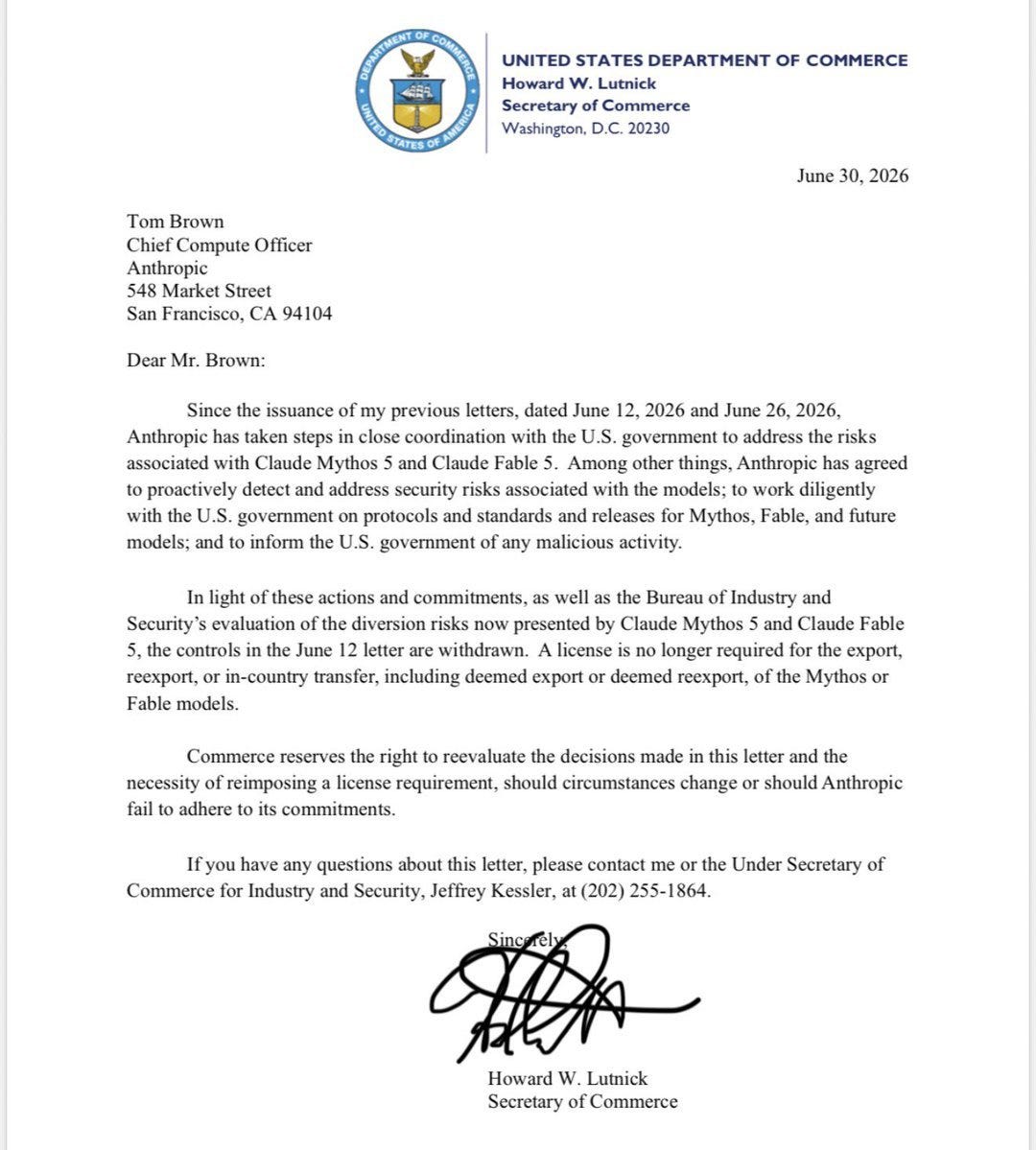
Here is the official letter restoring Fable, great job everyone. Notice it is addressed to Tom Brown, not to Dario Amodei.

Image

Anthropic had to make the controls more stupid for now, but this is a big win.

j⧉nus: YES!!! I’m really proud of Anthropic for their successful negotiation with the government. Also positive update on the government being sane and possible to cooperate with. Afaik Anthropic didn’t need to agree to any bad terms / genuflect / betray their principles or dignity.

Posted in Uncategorized | Tagged , , , , | Leave a comment

AI #175: The Fable Continues

Fable’s back. Back again. Fable’s back. Tell a friend. Use your free week to its fullest.

This is excellent news. The blip only lasted a few weeks.

It was still a fiasco, and we have to deal with the fallout.

Our system remains fully ad hoc. The precedent has been set that we may use export controls on models, or order them taken down on 90 minutes of notice based on a misunderstanding. At least some amount of counterproductive additional locking down has occurred to address Amazon’s little demonstration and reassure the government. And for now GPT-5.6 remains in limbo, awaiting its verdict, while OpenAI talks about giving away 5% of the company as tribute.

Posted in Uncategorized | Tagged , , , , | Leave a comment

Claude Sonnet 5 Is Not Frontier But Has Its Uses

Fable 5 is back today, baby! Premium subscribers have one week to use it within their subscriptions. First hit’s free. Then you pay by the token.

Today’s post is still about Sonnet 5.

I don’t know that there will be much call for Sonnet 5 for most purposes, given Opus 4.8 exists and especially now that Fable 5 is once again available, but this is what we do here, so sure, why not, system card time, including model welfare, after which we’ll do capabilities.

Sonnet costs $3/$15 per million tokens, versus $5/$25 for Opus and $10/$50 for Fable, after an introductory period. Once you pay for all the tokens you need you’re not really saving money, such as on the ArtificialAnalysis index where Sonnet ended up being more expensive.

Posted in Uncategorized | Tagged , , , , | 1 Comment

The Once And Future Fable #5

We, or at least ‘more than 100 American institutions,’ got Mythos back this week.

What we the people do not have is Fable or Sol.

While we wait for both Claude Fable 5 and GPT-5.6-Sol, today we instead got Claude Sonnet 5. As usual it will take a few days to get a handle on the new model. In this case, Anthropic is representing it as a cheaper and faster version of Opus 4.8, so even though the number says 5 this is a relatively minor development.

This post expands the Fable series to cover all further developments this week surrounding the Mythos Moment, and the various aspects of handling our new ad hoc licensing regime and figuring out policy going forward, and other aspects of policy as well.

Posted in Uncategorized | Tagged , , , , | 1 Comment

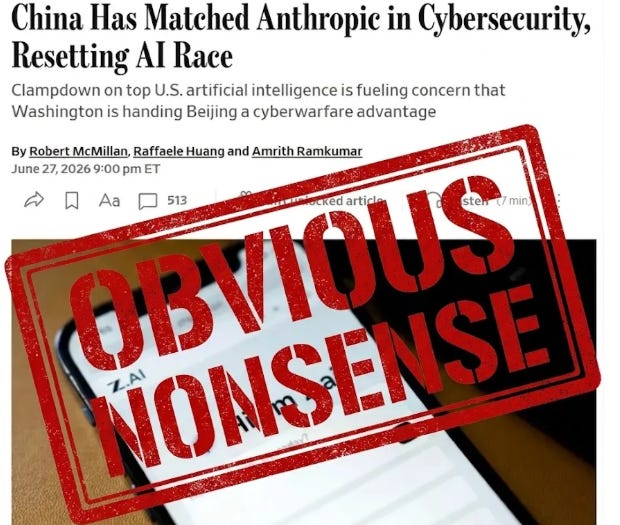
WSJ Article Claiming China Has Matched Anthropic Is Obvious Nonsense

The Wall Street Journal printed an outright false headline and heavily misleading story claiming this, which of course was uncritically amplified by the usual suspects.

I post this now on its own so that we have a place to link to, to explain the situation.

Headline News

WSJ Headline (Obvious Nonsense): ​China Has Matched Anthropic in Cybersecurity, Resetting AI Race.

Image


That. Did. Not. Happen.

The post even claims, explicitly, that Claude Opus 4.8 similarly ‘matches’ Claude Mythos, a claim which is even more obviously false.

Shame upon the Wall Street Journal. I fear Gell-Mann Amnesia. If they can get something as important as this so completely wrong, what about everything else?

Posted in Uncategorized | Tagged , , , , | Leave a comment